
Last week, a fourth-year student opened her inbox at 6:12 a.m., expecting her Step 2 CK score so she could finally relax and finish ERAS. Instead, she saw the word she never thought would apply to her: “Fail.” Her ERAS token was already used, personal statement done, letters requested. She called me an hour later, voice flat: “Am I just…done?”
If you are in that exact spot right now, reading this with your stomach in free fall, let me be blunt: you are not done. But you do not have the luxury of flailing. You need a clear, ruthless, step‑by‑step plan to protect your match chances, starting today.
1. First 24–48 Hours: Stop the Bleeding, Get Your Facts
You get one shot at handling the first few days well. Panic decisions now can cost you actual match chances later.
Step 1: Confirm the basics
Pull up your score report. Not just the email. The full PDF.
You’re looking for:
- The exact date the exam was taken
- The reported score and “Pass/Fail” status
- Performance profile (bars by content area)
- Any irregular behavior notes (should be none)
Why? Because specific weak areas will guide your second attempt strategy, and the test date matters for retake timing and ERAS planning.
Step 2: Do not rush to tell every program
Your instinct might be to email every PD you were planning to apply to and “explain.” Do not do this in the first 24–48 hours.
Right now:
- Programs do not know your Step 2 CK result unless:
- You already authorized score release and they run a query after the new score posts
- Or you manually send them your transcript (unlikely this early)
- You don't have a retake date yet
- You don't have a concrete plan
What you do now:
- Do not mention it on ERAS yet
- Do not send mass apologetic emails
- Do not write some rushed “overcoming failure” paragraph into your personal statement tonight
You’ll communicate with programs. But strategically and at the right time. Not from raw panic.
Step 3: Loop in the right people at your school
Same day if possible, next day at latest, you need three conversations:
Dean/Student Affairs / Academic Support
Say this clearly:- “I failed Step 2 CK. My score report came out yesterday. I’m scheduled to apply this cycle. I need help planning my retake and understanding how this affects my ability to enter the Match.”
Ask: - Are there any institutional policies about failing Step 2 (e.g., mandatory leave, max attempts)?
- Do they restrict ERAS certification or graduation until a passing score?
- Who on faculty is best to advise students in my position?
- “I failed Step 2 CK. My score report came out yesterday. I’m scheduled to apply this cycle. I need help planning my retake and understanding how this affects my ability to enter the Match.”
Your specialty advisor (or someone in the field you’re targeting)
Not your best friend in the class. An attending or program director-type in your intended specialty.
Ask:- “In your experience, how do programs in [specialty] view a Step 2 fail?”
- “Are there particular programs that have cutoffs or won’t consider applicants with a fail?”
- “Should I strongly consider a backup specialty now?”
Registrar / Licensing or Exams Office
Ask very specifically:- Earliest date I’m allowed to re-take Step 2 CK (based on NBME rules and school policies)
- Whether they foresee any graduation delays if the passing score comes in late spring
Get those answers in writing if you can (email recap).
2. Decide: Apply This Cycle or Hit Pause?
The big fork in the road: do you still apply this ERAS cycle after a Step 2 CK fail, or delay a year?
There’s no universal rule. But there are patterns.
| Situation | Applying This Cycle | Risk Level |
|---|---|---|
| Strong Step 1, solid CV, non-competitive specialty | Reasonable | Medium |
| Step 1 low/just passing, average CV, moderate specialty | Questionable | High |
| Step 1 fail *and* Step 2 fail | Usually unwise | Very High |
| IMG, lower scores, competitive specialty | Very tough | Extremely High |
When applying this cycle can still be reasonable
You might continue this cycle if:
- Step 1 was a solid pass (or strong if numerical)
- Your overall application is strong: honors, good letters, meaningful experiences
- You’re targeting less competitive specialties: FM, psych (though getting tighter), IM (non-elite programs), peds, path, PM&R in some regions
- You can realistically retake and pass Step 2 CK before rank lists are due (or at least before most programs make decisions)
When you should seriously consider a glide year
You should think about delaying the Match if:
- You already struggled on Step 1 (borderline or fail)
- You’re going for highly competitive specialties: derm, ortho, plastics, ENT, ophtho, urology, neurosurg, radiation oncology
- You’re an IMG with limited US clinical experience
- There are signs this wasn’t a fluke (you barely passed all your shelf exams, were behind on content, chronic time management problems)
Hard truth: repeatedly applying and not matching is worse than waiting a year, fixing the problem once, and applying with a cleaner story.
Time reality check: retake and score release
You need to map this out like a project, not a fantasy.
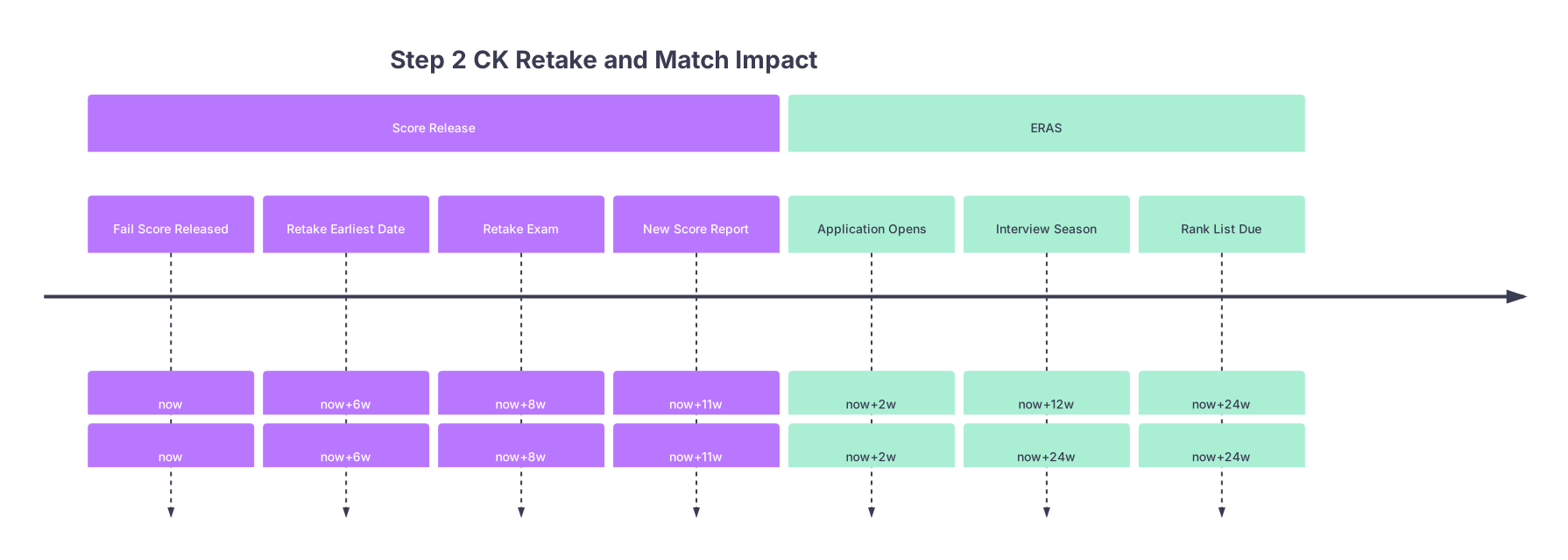
| Period | Event |
|---|---|
| Score Release - Fail Score Released | now |
| Score Release - Retake Earliest Date | now+6w |
| Score Release - Retake Exam | now+8w |
| Score Release - New Score Report | now+11w |
| ERAS - Application Opens | now+2w |
| ERAS - Interview Season | now+12w |
| ERAS - Rank List Due | now+24w |
Rough numbers:
- Required waiting period between attempts is usually 4 weeks, but you need more than 4 weeks of effective studying or you risk failing again
- Score reports take about 3–4 weeks after the test date
- Programs often stop sending most interview invites between late October and December
If your retake score won’t be out until after most interviews are given, you’re relying heavily on your pre-fail metrics and on programs being unusually forgiving. Some are. Many are not.
3. Immediate ERAS Strategy Adjustments
Assuming you’re still leaning toward applying this cycle, you can’t submit ERAS like nothing happened.
3.1. How to handle score reporting on ERAS
You do not get to “hide” a Step 2 fail. Once a new transcript is sent, they see your full USMLE history.
But you can be strategic about:
- When you send updated transcripts
- How you frame it in your application and communication
If Step 2 score isn’t yet available when you’re building ERAS:
- You can initially authorize release and let programs see “no score yet” while you schedule your retake
- Or delay release until after your retake. Risk: many programs will not consider you without scores at all
For most core specialties (IM, FM, Peds, Psych, EM), programs now expect Step 2 CK by the time they’re really reviewing applications. You need a plan to get a passing score visible as early as possible.
Plain rule:
- If you are going to continue this cycle, schedule your retake as early as you can competently prepare while still aiming to pass convincingly. Not just squeak by.
3.2. Rewrite your specialty list with cold eyes
Do not cling to the dream specialty while ignoring data.
Look at three categories:
- Specialty competitiveness
- Your exam history (Step 1 + this Step 2 fail)
- Your overall CV strength and home school reputation
If the combination is clearly mismatched, it’s time for:
- A frank talk with advisors about dual applying (e.g., Ortho + IM, Gen Surg + IM, EM + FM)
- Or fully switching to a less competitive specialty this cycle and preserving your ability to do a fellowship later
Yes, it stings. But matching in something and then later pivoting through fellowships or niche work is almost always better than not matching multiple times.
4. Communicating the Failure to Programs (and When)
This is where a lot of people screw it up. They either hide it poorly or overshare in a way that makes PDs wary.
4.1. Personal statement: what to do and what not to do
Do not write a dramatic, three-paragraph saga about failing Step 2 CK in your main personal statement. That’s not your story. That’s an event.
Options:
- If your fail is the only major blemish and your track record is otherwise strong, many PDs will prefer a passing retake score and a brief explanation when needed, not a big focus up front
- If you have a Step 1 struggle + Step 2 fail + red flags, you’ll need a more explicit, concise, accountable paragraph in either the personal statement or an added comment section
Guidelines for any mention:
- Own it. “I failed Step 2 CK on my first attempt.” No euphemisms.
- Briefly explain the real cause without excessive excuse-making: poor timing, overcommitted on rotations, personal crisis, etc.
- Immediately pivot to what you changed: study structure, question volume, dedicated time, support resources.
- End with the outcome once you have it: “On my subsequent attempt, I scored ___, reflecting a much more accurate representation of my knowledge and preparation.”
If you haven’t retaken yet when you submit ERAS, you can allude to upcoming retake, but don’t promise an outcome you don’t have.
4.2. Emailing programs
You do not need to cold email hundreds of programs with, “Hey, I failed.” That’s noise.
You do consider targeted communication:
- Once you’ve retaken and passed
- To programs where you have a strong connection (home program, away rotations, places where faculty know you)
- Or where you’ve already interviewed or have an invite
Template structure (short, no drama):
- Brief intro and context
- Acknowledge initial failure
- State new passing score and date
- One sentence connecting this to your overall performance and growth
Something like:
“Dear Dr. X,
I wanted to update you on my Step 2 CK status. I did not pass my initial attempt (reported [month, year]), which reflected poor timing during an intense clinical schedule. I have since adjusted my preparation, retaken the exam, and received a passing score of ___ on [date]. This new score aligns more closely with my clinical evaluations and shelf performances.
Thank you for your consideration,
[Name, AAMC ID]”
That’s it. No three-page confession.
5. Retake Strategy: You Cannot Afford a Second Fail
A second fail is catastrophic for most specialties. Some will not touch your file no matter what else you’ve done.
So the retake prep needs to be ruthless and realistic.
5.1. Diagnose why you failed, not just how many questions you missed
Look at:
- Did you run out of time on multiple blocks?
- Were certain content areas dramatically weaker on the performance profile?
- Were you chronically behind on UWorld? Barely touched NBME practice tests?
- Were there serious non-academic issues: depression, family emergency, burnout?
Don’t just “study harder.” Fix the specific failure mode.
5.2. Set a non-negotiable minimum prep window
Most students need at least 4–6 weeks of serious, mostly full-time prep to reliably pass from a fail. More if your baseline was weak.
That means:
- Cutting back significantly on rotations (you may need a lighter elective or dedicated study period)
- Daily question volume that actually hurts a little (e.g., 80–120 UWorld questions a day reviewed in depth)
- Regular NBME practice exams to track progress and decide if your test date is realistic
If your school or situation is pushing you to retake “as soon as possible” but your NBMEs are still nowhere near passing, you have to push back. Another fail is worse than a later score.
5.3. Use practice exams as gatekeepers
Before retaking Step 2 CK, you should be consistently scoring above the passing threshold on multiple NBMEs. Not just “close once.”
I like this rule:
- At least two different NBMEs at or above 5–10 points over predicted pass
- One of them within the last 7–10 days before your scheduled exam
If you’re still significantly below, move the test. Programs won’t care that you took it “on time” if the outcome is another fail.
6. Protecting Your Match Odds Beyond Scores
Scores matter. But once you’ve swallowed the Step 2 hit and started fixing it, you have other levers.
6.1. Letters and real humans vouching for you
A strong letter that says,
“Despite his Step 2 CK stumble, I trust this student to care for my patients as a resident. I’d rank them to match,”
is far more powerful than you apologizing in every paragraph.
So:
- Prioritize rotations with attendings who see you closely and are known in their field
- Ask directly for strong letters: “Do you feel you can write me a strong letter of recommendation, particularly given my Step 2 setback?”
- Tell letter writers the situation. Give them permission to briefly acknowledge it and emphasize their confidence in your clinical ability if they feel comfortable doing so
6.2. Apply broadly and strategically
After a Step 2 fail, the days of “only 25 programs in coastal cities” are gone.
You’re aiming for:
- A generous number of programs (often 60–100+ in IM/FM/Peds, more if IMG or multiple red flags)
- Mix of academic, community, and smaller name places
- Geographic flexibility (yes, even the states you “never wanted to live in”)
Does it cost money? Yes. Is it still cheaper than going unmatched and reapplying? Also yes.
6.3. Interview performance: own it once, then move on
If asked about the fail in interviews:
- Don’t get defensive
- Don’t overexplain the backstory
Use a tight structure:
- One line on what happened
- One or two lines on cause (under-prepared, mismanaged time, personal factors)
- A few specific changes you made (study strategy, time management, support, wellness)
- End on evidence of improved performance (retake score, shelf scores, clinical evaluations)
Then pivot back to why you’re a good fit for their program. If you keep dragging them back to your failure, they’ll stay there.
7. When It’s Actually Smarter to Sit Out This Match
No one wants to hear this, but I’ve seen it save careers.
Signs you should strongly consider waiting a year:
- You have multiple exam red flags (Step 1 borderline or fail, then Step 2 fail)
- You don’t have time to adequately prepare for a retake before rank lists are due
- Your mental health is truly in the ditch and you’re barely functioning, let alone studying
- Your specialty choice is hyper-competitive and advisors are unanimously doubtful you’ll get traction this cycle even if you pass on retake
What to do with a glide year:
- Work as a research fellow, chief scribe, or in a clinical research unit tied to your chosen specialty
- Crush the Step 2 CK retake, then optionally Step 3 if advisors recommend it
- Build deeper relationships with faculty who can later call PDs on your behalf
- Improve your application story so the narrative becomes:
“Yes, I failed. Then I rebuilt my knowledge, proved it objectively, and spent a year demonstrating commitment and reliability.”
Program directors are more willing to forgive old failures when the last 12–18 months show nothing but consistency and growth.
8. Quick Reality Check: What Programs Actually Think
Most PDs don’t hate you for failing. They just don’t like risk.
A Step 2 fail worries them because:
- They fear you’ll fail in‑training exams or the boards later
- They worry about your ability to handle stress and volume in residency
- They have more applicants than spots, many with clean exam histories
So your entire response — retake score, letters, interviews, emails — has one job: reduce their perception of risk.
You do that by:
- Passing comfortably on retake
- Showing a sustained record of solid clinical work
- Getting people they trust to say, “This student is safe and teachable”
- Presenting as self-aware, accountable, and stable, not fragile or chaotic
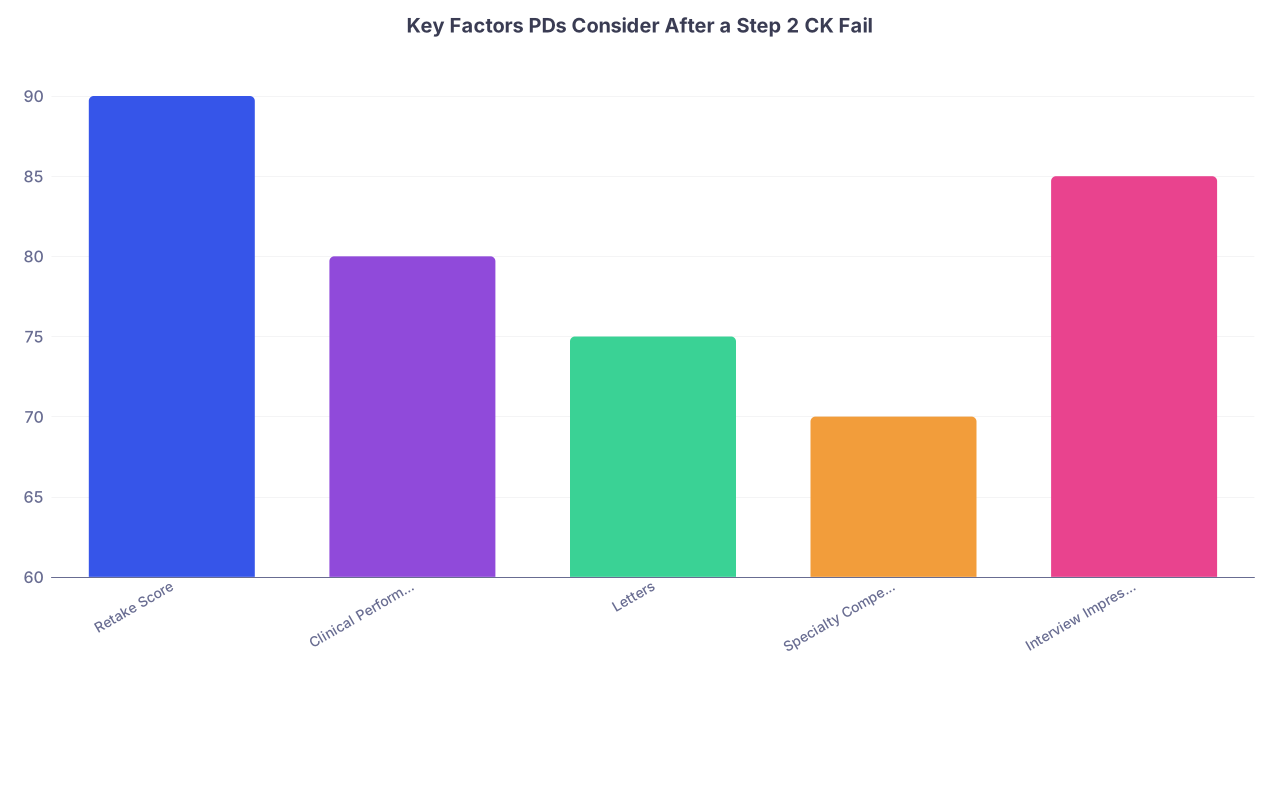
| Category | Value |
|---|---|
| Retake Score | 90 |
| Clinical Performance | 80 |
| Letters | 75 |
| Specialty Competitiveness | 70 |
| Interview Impression | 85 |
FAQs
1. Should I mention my Step 2 CK failure in my personal statement if I have not retaken it yet?
Only if ignoring it would make your application feel dishonest or confusing (for example, prior Step 1 issues and now Step 2 fail with no explanation). If you do mention it before the retake, keep it brief and focused on what you’re changing, not on self-punishment. Do not center your entire statement on the failure; your PS should still mainly tell the story of why you belong in that specialty.
2. If I pass Step 2 CK on the second attempt with just a barely passing score, is that enough?
Technically it meets minimum requirements, but it will not fully calm program directors, especially for competitive fields. A higher retake score helps rebuild confidence. If your retake practice tests suggest you’re just scraping by, consider extending your prep and delaying the exam rather than rushing for an early but weak pass that may not change many minds.
3. Will some programs automatically filter me out because of the fail, no matter what I do?
Yes. Some programs have hard filters or institutional bias against any exam failures. You cannot fix that, but you also don’t need those programs. Your job is to find the ones who are open to context and growth, and to give them enough evidence (retake, letters, performance) that you’re a safe choice. That’s why applying broadly and leveraging personal connections matters even more for you.
4. If I decide to take a glide year, how do I explain it later to programs?
You frame it as a deliberate, mature decision: you recognized that rushing back into the Match immediately after failing Step 2 CK would not let you present your best self. Then you show how you used the year: passed the exam with a stronger score, engaged in meaningful work (research, clinical roles), and grew clinically and personally. Programs are much more accepting of a gap year that’s clearly purposeful and productive than of repeated exam or match failures.
Key points to walk away with:
- A Step 2 CK fail before ERAS is serious, but not a permanent death sentence — if your response is fast, honest, and strategic.
- Your retake prep and timing are now mission‑critical; a second fail is way worse than a delayed but solid pass.
- Protecting your match means combining a realistic specialty and program list, strong human advocates, and a concise, accountable narrative — not panicked oversharing or denial.