
You’re 3 weeks out from your Step 2 CK date. Your parent just got diagnosed with cancer. Or your long-term relationship just exploded. Or you’re 2,000 miles from home dealing with a family emergency over FaceTime between shelf exams.
You sat for Step 2 anyway, because moving it felt impossible: scheduling, rotation pressure, everyone telling you “you’ll be fine.”
And then the score comes back. Lower than your practice tests. Lower than you needed.
Now you’re staring at ERAS and asking:
“How do I explain this without sounding like I’m making excuses?”
“Will programs care?”
“Is there a right way to document that I took Step 2 CK during a personal crisis?”
This is the situation I’m writing for. Not theory. You already took the exam, the crisis was real, and you are stuck with the score. Now you need to manage the fallout strategically.
We’ll talk concretely about what to document, where to put it, and how to keep it from sounding like a pity story.
Step 2 CK During a Crisis: What Programs Actually Care About
Let me be blunt: programs don’t care about your crisis because it’s sad. They care because:
- They need to know if the score reflects your true ability.
- They want evidence that you don’t fall apart under stress forever.
- They want to see judgment: did you make a reasonable decision at the time? Did you learn from it?
So your job is not to pour your whole trauma onto ERAS.
Your job is to:
- Establish that there was legitimate context.
- Show that your performance elsewhere contradicts that outlier.
- Demonstrate recovery, maturity, and forward motion.
Most PDs will skim any “extenuating circumstances” paragraph in under 30 seconds. If it looks like excuse-making, they tune out. If it looks like sober context plus evidence of resilience, they mentally upgrade you from “red flag” to “maybe.”
That’s the bar.
First Decision: Do You Even Need to Document It?
You might not like this answer, but here it is: not every bad day on Step 2 needs an essay.
Ask yourself these questions:
| Scenario | Should You Explain? |
|---|---|
| Step 2 is slightly below practice tests but still solid for your specialty | Usually no |
| Step 2 drop is large (≥15–20 points off practice) AND near/under specialty norms | Probably yes |
| Clear pattern: strong preclinical, good shelves, strong Step 1, only Step 2 is low | Yes, brief context |
| Crisis coincided exactly with exam window (death, hospitalization, major trauma) | Strong case to explain |
| You changed exam date earlier just to “get it over with” during crisis | Only if score meaningfully hurt you |
If you’re applying to a competitive specialty (derm, ortho, ENT, plastics, etc.), a mediocre or unexpectedly low Step 2 will be scrutinized. In those fields, even a small deviation can matter, so a short, clean explanation can help.
If you’re going into a less numerically brutal specialty (FM, psych, peds) and your score is acceptable for that field, you might be better off saying nothing and focusing on your strengths.
Rule of thumb:
Explain only if the crisis likely changed how programs interpret your academic trajectory. If your record already looked average and Step 2 is just more evidence of average, context won’t magically fix it.
Where To Document Context (And Where Not To)
You have a few places to give context. Don’t use all of them. Two at most.
1. ERAS “Additional Information” / “Impactful Experiences” Section
This is usually the best place for a short, factual explanation. It:
- Keeps the personal story out of your personal statement (which should be about your why, not your catastrophe).
- Lets PDs find the explanation right next to your academic profile.
Use this section for a tight 3–6 sentence paragraph. That’s it.
2. Dean’s Letter / MSPE
If your crisis was serious and known to your school (e.g., documented leave, major health incident, family death requiring time off), you can ask your dean or advisor to include a short note in the MSPE.
This is often more credible because:
- It’s third person, not you advocating for yourself.
- It shows this was recognized at the institutional level.
You’d say to your dean:
“I took Step 2 CK during a significant family emergency that affected my preparation and performance. Would you be willing to briefly acknowledge this context in my MSPE, especially given that my course performance and shelves were otherwise consistent?”
If they say no, fine. You still have ERAS and letters.
3. Letters of Recommendation
This is delicate. Don’t script your attendings, but you can flag the situation.
You might say:
“I’m applying to internal medicine. I did have a personal crisis that affected my Step 2 CK score, but my clinical performance remained strong. If you feel it’s appropriate to comment on my clinical ability and reliability during that period, I’d appreciate it.”
Then back off. Let them decide. A strong letter that says, “Despite significant personal stress, they performed at the level of our strongest sub-interns” is worth more than your own explanation.
4. Personal Statement
Use this only if:
- The crisis directly shaped your path, priorities, or specialty choice,
- And you can discuss it without centering the test score.
If it’s mainly about the score, keep it out of the personal statement. You do not want your defining narrative to be “I had a crisis and my test suffered.”
How To Write About the Crisis Without Sounding Like Excuses
Programs can smell “I bombed Step 2 and I want you to ignore it” from across the country. The trick is to sound like someone they’d want in their residency even if the exam had never happened.
Here’s a simple structure that works:
- Briefly name the event (no graphic details).
- State the timing relative to Step 2.
- Connect that to your preparation/performance in one line.
- Point to objective evidence that your overall performance is stronger than that one score.
- Close with a recovery statement.
Something like this:
During the month leading up to my Step 2 CK exam, my mother was admitted to the ICU with complications of advanced cancer. I chose not to delay my exam because of limited availability with my rotation schedule. While I completed the exam as scheduled, my score was significantly lower than my practice performance and not reflective of my usual test results. My clerkship grades, NBME shelf scores, and prior USMLE performance are more consistent with my typical academic level. Since that time, I have returned to my baseline focus and performance.
That’s it. No drama. No three-paragraph backstory. Just context, data, and closure.
Angle to avoid:
“I would have crushed Step 2 if not for this one catastrophe.”
Programs don’t buy that. What they can buy is: “There is a reason this one data point looks off, and here’s the rest of the picture.”
Tone Mistakes That Will Hurt You
If you’re in the middle of grief or burnout, your first draft will usually be too raw. Here’s what I’ve seen go wrong in actual applications:
Oversharing medical or family details.
They don’t need the whole story of your parent’s illness, your breakup, or your own psychiatric hospitalization. “Significant family health emergency” or “acute mental health crisis” is enough.Blaming others.
“My dean pushed me to keep the date.”
“Prometric wouldn’t reschedule.”
“My family wouldn’t stop calling.”
That reads as poor ownership. You can acknowledge constraints without blaming.Centering the victim narrative.
If the subtext is “Feel bad for me,” you’ve lost. The subtext should be “This happened, I handled it as best I could, and I’m back on solid footing now.”Dramatic language.
“I was completely shattered.”
“The worst time of my life.”
Use calmer, professional language. You’re writing as someone who will soon be responsible for patients during their worst days.No evidence of recovery.
If the last line is still about grief and chaos, programs will worry this will continue into residency.
Pair the Explanation With Hard Data
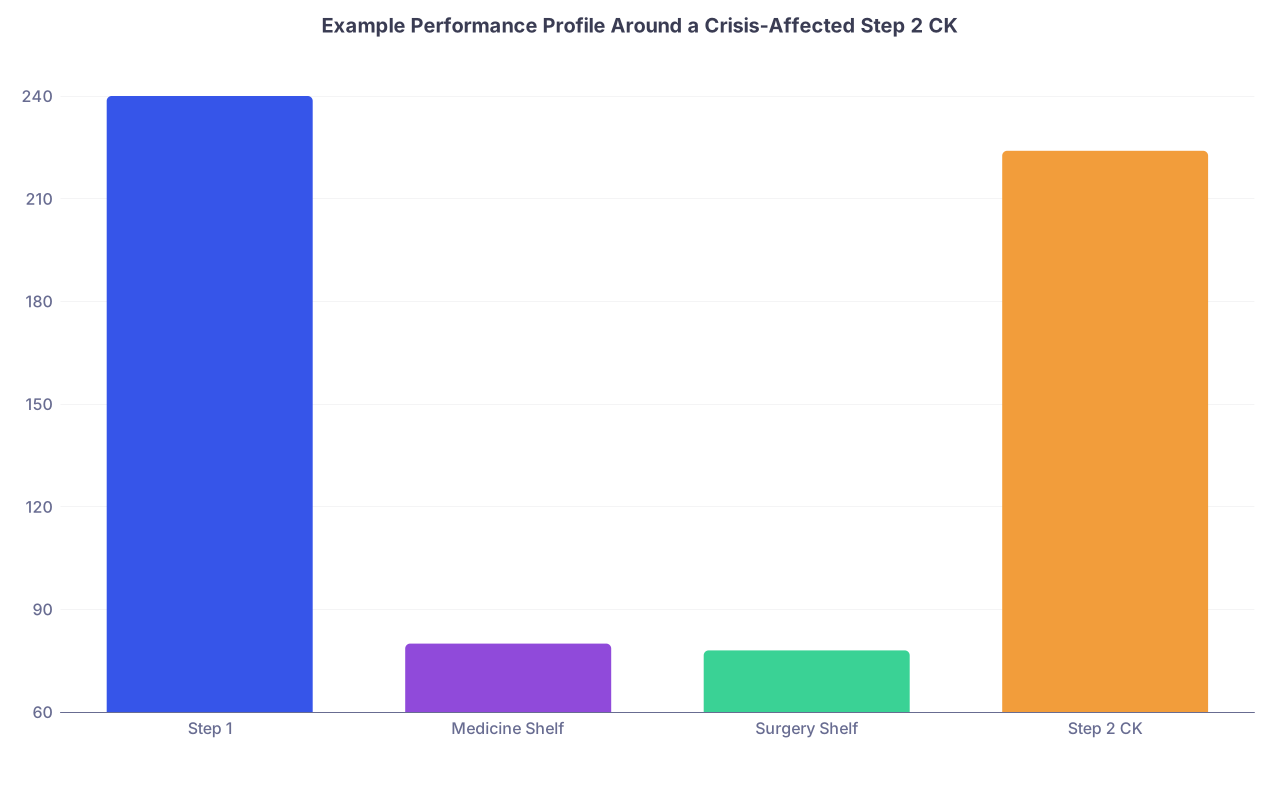
Words alone are weak. You need numbers and concrete performance to back you up.
Here is how you build that case.
| Category | Value |
|---|---|
| Step 1 | 240 |
| Medicine Shelf | 80 |
| Surgery Shelf | 78 |
| Step 2 CK | 224 |
Imagine this is you:
- Step 1: 240
- Shelves: mostly 75–85th percentile
- Step 2 CK: 224 during a major crisis
That’s a believable outlier story. So in your explanation, you must point to those shelves, course honors, maybe a later in-training exam, anything that shows: “No, I did not suddenly become a weaker learner.”
Examples of the kind of data to highlight:
- Honors or high passes in core clerkships (especially IM, surgery).
- Shelf scores at or above national mean.
- Strong Step 1 (if reported).
- Improved performance on later rotations after the crisis period.
- Any objective performance scores if you had a Sub-I later.
Do not just say “I worked hard.” Show evidence.
If Your Crisis Is Ongoing (Not Just Past)
Different situation: your crisis did not magically resolve after Step 2. Parent still in chemo. You’re still going through a divorce. You’re still under treatment for depression.
Programs are asking a silent question:
“Is this person going to be able to function when intern year hits?”
So you need to thread a careful line:
- Acknowledge that the situation existed during the exam.
- Clarify—honestly—what your current functioning is.
- Emphasize systems and support, not heroics.
Something like:
During my Step 2 CK preparation, I experienced an acute exacerbation of a chronic mental health condition, requiring short-term treatment adjustment and time away from studying. This affected my performance on the exam. Since then, I have been stable on a consistent treatment plan, have completed my remaining clerkships without further interruption, and have consistently received strong clinical evaluations. I am confident in my ability to maintain this stability and meet the demands of residency.
That tells a PD: “Yes, there was a real issue. Yes, there’s a plan. Yes, they’re functioning now.”
What not to say:
“I’m still struggling a lot but I’m hopeful residency will give me purpose.” That’s a program director’s nightmare line.
How To Talk About It If Asked in Interviews
If you document context, expect at least some interviewers to bring it up.
The worst thing you can do is look surprised or defensive. Have a 20–30 second, calm, practiced answer. Not rehearsed to death. Just tight.
Framework:
- One sentence about what happened.
- One sentence about how it impacted the exam.
- One to two sentences about what you learned/changed and how you’re doing now.
Example:
“During the lead-up to Step 2, my father was critically ill and I stayed involved with his care while on rotations. I chose to keep my initial exam date, and my score was lower than my practice tests and my other USMLE performance. Since then, I’ve had time to address the situation, return to my usual level of focus, and I think my clerkship evaluations and sub-I performance are a more accurate reflection of the resident I’ll be.”
If they push harder—“Why didn’t you just delay?”—do not get defensive. You can say:
“Looking back, I might have benefited from postponing. At the time, between rotation scheduling and limited testing dates, I made the best decision I could with the information and support I had. I’ve learned a lot about recognizing my limits and asking for help earlier, which I think will be important in residency.”
That admission of imperfect judgment paired with growth is far more attractive than pretending everything was perfect.
If You Haven’t Taken Step 2 Yet and You’re In the Crisis
Some of you reading are still pre-exam but already in the storm. Quick reality check.
If any of these are true:
- You’re not sleeping more than 3–4 hours/night regularly.
- You can’t focus on a UWorld block long enough to finish it.
- Your practice scores have tanked 15+ points in the last 2–3 weeks.
- You’re dealing with active grief, trauma, or mental health decompensation.
You should strongly consider rescheduling if there is any way to do so without blowing up your graduation or application timeline. Sometimes the bravest thing is not “pushing through,” it’s refusing to let a crisis permanently stain your record.
That said, I’ve seen students in toxic advising situations where everyone says “you’ll be fine” when they clearly won’t. Listen to your practice tests and your brain, not just the registrar calendar.
If you must take it anyway—limit the damage:
- Lock in sleep as your #1 priority.
- Cut fancy review and just do high-yield questions and error logs.
- Accept you’re fighting for “solid enough,” not perfection.
And then, if the score ends up bad, come back to everything above about documentation.
A Simple Process to Draft Your Explanation
You’re probably exhausted. So here’s a short, practical drafting process.

| Step | Description |
|---|---|
| Step 1 | Brain dump facts |
| Step 2 | Strip emotional details |
| Step 3 | Identify objective data |
| Step 4 | Write 4 to 6 sentence draft |
| Step 5 | Have advisor review |
| Step 6 | Polish tone and length |
| Step 7 | Paste into ERAS or send to dean |
- Brain dump the facts in 5–10 minutes. Everything. Dates, what happened, how bad it was.
- Cross out 80% of the emotional detail. Keep only what a professional stranger needs to understand timing and magnitude.
- Write down 3–5 objective points that argue, “I perform better than this score suggests.”
- Turn that into a 4–6 sentence paragraph following the structure I gave you.
- Show it to someone honest (advisor, trusted attending, upperclassman who matched already). Ask: “Does this sound like appropriate context, or like excuse-making?”
- Revise down. Shorter is usually better.
Example Paragraphs You Can Model
Not to copy verbatim—but to give you a sense of tone.
Family health emergency
During the month prior to my Step 2 CK exam, a close family member experienced a sudden, life-threatening health emergency that required my active involvement in their care and decision making. Because of scheduling constraints, I chose to proceed with the exam rather than delay. My performance on Step 2 CK was below both my practice exams and my prior USMLE performance. My clerkship grades and NBME shelf scores are more reflective of my typical academic performance. Since that time, I have been able to re-establish my normal study and work routines.
Personal mental health crisis
In the months leading up to Step 2 CK, I experienced an acute mental health crisis that required medical treatment and temporarily affected my ability to prepare and perform at my usual level. Although I completed the exam as scheduled, my score is lower than expected based on my coursework, shelf exams, and Step 1 performance. Since then, I have been stable on a consistent treatment plan and have successfully completed my remaining clinical rotations with strong evaluations. I feel well-prepared for the demands of residency.
Ongoing caregiving responsibilities
During my Step 2 CK preparation period, I assumed primary caregiving responsibilities for an ill family member. Balancing these responsibilities with rotations limited my ability to prepare as fully as I had for prior exams, and my Step 2 CK score is lower than my usual academic performance would predict. Despite this, I maintained strong evaluations on my clerkships and sub-internship. These experiences reinforced my commitment to internal medicine and my ability to function reliably under prolonged stress.
You’ll notice: no gore, no long play-by-play, no begging. Just facts.
Final Moves Before You Submit ERAS
Last things to sanity-check:

- Read your explanation out loud. If you’d feel awkward saying this to an attending in person, it’s probably too much.
- Make sure the word “because” doesn’t show up more than once. Too many “because” phrases start sounding defensive.
- Cross-check your narrative with your MSPE and letters. No contradictions.
- Confirm that somewhere in your application the good data is easy to see—clerkship honors, shelves, etc.
- Decide on your 20–30 second spoken version for interview day and stick with it.
Two Big Things To Remember
- Your Step 2 CK score is data, not destiny. Context doesn’t erase it, but it can protect you from being written off too quickly.
- Programs are looking less for a tragic story and more for proof that you can take a hit, own your decisions, stabilize, and still show up strong for your patients.
Document the crisis cleanly, highlight the stronger parts of your record, and then move your energy where it actually matters now: the rest of your application and the doctor you’re becoming.