
The idea that a failed shelf or bad rotation automatically kills your residency chances is nonsense. It hurts. But it’s not fatal if you respond strategically—and Step 2 CK is your best weapon.
You’re not trying to erase that failure. You’re trying to overpower it with a clear, undeniable signal: “I can handle high‑stakes clinical exams now.” That’s exactly what a strong Step 2 CK can do if you plan it right and then use it well on your application.
This is the playbook for when you’ve already taken a hit—failed a shelf, got an honors-to-pass drop because of an exam, maybe even had to remediate a rotation—and you’re wondering if Step 2 CK can pull you out of the hole.
Let’s go straight to what actually matters.
1. First, Get Real About How Bad the Damage Is
Not every “bad” rotation or exam is the same. Before you plan your Step 2 strategy, you need to know how programs will see your record.
Here’s how I’d roughly categorize it:
| Situation | Severity | Typical Impact if Unaddressed |
|---|---|---|
| Single failed shelf, passed remediation | Moderate | Raises questions but recoverable with strong Step 2 |
| Multiple low shelves, no outright fail | Mild-Moderate | Suggests weak test-taking; Step 2 signal critical |
| Failed core rotation (clinical + exam) | High | Serious concern; needs explicit explanation + strong Step 2 |
| Pattern of marginal passes across rotations | Moderate-High | Concerns about consistency; Step 2 must be solid |
If you’re in:
- Mild territory (one low shelf, no fail): Step 2 CK is still important, but you’re more in “polish the application” mode.
- Moderate territory (failed shelf, remediated, or several weak shelves): Step 2 CK becomes central evidence that your test-taking and clinical reasoning are fixed.
- High territory (failed rotation, professionalism concerns): Step 2 helps, but it’s not enough alone. You’ll need explanation, advocacy from faculty, and realistic expectations about specialty/tier.
You cannot change what’s already in the record. Your job now is to create a stronger data point that makes programs say, “Okay, they figured it out.”
That data point is Step 2 CK.
2. How Program Directors Actually Think About Step 2 After a Red Flag
Let me translate what a PD or selection committee member is really asking when they see a failed shelf or rotation:
- “Is this student unsafe clinically?”
- “Is this a pattern or a one-time thing?”
- “If I match this person, will they struggle with in-training exams and board pass rates?”
- “Has this been addressed or just carried along quietly?”
A strong Step 2 CK is a direct answer to those questions.
, Letters of recommendation, MSPE narrative](https://cdn.residencyadvisor.com/images/articles_svg/chart-how-programs-may-reweight-metrics-after-a-clinical-6501.svg "How Programs May Reweight Metrics After a Clinical Red Flag")
| Category | Value |
|---|---|
| Core clerkship grades | 70 |
| Shelf exam history | 65 |
| [Step 2 CK score](https://residencyadvisor.com/resources/usmle-step2-ck-importance/how-program-directors-quietly-use-step-2-ck-to-rank-you) | 90 |
| Letters of recommendation | 85 |
| MSPE narrative | 80 |
When you’ve got a negative on the clinical/testing side, many PDs subconsciously shift weight toward:
- Step 2 CK score: Can they handle standardized, clinically oriented exams now?
- Trend: Are they moving up after the failure, or stale/declining?
- Narrative: Do they own what happened, or is it ignored or blamed on everybody else?
So yes, Step 2 can absolutely “recover” you. But only if:
- The score is clearly strong relative to your specialty, and
- The rest of the application is aligned with that story.
Let’s talk numbers for a minute.
3. What “Strong Step 2 CK” Actually Means in This Situation
You’re not aiming for “good enough.” You’re trying to counterbalance a documented weakness. That bar is higher.
Very roughly (ballpark, not gospel):
| Specialty Tier | Examples | Target if You Have a Red Flag |
|---|---|---|
| Very competitive | Derm, Ortho, Plastics, ENT | ≥ 255–260+ |
| Competitive | EM, Anesthesia, Gen Surg, Neuro | ≥ 245–250+ |
| Mid-range | IM, Peds, OB/GYN | ≥ 240–245+ |
| Less competitive | FM, Psych, PM&R, Path | ≥ 235–240+ |
If your school publishes Step 2 averages, your minimum goal with a red flag should be:
- At least at or above your school’s average, and
- Ideally above the national mean for your target specialty.
Can people match with lower scores? Of course. But if you’re trying to use Step 2 as a recovery tool, don’t plan for “barely okay.”
You want your ERAS to tell this story:
“Yeah, there was that shelf/rotation issue. But look—when it came time for the big clinical board exam, they crushed it.”
4. Step 2 CK Study Strategy When You’re Coming Off a Failure
Your mindset has to shift from “please let me pass” to “I need to demolish this test.” That means:
A. Start With an Honest Autopsy of the Shelf/Rotation Failure
Do this before touching a Step 2 resource.
Ask yourself:
- Did I not know the content? (knowledge gap)
- Did I run out of time or panic? (test-taking and anxiety)
- Did I study the wrong way? (inefficient methods)
- Was there something external—illness, family crisis—that’s now resolved?
Write out a 1–2 paragraph “post-mortem” for yourself. Not to wallow. To make sure you don’t repeat it.
B. Build a Step 2 Plan That Directly Attacks Your Weaknesses
If your problem was knowledge:
- You need systematic content review, not just questions.
- Use one main text or video source (AMBOSS, OnlineMedEd, Boards & Beyond, or similar) plus UWorld.
- Schedule: Example 6–8 week dedicated:
- 4–5 hours/day UWorld timed, mixed
- 2–3 hours/day targeted review of weak systems
- 1–2 hours/day revisiting wrongs + flashcards
If your problem was test-taking/time:
- Every single practice block must be timed. No exceptions.
- Force yourself to finish with 5–8 minutes left per block.
- Practice skipping and flagging—don’t get stuck on one question.
- Do at least one full-length simulation (2 NBME exams back-to-back or a very long UWorld block day).
If anxiety killed you:
- Do many blocks under “exam conditions”: no phone, no pausing, quiet environment.
- Keep a simple pre-exam routine and use it for every NBME.
- Consider actual treatment if needed: therapy, coaching, or meds via a physician. White-knuckling severe anxiety is not “grit,” it’s sabotage.
5. Timing Step 2 CK Strategically When You Have a Red Flag
Here’s where a lot of students mess up. They rush Step 2 to “get it over with” and land another mediocre score on top of their previous issue. That’s how you go from “recoverable” to “this is a pattern.”
Your priority now is: one strong score, even if it means taking it later.
Some concrete rules:
- If your practice NBMEs are below 230, and you have a failed shelf/rotation, you’re generally not ready. Push the exam if possible.
- You want at least 2 practice NBMEs at or above your target score range within 2–3 weeks of the test date.
- Do not cling to the calendar date out of pride. Programs would rather see a late strong score than an early mediocre one that confirms their worry.
For ERAS timing:
- If you’re applying in September and can realistically hit your target by then, aim to have Step 2 reported by October at the latest.
- If you need to take Step 2 later (e.g., November) to make it strong:
- That’s acceptable, especially if you already have Step 1 and some solid clinical grades.
- Some programs will wait; some will not. But a weak Step 2 harms you more universally than a slightly late strong score.
6. Using Your Strong Step 2 CK to Reframe the Narrative
A high number alone is good, but you can make it do more work for you.
Here’s how to weave it into your application.
A. MSPE / Dean’s Letter
Most schools will mention failed shelves or remediations. You cannot control that. But you can:
- Ask your Dean’s office what exactly will be written.
- Provide a brief, professional explanation if they invite your input:
“During my surgery clerkship, I initially failed the shelf exam. After remediation and working closely with faculty, I passed the exam and have since significantly strengthened my test performance, as reflected in my Step 2 CK score of 247.”
No drama. No excuses. Just cause → response → outcome.
B. Personal Statement: Use Only If the Issue Is Big
If your red flag is mild (one low shelf, no failure), you probably do not need to burn personal statement space on it.
If you had:
- A failed rotation
- Multiple failed shelves
- A leave of absence related to performance
Then a short, focused paragraph in either the PS or a secondary essay can help. Structure it like this:
- What happened (one sentence, no blame-shifting)
- Why it happened (brief, concrete)
- What you changed (specific actions)
- How the outcome shows growth (Step 2 + later clinical feedback)
Example:
“Early in third year, I failed my internal medicine shelf exam. I underestimated the volume of material and relied too heavily on passive reading instead of question-based learning. With support from faculty, I changed my approach—developing a structured UWorld schedule, doing weekly NBME-style blocks, and reviewing missed questions in detail. I remediated the shelf successfully and continued to refine this system, which ultimately led to a Step 2 CK score of 246 and stronger subsequent clerkship evaluations.”
That’s it. No over-apologizing.
C. Letters of Recommendation
This part is underused and very powerful.
You want at least one letter from:
- A core rotation after your failure,
- Where you performed well clinically,
- From someone who actually knows you.
If they are aware of your struggle, you can respectfully ask for support like:
“I had a difficulty earlier in my clinical year with a failed shelf, which I’ve since remediated and addressed. If you feel it’s appropriate, I’d appreciate any comment on the growth you’ve seen in my clinical reasoning and reliability since then.”
The best-case scenario is a faculty member writing something like:
“Although he struggled with one shelf exam early in the year, the student I worked with on wards was organized, thoughtful, and clinically sound. By the time of our rotation, he had clearly learned from that earlier challenge.”
That kind of line in a strong letter plus a high Step 2 is powerful.
7. Adjusting Your Target Specialty and Program List (Hard Part)
Sometimes the honest answer is: yes, a strong Step 2 helps, but it does not completely erase certain red flags for certain specialties.
For example:
- You failed medicine and want top-tier academic cardiology-track IM? You’ll need a pretty exceptional Step 2 (250+) plus strong research and letters to stay competitive at the highest level.
- You failed surgery and want plastics or ortho? Possible, but you’re fighting uphill. You should build a much broader backup plan.
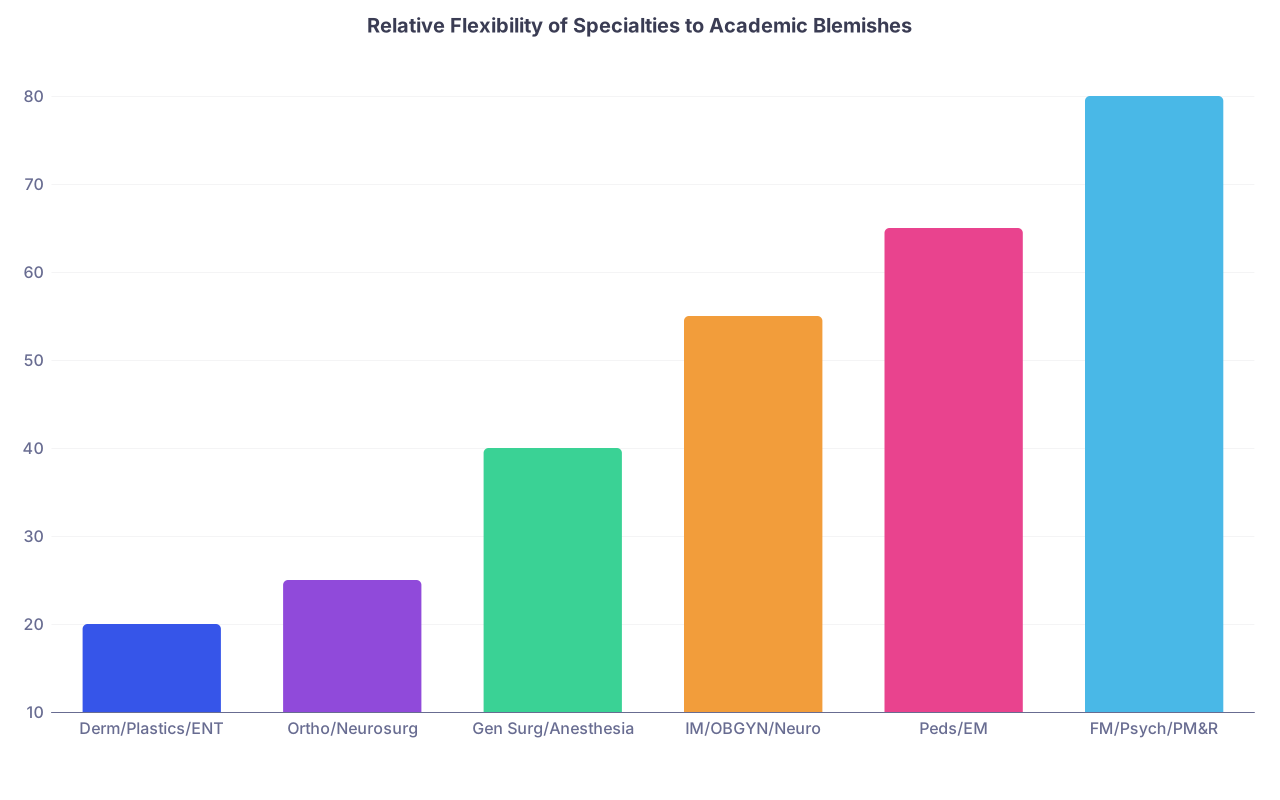
| Category | Value |
|---|---|
| Derm/Plastics/ENT | 20 |
| Ortho/Neurosurg | 25 |
| Gen Surg/Anesthesia | 40 |
| IM/OBGYN/Neuro | 55 |
| Peds/EM | 65 |
| FM/Psych/PM&R | 80 |
(Think of higher values here as “more forgiving” of a past stumble if you show clear improvement.)
You should:
- Sit down with an advisor who will be blunt, not just nice.
- Bring your full record: shelves, rotations, Step scores, any remediations.
- Ask: “If I hit a Step 2 of X, what range of specialties and programs is realistic for me?”
Then actually listen.
You can aim high, but do not build an application strategy on the fantasy that one Step 2 score makes you indistinguishable from a spotless applicant. It does not. It makes you a “red flag with a strong comeback”—and plenty of programs like that story, especially in less cutthroat specialties.
8. Handling Interviews When They Bring Up the Failure
They will ask. Not always, but often enough that you must be ready.
Your response needs to be:
- Calm
- Short
- Concrete
- Growth-oriented
A simple framework to use:
- Acknowledge
- Own it
- Show what you changed
- Point to the evidence (Step 2, later rotations)
Example answer:
“Yes, in my third-year surgery clerkship I failed the shelf exam. I misjudged how much consistent question practice I needed and relied too heavily on passive studying. I met with our clerkship director, reorganized my study schedule around daily timed questions and weekly self-assessments, and successfully remediated the shelf. I’ve kept that structure since, which helped me perform better on later rotations and on Step 2 CK, where I scored 244. It was a humbling experience, but it forced me to build much more reliable systems that I still use now.”
What you do not do:
- Blame the exam, the grading, or “they never taught us that.”
- Launch into a 5-minute saga about all your stresses.
- Get defensive or visibly flustered.
They’re testing your insight and maturity at least as much as your memory of the event.
9. Mental Side: Getting Your Head Back After Failing
You’re not a robot. A failure in third year hits your identity: “Maybe I’m not cut out for this.” I’ve seen very capable students spiral not because of ability, but because they never reset mentally.
You do not need a life coach. You need a few grounded rules:
- Do not catastrophize: Failing a shelf ≠ unsafe doctor. It means you lost a very specific exam battle.
- Your self-talk matters: “I’m someone who underperformed, learned, and adapted” vs. “I’m a bad test-taker and always have been.”
- Protect your bandwidth: If you’re studying for Step 2, this is not the season to over-commit to 6 side projects. Your comeback depends on one main thing now—this exam.
If you find yourself frozen, procrastinating, or panicking every time you open UWorld, that’s not “laziness.” That’s avoidance driven by fear. A couple of focused sessions with counseling services or a therapist can help you break that loop. Many med schools have this built in; use it.
10. Quick Example Scenarios
To make this less abstract, here’s how this plays out in real life.
Scenario 1: Failed Surgery Shelf, Aiming for Anesthesia
- Situation: You failed the surgery shelf, remediated with a pass, mostly high passes/honors elsewhere. Step 1 was pass.
- Step 2 goal: 245–250+.
- Plan: 8-week focused Step 2 prep, do not rush. Mention the shelf in MSPE Dean’s note with clear improvement. Get a strong IM letter. Apply to a broad mix of anesthesia programs with some IM as backup.
- Outcome if Step 2 = 248: Many anesthesia programs will see this as a resolved concern.
Scenario 2: Failed Medicine Rotation, Aiming for IM
- Situation: Failed internal medicine (clinical + shelf), remediated, other rotations okay.
- Step 2 goal: 240–245+ minimum.
- Plan: Extra time if needed. Get letters from later IM subspecialty elective and another core where you excelled. One paragraph explanation in PS or separate addendum.
- Outcome: Top university IM may be tough, but mid-tier academic and strong community IM are still very realistic with a robust Step 2 and solid letters.
Scenario 3: Multiple Low Shelves, No Fails, Wants Psych
- Situation: Passed all shelves but clustered in the low 60–65 percentile range. Step 1 pass.
- Step 2 goal: 235–240+ to show upward trend.
- Plan: Serious structured Step 2 prep, heavy NBME tracking. Might not need to explain in PS because there’s no outright failure; let the Step 2 score speak.
- Outcome: With a 238 Step 2, many psych programs will not care about the mediocre shelves.
FAQ (exactly 4 questions)
1. Should I delay my Step 2 CK if my practice tests are low and I already have a failed shelf?
Yes, if you can. With a known red flag, another weak score does more harm than taking Step 2 a bit later with a higher score. If your NBMEs are sitting below ~230 and your target specialty needs 240+, strongly consider delaying, tightening your study plan, and retesting once your practice scores consistently hit your target range.
2. Do I have to address my failed shelf or rotation in my personal statement?
Not always. A single failed shelf with clean remediation can often be handled in the MSPE and, if needed, briefly in interviews. Use your personal statement for who you are and why you want the specialty. Only dedicate PS space to the failure if it was significant (failed rotation, repeated exams, leave of absence) and you can clearly show what changed and how Step 2 and later performance reflect that growth.
3. How many NBMEs should I take before Step 2 CK if I’m trying to prove myself after a failure?
At least 3–4, spread across your study period, with the last 2 within striking distance of your target score. You’re not just checking a box; you’re collecting proof that your improvement is real and stable. Use them to decide on timing: if your last two are 10–15 points below your goal, you’re probably not ready yet.
4. Can a very high Step 2 CK completely erase a failed rotation for competitive specialties?
No, “erase” is the wrong word. A 260+ Step 2 after a failed rotation definitely changes how many places will take you seriously, but it doesn’t magically make you identical to someone with a clean record. For ultra-competitive fields (derm, plastics, ENT, ortho), the failure will still be a concern. What a high Step 2 does is move you from “probably an auto-screen” to “worth a closer look, especially if letters and experience are strong.”
Key points:
- A failed shelf or rotation is a real problem, but not a death sentence—your Step 2 CK can be decisive evidence that you’ve fixed the underlying issue.
- “Strong” Step 2 for recovery means above-average for your specialty, not just a pass; adjust timing and prep to hit that.
- Use your score strategically—in MSPE language, letters, and interviews—to tell a coherent story of insight, adjustment, and clear upward trajectory.