
It’s late August. Your Step 2 CK score just posted. You open the report, your heart rate spikes, and then you see it:
Not a catastrophe. But not what you wanted.
Borderline for your dream specialty.
Now you’re staring at your ERAS draft wondering:
“Do I still go all-in on my chosen specialty, or do I need to dual-apply? And if I dual-apply, how aggressively? To what? How do I not blow up both applications?”
This is where you actually are. Not in some theoretical “just follow your passion” world. You’re looking at a real score, real odds, real money, and a match you only get one clean shot at.
Let’s go step-by-step through what you should do.
1. First: Is Your Step 2 CK Really “Borderline” For Your Specialty?
“Borderline” is not a feeling. It’s context. A 240 might be borderline for ortho. Fantastic for family med. Fair for EM.
You need to pin down what borderline means for you.
A. Anchor your score against your target specialty
Use your Step 2 CK and compare it to typical matched data. Most recent NRMP Charting Outcomes will give you ballpark medians and distributions, and specialty organizations sometimes publish more current stuff.
Rough tiers, for context (these are approximations, not rules):
| Specialty Tier | Examples | Rough Step 2 CK Range (Matched US MD) |
|---|---|---|
| Ultra-competitive | Derm, Ortho, PRS, ENT, Neurosurg | 255–265+ common |
| Competitive | EM, Anesthesia, Rad, Ophtho, Urology | 245–255+ common |
| Mid-range | IM, Gen Surg, OB/GYN | 240–250+ common |
| Less score-driven | FM, Psych, Peds, Neuro, Path | 230–245+ common |
Then ask:
- Is your score ≥ 5–10 points above the rough average for your specialty? You’re not “borderline.” You’re fine; focus on application quality.
- Is your score within ±5 points of that rough average? This is “borderline but realistic,” especially if you’re not gunning for only top-20 programs.
- Is your score 10+ points below typical matched ranges for that specialty? That’s when dual-apply is very much on the table.
B. Factor in where you stand overall, not just the score
Your Step 2 CK isn’t living alone on the page. Programs will see:
- Step 1 (even if pass/fail, context and timing matter)
- Clerkship grades and class rank
- Research (especially for academic and competitive fields)
- Home programs / away rotations
- Red flags (leaves, LOA, professionalism issues, prior failures)
Who does “borderline” hurt most?
- No home program in the specialty
- No strong away rotation letters
- Middle or lower-third class rank
- Weak or generic letters
- Little to no research in a research-heavy specialty
If several of those are true and your Step 2 is below or barely at average for the field, your risk is higher than “just the score” suggests.
2. Decide: Are You Actually Willing to Do a Backup Specialty?
This is the part people skip, then regret.
Ask yourself bluntly:
If I matched only in the backup specialty and never in my dream field, would I be:
- Genuinely okay?
- Mildly disappointed but could build a good life?
- Miserable and likely to try to switch later?
If you’re in the “miserable” category, a dual-apply may be worse than a focused, risky single-apply. I’ve seen people match into their “safety” specialty, hate it, and then have zero realistic path back to their original interest.
So before tactics, sort your attitude:
“I’d be happy in either.”
True dual-apply candidate. You’re not betraying anything. You’re just covering outcomes.“I’d tolerate my backup if I had to.”
Dual-apply is reasonable, but you must be disciplined—strong primary application, thoughtful backup (not just panic spraying).“I’d rather reapply/unmatch than spend my life in the backup.”
Then you probably should not dual-apply, or if you do, choose a backup that’s adjacent enough that transition is at least plausible later (e.g., categorical IM when you wanted cards; gen surg if you wanted a surgical subspecialty).
3. Use This Practical Framework to Decide if Dual-Applying Makes Sense
Let’s build a quick risk grid using three variables:
- Specialty competitiveness
- Your Step 2 CK vs that field
- Your overall application strength
A. Quick risk table
| Scenario | Example | Dual-Apply Advice |
|---|---|---|
| High-competitive field, low Step 2, weak app | Ortho 232, no ortho LORs, no research | Strongly consider dual-apply |
| High-competitive field, borderline Step 2, strong app | Derm 248, strong research, great letters | Focus single-apply, widen program list |
| Mid-competitive field, borderline Step 2, average app | IM 235, average grades, 1–2 pubs | Consider dual-apply if geography is tight |
| Less competitive field, borderline Step 2, average+ app | FM 225, decent clinical evals, solid letters | Single-apply usually fine |
| Any field, multiple red flags + borderline score | 2 LOAs, repeat year, 230 | Strongly consider dual-apply and SOAP planning |
This isn’t perfect, but it gives you a starting category.
B. Don’t ignore the geography question
Even in less competitive specialties, being ultra-picky on location can effectively make you a competitive-applicant situation.
- Want only coastal major cities? Your bar is higher.
- Need to stay in one metro area for family? Your bar is higher.
If you must be in a narrow region and your Step 2 is borderline for that specialty in that region, dual-apply becomes more logical.
4. If You Dual-Apply: How to Choose a Backup That Isn’t Random
A bad dual-apply strategy is:
“My ortho score is borderline, I’ll just apply to psych too I guess.”
Program directors can smell “backup” from the ERAS screen. You don’t want that.
A. Think in “families” of specialties
Stay as close as you realistically can to your main interests, skills, and existing experiences.
Examples that often work better:
Ortho / Neurosurgery borderline
Backup: Categorical general surgery (if you truly like the OR).EM borderline
Backup: IM or FM with strong ED relationship at home program.Derm borderline
Backup: IM or FM at academic centers with strong derm fellowships (if you might later chase derm-adjacent fellowships, like rheum or allergy, or rarely, a later derm attempt).Anesthesia borderline
Backup: IM or prelim/transitional year with option to re-apply anesth.Radiology borderline
Backup: IM or transitional year programs; some people then re-apply.
Note: This is strategy, not a promise. Switching after matching into something else is hard and uncertain. Do not rely on it. But adjacency matters for your long-term satisfaction.
B. Align your real interests
If you hate clinic, don’t dual-apply to FM just because it feels “safe.” That’s how people burn out.
Ask:
- Do I like acute care vs longitudinal care?
- Do I like procedures vs talking/thinking?
- Adults vs kids vs women’s health vs psych?
Pick a backup that fits those answers reasonably well.
5. How to Split Your ERAS: Documents, Messaging, and Not Looking Fake
You cannot just copy-paste the same personal statement with different specialty names and expect this to work. Programs aren’t dumb.
A. Two separate personal statements, zero overlap in tone
You need:
- One primary statement for your main specialty.
- One for the backup specialty.
Each should:
- Sound like you only ever wanted that field.
- Use field-specific stories: a clinic moment vs a trauma bay vs OR case.
- Avoid crossover language like “I also enjoy…” that hints at another field.
Do NOT:
- Recycle the same generic “I like working with teams and lifelong learning” fluff and just swap labels.
- Mention your other specialty at all.
B. Letters of recommendation: be surgical and intentional
You have to decide where each LOR lives.
Guidelines:
For your primary specialty:
Use all the specialty-specific attendings who can speak to your skills in that field. Prioritize quality over title.For backup specialty:
If you have a home rotation or any elective in that field, get at least one letter there. If you don’t, use strong IM/FM letters that are applicable anywhere (professionalism, clinical reasoning, work ethic).
What you avoid:
- Using clearly specialty-specific letters (e.g., “X will be an excellent emergency physician”) for a completely unrelated backup field.
- Overloading backup apps with letters that scream “they’re really an X person.”
C. ERAS experiences: generic enough to serve both, but with emphasis
You don’t need two different experience entries. You just need to describe your work in a way that:
- Highlights reasoning, communication, reliability.
- Avoids field-specific overkill that screams “I am only applying to X.”
You can then tweak how you talk about them in interviews depending on the specialty.
6. How Many Programs and How to Distribute Them
This is where people either under-shoot or torch money.
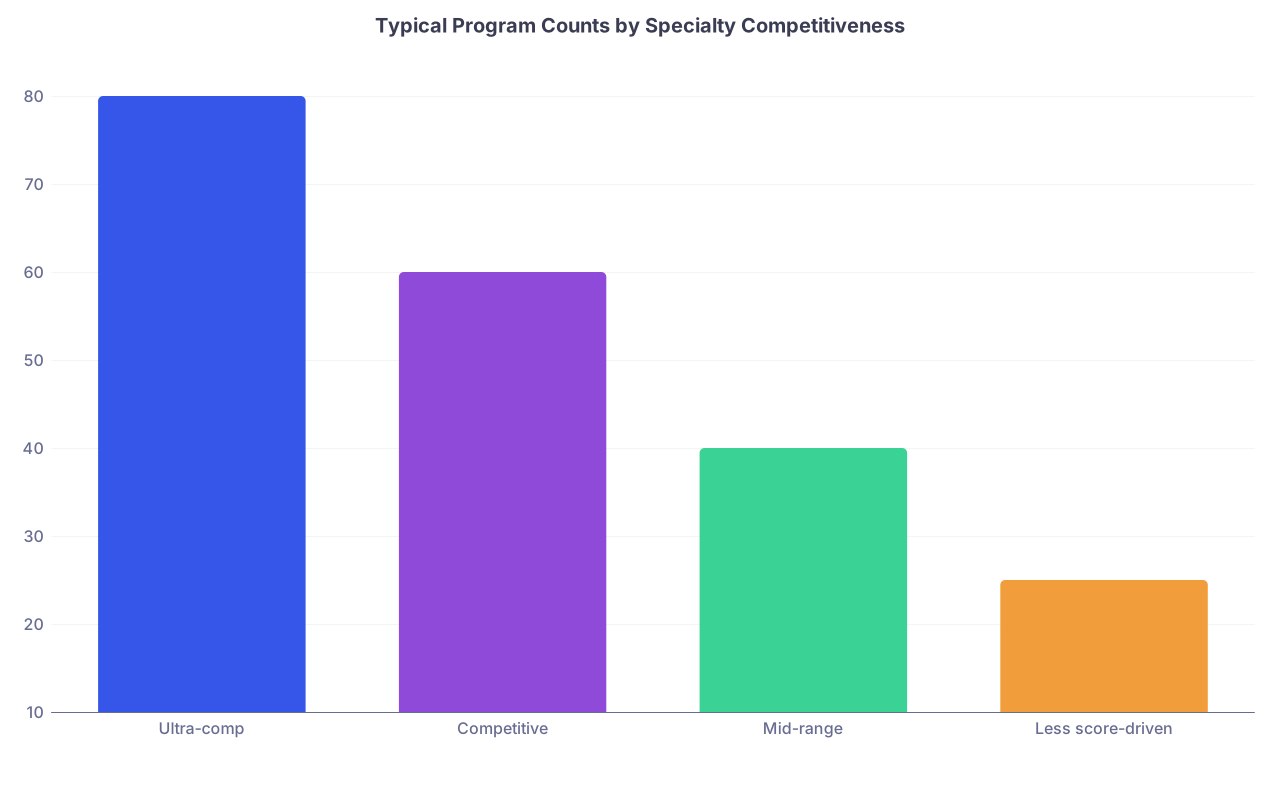
| Category | Value |
|---|---|
| Ultra-comp | 80 |
| Competitive | 60 |
| Mid-range | 40 |
| Less score-driven | 25 |
These are general ranges for borderline Step 2 applicants, assuming you’re a US MD:
- Ultra-competitive (ortho, derm, neurosurg, ENT, PRS): 60–100+
- Competitive (EM, anesthesia, rads, ophtho, uro): 40–70
- Mid-range (IM, gen surg, OB/GYN): 30–50
- Less score-driven (FM, Peds, Psych, Neuro, Path): 20–35
If dual-applying, you’re often looking at something like:
- 40–60 in primary specialty
- 20–40 in backup specialty
But this depends heavily on:
- Your school’s reputation
- Home program presence
- Region flexibility
- Red flags
If you have significant risk factors (low score + repeated year + no home program), your backup needs to be more than just a token 10–15 applications. That’s wishful thinking.
7. Using Step 2 CK Strategically: When It Helps You, When It Hurts
The whole point is this: Step 2 CK is the only standardized number most PDs now trust. You cannot hide it, but you can frame it.
A. When a borderline Step 2 still helps you
Step 2 CK can still be a net positive if:
- Your Step 1 was low or you failed and Step 2 is solidly higher. Shows upward trajectory.
- Your school is lower ranked and Step 2 is at or slightly above the specialty mean. That number gives them reassurance.
- You’re applying mid-range or less competitive fields. A “borderline” for a hyper-competitive field might be “very good” for IM or Peds.
In your personal statement or interviews, if someone brings it up (don’t bring it up unprompted), you frame it as:
- Consistent improvement over time.
- Coupled with strong clinical comments and solid shelf scores.
- Evidence you can handle residency exams.
B. When a borderline Step 2 really bites
It hurts more when:
- You had a strong Step 1 (numeric era) and Step 2 is a clear downward hit. PDs will wonder why.
- You’re aiming for fields where Step 2 is used as an early “hard cutoff” (some surgical subspecialties, radiology, etc.).
- The score is close to or just above the pass mark. Programs get nervous about in-training exam and board pass rates.
You cannot spin that into a strength. What you can do:
- Double-down on strong rotations and letters.
- Crush any AI/away rotations.
- Apply broadly and smartly.
- Use backup specialty seriously, not symbolically.
8. Interview Strategy When You’ve Dual-Applied
Sooner or later, someone will ask: “So, what other specialties are you applying to?”
You need a calm, non-desperate answer.
A. For your primary specialty
You want to project commitment without lying.
Something like:
“This is the field I see myself in long-term. I’ve oriented my rotations, research, and mentors toward it. I did consider a small number of backup applications given how competitive the match has become overall, but my clear priority is to train in [specialty] if given the opportunity.”
Short. Direct. No life story.
B. For your backup specialty
Do not say: “I’m only here because I probably won’t match [primary].”
Try:
“I really enjoy [key elements that genuinely fit the backup field: continuity of care, acute care, procedures, etc.]. I explored [primary specialty], but as I spent more time on rotations and thought about lifestyle, training paths, and geography, I realized I’d be very happy building a career in [backup specialty]. I applied here because your program in particular aligns with [specific thing].”
You’re not required to announce your original dream specialty. You’re required to not sound like you hate being there.
9. Timeline and Moves If You’re Late or Already Applied
If you’re reading this with ERAS already in, you still have levers.
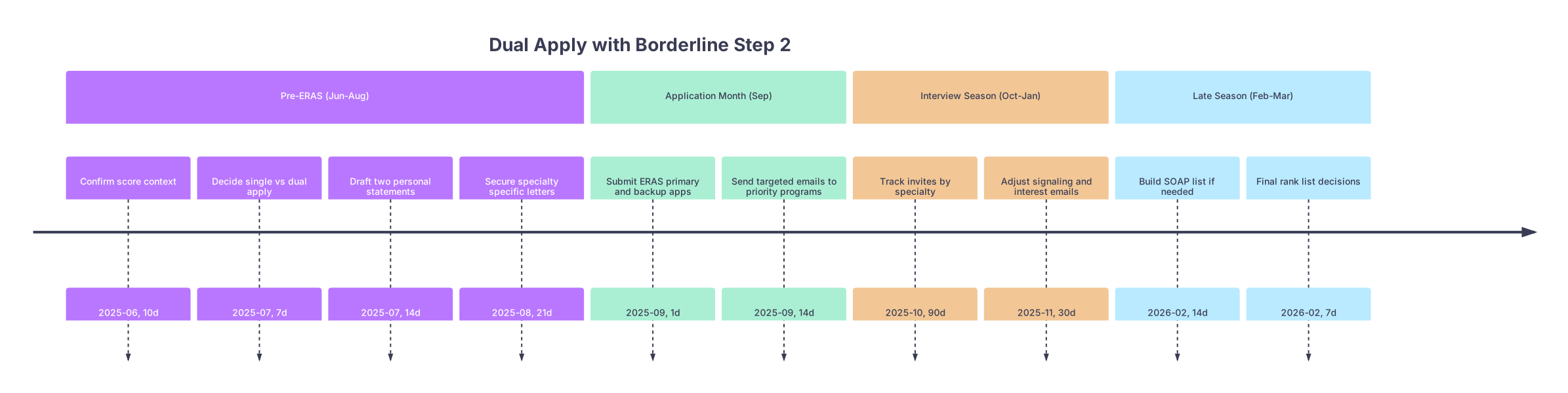
| Period | Event |
|---|---|
| Pre-ERAS (Jun-Aug) - Confirm score context | 2025-06, 10d |
| Pre-ERAS (Jun-Aug) - Decide single vs dual apply | 2025-07, 7d |
| Pre-ERAS (Jun-Aug) - Draft two personal statements | 2025-07, 14d |
| Pre-ERAS (Jun-Aug) - Secure specialty specific letters | 2025-08, 21d |
| Application Month (Sep) - Submit ERAS primary and backup apps | 2025-09, 1d |
| Application Month (Sep) - Send targeted emails to priority programs | 2025-09, 14d |
| Interview Season (Oct-Jan) - Track invites by specialty | 2025-10, 90d |
| Interview Season (Oct-Jan) - Adjust signaling and interest emails | 2025-11, 30d |
| Late Season (Feb-Mar) - Build SOAP list if needed | 2026-02, 14d |
| Late Season (Feb-Mar) - Final rank list decisions | 2026-02, 7d |
If it’s before ERAS submission:
- You can still:
- Decide dual vs single apply.
- Rewrite your personal statements.
- Redirect letters to support one or both fields.
- Expand your program list and widen geography.
If ERAS is already submitted but interview season hasn’t started:
- You can:
- Add more programs (costly but sometimes smart).
- Email PDs or PCs at realistic programs with a concise interest note, especially where you have a tie (region, med school, personal reason).
- Make sure your school’s advisors know your score and risk tolerance; they can quietly advocate.
If interviews are sparse or all from the backup field:
Then you’re de facto backup-heavy, whether you like it or not.
At that point:
- Take every interview seriously, no matter the specialty.
- Start quietly building a SOAP plan with your dean’s office.
- Decide if re-application in the primary specialty is on the table or if you’ll commit to backup if you match.
10. When Single-Applying is Still the Right Move (Even with a Borderline Score)
There are absolutely times where you should keep it single and focused, even with a Step 2 CK that makes you a bit nervous.
You lean single-apply when:
- Your primary specialty is mid-range (IM, Peds, Psych, FM) and your Step 2 is within a few points of typical matched ranges.
- You’re flexible on geography and prestige.
- You have strong clerkship performance and letters in that specialty.
- The thought of doing a different specialty for life genuinely feels wrong.
In that case, the smarter play is:
- Apply broadly.
- Add more community and mid-tier academic programs.
- Get honest feedback from faculty in that specialty.
- Prepare yourself mentally that you may match somewhere less “shiny” but still solid.
Dual-applying out of pure anxiety can absolutely sabotage a good single-apply.
11. Quick Reality Check: What Actually Matters Most Now
No one thing decides your fate. Step 2 is important, but not destiny.
You should focus your energy on:
- Strong, specific letters where attendings say more than “hard working and pleasant.”
- Personal statements that read like you actually know this specialty’s daily life.
- A program list that’s broad enough to match your risk level, not your ego.
- Taking interviews seriously across all places and fields you applied to.
And drop the fantasy that there’s some perfect algorithm that guarantees safety. There isn’t. You’re managing risk, not eliminating it.
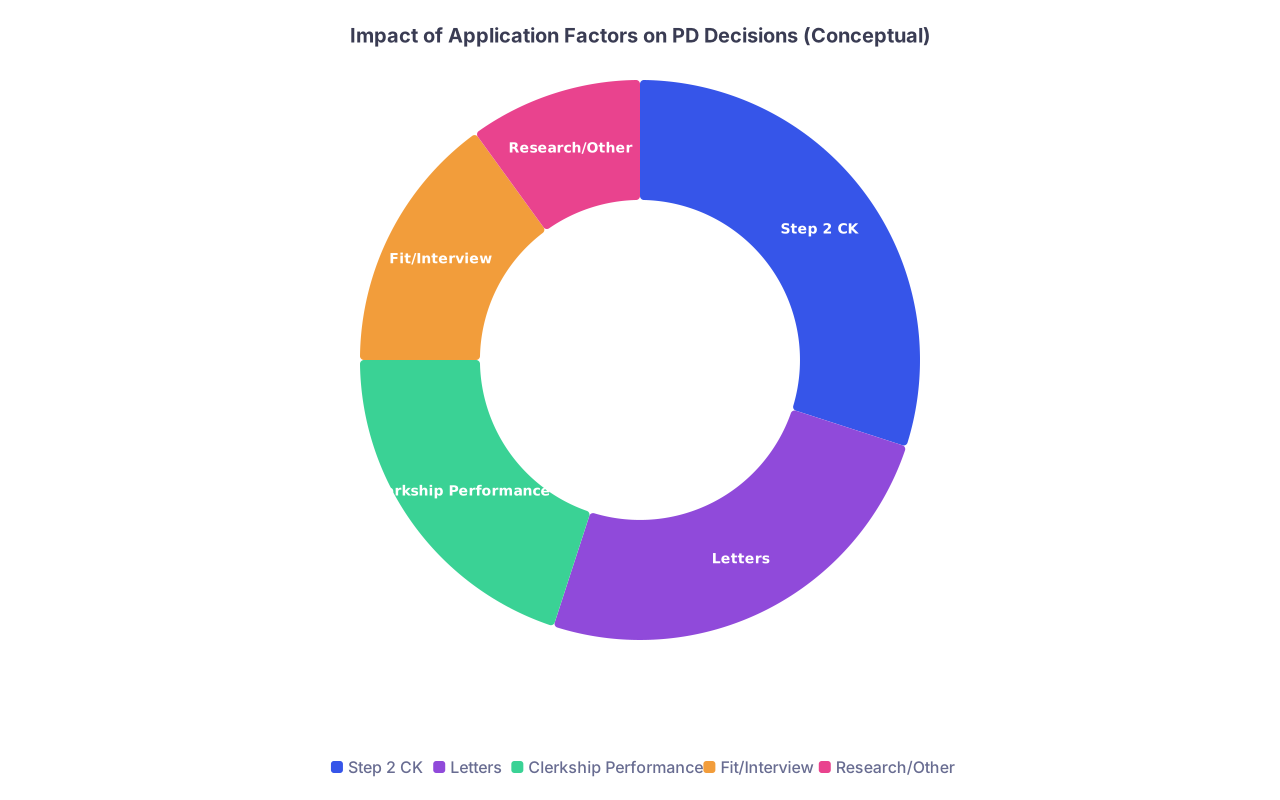
| Category | Value |
|---|---|
| Step 2 CK | 30 |
| Letters | 25 |
| Clerkship Performance | 20 |
| Fit/Interview | 15 |
| Research/Other | 10 |
3 Things To Walk Away With
- “Borderline” is not a vibe; it’s your Step 2 CK relative to your specialty, your full application, and your geography demands. Define it clearly first.
- Only dual-apply if you can live with the backup specialty. Then build two coherent applications—separate statements, targeted letters, real interest.
- If you stay single-apply, you must accept more risk and compensate with breadth and a humble program list. Half-committing to two fields is worse than fully committing to one.