
The idea that your original specialty choice is locked in after Step 2 CK is a lie that traps a lot of smart people. You can absolutely switch specialties after Step 2 CK—but you cannot afford to think about your metrics the same way anymore.
You’re not just “applying late” or “changing your mind.” You’re asking a brand‑new specialty to take a risk on you with a limited record, limited time, and a test score that was earned under a completely different plan. That is survivable. But only if you reframe how you use your metrics—especially Step 2 CK.
This is about triage, not perfection. Let’s walk through how to do it.
Step 1: Get Brutally Clear on Your Starting Point
If you’re switching specialties after Step 2 CK, you fall into one of a few buckets. Do not skip this part; which bucket you’re in changes your strategy.
| Scenario | Main Issue |
|---|---|
| New love, solid scores | Need evidence of genuine switch |
| Burned by Step 1 | Need Step 2 to rescue narrative |
| Weak Step 2 | Need non-test strengths to carry weight |
| IMG/late switch | Need extreme focus and realism |
Scenario 1: “I discovered a new specialty and my scores are fine”
Example: You were tracking toward IM, scored a 247 on Step 2 CK, then did an anesthesiology rotation and everything changed.
Your issue: not metrics. Credibility.
Programs are thinking:
“Is this person serious about us, or are we Plan B? Why no early signals of interest?”
Scenario 2: “Step 1 hurt me; Step 2 is better”
Example: Step 1: 207 (pass but low). Step 2 CK: 238. You’ve now decided to pivot from something competitive like derm (which is dead now, be honest with yourself) to something like psych, neuro, or PM&R.
Your issue: narrative and fit.
Programs are thinking:
“Did they grow and improve, or are they just running from their original plan?”
Scenario 3: “Step 2 isn’t great and I’m switching”
Example: Step 1 pass, Step 2 CK 220, you were pointed toward FM, then mid‑MS4 decide you want EM or anesthesia.
Your issue: realism and risk.
Programs are thinking:
“Why should we gamble on this applicant with late interest and mediocre test performance?”
Scenario 4: “IMG or very late switch with borderline scores”
Example: You’re an IMG with Step 2 CK 230, decided late to pivot from IM to neurology, with limited US clinical experience.
Your issue: everything—competition, visas, timing, and documentation of interest.
Now that you know your camp, you can reframe your metrics properly.
Step 2: Reframe What Step 2 CK Means To Programs Now
Your Step 2 CK score is no longer “how smart are you?” It’s now, “How much risk are we taking if we rank you?”
Programs use Step 2 CK post‑switch mainly for three things:
- Can you pass in‑training and boards with reasonable safety?
- Do you meet our internal or unofficial cutoff?
- Does this number match your story of “I’ve grown,” “I perform under pressure,” or “I belong in this new field”?
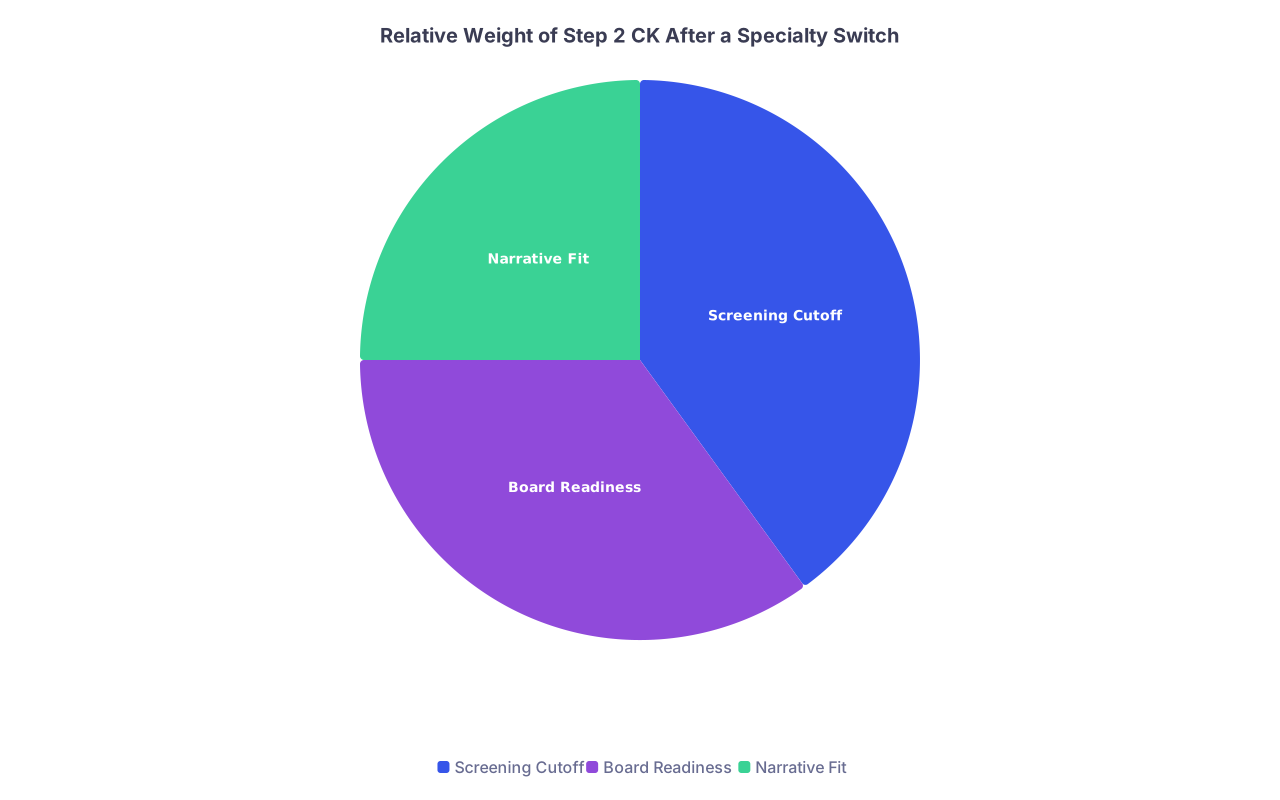
| Category | Value |
|---|---|
| Screening Cutoff | 40 |
| Board Readiness | 35 |
| Narrative Fit | 25 |
Translate your score into “risk language”
Use rough bands like this:
| Score Band | Risk Interpretation |
|---|---|
| ≥ 250 | Very low risk, can offset weak Step 1 |
| 240–249 | Low risk, solid for most non‑ultra‑competitive fields |
| 230–239 | Moderate risk, needs support from other strengths |
| 220–229 | Higher risk, need strong story + letters + fit |
| < 220 | Significant risk, require heavy mitigation and realistic targets |
You can’t change the number now. But you can:
- Control the story of that number
- Control how obvious your specialty fit looks everywhere else
- Control what “backup plan” programs assume you have
If your Step 2 is higher than Step 1, your narrative is: “I improved under clinical pressure.”
If your Step 2 is similar: “Consistent performance; I’m steady and reliable.”
If your Step 2 is lower: “I got hit; here’s why, here’s what I fixed, and here’s new evidence that I’m safe.”
Stop thinking “Is 234 enough for X specialty?” and start thinking “Given 234, how do I prove I’m safe to rank and clearly committed to this new field?”
Step 3: Decide If Your Target Specialty Is Realistic—Fast
You cannot waste another cycle on fantasy.
Use a blunt three‑part screen:
- Look at recent NRMP data for your new specialty (US MD vs DO vs IMG, average Step 2 if available, match rates).
- Compare your Step 2 and class performance to your cohort realistically.
- Factor timing: are you switching before ERAS submission, after ERAS but before interviews, or between cycles?
If your Step 2 is:
- 10–15+ points above the average matched applicant for that specialty and background: you’re in a strong enough place.
- In the same ballpark: you’re viable, but need a very clean narrative and strong non‑test metrics.
- Clearly below: you either need to pick less competitive programs (community over university, less desirable locations) or a different specialty.
Do not ask, “Is there any chance?” Ask, “Could I explain this plan with a straight face to a program director I respect?” If the answer is no, adjust.
Step 4: Rewrite Your Entire Application Around the New Specialty
The worst thing a switching applicant does is “tweak” old content. They leave Step‑1‑era interests and research all over their application and then drop a single line about “always loving radiology.” Programs see right through that.
You are not “adding” a new specialty. You are rewriting your professional story.
Personal statement: how Step 2 CK fits the pivot
You need one clean paragraph that handles your exams without sounding like a confession.
For example, if Step 2 saved you:
“Earlier in medical school, I struggled to translate my understanding into standardized exams, reflected in my Step 1 performance. During my clinical years, I adjusted how I learn—using case‑based questions, direct feedback from residents, and structured review—which is reflected in my Step 2 CK score of 241. More importantly, that shift changed how I approach clinical problems day to day, and it’s that practical, pattern‑based thinking that drew me toward neurology.”
If Step 2 is average and not your selling point, don’t obsess over it:
“My exam scores have been solidly within the passing and safe range. What has differentiated me more has been clinical performance and ownership of patient care…”
Only bring up numbers explicitly if:
- They correct a bad impression (weak Step 1 → stronger Step 2), or
- You’re using them to emphasize growth.
Otherwise, let ERAS transmit the number and focus on clinical fit.
Experiences: filter through the new specialty lens
Take every experience and ask: “How does this matter for my new field?”
Old description (for IM‑leaning student):
“Managed diabetic patients on the wards; focused on optimization of insulin regimens and discharge planning.”
Reframed for psych:
“Managed multiple patients with severe depression and co‑morbid diabetes; learned to coordinate closely with psychiatry to align medication plans and safety assessments before discharge.”
Same rotation. Different lens. You’re showing that, even before you “decided” to switch, your brain was already working like someone in the new field.
Step 5: Use Other Metrics To Carry Weight Where Step 2 Can’t
When you’re switching late, everything beyond Step 2 becomes more important than it is for someone who’s been aligned with a specialty since MS2.
Here’s what programs look at harder in a switcher:
- Clinical grades, especially in the new specialty
- Sub‑I performance and narrative comments
- Letters of recommendation from people in the new field
- Concrete specialty‑related work—research, QI, teaching, electives
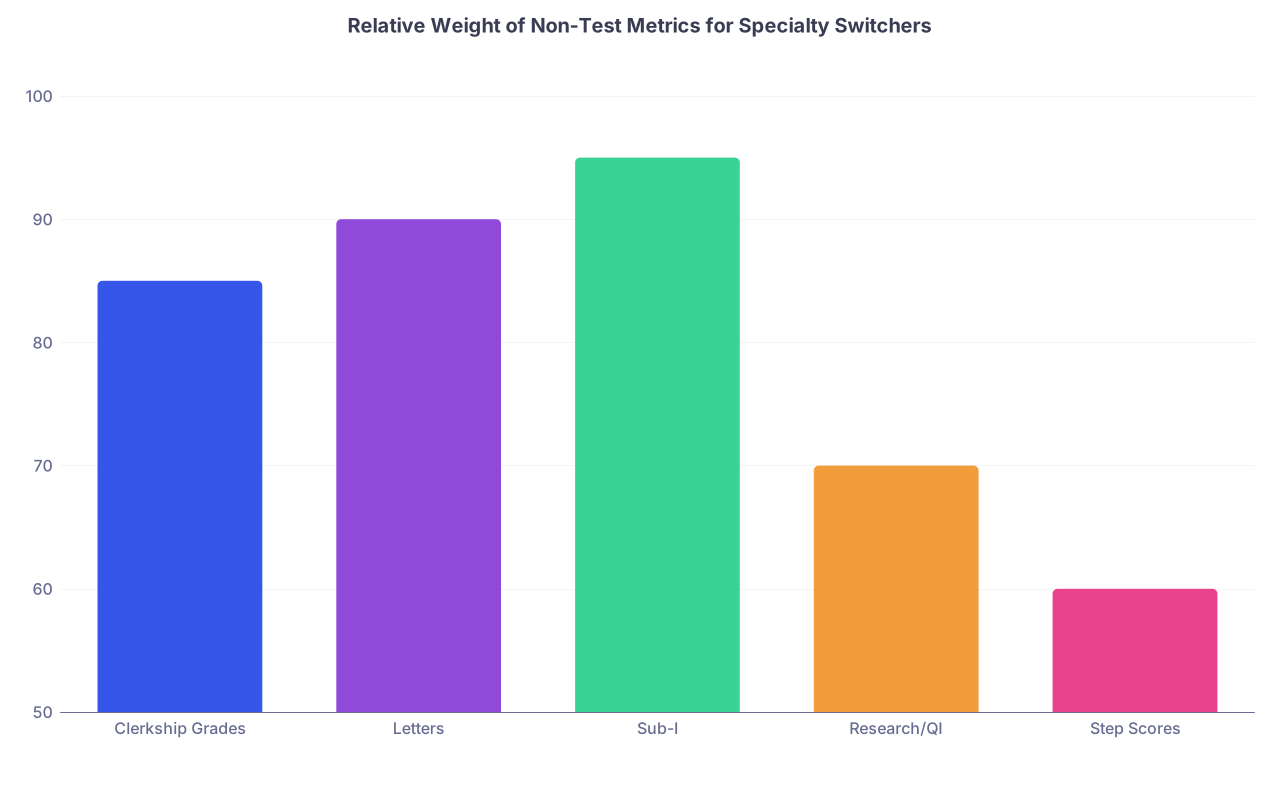
| Category | Value |
|---|---|
| Clerkship Grades | 85 |
| Letters | 90 |
| Sub-I | 95 |
| Research/QI | 70 |
| Step Scores | 60 |
These numbers are conceptual, but the point is simple: for switchers, letters and real‑world performance are often more decisive than exam scores alone.
If your Step 2 is weak, you must overcompensate in these areas
Concrete moves you can still make:
- Arrange a sub‑I or away rotation in the new specialty urgently, even if it’s short.
- Ask for at least one letter that directly mentions:
- Your clinical reasoning
- Reliability
- Evidence that you’ll pass boards
- If you have time before applications, attach yourself to a small project (chart review, QI, case report) in the new field. Even a poster accepted locally beats “nothing relevant.”
A PD once told me in the hallway: “If they’re switching to us late with a 225, their letter better say they walk on water.” Crass, but accurate. Weak Step 2? Your letters must scream, “Trust this person. I would rehire them.”
Step 6: Fix the “Why Now?” Problem Directly
Programs hate feeling like a rebound partner.
If you’re switching post‑Step 2, you need a clean, believable answer to “Why this field, and why now?”
Do not say: “I always loved [new specialty] but somehow never rotated in it until MS4.” That sounds unserious.
A better structure:
- Concrete trigger: a rotation, mentor, patient, or series of cases.
- Specific aspects of the specialty that fit your strengths (tie in Step 2 if relevant—analytical, pattern‑based, procedural, longitudinal).
- Evidence that you acted on this decision quickly and seriously (sub‑I changes, mentors, projects).
Example for switching to anesthesia:
“I had planned to pursue internal medicine and had aligned most of my early electives accordingly. During my ICU rotation, I worked closely with anesthesia residents during intubations and sedation management. I realized that the combination of physiology, acute decision‑making, and procedural work fit the way I think and the parts of medicine I enjoyed most. Over the last several months, I’ve transitioned my elective time into anesthesia, completed a sub‑I in the OR, and sought mentorship with our anesthesia program director. Those experiences have confirmed that this is not a passing interest but the right long‑term fit.”
You’re not apologizing for changing your mind. You’re showing you changed it responsibly.
Step 7: Adjust Your Application Strategy and List Like a Grown‑Up
Switching specialties late means you do not get to be picky the first time around. I’ve watched people sink two years because they refused to rank community programs in the Midwest when they pivoted to a moderately competitive field with an average Step 2.
If you’re post‑Step 2 switcher, and especially if scores are average or below, act like this:
- Apply broadly (yes, 40–80+ programs is common in many fields now).
- Do not over‑concentrate on big‑name academic places that can fill their spots with perfectly aligned, early‑deciding applicants.
- Target: university‑affiliated community programs, less popular locations, newer programs.
This is not defeatist. It is strategic. You can always subspecialize later, or move academically if you want. First job: get trained.
Step 8: If You’re Between Cycles—Use The Gap Intelligently
A lot of people reading this will be in the “I just didn’t match” category, now wondering if they should switch fields.
Your Step 2 is fixed. Your specialty target is changing. What you do this year matters more than you think.
High‑yield gap‑year options for switchers:
- A research year inside the new specialty, ideally at a place that also has a residency
- A prelim or transitional year that gives you direct contact with faculty in the new field
- A dedicated clinical position (hospitalist extender, research coordinator, etc.) that keeps you close to the new team
Your goal: stack your file with proof that you’re already functioning in or around the new specialty and that people there trust you.
Bad gap‑year choice? Generic research with no connection to the new field, or non‑clinical work that makes PDs question if your clinical skills are getting stale.
Step 9: Do Damage Control If Step 2 Went Poorly
If Step 2 is the weak link and you’re switching specialties, you have to answer three silent PD questions:
- Why was the score low?
- Why should I believe it won’t repeat on in‑training/boards?
- Why is this specialty still a reasonable fit?
You do not owe a sob story, but a short, precise explanation helps. For example:
- “I took Step 2 during a prolonged family medical crisis and underestimated its impact. Since then, I’ve completed X, Y, Z with scores/feedback showing improvement.”
- “I struggled with time management on standardized exams. I’ve since completed NBME subject exams and an in‑house in‑training‑style exam with [better performance].”
If you have any objective post‑Step 2 data (in‑service exam during a prelim year, additional NBME practice tests supervised, subject exam percentiles), mention them. Programs like trend, not just promises.
Step 10: What To Do This Week
If you’re in this situation right now, do not just “think about it.” Do this:
- Write your Step 2 stats at the top of a page (Step 1, Step 2, any other exams).
- Underneath, write: “What risk do programs see?” and answer honestly in 2–3 bullet points.
- Then list three concrete things you can do in the next 30 days to lower that perceived risk (new letter, sub‑I, project, PD meeting, reworked personal statement).
- Start with the one that requires another human being’s time (letters, rotations, meetings) because those slots disappear first.
Your Step 2 CK is not changing. But the story programs read from it absolutely can.
Open your ERAS CV or draft application today and, line by line, ask: “If I were an attending in this new specialty, would I believe this person is really one of us?” If the answer is not a clear yes, you still have work to do.