
It’s May. You did not match in March. You watched your name stay off the screen on Match Day, you went through the SOAP chaos, and now you’re sitting in front of your computer with one small but very real piece of good news: you just got a much stronger Step 2 CK score.
Step 1 was mediocre or low. Maybe you failed it once. Maybe you’re an IMG with a 218 and no attempt at Step 1 anymore means less, but you know programs saw that file and passed. You reapplied through SOAP, maybe got a couple interviews, maybe none. And somewhere in the middle of that mess, you refocused, studied hard, and your new Step 2 CK score just came back. And it’s…good. Or at least clearly better than what programs thought of you the first time.
Now you’re staring down another application season thinking:
“I have a new Step 2 CK. But my old story is still my old story. How do I rebuild this into something programs will actually buy?”
That’s the right question. Let’s tear it apart.
Step 2 CK: What Your New Score Actually Changes (and What It Doesn’t)
First thing: understand exactly what this new number can and cannot fix.
A strong Step 2 CK score can:
- Show you had an upward trend (boards are not destiny if you prove it).
- Reassure PDs you can pass specialty boards and handle clinical reasoning.
- Counteract some concerns from a weak Step 1, especially now that Step 1 is pass/fail and people lean harder on Step 2 CK.
- Push you above hard cutoffs that quietly filtered you out last year.
It does not:
- Erase prior failures or attempts.
- Magically fix zero US clinical experience, no letters, or weak clerkship narratives.
- Override massive professionalism red flags.
Programs read your application as a story. Last cycle your story might have sounded like:
“Borderline scores, limited clinical strength, not a standout. Risky.”
Your job now is to turn that into:
“Early struggle, then clear improvement and proof they can handle real clinical work. Less risk. Maybe even an asset.”
Step 2 CK is the spine of that “improvement” story. But you need the rest of the skeleton.
Get Real About Where You Stand (No Fantasy Planning)
Before you rewrite anything, you need a brutally honest snapshot of your file.
Pull up last year’s ERAS and go through it like a PD who does not know you and doesn’t care about your feelings.
Look at:
- USMLE/COMLEX:
- Step 1: pass/fail? low? failed attempt?
- Old Step 2 vs new Step 2: what’s the exact jump?
- Clinicals:
- Core clerkship grades (for AMG) or core IM/FM/other rotations (for IMG).
- Any red flags: failed rotations, remediation, gaps.
- Letters:
- How many US-based? From what level (faculty vs PD vs “Dr. Random Outpatient Preceptor”)?
- Actually strong content, or generic fluff?
- CV:
- Any gap years with nothing clinical?
- Research, QI, teaching, leadership—real responsibility or padded lines?
- Personal statement:
- Was it vague? Overly dramatic? Did it ignore your weaknesses?
Now, layer in the new Step 2 CK score.
Let’s be concrete.
| Old Step 2 | New Step 2 | Impact Tier |
|---|---|---|
| 220 | 240 | Noticeable improvement |
| 205 | 235 | Major redirection of narrative |
| 215 | 250 | Transformative for many IM/FM/psych/peds apps |
| 198 (fail) | 228 | Redemption but still a flagged file |
| 230 | 240 | Mild bump, helps but not a new story |
If your jump is 15+ points, or you moved from “questionable” to “comfortably above many programs’ cutoffs,” you have a real lever.
If your new Step 2 CK is still very low (e.g., under 220, or under 230 for competitive IM, or under 240 for competitive surgery/EM), you still can build a better story, but your strategy and target specialties need to be aligned with reality. Do not build a reapplicant strategy around fantasy competitiveness.
Rebuilding Your Story: From “Test Score Problem” to “Trajectory Story”
Your application this cycle must read like a coherent narrative arc: early struggle → insight → correction → sustained performance.
Your new Step 2 CK is your proof of “correction” and “sustained performance.”
Here’s how you build that story across all parts of the application.
1. Personal Statement: Explicitly Own and Reframe
You’re a reapplicant. PDs can see that. Trying to pretend last cycle did not happen is dumb. You do not need a confession essay, but you must show insight and growth.
You want roughly this shape:
- One or two sentences acknowledging earlier academic difficulty or inconsistency (if that’s a major part of your file).
- A clear, specific description of what changed: study approach, time management, use of mentors, clinical engagement.
- A connection between your Step 2 CK improvement and how you function clinically now: better reasoning, more structured thinking, more reliable under pressure.
- Tie this to why you’re actually a safer, stronger bet now.
Example skeleton:
Early in medical school, my performance did not reflect the physician I wanted to become. My approach to learning was passive and last-minute, and my early board performance showed that. During my clinical rotations and preparation for Step 2 CK, I rebuilt how I learn medicine—shifting to daily question-based practice, structured review with residents, and active case discussions on the wards.
The improvement in my Step 2 CK score is one measure of that change, but more important is how it has translated into my clinical work: I now walk into each patient encounter with a clear framework…
You don’t need to mention exact numbers in the statement. PDs can read the score report. Focus on the process behind the improvement.
2. MSPE/Dean’s Letter and Letters of Recommendation: Back Up the Story
If your old letters are weak or generic, replacing them is not optional.
You want at least one letter that:
- Knows you after or around the time you prepped for Step 2 CK or after you took it.
- Can say, “This person’s clinical reasoning is strong and matches their improved Step 2 CK.”
Ask for very specific language. When you request a letter, you can say (to a trusted attending or PD):
“I had earlier struggles with standardized tests, but I’ve shown significant improvement in Step 2 CK. Programs may wonder if that improvement is real and reflected in my clinical skills. If you feel comfortable, it would help me a lot if you could comment directly on my clinical reasoning and reliability, and how that fits with my recent Step 2 CK performance.”
You’re handing them the frame: Step 2 CK wasn’t a fluke. It’s visible in your day-to-day behavior.
Tactical Changes: What You Must Update in ERAS
You cannot just upload a new score and hit resubmit. Reapplicants who do that get the same result.
Here’s what needs to actually change.
Step 2 CK Section
Obvious: make sure your new score is correctly reported and released. Double-check that USMLE has sent the updated transcript to ERAS.
But also: if you have both a weak Step 1 and a new strong Step 2 CK, you should highlight the Step 2 CK improvement in your experiences section or personal statement. Don’t just hope PDs will do that math for you.
Experiences: Show That You Changed, Not Just That You Waited
If between last Match and this next ERAS cycle you did nothing but “studied and waited,” that’s a problem. You need activity—preferably clinical and US-based if you’re an IMG or had trouble matching.
Aim for at least one of these in the “gap” year:
- US clinical experience with direct patient care (sub-I, observership with real involvement, prelim/transitional PGY-1 if you got it, or a research year with clinical exposure).
- A research or QI position in your target specialty with real responsibilities (data collection, IRB work, writing, presenting).
- Teaching or tutoring roles in Step 1/Step 2 content that show mastery and consolidation.
When you describe these, connect them to the same growth arc as Step 2 CK:
“During my dedicated Step 2 CK preparation and subsequent clinical elective in internal medicine, I developed a daily habit of reviewing cases and associated questions… This approach strengthened both my exam performance and my ability to structure assessments and plans on the wards.”
You’re turning a random observership into evidence of integrated growth.
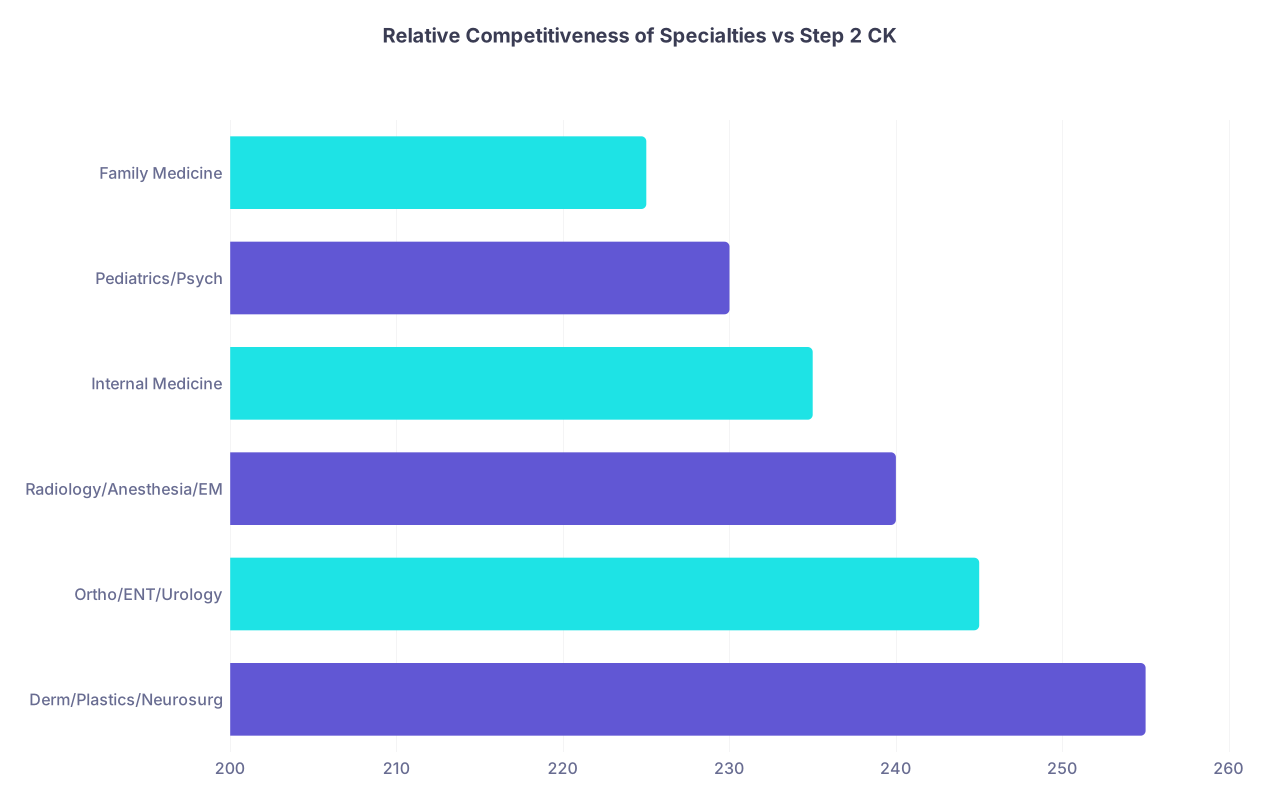
Choosing Targets: Your New Score and Your Specialty Reality
Your new Step 2 CK score might open doors. It doesn’t open all doors.
You need to recalibrate where you aim.
| Category | Value |
|---|---|
| Derm/Plastics/Neurosurg | 255 |
| Ortho/ENT/Urology | 245 |
| Radiology/Anesthesia/EM | 240 |
| Internal Medicine | 235 |
| Pediatrics/Psych | 230 |
| Family Medicine | 225 |
This isn’t precise for every program, but directionally:
- If you jumped from 215 → 250, you may now be a plausible candidate for mid-tier IM, peds, psych, anesthesia, EM (with good letters and no giant red flags).
- If you jumped from 205 → 230, you’re now a much safer target for IM/FM/peds/psych—especially community programs and university affiliates that care more about reliability than prestige.
- If you’re still below 230, aiming for Derm/rads/ortho/EM at big-name places is self-sabotage.
Also: reapplicants are already higher risk. Combining “reapplicant” with “borderline score” and “hypercompetitive specialty” is how you end up in SOAP again.
If your real goal is just to train and practice medicine in the US, stop chasing a fantasy specialty that no longer fits your record. I’ve watched people lose 2–3 years of their lives refusing to pivot. Programs notice that lack of insight.
Communicating as a Reapplicant: How and When to Bring Up the New Score
PDs will see your new Step 2 CK automatically. But many will also remember your old file or see that you’re a reapplicant in their spreadsheet. You want to control that narrative.
On ERAS
There’s no “I’m a reapplicant” checkbox you can narrate, but you can:
- Mention “after last Match cycle” or “over the past application year” in 1–2 experience descriptions.
- Frame your time since not matching as purposeful: clinical work, exam improvement, maturity. Not “I just waited and hoped.”
On Email to Programs
For some programs—especially ones where you got interviews last cycle or where you have a real connection—you can send a short, professional email after ERAS opens and your new score is in.
Something like:
Dear Dr. [PD],
I applied to [Program] last cycle and valued the opportunity to interview/learn more about your program. Since then, I have worked to strengthen my application, including significantly improving my Step 2 CK performance (from [old] to [new]). I also [briefly: completed X clinical role, Y research, Z USCE].
I remain very interested in [Program] because [one specific reason, not a template line]. Thank you for your time and consideration this cycle.
Sincerely,
[Name], [AAMC ID]
Keep it short. No apologizing for last year. No paragraphs of justification.
On Interview Day
If they ask about your exam history or being a reapplicant, don’t spin. Answer like this:
- Acknowledge fact.
- State what you changed.
- Tie to how it helps you be a better resident.
Example:
“Yes, I’m a reapplicant. My earlier standardized test performance, including Step 1, was not as strong as I wanted. Before Step 2 CK, I overhauled how I studied—more question-based learning, scheduled review, and integrating cases from my rotations. That led to a significant improvement in my Step 2 CK score, but also in how I approach patient care. I’m now much more structured in how I gather data and form assessments, which I think will make me a more efficient and reliable intern.”
Direct. No drama. Shows insight.
Specialty-Specific Angles: How Step 2 CK Plays Differently
Step 2 CK matters differently depending on where you’re applying.
Internal Medicine / Pediatrics / Family Medicine
Step 2 CK is a big deal here, especially with Step 1 now pass/fail. A strong improvement can significantly change how you’re perceived.
You should:
- Explicitly highlight your clinical reasoning growth.
- Get letters from inpatient rotations that confirm your reliability and thought process.
- Emphasize continuity, follow-up, and patient ownership in your experiences.
Psychiatry
Psych PDs care about Step 2 CK, but they care just as much about:
- Communication skills.
- Maturity, empathy, professionalism.
- Reliability (no-shows, poor documentation, etc. are death).
Use your Step 2 CK improvement as evidence that you can handle the cognitive side, then reinforce with narratives showing you’re stable and trustworthy with vulnerable patients.
EM / Surgery / Anesthesia
These are more competitive, and a new Step 2 CK can help but will not carry you alone.
You need:
- Strong letters that specifically comment on work ethic, ability to function under pressure, and teamwork.
- Ideally, a sub-I or away rotation after your Step 2 CK that shows your current level.
If you’re still below many programs’ averages, consider whether a pivot is smarter than banging your head against closed doors again.
Avoiding Common Reapplicant Landmines (Even with a Better Score)
I’ve watched reapplicants sabotage themselves with the same predictable mistakes, even after a big Step 2 turnaround.
Don’t:
- Reuse your exact personal statement from last year with one new sentence.
- Fail to significantly change your letters and experiences—even if that means aggressively seeking new rotations or roles.
- Apply to the same overly competitive list “just in case” because your ego can’t handle a more realistic strategy.
- Ignore your geographic reality. If you’re an IMG with visa needs and limited USCE, you cannot act like you’re in the same bucket as a US grad willing to go anywhere.
Do:
- Increase the number of programs you apply to if you were under-applying before (within financial limits).
- Prioritize programs that historically take IMGs, reapplicants, or have larger class sizes (they can absorb “risk” more easily).
- Be relentlessly consistent in your story across platforms: ERAS, emails, interviews, even your LinkedIn if you use it.
Using Your New Step 2 CK to Guide This Year (Not Just Your Application)
One last angle people miss: your Step 2 CK improvement is not only marketing material. It’s a blueprint of what actually works for you academically.
You improved because you changed how you:
- Organized time.
- Processed information.
- Handled pressure.
- Sought feedback.
Residency is just a nonstop Step 2 CK environment with human beings attached. The same systems that got you from 210 → 240 will keep you afloat as an intern.
Make those systems explicit:
- What daily habits did you adopt during Step 2 CK prep?
- How did you break down complex topics?
- How did you handle days when you felt behind or overwhelmed?
Write those down somewhere. Use them as your resident survival plan.

| Step | Description |
|---|---|
| Step 1 | New Step 2 CK Score |
| Step 2 | Honest File Review |
| Step 3 | Rebuild Narrative |
| Step 4 | Reassess Specialty Targets |
| Step 5 | Update PS and Letters |
| Step 6 | Add New Clinical or Research Experiences |
| Step 7 | Realistic Program List |
| Step 8 | Targeted Communication as Reapplicant |
| Step 9 | Interview Preparation with Clear Story |
| Step 10 | Score Improved Significantly |
What You Should Do Today
Not “sometime soon.” Today.
Open your ERAS personal statement from last year and do this:
Highlight every sentence that could have been written before you took Step 2 CK.
Now, force yourself to write one new paragraph that connects your improved Step 2 CK score to specific, concrete changes in how you learn and how you work with patients. Not vague “I worked harder.” Actual process.
That paragraph is the anchor of your new application story. Build the rest around it.