
A high Step 2 CK score is wasted if you treat it like a trophy instead of a battering ram.
You’re in one of the strangest positions in the match game:
Your Step 2 CK is strong — 250s, maybe 260s. But your home program either doesn’t exist in your specialty, is tiny and uninterested, or just flat-out won’t support you with aways, phone calls, or a real push.
Everyone loves telling you “Step 2 CK matters.”
You need to know: how do I weaponize this score to break into other programs when my home base isn’t backing me?
Let me walk you through exactly what to do.
1. Get Clear: What Your High Step 2 CK Actually Buys You
A high Step 2 CK with no home support is not a golden ticket. It’s more like TSA PreCheck: you still have to go through security, but your line is shorter.
Here’s what that score usually does for you:
- Gets you past automated filters and quick screens.
- Forces programs to at least look at the rest of your application.
- Offsets some weaknesses: average school, limited research, weaker Step 1.
- Makes you attractive for interview numbers — not necessarily at the top 5, but solid mid-high tier.
Here’s what it does not do by itself:
- It doesn’t replace a chair’s phone call.
- It doesn’t erase bad clinical evals or failed rotations.
- It doesn’t guarantee ranking at programs that care a lot about “fit” or “regional ties.”
So you need to use your score in a very targeted way:
- As a door-opener in regions where you have zero ties.
- As leverage to justify aways or research at stronger outside institutions.
- As proof in emails and networking that you can perform at a high level clinically.
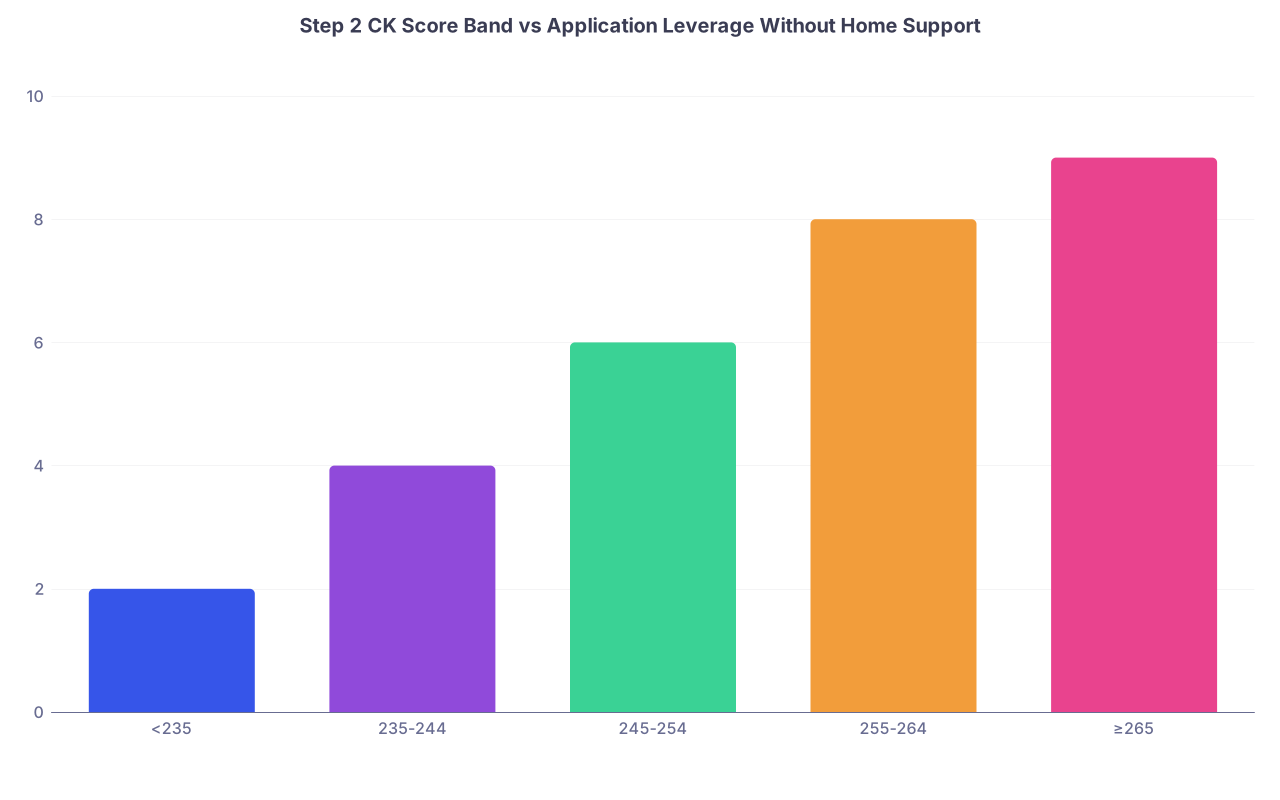
To keep expectations sane, here’s roughly how different Step 2 CK bands shift your leverage when you lack home support:
| Category | Value |
|---|---|
| <235 | 2 |
| 235-244 | 4 |
| 245-254 | 6 |
| 255-264 | 8 |
| ≥265 | 9 |
(Think of 1–10 as “how much your score alone can pull weight for you” when nobody at home is pushing you.)
2. Diagnose Your Exact Situation Before You Move
You’re not just “no home support.” There are flavors of this problem, and the fix depends on which one you’re in.
Common scenarios
No home program in your target specialty
Example: You attend a community-based MD or DO school with no derm, neuro, ENT, or rad onc residency.Home program exists but is cold or indifferent
Classic version:
“Yeah, you can rotate with us, but we don’t really send emails or make calls,”
or,
“We mostly match our own students; outside advocacy is not our thing.”Home program exists but is actively discouraging you
Subtle or not-so-subtle:
“This specialty is probably too competitive for you,”
“We don’t think you’re a good fit here,”
or just plain gatekeeping.Osteopathic or Caribbean student with high Step 2 but no academic home base
Solid score, but your institution’s name makes programs hesitant.
Here’s a quick reality grid:
| Situation Type | How Much Step 2 Helps | Main Workaround |
|---|---|---|
| No home program at all | High | Aways + networking + research |
| Home program but indifferent | Medium-High | External mentors + aways |
| Home program discouraging you | Medium | New advocates outside institution |
| DO/IMG with strong Step 2 | Medium | Volume strategy + targeted emails |
You need to be brutally honest about which column you’re in. That determines how aggressive you must be with away rotations, emails, and networking.
3. Build a Strategy Around Your Score: Not Just “Apply Broadly”
Randomly submitting 80 applications because you have a 255 is not a plan. It’s panic.
Step 1: Choose the right tier to target
Rough ballpark when you don’t have strong institutional backing (assume average clinical evals, no red flags):
- 230–239 – Focus heavily on community and low-mid academic programs, mostly in regions where you have any tie you can plausibly claim.
- 240–249 – Solid shot at a wide range of academic programs outside the very top tier; still anchor your list with community programs.
- 250–259 – Now you can realistically take swings at higher academic programs, including in regions you have no ties to, if your story is consistent.
- 260+ – You’re in “we at least need to look at this application” territory at nearly any program, especially if the rest of your file isn't a mess.
If you’re ≥250 and unsupported, you should resist the temptation to be “top-heavy only.” Your lack of home backing still makes you vulnerable. You need both:
- Aspirational programs (reach and mid-high tier)
- Stable floor programs (community, lower-mid academic, safety regions)
Step 2: Decide how many programs to apply to
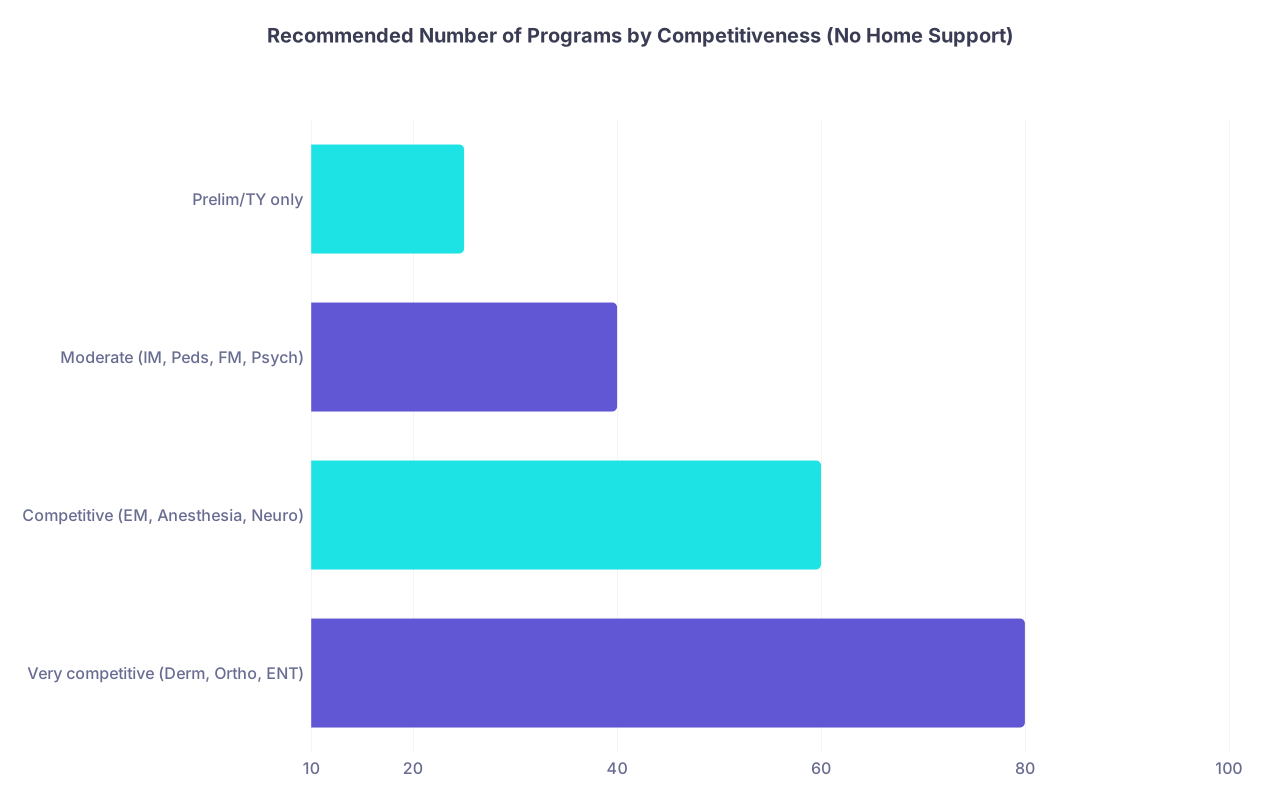
Here’s how I’d think if you’re trying to break into a competitive or mid-competitive specialty without home help:
| Category | Value |
|---|---|
| Very competitive (Derm, Ortho, ENT) | 80 |
| Competitive (EM, Anesthesia, Neuro) | 60 |
| Moderate (IM, Peds, FM, Psych) | 40 |
| Prelim/TY only | 25 |
These are starting points, not commandments. But lowballing the number of programs because “my Step 2 is great” is how people end up unmatched.
Step 3: Align your story around your score
Program directors aren’t just thinking “big number good.” They’re thinking:
- “Does this score match the rest of what I see?”
- “Is there a reason this person has to leave their home institution?”
- “If I bring them for an interview, what are the odds they can actually function at this level?”
Your story has to explain three things:
- Why you want this specialty
- Why you’re moving away from your home base
- Why your high Step 2 CK makes you a good bet
You’ll bake that into your personal statement, any supplemental questions, and your emails. We’ll come back to this.
4. Use Aways and Rotations Like Your Life Depends on Them (Because It Might)
If you have no home support, aways are your proxy home program. They’re your audition, your letters, your “someone vouches for me.”
How many aways, realistically?
- Competitive specialties: 2–3 aways is normal, sometimes 4 if you can swing it without tanking your sanity or wallet.
- Less competitive: 1–2 aways can still be huge if your home program is useless.
Where to apply for aways
Do not just chase brand names. Chase places where:
- Your Step 2 CK will stand out relative to their norms.
- They have a history of taking outside students seriously.
- They aren’t completely saturated with their own medical school’s students.
For example, a 257 at a mid-tier academic IM program in a non-coastal city might pop more than the same score at a top-10 coastal powerhouse that already has 20 home rotators.
This is where your score becomes a tool: in your VSLO application or emails, you make it obvious:
- “USMLE Step 2 CK: 258 (top percentile)”
- Short explanation of why you’re seeking outside exposure (no home program, or limited home opportunities).
On the away itself
Your mentality on away rotations should be:
- Show up early.
- Do the scut without whining.
- Ask for feedback once, early, and then implement it fast.
- Be the student where attendings say, “That kid’s sharp and low-maintenance.”
You’re not there to impress with raw intelligence alone. You’re there to make someone willing to say, “We should interview this one.”
5. Letters of Recommendation: Manufacturing Support When Home Won’t Help
You cannot change your home program’s culture. You can, however, outgrow it by collecting advocates elsewhere.
Priority list for letters when you lack home backing:
Away rotation letters in your target specialty
Gold. Especially if written by a program director or well-known faculty at a program that actually interviews outside rotators.Home letters from individuals (not the program as a whole)
Even if the residency department is cold, a well-respected faculty member who writes,
“Despite lack of structured support in our system for this specialty, I strongly endorse this student,”
is powerful.Research mentor letters in the specialty or a closely related field
Strong if they can speak to your work ethic, follow-through, and how your performance matches your Step 2 score.Backup specialty or medicine sub-I letters
These won’t carry as much weight as a big-name specialty letter, but they help confirm: this person functions well on the wards.
Avoid letters that are generic or from random outpatient preceptors unless they know you extremely well and are enthusiastic.
6. Email Strategy: When and How to Bring Up Your Score
You should not spam programs with “Hi, I got a 260, please look at me.” That reads desperate and tone-deaf.
But you should use your score strategically:
1) When asking for an away rotation
Brief email to the rotation coordinator or student director if there’s any flexibility outside VSLO:
- 3–5 sentences
- Who you are (school, year)
- Your Step 2 CK (if strong)
- Why their program/region specifically
- Mention lack of home program or limited exposure in your specialty
Example skeleton:
I’m a fourth-year at [School], interested in [Specialty]. I scored a [Step 2 CK score], and our institution doesn’t have a [Specialty] residency, so I’m seeking strong external training and mentorship. Your program’s strengths in [X/Y] and the patient population in [Region] align closely with my interests. If there’s possibility for a rotation in [Month], I’d be grateful for consideration.
Short. Clear. Not groveling.
2) Pre-ERAS “on their radar” emails (selectively)
For 5–15 programs you really care about and that are realistically within reach with your score, you can send a short, targeted note to the program coordinator or APD around the time ERAS opens:
- One paragraph, max two
- Mention your Step 2 score once, not twice
- Connect your story: no home program/support → seeking strong external training → why their program fits
You’re not asking for an interview. You’re posting a small flag that makes them more likely to pause when they see your name.
3) Post-interview or pre-rank communications
You do not need to re-state your Step 2 every time. They know. At that stage, Step 2 has already done its filter work. Focus on fit and genuine interest.
7. Personal Statement and Application: Turn “No Home Support” Into a Coherent Narrative
You can’t whine in your personal statement about lack of home support. That looks bad fast. But you can frame your situation.
Key moves:
Acknowledge, don’t complain
Short line in the PS or experiences:
“Our institution does not have a [specialty] residency, so I sought exposure and mentorship through research and away rotations at [X/Y].”Connect your Step 2 CK to clinical performance
Don’t say, “I’m smart.” Say something closer to:
“My performance on Step 2 CK reflects the same attention to detail and disciplined preparation I bring to patient care.”Show initiative
You want the reader to think:
“This person created opportunities in a system that didn’t offer them by default.”
Make sure your ERAS experiences, PS, and letters all tell the same story:
Student in a limited or unsupportive environment → performed at a high level (Step 2, clinicals) → proactively built external experiences.
8. Specialty-Specific Realities: Where High Step 2 Helps More (and Less)
Some specialties worship Step 2 more than others. Some care a lot more about home advocacy.
Very rough breakdown when you’re lacking home support:
| Specialty Type | Step 2 Power | Home Support Importance |
|---|---|---|
| Derm, Ortho, ENT, Plastics | Medium | Very High |
| Radiology, Anesthesia, Neuro | High | Medium |
| EM (post-SLOE era), Gen Surg | Medium-High | High |
| IM, Peds, Psych, FM | High | Medium |
Translation:
- For super competitive fields: Step 2 gets you looked at, but connections and research still rule. You must hustle for aways and mentors.
- For mid-competitive (anesthesia, rads, neuro): a 250+ without home backing can still go far with good letters and smart program selection.
- For core fields (IM, peds, psych, FM): a high Step 2 can almost single-handedly drag you into strong academic places despite weak home support, if you don’t torpedo yourself with poor interviewing or strange behavior.
9. Common Mistakes High-Scorers With No Home Support Make
I’ve watched this play out too many times:
Overweighting prestige
Applying to mostly top-20 programs “because my score fits,” while ignoring strong mid-tier and community programs that would actually love them.Underusing aways
Assuming “my score speaks for itself,” so they skip or minimize away rotations, then wonder why no one knows them.Radio silence
Never reaching out to programs where they’re genuinely interested. No away. No email. Nothing. Then shocked they blend into the 1,000-applicant pile.Disorganized narrative
Personal statement says one thing, experiences say something else, letters are generic. No one can tell what they’re about or why they’re leaving home.Arrogance vibes
Subtle stuff: bragging about score casually on rotation, dismissing lower-resourced programs, acting like any program would be “lucky” to have them. That kills momentum faster than a low Step score.
You’re already in a slightly uphill situation without home support. Don’t add ankle weights.
10. Concrete Action Plan: Next 4–6 Months
Let’s get very tactical. If you’re about to apply or are in the middle of the season, this is the general move-set:

| Step | Description |
|---|---|
| Step 1 | High Step 2 CK Score |
| Step 2 | Target aways at mid-high academic |
| Step 3 | Find individual mentors |
| Step 4 | Secure 2-3 strong letters |
| Step 5 | Build realistic program list |
| Step 6 | Send targeted emails to key programs |
| Step 7 | Interview prep and practice |
| Step 8 | Rank list with solid safety net |
| Step 9 | Home program? |
And in words:
- Lock in aways (if not done): prioritize programs where your Step 2 stands out and that actually interview their rotators.
- Identify 2–3 letter writers who truly know you and can write enthusiastic letters that align with your “I had to build my own path” story.
- Draft a focused personal statement that explains your trajectory without complaining.
- Build a tiered program list: some reach, many realistic, some safe. Don’t anchor on prestige alone.
- Send 10–20 targeted emails total to programs you care about and are plausible with your stats. Include score once if it helps.
- Prep hard for interviews; a high Step 2 has raised expectations. You’re no longer “pleasant surprise” category — you’re “prove you’re not just a test taker.”
FAQ (Exactly 5 Questions)
1. Should I put my Step 2 CK score in the body of cold emails to programs?
Yes, but sparingly and only if it’s clearly an asset (roughly ≥245 in most fields, higher in very competitive ones). One mention is enough: “I scored a 256 on Step 2 CK.” If your score is already visible in ERAS and not especially standout for that specialty, you do not need to highlight it in emails.
2. How do I explain having no home program or support without sounding bitter?
Use neutral, factual language. For example: “Our school does not have a [specialty] residency, so I sought clinical exposure and mentorship through away rotations at X and Y.” Or, “Opportunities in [specialty] at my home institution are limited, which motivated me to seek external rotations.” Do not call out specific people or complain about politics. Programs smell drama and run the other way.
3. I have a strong Step 2 but weak Step 1 or a fail — does that still help if I lack home support?
Yes, it still helps a lot. Many programs now lean heavily on Step 2 CK, especially since Step 1 went pass/fail. Your job is to make the narrative: early stumble, then clear upward trajectory. Strong clerkship grades, solid letters, and a mature explanation in interviews matter even more in that situation, but the high Step 2 absolutely still opens doors.
4. Is it a mistake to do an away at a “reach” program where I might be outgunned?
It depends. If your Step 2 is high for that program and your clinical skills are solid, a “reach” away can pay off. But if the program is ultra-elite and packed with home rotators and research powerhouses, you risk being the bottom of a very strong group, which can backfire. Usually, choosing a solid mid-high program where you can realistically be near the top of the student pack is smarter than chasing the biggest name on the list.
5. How many interviews do I need to feel safe without strong home support?
For most core specialties (IM, peds, psych, FM), 12–15 interviews puts you in a pretty safe zone statistically. For more competitive specialties, the comfortable number is often higher, and many applicants also carry a backup specialty. Because you lack home advocacy, you should aim to slightly overshoot the average for your specialty rather than skate by on the bare minimum.
Key points:
Use your high Step 2 CK as a tool, not decoration — it buys you second looks and leverage for aways and emails, but it doesn’t replace human advocates.
When your home program won’t or can’t support you, manufacture your own support through aways, strong letters, and a coherent, initiative-driven story.
Stop chasing prestige alone; combine smart program selection with targeted outreach, and your score can carry you much farther than your home institution ever planned to.