
The panic you feel seeing a low Step 2 CK score after you already submitted ERAS is real—but blowing up your application out of fear is how people tank their cycle.
You’re not ruined. But you also do not have room for sloppy decisions now.
Let’s walk through exactly what to do, step by step, if you’re in this spot.
1. First: Define “Low Step 2 CK” For Your Situation
Before you decide anything, you need a reality-based definition of “low,” not a Reddit definition.
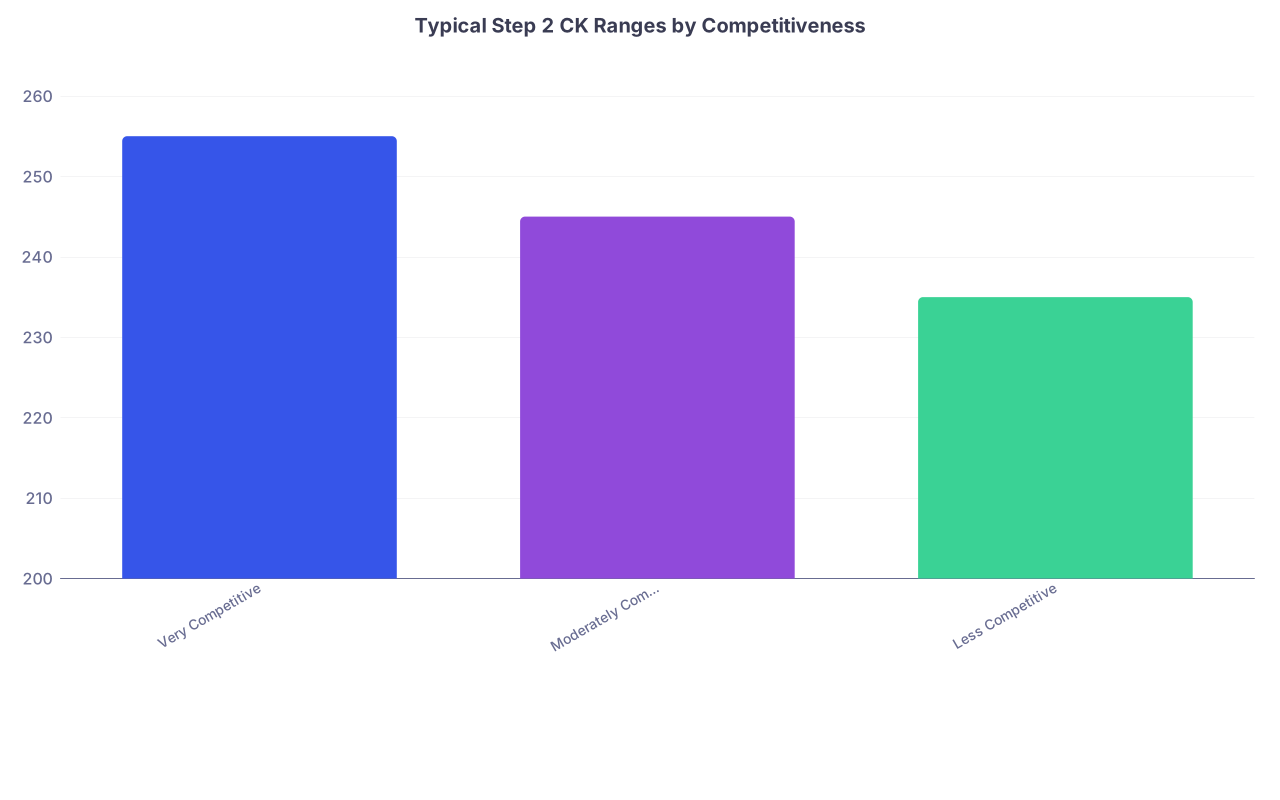
| Category | Value |
|---|---|
| Very Competitive | 255 |
| Moderately Competitive | 245 |
| Less Competitive | 235 |
Here’s the rough truth I’ve seen play out over multiple cycles:
| Specialty Tier | Approx "Comfortable" Range | Often Considered Concerning* |
|---|---|---|
| Ortho, Derm, Plastics, ENT, NSurg | ≥ 250 | < 240 |
| EM, Gen Surg, Anes, Rads, Ortho-lite | ≥ 245 | < 235 |
| IM (academic), OB/GYN | ≥ 240 | < 230 |
| IM (community), Peds, Neuro, Psych | ≥ 230 | < 220 |
| FM, PM&R, Path, less competitive | ≥ 225 | < 215 |
*Concerning doesn’t mean “hopeless.” It means “you now need to be strategic.”
Also, context matters:
- If Step 1 was low and Step 2 is higher → your score may actually help.
- If Step 1 was solid and Step 2 is a big drop → some PDs will worry.
- If you failed an earlier exam → bar is higher for Step 2.
So your first move is not emailing programs. It’s this:
Write down:
- Step 1: ____ (or Pass)
- Step 2 CK: ____
- Specialty you’re applying to
- Type of programs: academic vs community
Ask: “Am I:
- Below common filters?
- In the gray zone?
- Just lower than I hoped but still reasonable?”
You have to know which battlefield you’re actually on.
2. Stop The Bleeding: Immediate Do’s and Don’ts
This is the “do not make it worse” section.
Do NOT:
Do not mass-email 80 programs with a dramatic explanation.
- That reads as needy and unfiltered.
- You want targeted communication, not emotional broadcasting.
Do not withdraw your application from ERAS impulsively.
- I’ve seen people panic-withdraw from entire specialties they could have matched into.
- You can adjust your strategy without burning the whole thing down.
Do not send a long personal statement-style essay explaining your score.
- PDs don’t have time.
- Over-explaining can make the score a bigger issue than it already is.
DO:
- Be brutally honest with yourself about competitiveness.
- Decide quickly if you need:
- More programs
- Backup specialty
- Targeted communication to select PDs
- Clean up everything else in your application:
- Fix any obvious PS issues (typos, weird tone) if you’re still editing for new programs.
- Make sure your experiences are clear, specific, and not bloated.
- Confirm all LoRs are in and labeled correctly.
Your score is now a liability. That means every other part of your file has to pull more weight.
3. Adjusting Strategy By Scenario
Let’s get specific. Here’s how I’d handle this depending on your lane.

Scenario A: You’re Going For A Very Competitive Specialty
Think derm, ortho, plastics, ENT, neurosurgery, integrated vascular, etc.
And now your Step 2 CK is, say, 232.
What this usually means:
- A lot of high-tier academic programs won’t even see your app because of filters.
- Your best chances (if any) will be:
- Home program (if strong support)
- Places where you rotated and crushed it
- Lower-tier or community programs (if they exist for your specialty)
Your moves:
Talk to your department leadership. Today.
- Chair or PD or student advisor in that specialty.
- Ask them bluntly: “Given this score and my file, do you believe I have a realistic shot this year? And if so, at what types of programs?”
- Ask if they’re willing to pick up the phone or email specific PDs for you.
Strongly consider a parallel or backup plan.
- IM, prelim surgery, transitional year, etc. depending on specialty.
- If you’re ortho with a 232 and no insane research portfolio:
- A solid IM or TY backup is not cowardice; it’s maturity.
- Apply to that backup now, not in December.
Be selective about outreach.
- Target: programs where you rotated, your home program, places with known holistic review.
- Message content:
- Brief.
- Own the score.
- Highlight your strengths: letters, research, clinical performance.
- Example script later—we’ll get there.
Load up on interviews if they come.
- For a low Step 2 in a competitive specialty, every invite is gold.
- You don’t “hold out” for dream places; you bank interviews.
If you get zero traction by late October, you and your advisor should have a real conversation about whether to:
- Expand backup specialty programs
- Take a research year (more common in derm/ortho/etc.)
- Regroup and reapply stronger
Scenario B: Mid-Competitive Specialty, Middle-Low Score
Say you’re applying EM, anesthesia, radiology, OB/GYN, academic IM, and your Step 2 CK is ~225–230.
You’re not dead. But you’re no longer autopilot.
Your priorities:
Expand your program list intelligently.
- Add more:
- Community programs
- “Mid-tier” academic programs
- Places in less desirable locations (geographically or lifestyle-wise)
- Stay away from top-heavy lists. If half your programs are big names, fix that.
- Add more:
Use your school’s advising office hard.
- Ask for:
- A score-context meeting
- Specialty-specific program list guidance
- Honest feedback: “Do I have enough safety programs?”
- Ask for:
Selective outreach is optional but can help.
- If you have unique ties (family, grew up nearby, SO there), a short email to PD can be reasonable.
- Keep it professional; no pleading.
Double down on interview performance and updates.
- If you’re strong clinically:
- Ask for updated MSPE comments or narrative evaluations to highlight strength.
- Prepare an airtight, calm 30-second explanation for your score (for interviews).
- If you’re strong clinically:
Your main mission: make sure you are not under-applying to realistic places just because you were initially optimistic.
Scenario C: Less Competitive Specialty, Low but Passing Score
Say FM with a 215. PM&R with a 220. Psych with a 218.
You can absolutely still match. I’ve watched it happen over and over.
But you cannot:
- Only apply to coastal academic centers in major cities.
- Assume your personality will “carry you” if no one interviews you.
Your moves:
Check your program mix.
- You need:
- Community-heavy lists
- Some rural or less-popular geographic locations
- A few safer programs where your school has historically matched
- You need:
Make everything else in your app scream “safe, dependable resident.”
- Strong clinical comments: “hardworking,” “reliable,” “team player.”
- Letters from people who will emphatically vouch for you.
- Personal statement that’s clear, coherent, and not full of clichés.
Consider targeted outreach only where you have a real connection:
- Hometown program
- Place you rotated
- Program where an attending knows the PD
Here, your Step 2 is not a total door-closer. It just means you have less margin for overreaching.
4. Should You Email Programs About Your Score?
People mess this up constantly.

| Step | Description |
|---|---|
| Step 1 | Low Step 2 After ERAS |
| Step 2 | Targeted PD Emails With Advisor Support |
| Step 3 | Focus On Backup And Broader List |
| Step 4 | No Mass Emails, Let Application Stand |
| Step 5 | Very Competitive Specialty? |
| Step 6 | Strong Home or Rotation Support? |
| Step 7 | Strong Connection To Specific Program? |
Good reasons to email:
- You have a strong existing connection:
- Rotated there and got great feedback
- Your home program
- A mentor knows the PD personally and told you to reach out
- You have new positive data:
- New strong letter uploaded
- New publication accepted
- Updated class rank/Honors, etc.
Bad reasons:
- You’re just scared and want reassurance.
- You want to “explain” test anxiety, breakup, illness, etc. in detail.
- You think mass-emailing will “show interest.”
How to do it if you decide to:
Keep it lean. Something like:
Subject: Application Update – [Your Name], [Specialty]
Dear Dr. [PD Last Name],
I hope you are well. I recently submitted my ERAS application to [Program Name] for [Specialty]. I wanted to briefly acknowledge that my Step 2 CK score (*** ) is below the typical range for many applicants.
On our core clerkships I’ve consistently performed at a high level, including [Honors in IM and Surgery / strong narrative feedback]. My letters from [Dr. X, Dr. Y] speak to my clinical judgment, work ethic, and ability to function well on the team.
I’m particularly interested in [Program Name] because of [specific, genuine reason]. If my application is still under consideration, I’d be grateful for the opportunity to interview and represent my abilities in person.
Thank you for your time and consideration.
Sincerely,
[Your Name]
AAMC ID: [#######]
Notice what this does:
- Owns the score plainly.
- Redirects focus to strengths.
- Doesn’t overshare or beg.
If you can, coordinate with a mentor: “If I email Dr. X at [Program], would you be willing to follow up with a quick note?” A PD hearing your name twice is more powerful than your one email.
5. How To Talk About A Low Step 2 In Interviews
You absolutely need a practiced, boring answer to, “Can you tell me about your Step scores?”
Boring is good. You want this to feel like a non-event.
Here’s the structure:
- Acknowledge plainly.
- Briefly explain context (if real and relevant).
- Show what changed or what you learned.
- Pivot to your demonstrated strengths.
Example:
“You’re right, my Step 2 CK score is lower than I would have liked. I didn’t perform at my best on that exam. Around that time I was juggling [brief context if appropriate: family issue, personal health, or simply poor planning], and I underestimated how much structured practice I needed.
Since then, my clinical evaluations and sub-internship show a much more accurate picture of my capabilities. I’ve consistently been described as reliable, prepared, and strong clinically. On my [IM sub-I], for example, I was functioning essentially at an intern level by the end of the month.
So I view that score as a data point, but not the defining one. Day-to-day patient care is where I’m strongest, and that’s what I’m excited to bring to residency.”
Key mistakes to avoid:
- Blaming everyone else (school, exam, proctor).
- Crying or emotionally unraveling while explaining.
- Over-explaining test anxiety unless you can show it’s been addressed.
You’re not trying to “win” this question. You’re trying not to bleed out from it.
6. Expanding Your Program List: How Many And Where
If your Step 2 CK came in lower than expected after you submitted ERAS, you may need to add more programs.
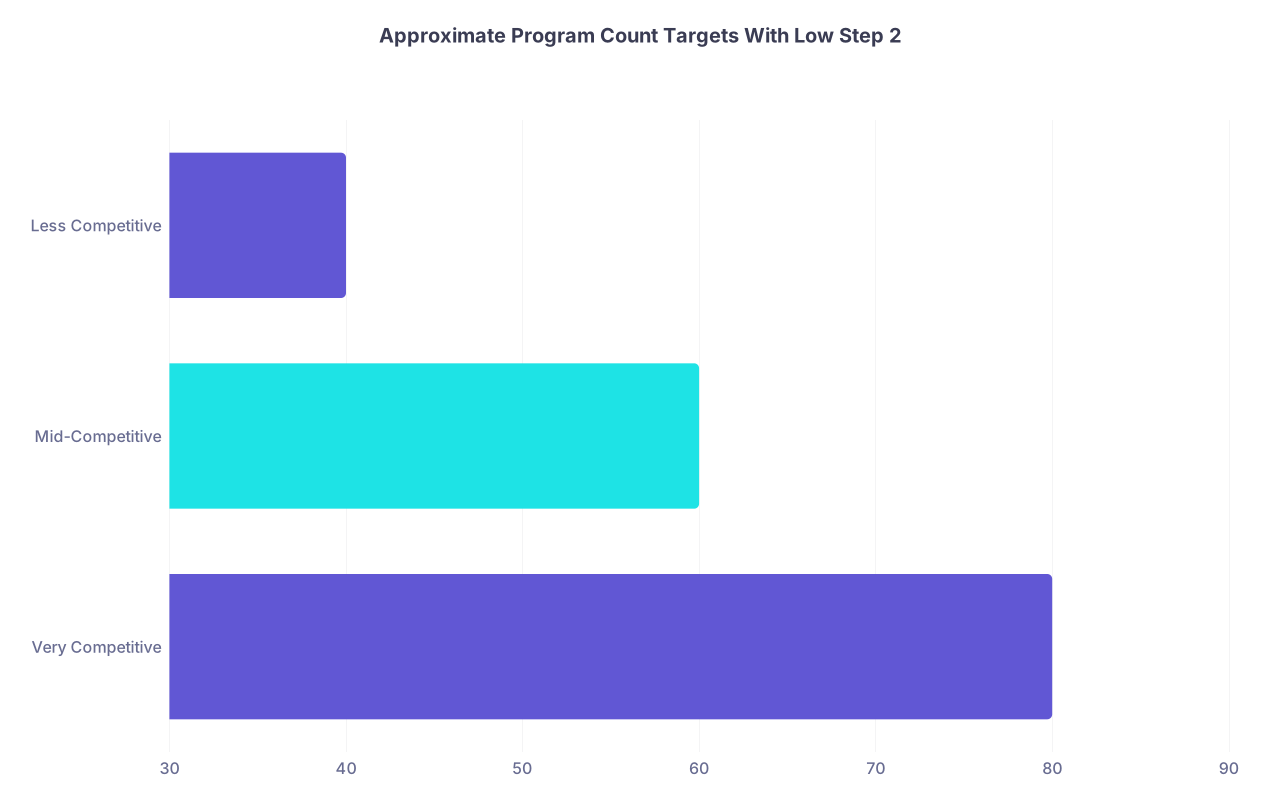
| Category | Value |
|---|---|
| Very Competitive | 80 |
| Mid-Competitive | 60 |
| Less Competitive | 40 |
Rough ranges I’ve seen work for people with lower Step 2:
- Very competitive specialty:
- 70–100+ total (including backup/parallel if you’re serious about matching this year)
- Mid-competitive:
- 50–70, with a heavy community and mid-tier presence
- Less competitive:
- 35–50, but skewed to realistic places
Also:
- Look at places your school historically matches with lower or average scores.
- Don’t chase only city-name prestige. Programs in smaller cities or less “cool” locations often care more about fit and reliability than raw score.
7. If You Also Have Red Flags (Repeats, Fails, LOA)
Low Step 2 plus:
- Failed Step 1, or
- Remediated courses, or
- LOA for non-medical reasons
…you’re playing on hard mode. Not impossible mode, but hard mode.
Your priorities:
Consistency of the story.
- Whatever you say in your personal statement, advisor letter, and interviews must match.
- One clean, honest narrative is better than five partially overlapping half-truths.
Documented improvement.
- Shelf exams trending up.
- Strong later clerkships.
- Recent success in high-intensity rotations (ICU, Sub-I, EM month, etc.).
Mentor/PD advocacy.
- For applicants with real red flags, I’ve seen one strong phone call from a respected PD rescue an application that otherwise would have been auto-screened out.
Be realistic on geography and prestige.
- Coastals and big-name academic centers are often not where these applications match.
- Think: community, midwestern, southern programs, smaller cities.
8. Mental Game: Not Letting This Tank Your Whole Season
The other way applicants sabotage themselves is psychological. They decide they’re already doomed and then interview like it.
Here’s what you control now:
- How quickly and rationally you adjust your program list.
- Whether your emails are calm and professional, or frantic and oversharing.
- How well you prepare for interviews.
- Whether you show up to rotations and interviews like a beaten dog or like a future colleague.

You don’t need to pretend your score doesn’t matter. It does. But it’s one part of the picture, and you still get to influence how the rest of the picture looks.
Talk to:
- Your dean’s office.
- Specialty advisors.
- A couple of residents who matched with similar scores (your school knows who they are; ask).
Do not:
- Spend six hours a day on Reddit r/medicalschool to “research outcomes.”
- Spiral comparing yourself to the one person in your class who scored 270 and matched MGH Derm.
Use your limited energy for things that change your trajectory: applications, emails, interview prep, clinical performance.
9. Example Timeline: Next 2–4 Weeks After Seeing a Low Score
To make this concrete:
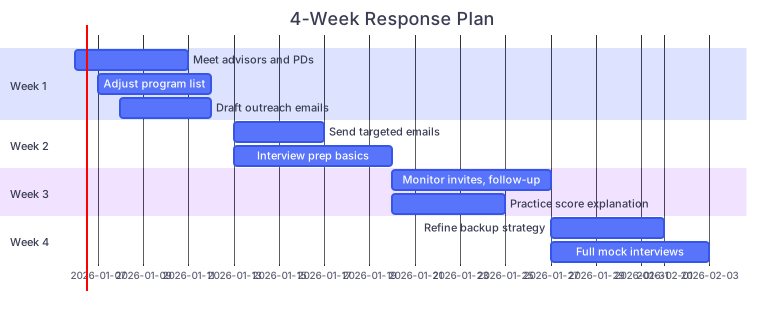
| Task | Details |
|---|---|
| Week 1: Meet advisors and PDs | a1, 2026-01-06, 5d |
| Week 1: Adjust program list | a2, 2026-01-07, 5d |
| Week 1: Draft outreach emails | a3, 2026-01-08, 4d |
| Week 2: Send targeted emails | b1, 2026-01-13, 4d |
| Week 2: Interview prep basics | b2, 2026-01-13, 7d |
| Week 3: Monitor invites, follow-up | c1, 2026-01-20, 7d |
| Week 3: Practice score explanation | c2, 2026-01-20, 5d |
| Week 4: Refine backup strategy | d1, 2026-01-27, 5d |
| Week 4: Full mock interviews | d2, 2026-01-27, 7d |
If you handle those four weeks intentionally instead of emotionally, you’ll be in a far better spot by the time interviews are in full swing.
FAQ (Exactly 4 Questions)
1. Should I delay releasing my Step 2 CK score to programs if it’s low?
If ERAS is already submitted and your score is back, holding it usually does more harm than good. Many programs now require Step 2 CK for ranking or even for offering interviews. If you hide it and then drop a low score in December, some programs will feel blindsided and may quietly move on. The only time I’d consider delay is if you’re still waiting on a retake or there’s an ongoing appeal—but that’s rare and needs advisor input.
2. Is it worth re-taking Step 2 CK during application season to “fix” a low score?
Usually no. A retake is only possible if you failed. If you passed but scored low, repeating is not an option. What you can do is strengthen other parts of your profile (sub-I performance, letters, research, interview skills) and adjust your program strategy. If you truly bombed (fail), then a strong pass on the second attempt plus a convincing narrative about what changed can still get you matched, especially in less competitive fields.
3. Will a strong Step 3 score later “erase” a low Step 2 CK?
Not really, especially not for the current Match cycle. Programs make interview and rank decisions long before your Step 3 result appears. A good Step 3 can help within residency (for fellowship applications or PD reassurance), but it doesn’t undo Step 2 CK in PDs’ eyes for this application year. Plan as if Step 2 CK is the test that matters for this cycle—because it is.
4. If I do not match this year, is a low Step 2 CK a permanent anchor on future applications?
It’s a fixed part of your record, yes, but not an automatic life sentence. I’ve seen reapplicants with low Step 2 CK match on the second attempt because they used their “gap” year smartly: strong research in their field, glowing letters from respected faculty, sometimes switching to a more realistic specialty. The score will always be there; your job is to build such a compelling recent track record that it becomes one data point, not the defining summary of your potential.
You cannot rewrite your Step 2 CK score. But you absolutely can decide whether this moment becomes the start of a disciplined, smart response—or the beginning of a panic spiral.
You’ve already submitted ERAS. The foundation is laid. Now comes the part where you adjust, communicate strategically, and show programs who you are beyond a three-digit number. Handle this phase well, and you’ll give yourself the best possible shot at making it to Match Day with a spot. What you do once you actually get there—interviews, rank list gamesmanship—that’s the next chapter.