Navigating U.S. visas as a Caribbean international medical graduate (IMG) entering internal medicine residency can feel like learning a second language while also preparing for the Match. The rules are technical, the stakes are high, and misinformation is common—especially on social media and student forums.
This guide breaks down visa navigation for residency for Caribbean IMGs in Internal Medicine, with a particular lens toward Caribbean medical school residency pathways and issues commonly faced by graduates of schools like SGU, Ross, AUC, Saba, and others. It is written for you if you’re:
- A Caribbean IMG applying to internal medicine
- Worried about J-1 vs H-1B, the IM match, and long‑term plans
- Unsure which programs or states favor which visa types
- Trying to align your visa strategy with a successful SGU residency match or similar
Understanding the U.S. Visa Landscape for Caribbean IMGs
Before choosing programs or finalizing your rank list, you need a clear mental map of key IMG visa options. For residency training, almost all Caribbean IMGs will use one of two visas:
- J-1 (Exchange Visitor for Graduate Medical Education)
- H-1B (Temporary Worker in Specialty Occupation)
Other categories (like F-1 OPT, O-1, green card holders, or U.S. citizens) exist, but they’re less common or apply mainly after you’ve already trained or changed status.
Why Visa Planning Matters for Internal Medicine
Internal medicine has many attractive pathways—hospitalist work, subspecialty fellowships, academic careers—but the visa you choose can:
- Affect where you can train (some programs are J‑1 only; a few are H‑1B friendly; some don’t sponsor at all)
- Shape your post-residency options, especially if you later want fellowship or academic jobs
- Influence how you handle the IM match strategy, especially order of ranking and backup plans
- Determine your timeline for long‑term U.S. immigration (green card, citizenship, or return home)
For Caribbean IMGs without U.S. citizenship or permanent residency, the default expectation is often a J-1 visa through ECFMG. H‑1B is possible but more restrictive and competitive.
The J-1 Visa for Internal Medicine Residency
The J-1 visa for physicians is specifically designed for graduate medical education (GME) and is administered by ECFMG as the visa sponsor. Most Caribbean IMGs in internal medicine residency train on J‑1s.
Core Features of the J-1 for IMGs
- Purpose: Graduate medical education (residency and fellowship)
- Sponsor: ECFMG (not your individual program—ECFMG manages the visa aspect)
- Max duration: Up to 7 years total of clinical training (residency + fellowship)
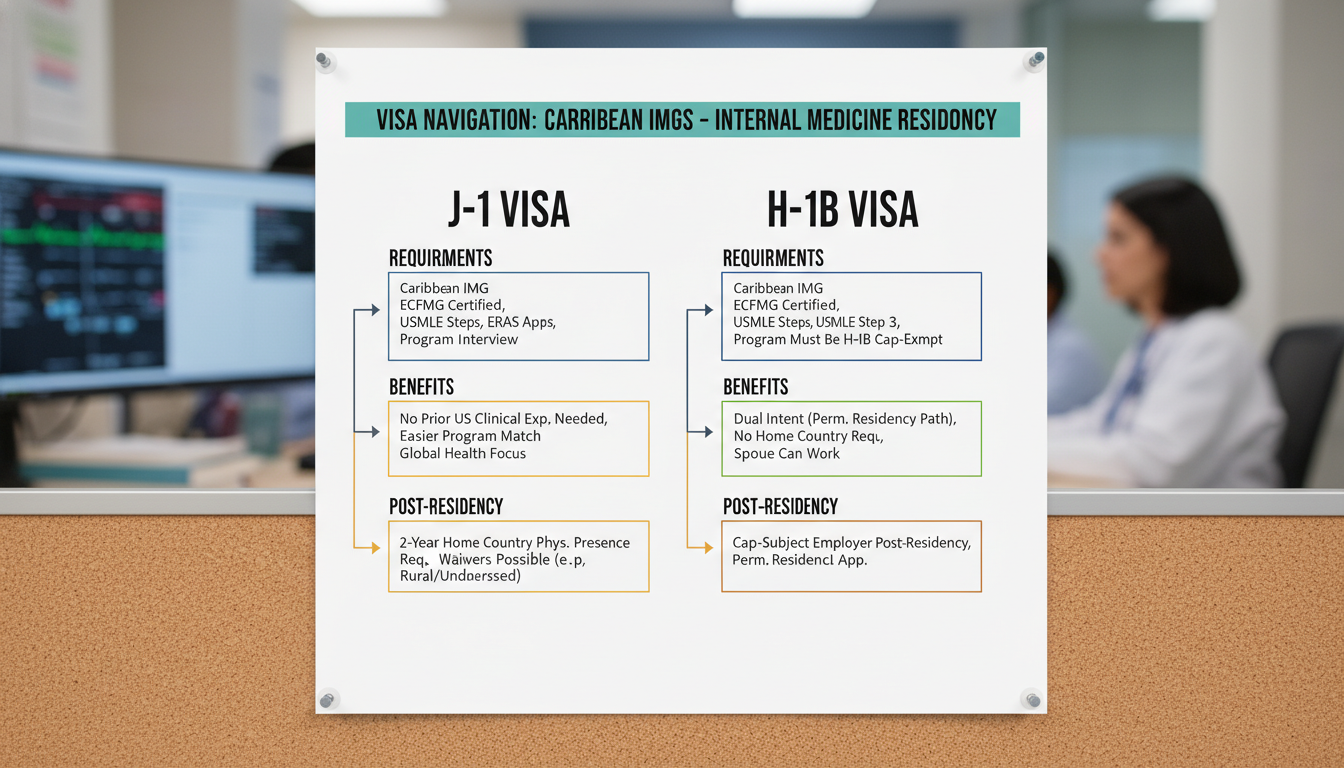
- Key restriction: After finishing, you usually face a two-year home country physical presence requirement (the “2-year rule”)
The 2-year rule is the most important concept to understand. Once you complete your J‑1 training, you must either:
- Return to your passport or permanent residence country for at least 2 years in total, or
- Obtain a J‑1 waiver (most commonly through serving in a U.S. medically underserved area), or
- Use certain narrow exceptions (e.g., hardship or persecution waivers—rare and hard to win)
Basic J-1 Eligibility for Caribbean IMGs
To qualify for a J‑1 for internal medicine residency, you will generally need:
- Valid ECFMG certification (Step 1 + Step 2 CK + English proficiency if required, and primary source verification complete)
- A signed residency contract or appointment letter from an ACGME-accredited internal medicine program
- Proof of adequate financial support (usually your residency salary is sufficient)
- No prior J‑1 status violations or major immigration issues
- A passport valid long enough to cover your training period
Most Caribbean schools (including “big four” like SGU, Ross, AUC, Saba) are well understood by ECFMG and U.S. programs. As long as your school is recognized and you meet ECFMG requirements, your school itself isn’t usually a barrier to a J‑1.
Advantages of J-1 for the IM Match
- Widely accepted: A large majority of internal medicine residency programs that accept IMGs are J‑1 friendly
- Streamlined process: ECFMG has a standardized system; most programs are familiar with the steps
- Fellowship continuity: Most fellowship programs (cardiology, GI, critical care, etc.) are comfortable sponsoring J‑1s for further training
- No need for separate employer-based H‑1B petition: Reduces administrative and legal obstacles during tight onboarding timelines
For many Caribbean IMGs, the J‑1 is the most realistic and reliable path to entering a U.S. internal medicine residency.
Limitations and Risks of the J-1
- Two-year home requirement:
- You must either leave the U.S. for two years or secure a J‑1 waiver.
- Without a waiver, you cannot change to H‑1B or obtain a green card from within the U.S.
- J-1 waiver job constraints:
- Most waivers require you to work in a medically underserved or rural area for 3 years.
- Job location and type may be more limited initially.
- Dependent limitations (J‑2):
- Your spouse may have some work authorization options, but school and work logistics for family need planning.
- Strict adherence requirements:
- Gaps in training, part-time work, research-only positions, or moonlighting require careful compliance with rules.
The H-1B Visa for Internal Medicine Residency
The H-1B visa is an employment-based visa for “specialty occupations” requiring a bachelor’s degree or higher. For physicians, this includes clinically focused roles like internal medicine residents—provided certain conditions are met.
Core Features of H-1B for IMGs
- Purpose: Employment in a specialty occupation (here: residency as a physician)
- Sponsor: Your residency program (employer), which must file a petition with USCIS
- Typical duration limits: Up to 6 years total (with limited exceptions/extensions)
- No automatic two-year home requirement:
- You are not subject to the “J‑1 2-year rule” if you never held a J‑1 physician visa.
However, H‑1B for residency comes with important nuances:
- Most residency salaries do meet the prevailing wage requirements, but some program HR departments worry about this.
- Legal fees and paperwork can be significant; some programs are unwilling to take this on.
- You must have passed USMLE Step 3 (or COMLEX Level 3 for DOs) and usually need results before H‑1B petition filing.
H-1B Eligibility Specific to Caribbean IMGs
To qualify for an H‑1B as an internal medicine resident:
- ECFMG certification must be complete.
- You must have passed USMLE Step 3 (this is critical—without it, H‑1B is usually not an option).
- Your employer (the IM program) must be willing to
- File the H‑1B petition,
- Pay or handle legal fees and filing fees as required, and
- Demonstrate that your salary meets prevailing wage requirements.
- You must meet any state medical licensure or training permit requirements that intersect with H‑1B filing.
Many Caribbean IMGs aiming for H‑1B take Step 3 early (before Match or at least before starting residency) specifically to be competitive for H‑1B-friendly IM programs.
Advantages of H-1B for Internal Medicine Residents
- No J-1 2-year home requirement:
- You can more easily transition to green card sponsorship after residency or fellowship.
- More flexible post-residency options:
- You can immediately take a hospitalist job or pursue an employer-sponsored green card without needing a waiver job first.
- Attractive for long-term U.S. stay:
- If your goal is to stay in the U.S. permanently, H‑1B may streamline that path.
For Caribbean medical school graduates thinking strategically about long-term practice in the U.S., H‑1B can be appealing—but it is not universally available.
Limitations and Challenges of the H-1B
- Fewer programs offer it:
- Many community internal medicine programs are J‑1 only or “dependent students” only.
- Some academic centers may be H‑1B friendly, but competition is higher.
- Step 3 timing pressure:
- You must fit Step 3 into an already packed schedule (clinical rotations, CK, OET/English testing, residency applications).
- Administrative and cost barriers:
- Some programs avoid H‑1B due to filing costs, HR workload, or institutional policies.
- Time limit constraints:
- A 3-year IM residency plus 3–4 year fellowship can exceed standard H‑1B duration, requiring careful immigration planning.
J-1 vs H-1B: Choosing the Right Visa Strategy for an IM Match
The J-1 vs H-1B decision is not only about preferences; it’s shaped by your profile, timeline, program list, and long-term goals. As a Caribbean IMG, you must balance realism and strategy.
Factors to Consider When Comparing J-1 vs H-1B
Your Academic Profile & Competitiveness
- Higher USMLE scores, strong letters, and strong research may make you more competitive for academic programs that are open to H‑1B.
- If your profile is mid-range, limiting yourself to H‑1B-only programs can drastically reduce your chances of matching.
Timing of Step 3
- If you haven’t taken or passed Step 3 before Match application season, H‑1B becomes unlikely for your first PGY‑1 year.
- Many programs require Step 3 results in hand well before they file H‑1B petitions.
Family and Long-Term Immigration Goals
- If you are determined to stay long-term in the U.S. and want the shortest path to a green card, H‑1B offers more direct pathways.
- If you’re open to serving in underserved areas for a few years and potentially returning home later, J‑1 + waiver could work well.
Fellowship Aspirations
- J‑1 status is common in fellowships (cardiology, GI, heme/onc, etc.), and ECFMG allows up to 7 years total.
- If planning multiple fellowships (e.g., IM → cardiology → interventional cardiology), think through total training years and visa continuity.
Practical Strategy for the IM Match as a Caribbean IMG
Scenario A: You already passed Step 3 and are a strong applicant
- Apply broadly to internal medicine programs, including both J‑1 and H‑1B friendly institutions.
- Ask programs during or after interviews (politely) about H‑1B possibilities.
- Rank programs based on a combination of training quality, visa flexibility, and personal fit—not just H‑1B availability.
Scenario B: You haven’t taken Step 3 yet or are unsure about your competitiveness
- Assume J‑1 will be your primary pathway.
- Focus on maximizing your overall application: USMLE scores, clinical performance, U.S. letters, and clear personal statement.
- After matching on J‑1, consider taking Step 3 early PGY‑1 to keep options open for future transitions (e.g., J‑1 waiver, later H‑1B if you qualify after waiver).
Scenario C: You absolutely must avoid the J‑1 2-year rule
- You must realistically accept that this will sharply reduce your interview pool, especially as a Caribbean IMG.
- Focus on:
- Strong academic centers that explicitly state H‑1B sponsorship
- Programs with a history of sponsoring H‑1Bs for past IMGs
- This approach is high risk: be prepared with a well-thought-out backup plan (prelim year, research, or even reapplying).

Aligning Visa Strategy with Program Selection and the IM Match
Your choice of programs—and how you research them—directly affects your visa outcomes. As a Caribbean IMG, you must be deliberate about building your list with realistic visa possibilities.
Step 1: Research Program Visa Policies Early
When exploring internal medicine programs (especially for Caribbean medical school residency paths such as SGU residency match outcomes), systematically track:
- Does the program sponsor visas?
- Some explicitly state: “We do not sponsor visas.” If so, you should not apply as a non-U.S. citizen IMG.
- Which visas are accepted?
- “J‑1 only”
- “J‑1 and H‑1B considered”
- “J‑1 only, but may sponsor H‑1B for exceptional cases”
- What have they done historically?
- Ask current residents (especially other Caribbean IMGs) how the program handled their visas.
- Check program websites, FREIDA, and alumni networks.
Make a simple spreadsheet with columns for:
- Program name
- Location
- IMG friendliness
- J‑1 accepted? (Yes/No)
- H‑1B accepted? (Yes/No/Case-by-case)
- Number of Caribbean IMGs in current residents/fellows
- Notes from emails or interviews about visa preferences
Step 2: Communicating About Visa During Interviews
Many Caribbean IMGs are anxious about asking visa questions; they worry it might hurt their chance. The key is timing and tone:
- Avoid leading with visa questions as your first topic.
- Ask once you’ve established interest in training, curriculum, and resident life.
- Good ways to phrase it:
- “Could you share how your program has handled visa sponsorship for IMGs in recent years?”
- “Do you typically sponsor J‑1, H‑1B, or both for incoming residents?”
If you are hoping for H‑1B and already passed Step 3, you can gently signal that:
- “I have passed Step 3 and would be very interested in programs that are able to consider H‑1B sponsorship. Is that something your institution supports for categorical internal medicine residents?”
Step 3: Ranking Strategy with J-1 vs H-1B in Mind
When ranking programs:
- Never rank a non-visa sponsoring program above one that will sponsor you, no matter how much you like the location or curriculum.
- Consider a tiered approach:
- Top ranks: Strong training + clear visa support (J‑1 or H‑1B)
- Middle ranks: Good training, J‑1 only but supportive of future waivers
- Lower ranks: Acceptable programs that still give you a viable visa path
Remember: Matching on J‑1 at a solid internal medicine residency is far better than not matching while holding out for H‑1B. Without a match, there is no visa.
Life After Residency: Waivers, Green Cards, and Long-Term Planning
Visa navigation doesn’t end when you secure your IM match. Your post-residency years—especially for those on J‑1—require advanced planning.
If You Trained on J-1: J-1 Waivers and Next Steps
To stay in the U.S. without fulfilling the two‑year home requirement, most Caribbean IMGs pursue a J‑1 waiver job:
Find a qualifying job:
- Typically in a Health Professional Shortage Area (HPSA) or Medically Underserved Area (MUA).
- Many positions are in rural or semi-rural internal medicine hospitalist or outpatient roles.
Common waiver routes:
- Conrad 30 Waiver Program (state-sponsored; each state can sponsor up to 30 waivers/year, often primary care and IM-focused).
- VA facilities (federal institutions sometimes exempt from certain location requirements).
- Other federal waiver programs (ARC, DRA, etc., depending on geography).
Service requirement:
- Usually 3 years full-time in the designated underserved setting.
Transition to H‑1B or other status:
- Your waiver job will often sponsor you on an H‑1B, allowing you to then start or continue the green card process.
If You Trained on H-1B: Post-Residency Flexibility
Caribbean IMGs who complete internal medicine residency on H‑1B have:
- More immediate ability to take a non-waiver job anywhere in the U.S. (subject to licensure and standard H‑1B rules).
- Potential to begin green card sponsorship (PERM + I‑140) using their employer from early on.
- The option to do fellowship on either H‑1B (if institution supports it) or in some cases transition to J‑1 (though that’s less common and should be carefully assessed with an immigration lawyer).
However, watch your H‑1B time limit:
- Example: 3 years of IM + 3 years of cardiology = 6 years.
- If green card processing is delayed, you may run into the H‑1B max. Planning and legal guidance are important.
When to Consult an Immigration Lawyer
While many Caribbean IMGs successfully navigate residency visas with just program GME and ECFMG, you should strongly consider a qualified immigration attorney if:
- You have prior visa denials or status violations.
- You’ve held multiple visa types and are unsure about two-year home requirement implications.
- You are transitioning from J‑1 + waiver to green card and want to optimize your approach.
- You are on H‑1B and approaching your 6‑year limit.
Your program will sometimes provide legal support for H‑1B and waiver processes, but remember: their lawyer represents the institution, not you personally. For complex or long-term strategic issues, individual counsel is valuable.
FAQs: Visa Navigation for Caribbean IMGs in Internal Medicine
1. As a Caribbean IMG (e.g., SGU graduate), am I at a disadvantage for residency visas compared to other IMGs?
Not generally for visas alone. Caribbean medical school residency applicants (including those from SGU, Ross, AUC, Saba) are very common in U.S. IM programs. Programs are used to sponsoring J‑1s for these graduates. You may compete with a larger number of peers from similar schools, but your visa category (J‑1 or H‑1B) is rarely decided by your medical school alone. It depends more on:
- Program policy
- Your Step scores and clinical performance
- Whether you’ve passed Step 3 (for H‑1B)
- Overall competitiveness of your application
2. Is it realistic to aim for an H-1B as a Caribbean IMG in internal medicine?
Yes, but with caveats. It is realistic only if:
- You pass Step 3 early, ideally before or shortly after applying.
- You apply to programs known to sponsor H‑1Bs for IMGs.
- Your overall profile is strong enough to compete at those programs.
Many Caribbean IMGs still match on J‑1, even with Step 3, because many internal medicine programs simply prefer J‑1 sponsorship. Use H‑1B as a bonus opportunity, not your only door.
3. How does my visa choice affect internal medicine fellowship options later (cardiology, GI, etc.)?
- On J‑1:
- Most fellowships sponsor J‑1 trainees through ECFMG, and the 7-year limit usually covers IM + one fellowship.
- You remain under the two-year home requirement until you later secure a J‑1 waiver.
- On H‑1B:
- Some fellowships sponsor H‑1B; others only accept J‑1.
- You must track your total H‑1B time used.
In both cases, your clinical performance, research, and letters matter far more for fellowship selection than your visa—though visa policy can tilt program choices.
4. I’m worried about the J-1 two-year rule. Should I avoid J-1 completely?
Not necessarily. Many Caribbean IMGs build successful U.S. careers using the J‑1 → J‑1 waiver job → H‑1B → green card path. Avoiding J‑1 entirely can sharply reduce your chance of matching at all, especially as a Caribbean IMG in internal medicine. Instead of avoiding J‑1, focus on:
- Understanding waiver options and underserved job markets
- Networking with senior IMGs who completed the J‑1 waiver route
- Planning your career timeline (residency → fellowship → waiver job) early
In most cases, matching into a solid IM residency—even on J‑1—is the most important first step. Once you’re in training, you’ll have more information, more mentorship, and more leverage to plan your long-term immigration journey.
By approaching visas as an integrated part of your internal medicine residency strategy, rather than a separate stressor, you can make informed decisions that balance realism and aspiration. As a Caribbean IMG, your path may be complex—but it is absolutely navigable with early planning, accurate information, and the right support.