

Understanding the Visa Landscape for Caribbean IMGs in Medical Genetics
Caribbean graduates aiming for a medical genetics residency in the United States face a dual challenge: excelling in the residency match and successfully navigating immigration and visa requirements. For an aspiring medical geneticist trained at a Caribbean medical school, residency visa strategy is not an afterthought—it is central to your entire residency planning.
As a Caribbean IMG (including those from schools like St. George’s University, Ross, AUA, Saba, AUC, etc.), you likely already know that some programs are cautious about IMG visa options. In a relatively small specialty like medical genetics, those constraints can feel even tighter. But with the right planning, you can absolutely create a viable pathway to a successful genetics match and long-term career in genomic medicine.
This guide focuses specifically on visa navigation for residency for Caribbean IMGs targeting medical genetics. It will walk you through:
- How medical genetics training is structured in the US
- Practical differences between J-1 vs H-1B visas
- How to research and prioritize programs that are IMG- and visa-friendly
- Strategies to align your CV, specialty choice, and visa plans
- Long-term immigration considerations for your genetics career
Throughout, you’ll see references to the Caribbean medical school residency context and examples relevant to SGU residency match patterns and similar schools.
1. Medical Genetics Residency Pathways and Why Visa Strategy Matters
1.1. How Medical Genetics Training Works in the US
“Medical genetics” can mean several related training pathways. For Caribbean IMGs, the most relevant are:
Combined Pediatrics–Medical Genetics (Peds/Genetics)
- Typically 4–5 years
- Leads to board eligibility in both Pediatrics and Medical Genetics and Genomics
- Many positions are at major academic centers (which often sponsor J‑1; H‑1B varies)
Combined Internal Medicine–Medical Genetics (IM/Genetics)
- Typically 4–5 years
- Board eligibility in Internal Medicine and Medical Genetics and Genomics
- Often university-based, similar visa dynamics as Peds/Genetics
Post-residency Medical Genetics Fellowship (2 years)
- After a primary residency (e.g., Pediatrics, Internal Medicine, OB/Gyn, or other relevant specialties)
- Fellowship positions often use the J‑1 research/clinical training framework or extend existing H‑1B sponsorship
For a Caribbean IMG in medical genetics, the question is not only “Can I match into genetics?” but “Can I obtain and maintain the appropriate visa at every training stage?”
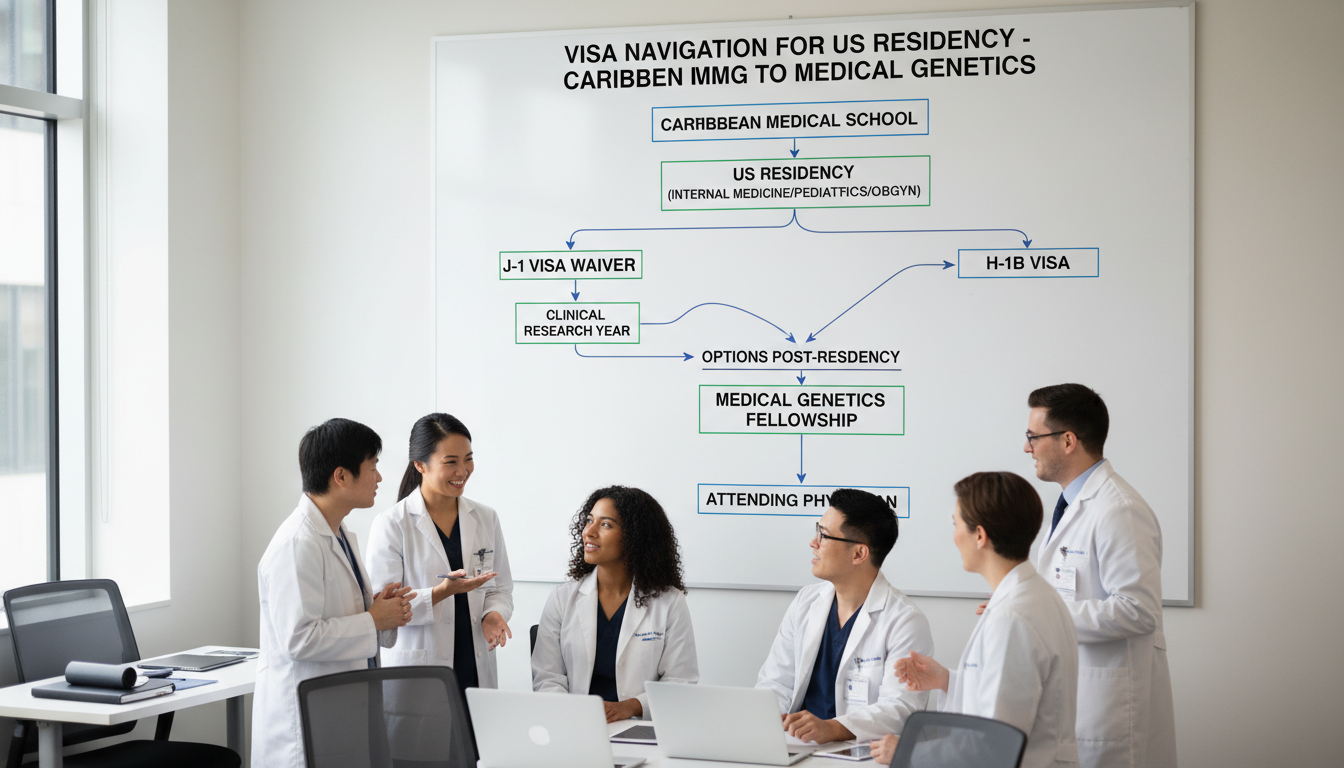
Common routes:
- Route A: Primary residency + genetics fellowship
- Example: Pediatrics residency (J‑1) → J‑1 medical genetics fellowship → J‑1 waiver job
- Route B: Combined residency (IM/Genetics or Peds/Genetics) from the start
- Example: Match into a 4-year IM/Genetics program on J‑1 → waiver → practice
- Route C: H‑1B pathway
- Example: H‑1B IM residency → H‑1B medical genetics fellowship → employer-sponsored H‑1B or green card
Your choice of residency visa (J-1 vs H-1B) will determine which of these is realistic for you.
1.2. Why Genetics as a Specialty Has Unique Visa Dynamics
Medical genetics is a small, subspecialized, academic-heavy field:
- Fewer programs and positions than high-volume specialties
- Many programs are embedded in major academic centers (university hospitals, children’s hospitals)
- NIH-funded or academic institutions often default to J‑1 sponsorship, especially for fellowship-level training
- Some programs explicitly prefer or limit to J‑1 for clinical trainees for compliance/administrative reasons
For Caribbean graduates, including those in the SGU residency match pipeline, this usually means:
- J‑1 is widely accepted in genetics programs
- H‑1B may be possible but is less common and often limited to candidates with very strong profiles or specific institutional needs
- Long-term planning for waivers or permanent residency is essential if you plan to stay in the US
2. J‑1 vs H‑1B for Caribbean IMGs: Pros, Cons, and Practical Realities
Understanding J-1 vs H-1B is fundamental to your planning as a Caribbean IMG aiming for a genetics match.
2.1. J‑1 Visa for Residency (ECFMG-Sponsored)
The J‑1 physician visa is designed for graduate medical education (GME):
- Sponsored by ECFMG (Educational Commission for Foreign Medical Graduates)
- Applies to residency and fellowship training
- Requires return to home country or last permanent residence for 2 years after completion, unless you obtain a J‑1 waiver
Advantages:
- Widely accepted: Most university and academic hospitals sponsor J‑1
- Straightforward processing: Standardized ECFMG process
- Generally easier to obtain for first-time trainees, including Caribbean medical school residency applicants
Disadvantages:
- Two-year home residency requirement affects your long-term plans
- Requires a J‑1 waiver (e.g., Conrad 30 or other federal waivers) if you want to remain in the US to practice
- Usually cannot convert directly to H‑1B or green card without addressing the 2-year requirement
For medical genetics specifically:
- Many genetics fellowships explicitly sponsor J‑1 and expect fellows to use this route
- If your initial pediatrics or internal medicine residency is on J‑1, continuing into a genetics fellowship on J‑1 is usually seamless
- You must, however, think early about J‑1 waiver jobs that can accommodate a genetics-focused practice or that recognize your genetics skill set
2.2. H‑1B for Residency
The H‑1B is a temporary work visa for specialty occupations:
- Sponsored directly by the employing institution (hospital/university)
- Requires passing USMLE Steps 1, 2 CK, and 3 before H‑1B petition filing
- Typically granted in three-year increments, up to six years (with some exceptions)
Advantages:
- No automatic two-year home return requirement
- More direct pathway to employer-sponsored green card during or right after training
- May simplify later transitions into non-academic or industry roles in genetics
Disadvantages:
- Not all residency programs sponsor H‑1B (many explicitly do not)
- Passing Step 3 early is mandatory for H‑1B; this can be difficult for Caribbean IMGs managing clinicals and exams
- Cap issues may arise (though many universities and teaching hospitals are cap-exempt)
In medical genetics:
- Fewer programs are willing to sponsor H‑1B for combined genetics residencies or genetics fellowships, particularly given funding structures
- You may be more likely to secure H‑1B for a primary IM or Pediatrics residency, and then negotiate continuation for a genetics fellowship at the same or related institution
2.3. How to Choose Between J‑1 and H‑1B as a Caribbean IMG
Your choice will depend on:
Goals after training
- Want flexibility to work anywhere in the US and possibly seek academic/industry roles? H‑1B is attractive.
- Comfortable with J‑1 waiver in an underserved area and possible return to home region after some years? J‑1 can be practical.
Timeline and exam readiness
- If Step 3 will be challenging to complete before match season, J‑1 is more feasible.
- If you’re ahead on exams and have strong scores, H‑1B could be realistic.
Target program list
- Many medical genetics pathways are more open to J‑1 than H‑1B.
- In a niche field like genetics, anchoring your strategy to a realistic sponsor type is crucial.
Practical advice:
As a Caribbean IMG in medical genetics, treat J‑1 as the baseline assumption unless:
- You are sure you can complete Step 3 early, and
- You identify several genetics-friendly programs (or core residencies with genetics tracks) that clearly support H‑1B.
3. Researching Programs: Aligning Genetics Interests with Visa Sponsorship
3.1. Finding Genetics-Relevant Programs That Accept Caribbean IMGs
Your first step is to identify:
Primary residencies (IM or Pediatrics) that:
- Are IMG-friendly
- Accept graduates from Caribbean medical schools
- Explicitly state their residency visa options
- Have a strong genetics presence (clinical genetics services, cytogenetics labs, genomics research)
Combined programs (IM/Genetics or Peds/Genetics) that:
- Mention interest in international graduates
- List current or past IMG in their roster
- Specify J‑1 and/or H‑1B support
Use:
- FREIDA (AMA)
- Program websites (check GME or Education → International Medical Graduates / Visa Policies)
- NRMP data, where available
- Alumni match lists from your Caribbean medical school (SGU residency match data is a common example, but other Caribbean schools publish similar lists)
Look for signals like:
- “We sponsor J‑1 visas only”
- “We sponsor J‑1 and H‑1B for qualified applicants”
- “We are unable to sponsor visas” (exclude these)
3.2. Screening Programs by Visa Type
When you’re building your target list:
If aiming for J‑1:
- You can cast a wider net, especially at large academic centers and children’s hospitals
- Prioritize places with an established medical genetics division:
- On-site genetics clinic or metabolic clinic
- Genetic counseling program
- Affiliation with a cancer center offering hereditary cancer genetics
If aiming for H‑1B:
- Filter to programs that:
- Explicitly note “H‑1B available”
- Historically list H‑1B residents or fellows (check resident bios)
- Have a track record with Caribbean IMGs who hold H‑1B
- Confirm you can realistically pass Step 3 before rank lists are due, because most GME offices will not initiate H‑1B paperwork otherwise
Example approach for a Caribbean IMG:
“I’m graduating from a Caribbean medical school in May. I plan to sit USMLE Step 3 by September before ERAS opens. I’ll focus on internal medicine programs that sponsor H‑1B and have formal genetics services (e.g., adult genetic clinics, inherited cardiomyopathy, cancer genetics). I’ll keep a second tier of solid J‑1-friendly programs in case Step 3 timing or score isn’t ideal.”
3.3. Contacting Programs Strategically
It’s reasonable to contact programs before applying to clarify visa details, especially when you’re focused on a niche like medical genetics.
When emailing:
- Introduce yourself briefly (Caribbean IMG, graduation year, Step scores)
- State your interest in medical genetics residency or a future genetics fellowship
- Ask two or three specific questions about visa sponsorship and genetics training opportunities
Example email snippet:
“I am an international medical graduate from a Caribbean medical school with a strong interest in adult medical genetics and genomics. I am particularly drawn to your institution’s cancer genetics and inherited cardiomyopathy services.
Could you kindly confirm:
- Which visas your program sponsors for incoming residents (J‑1, H‑1B, or both)?
- Whether recent graduates have pursued a medical genetics fellowship or an IM/Genetics combined pathway at your institution or affiliates?”
Avoid sending mass-generic emails. Quality over quantity—especially in a small field like genetics—will work better.

4. Building a CV and Application That Supports Both Genetics and Visa Goals
4.1. Show Clear Commitment to Medical Genetics
Programs are more willing to invest visa sponsorship resources when they see a coherent, long-term career plan—particularly for niche specialties like genetics.
As a Caribbean IMG, demonstrate:
- Genetics-related experiences
- Electives in medical genetics (clinical or lab-based)
- Research in genomics, rare diseases, hereditary cancers, or metabolics
- Participation in genetics interest groups or case conferences
- Scholarly output
- Case reports on genetic conditions you saw during rotations
- Posters about genome-based therapies, variant interpretation, etc.
- Personal statement clearly linking:
- Your Caribbean medical school experience
- Your interest in underserved or diverse populations
- The role of genetics in addressing health disparities
- Your long-term plan (e.g., return to Caribbean region as a medical geneticist, or serve under-resourced US communities through a waiver program)
Programs reading your application should think:
“This candidate is serious about medical genetics, understands the pathway, and is likely to complete advanced training—worth the visa effort.”
4.2. Aligning Visa Story in Your Personal Statement and Interviews
You do not need to write a “visa essay,” but you should:
- Convey stability and long-term planning
- Avoid sounding indifferent or vague about your future location
- Be honest but strategic about your intentions
Example framing during interviews:
“My long-term goal is to practice as a clinical geneticist serving diverse populations, including Caribbean and Black communities, who are often underrepresented in genomic research. I understand that as an IMG, I may need to pursue training on a J‑1 visa and later fulfill a waiver commitment in an underserved area. I’m open to that pathway and see it as consistent with my commitment to equity in care.”
For H‑1B-focused candidates:
“I have already passed Step 3 and am seeking a program that can support H‑1B sponsorship. This would allow continuity through residency, medical genetics fellowship, and potential academic or industry roles in genomics without interruption, which I believe would maximize my ability to contribute to the field over the long term.”
Programs—especially those familiar with the Caribbean medical school residency ecosystem—appreciate realistic, well-informed applicants.
4.3. Timing USMLE Step 3 for H‑1B Aspirants
If your plan leans toward H‑1B:
- Schedule Step 3 so that you have your score available before rank list deadlines (usually around February).
- Remember that some state medical boards must first authorize you for Step 3, which can add weeks.
- Discuss your Step 3 plan during interviews if H‑1B is important to you.
If you risk not having Step 3 in time, consider:
- Applying to a mix of J‑1 and H‑1B programs
- Viewing J‑1 as a viable backup rather than a failure
5. Post-Residency and Long-Term Immigration Planning for Future Medical Geneticists
Your visa navigation does not end with the residency match; as a future medical geneticist, you must plan several steps ahead.
5.1. From Residency to Medical Genetics Fellowship (J‑1 Path)
If you complete an IM or Pediatrics residency on J‑1, there are two main options:
Continue on J‑1 into a medical genetics residency/fellowship
- Many genetics programs are comfortable with J‑1 fellows
- ECFMG will often extend J‑1 sponsorship for an approved GME program
- You must monitor total years allowed and ECFMG/USCIS rules
Seek a J‑1 waiver job first, then pursue genetics later
- Less common in genetics because of the need for specialized training
- May be possible if you work in a setting that later sponsors you for H‑1B and then support fellowship training or part-time academic roles
Most Caribbean IMGs aiming squarely at medical genetics will follow path (1): J‑1 IM/Peds → J‑1 medical genetics → J‑1 waiver position using combined skill set (e.g., internal medicine with a genetics focus).
5.2. From Residency to Genetics Fellowship (H‑1B Path)
If you train on H‑1B:
- You may continue H‑1B at the same institution for a genetics fellowship, assuming the institution remains cap-exempt and willing.
- If you change institutions, the new hospital must file an H‑1B transfer. They may or may not be H‑1B cap-exempt, which complicates timing.
- During or after genetics fellowship, your employer (academic center, hospital system, or industry lab) can often sponsor you for a green card if they value your specialized expertise.
For a Caribbean IMG who wants to build a long-term academic or industry career in medical genomics in the US, an H‑1B → green card path can be powerful—but it’s less common and requires more front-loaded achievement.
5.3. J‑1 Waivers and How They Affect Genetics Careers
If you train entirely on J‑1, you must address the 2-year home-country residency requirement in one of three ways:
Complete 2 years in your home country or last permanent residence
- For Caribbean graduates, this could mean returning to your island nation or to the country of permanent residence.
- You might still use your genetics training in local or regional centers.
Obtain a J‑1 waiver
- Conrad 30 programs (state-level) for physician shortages, typically primary care/specialty roles in underserved areas
- Federal waivers: VA, DoD, etc.
- Some states are open to specialists, and you may be able to practice a mix of your core discipline (IM or Peds) and genetics
Apply for an I‑612 waiver based on hardship or persecution
- Complex, case-by-case, and usually not the main pathway for most trainees
For medical geneticists, waiver positions might not always be labeled “genetics,” but your dual training (e.g., IM/Genetics) can still be leveraged:
- You might serve as a general internist in an underserved clinic while building a regional genetics consultation practice.
- Alternatively, you may focus on Peds or IM with embedded genetics consults if the institution sees the value.
5.4. Considering Returning to the Caribbean or Working Internationally
Some Caribbean IMGs intentionally plan to return to the Caribbean after US training, particularly in a high-need specialty like genetics.
Advantages:
- You fulfill the J‑1 home requirement naturally.
- You bring cutting-edge genetics expertise to a region that often lacks specialized genomic services.
- You may still collaborate with US and international centers in research and tele-genetics.
If this is your long-term plan, emphasize it in your application:
“I hope to eventually return to the Caribbean to help establish or strengthen regional genetic services, newborn screening programs, and counseling for inherited conditions that are prevalent in Caribbean populations.”
Programs value trainees who will spread expertise globally, especially in under-resourced regions.
6. Practical Action Plan and Common Pitfalls for Caribbean IMGs
6.1. Step-by-Step Action Plan
Clarify your career vision in medical genetics
- Decide whether you’re more drawn to pediatrics, internal medicine, cancer genetics, inborn errors of metabolism, or adult-onset conditions.
Assess your exam status immediately
- Determine whether H‑1B is realistic (Step 3 timing) or you should consolidate J‑1 as your main plan.
Compile a program list
- Identify IM, Peds, and combined genetics residencies with clear residency visa options friendly to IMGs.
- Prioritize programs where prior graduates have gone into genetics or genomics fellowships.
Strengthen genetics content on your CV
- Seek genetics-related electives, projects, or QI initiatives—even remotely or as chart reviews.
- Write at least one case or short review involving genetic disease.
Craft a targeted personal statement
- Clearly articulate your interest in genetics and how your background as a Caribbean IMG informs your commitment.
- Mention an understanding of the realities of J-1 vs H-1B without making the statement entirely about visas.
Communicate with programs and mentors
- Use faculty and advisors (including at your Caribbean medical school) to identify genetics-friendly institutions.
- If your school tracks outcomes like SGU residency match or similar, look at alumni who entered genetics.
Prepare for interviews
- Be ready to discuss your specialty interest, research, and realistic visa understanding.
- Answer visa questions confidently but concisely, focusing on your readiness to comply with legal requirements.
Think beyond the match
- Draft at least one long-term scenario:
- J‑1 residency → J‑1 genetics fellowship → J‑1 waiver job
- H‑1B residency → H‑1B genetics → employer-sponsored green card
- J‑1 training → return to Caribbean region and regional genetics practice
- Draft at least one long-term scenario:
6.2. Common Pitfalls to Avoid
Ignoring visa policies during program selection
- Applying blindly and later discovering your top choices don’t sponsor your visa type.
Underestimating Step 3 timing
- Planning for H‑1B without a realistic Step 3 schedule.
Being vague about future plans
- Saying “I’ll see what happens” signals a lack of planning that may worry programs investing in international hires.
Not leveraging IMG- and Caribbean-friendly programs
- Many institutions have a history of training Caribbean grads who match into subspecialties, including genetics—use that data.
Assuming that genetics is impossible for IMGs
- While competitive and small, medical genetics residency and genetics match are achievable for Caribbean IMGs who are strategic, informed, and persistent.
FAQs: Visa Navigation for Caribbean IMGs in Medical Genetics
1. As a Caribbean IMG, is it realistic to match into medical genetics in the US?
Yes. Although medical genetics residency positions are limited, IMGs—including Caribbean graduates—do match into genetics pathways, particularly through internal medicine or pediatrics first, followed by a genetics fellowship. Your chances improve if you build a strong CV, understand program visa policies, and clearly articulate why genetics is your long-term goal.
2. Should I prioritize J‑1 or H‑1B if I want a career in medical genetics?
Most genetics programs are comfortable with J‑1, making it the more commonly used pathway for IMGs. If you can pass Step 3 early and identify programs that sponsor H‑1B, that route offers more flexibility for long-term US practice and green card sponsorship. For many Caribbean IMGs, the practical plan is to view J‑1 as the default and consider H‑1B as an optional enhancement if circumstances allow.
3. Can I do a genetics fellowship after a J‑1 residency without problems?
Typically yes. ECFMG can extend your J‑1 for an accredited medical genetics fellowship, as long as total training time and regulations are respected. You still face the two-year home-country requirement after all training, which you can address via a J‑1 waiver or by returning to your home region. Planning for that step early is important.
4. Do programs treat Caribbean medical school graduates differently from other IMGs for visa sponsorship?
Most GME offices and programs evaluate visa sponsorship based on institutional policy, not the specific country or school. However, individual program directors may be more familiar with certain well-established Caribbean schools and their graduates (e.g., when reviewing SGU residency match outcomes). Your performance, exam scores, professionalism, and clarity of goals will ultimately matter more than the specific Caribbean island of your campus, as long as your school is appropriately accredited and recognized by ECFMG.
By understanding your residency visa options, proactively targeting the right programs, and aligning your training path with your long-term goals, you can successfully navigate visas as a Caribbean IMG and build a meaningful career in medical genetics—whether in the US, the Caribbean, or both.


