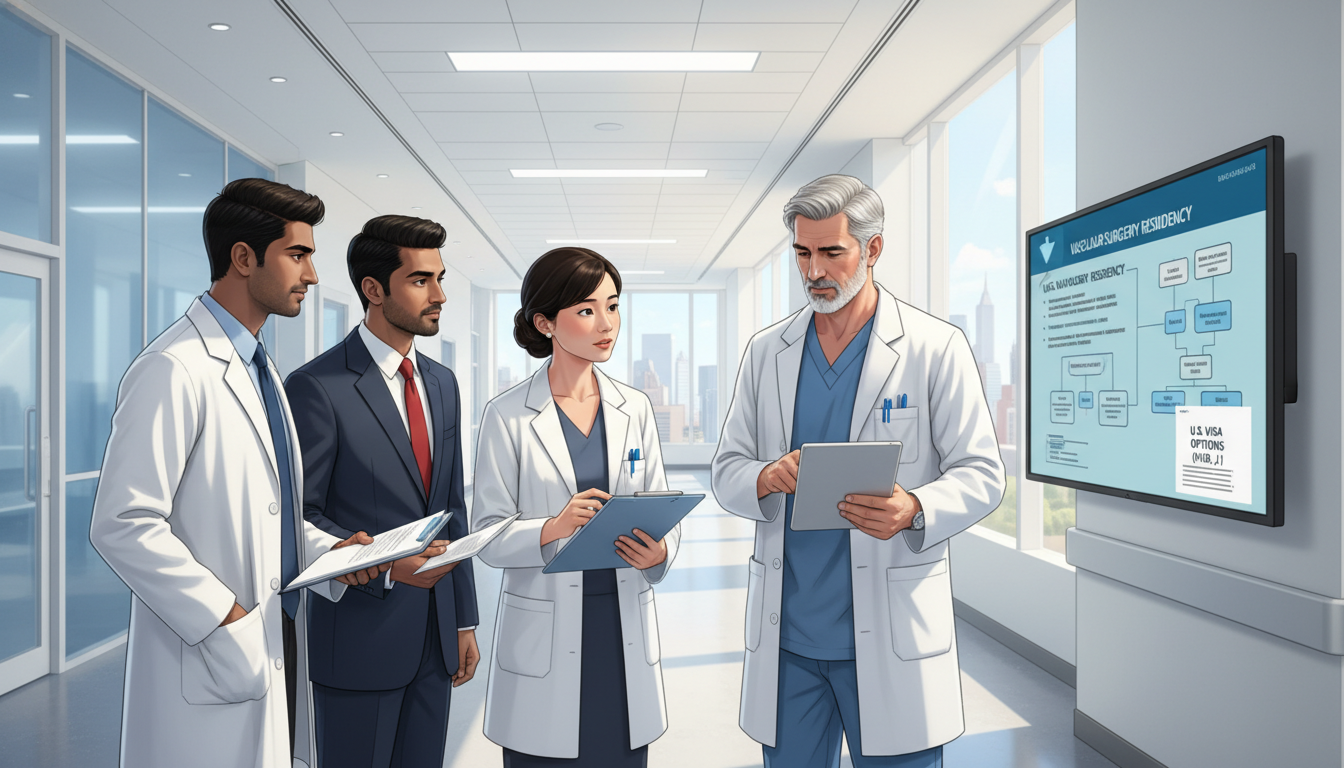
Understanding the Visa Landscape for Caribbean IMGs in Neurology
For a Caribbean medical school graduate aiming for a neurology residency in the United States, visa planning is just as critical as board scores and letters of recommendation. Many otherwise strong applicants are limited in their options—or even unable to start residency—because they didn’t fully understand residency visa requirements early enough.
This guide focuses on Caribbean IMGs targeting neurology residency, including those from schools like SGU, AUC, Ross, Saba, and others. It explains J-1 vs H-1B, gives neurology‑specific perspectives, discusses IMG visa options strategically, and walks through common pathways from medical school through the neurology match and beyond.
Throughout, remember: Caribbean medical school residency success = strong application + early visa strategy.
Core Visa Options for Caribbean IMGs Targeting Neurology
When U.S. programs consider non‑U.S. citizen IMGs, they usually think in terms of two main residency visas:
- J-1 (ECFMG-sponsored)
- H-1B (employer-sponsored work visa)
Understanding these two is foundational for your neuro match planning.
J-1 Visa for Residency (ECFMG Sponsored)
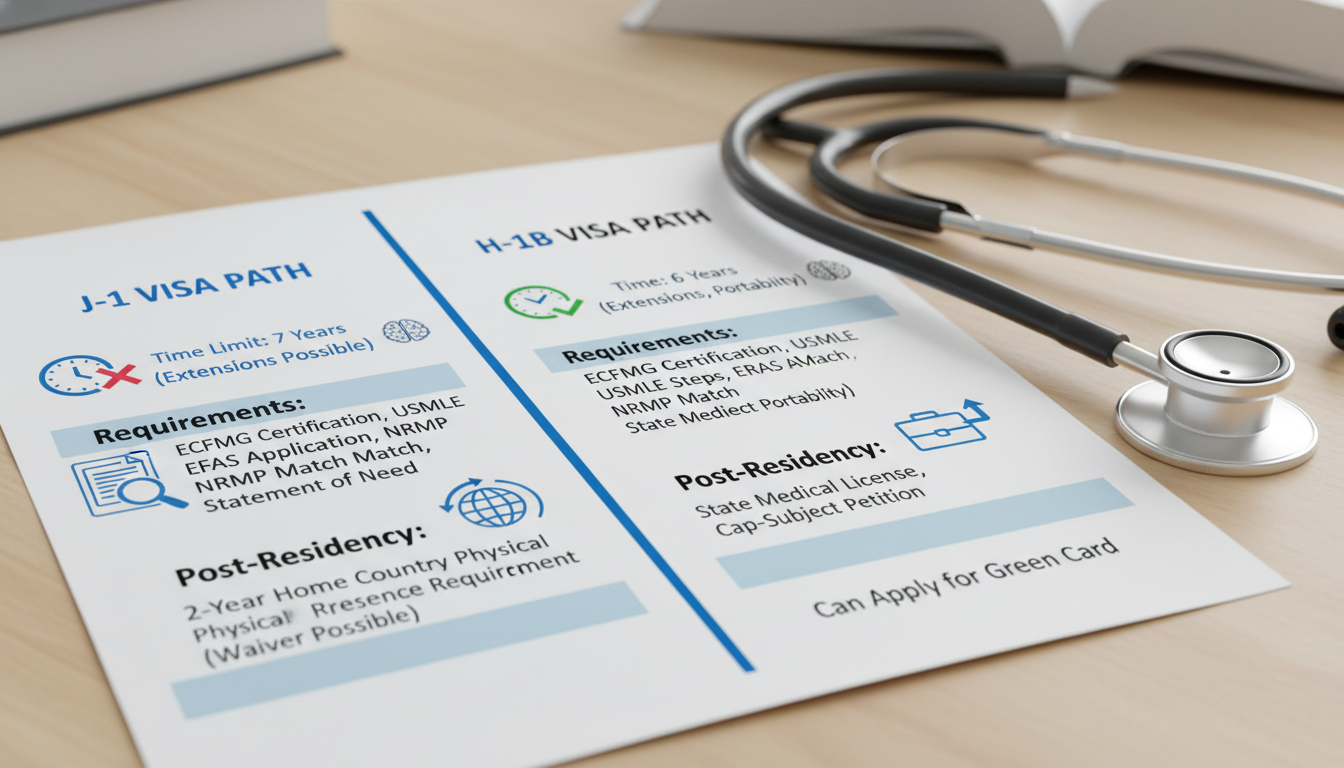
The J-1 visa is the most common visa used by IMGs in U.S. residency and fellowships.
Key features:
- Sponsor: Educational Commission for Foreign Medical Graduates (ECFMG)
- Primary purpose: Graduate medical education (residency/fellowship)
- Duration: Typically up to 7 years for clinical training
- Funding: Must have adequate financial support (usually your residency salary qualifies)
- Return-home requirement:
- After completing J-1 training, you’re required to return to your home country (or country of last permanent residence) for a total of 2 years,
- Unless you obtain a J-1 waiver (e.g., Conrad 30, hardship, or persecution waiver).
Advantages for a neurology residency:
- Widely accepted – most neurology residency programs are J-1 friendly.
- Standardized process through ECFMG; programs are familiar with this pathway.
- Covers the full span of adult neurology training (4 years) and typically leaves enough time for a subspecialty fellowship (e.g., epilepsy, stroke, neurocritical care) within the 7-year limit.
Disadvantages:
- The 2-year home residence requirement is a major factor for long-term plans.
- You cannot freely transition to a green card or H-1B without addressing this requirement.
- You are tied to training; the J-1 is not a general “work visa.”
What this means for Caribbean neurology applicants:
As a Caribbean IMG, you will almost always be competitive first as a J-1 candidate. Many neurology programs—community-based and university-affiliated—are comfortable sponsoring J-1 but may have limited H-1B capacity or avoid it altogether due to cost and administrative complexity.
If your primary goal is to match neurology in the U.S., accepting J-1 sponsorship significantly broadens your program list and improves your residency match odds.
H-1B Visa for Residency
The H-1B visa is an employer-sponsored visa for specialty occupations and is used by some programs to sponsor residents and fellows.
Key features:
- Sponsor: Individual residency program/hospital (not ECFMG)
- Duration: Up to 6 years total, including all H-1B time (residency + any prior H-1B employment)
- Requirements:
- Must have passed USMLE Step 3 before the visa petition is filed (many programs require a Step 3 pass before offering H-1B).
- State medical board licensing requirements must be met (varies by state).
Advantages for neurology residency:
- No J-1 two-year home residence requirement.
- More direct pathway to H-1B extensions and eventually employment-based green card, especially if you plan an academic or long-term U.S. career.
- Attractive if you know you do not want to return home soon after training.
Disadvantages:
- Fewer neurology programs sponsor H-1B for residency due to:
- Legal costs
- Cap concerns (in some settings)
- Administrative burden
- Needs Step 3 passed early, usually before ranking or contract signing.
- The 6-year total H-1B limit must cover:
- 4-year neurology residency (prelim/internal medicine year + 3 years of neurology)
- And any H-1B time used later for fellowship or employment (unless green card process allows extensions).
What this means for Caribbean IMGs:
If you are a Caribbean medical graduate targeting an H-1B neurology residency, you need to:
- Pass USMLE Step 3 early (ideally before the ERAS season you’re applying for).
- Strategically target H-1B-friendly neurology programs.
- Accept a smaller program pool, often favoring academic centers with established IMG sponsorship pathways.
For many Caribbean IMGs, insisting on H-1B from the start can significantly narrow options and may reduce the chance of any neurology match—especially in competitive cycles.
J-1 vs H-1B: Strategic Considerations for the Neuro Match
Choosing between J-1 and H-1B is not just an immigration decision; it’s a career strategy. As a Caribbean IMG targeting neurology, you must align:
- Your residency visa
- Your long-term practice goals
- Your risk tolerance
- And your timeline relative to USMLE and graduation
Factors to Consider for Caribbean Neurology Applicants
1. Match Probability vs Visa Preference
- Broader acceptance of J-1: Most neurology programs will say “we sponsor J-1, and a small number sponsor H-1B.”
- If you limit yourself to H-1B only, you may cut your viable neurology program list by 50–80%, depending on your filters.
- For Caribbean medical school residency applicants in neurology—including SGU residency match candidates—flexibility with J-1 is often essential to matching at all.
Actionable advice:
When contacting programs or researching websites, categorize them as:
- J-1 only
- J-1 + H-1B
- No visa sponsorship
Then decide:
- “Will I apply J-1-only, or J-1 + H-1B, or H-1B-only?”
Most Caribbean IMGs benefit from J-1 + H-1B (willing to accept both) as their approach.
2. Long-term Plans: U.S.-Based vs Return Home
Ask yourself:
- Do I envision my long-term career in the U.S., including subspecialty training (e.g., stroke, epilepsy, neuromuscular) and possibly academic neurology?
- Or am I comfortable with a possible return to my home country or another country for some years after training?
If your only acceptable outcome is permanent U.S. practice without interruption, an H-1B path may be preferable. But you must weigh this against the risk of not matching at all if you restrict to H-1B-only programs.
If you are open to:
- A J-1 waiver job in a medically underserved area, or
- Spending some time outside the U.S. after training
then J-1 becomes entirely workable and much easier to secure.
3. Neurology Fellowship Aspirations
Neurology is fellowship-heavy. Many graduates pursue:
- Vascular neurology (stroke)
- Epilepsy
- Clinical neurophysiology
- Neurocritical care
- Movement disorders
- Neuromuscular medicine
- Cognitive/behavioral neurology
Consider:
- J-1 7-year limit:
- 4 years for adult neurology (PGY-1 internal medicine prelim + 3 years neurology)
- Leaves ~3 years for fellowship(s).
- You can usually complete at least one, often two fellowships within this time.
- H-1B 6-year limit:
- 4 years neurology residency
- Only 2 years left for fellowship and employment unless a green card process extends H-1B eligibility.
Implication:
From a pure fellowship timing view, J-1’s 7-year training limit is usually adequate. H-1B’s 6-year limit can become tight if you delay starting a green card process.
4. Timing for USMLE Step 3
If you want to keep H-1B as an option, you must realistically plan:
- When will you take Step 3?
- Will you have your Step 3 pass result before programs need to decide on visa type?
For Caribbean students:
- Ideally, take Step 3 during your final year or immediately after graduation.
- If you cannot guarantee a Step 3 pass result before Match rank lists, assume J-1 will be your likely visa.
Rule of thumb for Caribbean IMGs in neurology:
Unless you are 100% confident about Step 3 timing and targeting a small group of H-1B-friendly programs, don’t design your entire strategy around H-1B only.
Program Selection and Application Strategy for Caribbean Neurology IMGs
Beyond understanding the J-1 vs H-1B framework, you must integrate visa thinking into your application and program selection.
Researching Visa Policies of Neurology Programs
Use these sources to understand each program’s stance:
Program Websites
- Look for sections labeled “International Medical Graduates,” “Visa Sponsorship,” or “FAQ.”
- Example phrasing you might see:
- “We sponsor ECFMG J-1 visas only.”
- “We sponsor J-1 and will consider H-1B for exceptional candidates with Step 3 passed.”
- “We do not sponsor visas.”
FREIDA / ACGME / Program Directory
- FREIDA profiles often mention whether a program sponsors visas and sometimes which type.
Emails to Program Coordinators
- Send concise, professional questions:
- “Do you sponsor J-1, H-1B, or both for neurology residency?”
- “Is Step 3 required for H-1B sponsorship?”
- Keep the email short and clearly identify yourself as a Caribbean IMG and your graduation year.
- Send concise, professional questions:
Current Residents & Alumni Networks
- Reach out via LinkedIn, alumni groups, or school networking events.
- Ask: “As an IMG at your program, what visa are you on? Does the program support H-1B?”
Building Your Neurology Program List with Visa Realism
When creating your ERAS list for a neurology residency:
Divide programs into three main groups:
- J-1 only
- J-1 + H-1B
- No visa sponsorship
As a Caribbean IMG, your goal is typically:
- A strong core of programs that sponsor J-1 (most of your list).
- A subset that also offer H-1B if you have Step 3 done.
- Avoid programs that explicitly offer no sponsorship.
Practical numbers (will vary by your profile):
Aim for 20–40 neurology programs total as many Caribbean IMGs do, expanding or contracting based on:
- Step scores
- Number of attempts
- Gaps in training
- Research/US clinical experience
Ensure that most of these sponsor J-1 so your residency visa options are viable.
Highlighting Visa Readiness in Your Application
You generally do not need a separate “visa statement,” but you can:
- Indicate USMLE Step 3 passed clearly on ERAS if completed (makes H-1B consideration easier).
- Make sure ECFMG certification is completed or on track; some programs require certification at application or before ranking.
- In interviews, be ready to discuss your visa flexibility clearly and confidently:
- “I am open to both J-1 and H-1B sponsorship; I understand the implications of both.”
- Or, if you must avoid J-1, have a coherent rationale (e.g., unavoidable family circumstances), knowing this can limit your options.

Post-Match and Beyond: Visa Steps After Securing a Neurology Residency
Once you match into a neurology residency, your visa journey shifts from planning to execution.
Timeline After the Match
After Match Day:
- Program contacts you with onboarding information and confirms your visa type.
- If on J-1:
- The program’s GME office provides instructions to apply for J-1 through ECFMG’s Exchange Visitor Sponsorship Program.
- You complete ECFMG’s online forms and submit:
- Valid passport
- ECFMG certification
- Contract or official offer letter
- Proof of funding (your salary)
- Any required health or police clearances (varies by time and policy)
- ECFMG issues the Form DS-2019, which you use to:
- Schedule a visa interview at a U.S. embassy/consulate.
- If on H-1B:
- Your program’s legal team or outside counsel prepares an H-1B petition to USCIS.
- You provide required documents:
- Passport
- Medical degree and ECFMG certificate
- USMLE Step 3 score report
- State license or training license documentation
- Once approved, you use the approval notice to obtain the visa stamp (if you’re outside the U.S.) or to change status (if you’re already in the U.S. in another non-immigrant category).
J-1 Neurology Residents: Planning for Waivers and Careers
If you complete neurology residency and possibly a fellowship on J-1, you must plan for the two-year home residence requirement or a J-1 waiver.
Common waiver routes for neurologists:
Conrad 30 Waiver Programs (State-based):
- Each state can sponsor up to 30 J-1 physicians per year, usually for underserved areas.
- Historically more primary care, but neurology demand is increasing, especially in rural and smaller metro areas with stroke neurology needs.
- Requires a 3-year service commitment in the sponsoring site, typically on H-1B.
Federal Waiver Programs (e.g., VA, HHS, ARC in some cases):
- Some federal agencies can sponsor J-1 waivers for specialists, including neurologists, especially in underserved or high-need areas (stroke centers, epilepsy centers).
Hardship or Persecution Waivers:
- Based on proving that returning home would cause exceptional hardship to a U.S. citizen or permanent resident spouse/child, or risk of persecution.
- Complex; require legal counsel and strong documentation.
For Caribbean IMGs:
- Many Caribbean graduates trained on J-1 successfully obtain Conrad 30 neurology positions in underserved U.S. communities.
- Non-U.S.-citizen Caribbean IMGs (e.g., from Trinidad & Tobago, Jamaica, Barbados, etc.) often plan early for a waiver job as their bridge to long-term U.S. practice.
H-1B Neurology Residents: Transitioning to Long-Term Status
As an H-1B resident:
- You may continue in H-1B status for fellowship and subsequently for attending positions, subject to the 6-year total limit and any applicable cap-exempt vs cap-subject rules.
- Academic centers and hospitals often start a green card (PERM or NIW/EB-1/EB-2) process during fellowship or early employment, providing a pathway to permanent residency.
Key reminders:
- Track how many H-1B years you use during residency.
- Be proactive about:
- Talking with potential fellowship programs about H-1B sponsorship.
- Discussing green card timelines with your future employers.
Practical Scenarios: Applying Visa Strategy to Real-Life Caribbean Neurology Paths
Scenario 1: SGU Graduate Matching into Neurology on J-1
- Graduate of St. George’s University (SGU), strong USMLE scores, good U.S. clinical experience, but Step 3 not yet completed.
- Applies broadly to neurology programs that sponsor J-1.
- Matches at a mid-size academic neurology program that only sponsors J-1.
- Completes neurology residency + 1-year epilepsy fellowship (total 5 years J-1 time).
- Applies for a Conrad 30 waiver job as an epileptologist in a smaller city with strong patient volume.
- Serves 3 years on H-1B in that underserved area, then moves to a larger academic center after obtaining a green card.
Takeaway: J-1 plus a well-planned waiver can still lead to robust academic or subspecialty careers in neurology.
Scenario 2: Caribbean IMG on H-1B from the Start
- Graduate of a Caribbean school, high scores, research in stroke neurology, early Step 3 pass.
- Targets programs known for H-1B sponsorship and notifies them clearly of H-1B readiness.
- Matches into a university-based neurology residency on H-1B.
- Starts green card (EB-2 or NIW) during fellowship in vascular neurology.
- Uses H-1B extensions beyond 6 years due to an ongoing permanent residency process, then obtains a green card.
Takeaway: For highly competitive Caribbean IMGs with early Step 3 and strong research, H-1B may be realistic and can ease later immigration steps—but the initial program pool is smaller.
Scenario 3: Late Realization of Visa Constraints
- Caribbean IMG, no Step 3, applies only to programs advertising H-1B sponsorship because of fear of the J-1 home requirement.
- Receives very few interview offers, fails to match in neurology.
- Applies the following year with a more flexible stance (J-1 accepted) and matches successfully.
Takeaway: Rigid visa preferences without full awareness of the program landscape can significantly harm match chances. Visa flexibility often increases opportunities in neurology.
FAQs: Visa Navigation for Caribbean IMGs in Neurology
1. As a Caribbean IMG, will choosing J-1 over H-1B hurt my long-term neurology career in the U.S.?
Not necessarily. Many neurologists on J-1 visas successfully obtain waivers (often through Conrad 30) and later transition to permanent residency and academic or private practice positions. J-1 may require more planning—particularly around waiver jobs and potential rural/underserved service—but it does not inherently limit you to a weaker career. What matters is strategic planning and early awareness of your waiver options.
2. Do neurology programs prefer J-1 or H-1B for Caribbean IMGs?
Most neurology residencies are more comfortable with J-1, because:
- The process is standardized via ECFMG.
- It doesn’t tie up their institution in complex immigration filings. Some programs will consider H-1B if you have USMLE Step 3 and are a strong candidate, but neurology is not like some surgical fields where H-1B is more common. As a Caribbean IMG, expect J-1 to be the default offered, unless a program clearly advertises H-1B options.
3. Do I need to decide between J-1 vs H-1B before I apply for neurology residency?
You should have a preference and a strategy, but in practice:
- Apply to programs that sponsor J-1, and selectively to those that also sponsor H-1B if you have Step 3.
- During interviews, be honest about your flexibility. You typically finalize the visa type after the Match, in conversation with your matched program. However, if you are absolutely unwilling to accept J-1, you need to filter your list carefully and accept a smaller universe of programs.
4. How early should I start planning my residency visa strategy as a Caribbean neurology applicant?
Start by your third year of medical school (or earlier if possible):
- Understand the basics of J-1 vs H-1B and IMG visa options.
- Plan your USMLE timing (especially Step 3, if you want H-1B opportunities).
- Identify neurology programs historically friendly to Caribbean IMGs. By the time you open ERAS, you should have:
- A realistic program list based on your profile and visa possibilities.
- A clear statement you can give to programs:
“I am open to J-1 and H-1B” or “I will require H-1B only, and I have Step 3 passed.”
Navigating the residency visa landscape as a Caribbean IMG aiming for neurology requires as much planning as building a strong CV. Understanding J-1 vs H-1B, designing a realistic Caribbean medical school residency application strategy, and preparing for life after the neuro match will position you not just to match, but to build a sustainable and rewarding neurology career in the United States.