
Understanding the Visa Landscape for Caribbean IMGs
Caribbean medical school residency planning involves a second application track running parallel to ERAS and the Match: your U.S. visa strategy. For a Caribbean IMG, your competitiveness is not only about scores, letters, and clinical performance; it also depends on whether programs can legally train and employ you under a specific visa type.
This article is written specifically for:
- Students and graduates of Caribbean medical schools (e.g., SGU, AUC, RUSM, Saba, etc.)
- Applying to IMG friendly residency programs in the United States
- Wanting to understand residency visa policies, IMG visa options, and how J-1 vs H‑1B decisions affect your career
We will walk through:
- The two main visa options for residency (J‑1 and H‑1B)
- How Caribbean IMGs can align school, exams, and timing with visa requirements
- How to target international graduate programs that genuinely support IMGs
- The special considerations for Caribbean schools (e.g., SGU residency match)
- Practical strategies and common pitfalls
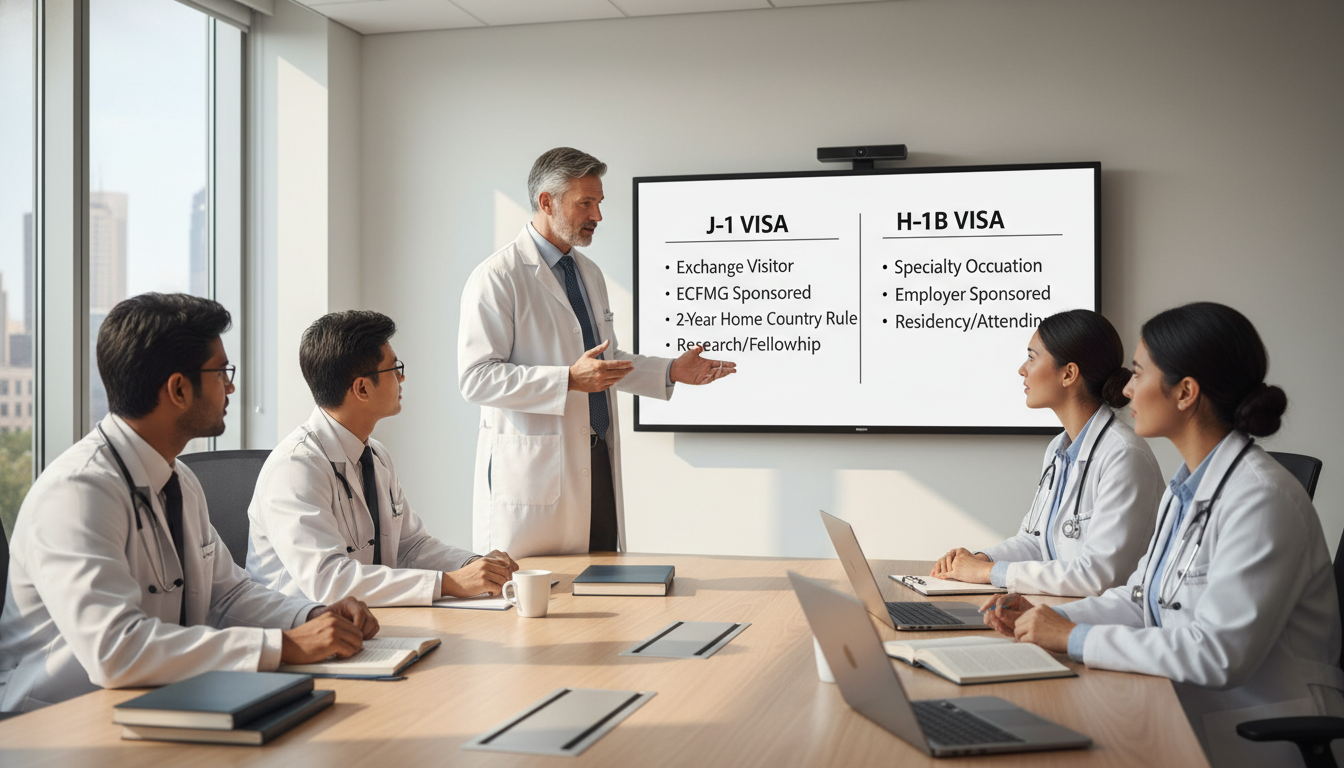
Core Visa Options for Residency: J‑1 vs H‑1B
The vast majority of non‑U.S. citizen, non‑green card IMGs train in the U.S. on one of two visas:
- J‑1 Alien Physician Visa – for graduate medical education
- H‑1B Temporary Worker Visa (Specialty Occupation) – for residents/fellows as “physicians”
Understanding the J‑1 vs H‑1B differences will shape your application list, your negotiation strategy, and even your long‑term career plans.
J‑1 Visa for Residency: The Default Route for Many Caribbean IMGs
The J‑1 physician visa, sponsored by the Educational Commission for Foreign Medical Graduates (ECFMG), is currently the most common visa for IMGs in U.S. residency training.
Key features
- Sponsor: ECFMG (not the hospital or residency program directly)
- Purpose: Graduate medical education (residency, fellowship)
- Duration: Up to 7 years in total (with annual renewals)
- Dependents: J‑2 dependents (spouse/children) can accompany and may be eligible for work authorization (EAD)
Major advantages
- Widely accepted: Many IMG friendly residency programs explicitly state they sponsor or accept J‑1 through ECFMG.
- Predictable process: ECFMG has a standardized, well‑documented procedure.
- No USMLE Step 3 requirement: You only need Step 1 and Step 2 CK to begin residency on a J‑1 visa.
- Often fits well with Caribbean medical school residency pathways, where schools have extensive experience guiding students through J‑1 documentation.
Critical limitation: The 2‑year home residence requirement
The biggest downside is the “2‑year home residency requirement” (INA 212(e)):
- After finishing training on a J‑1, you must either:
- Return to your country of last legal permanent residence for a total of two years, or
- Obtain a J‑1 waiver (e.g., Conrad 30, federal interest waiver) by agreeing to work in a designated underserved area, usually in a non‑academic, service-focused role for 3 years.
Why this matters
- If you plan a long academic career, subspecialty training, or flexibility in job geography right after residency, the J‑1 requirement can be restrictive.
- However, many Caribbean IMGs successfully complete a J‑1 waiver job after training and then move on to broader career options.
H‑1B Visa for Residency: Fewer Programs, More Flexibility
The H‑1B is a work visa for specialty occupations, which includes physicians in training as long as certain conditions are met.
Key features
- Sponsor: The residency program/hospital directly (not ECFMG)
- Duration: Up to 6 years total in H‑1B status (including residency and fellowship)
- Dependents: H‑4 dependents; some may obtain work authorization depending on your green card process
Major advantages
- No 2‑year home residency requirement: You can transition to another H‑1B job or begin a green card process without a J‑1 waiver obligation.
- Better alignment with long‑term U.S. career for those planning to stay permanently.
- Often attractive to Caribbean IMGs who are U.S. citizens or permanent residents—but note they don’t need visas; this is more relevant to non‑U.S. Caribbean IMGs aiming to avoid J‑1.
Key constraints
- USMLE Step 3 required before H‑1B petition approval (practically, before residency starts)
- Programs must:
- Pay prevailing wage or higher, which can be more complex for PGY‑1 salaries
- File LCA (Labor Condition Application) and H‑1B petition
- Many community programs and smaller institutions do not sponsor H‑1B due to cost, complexity, or policy.
For a Caribbean IMG, H‑1B is more common in certain specialties (e.g., internal medicine, neurology, pathology) and more frequently in university‑affiliated or large teaching hospitals with robust international graduate programs.

Matching Your Profile to the Right Visa Path
Choosing between J‑1 and H‑1B is less about personal preference and more about what is realistic for your profile and timeline as a Caribbean IMG.
Factors That Influence Your Best Option
Exam Timeline and Step 3 Planning
If you plan to pursue H‑1B, you must:
- Pass USMLE Step 3 early enough to:
- Receive your score report
- Give the program time to file the H‑1B petition prior to your GME start date (usually July 1)
- This typically means:
- Taking Step 3 no later than December–January of the Match year
- Earlier is safer (late fall of the application year).
- Pass USMLE Step 3 early enough to:
If you do not have Step 3 and are still early in your exams:
- The J‑1 route is more feasible, particularly for Caribbean medical school residency applicants still focusing on Step 2 CK and clinical rotations.
Competitiveness and Specialty Choice
- H‑1B‑sponsoring programs tend to be:
- More competitive
- Concentrated in certain specialties and regions
- If you are targeting highly competitive specialties (e.g., dermatology, plastic surgery) as a Caribbean IMG, you may be primarily filtered out on other metrics before visa type even comes into play.
- For IMG friendly residency specialties like:
- Internal medicine
- Family medicine
- Pediatrics
- Psychiatry
- Neurology
…the J‑1 is broadly accepted and may open more doors than insisting on H‑1B only.
- H‑1B‑sponsoring programs tend to be:
Long‑Term Career Plans
- Consider:
- Are you planning to live long‑term in the U.S.?
- Are you open to working in underserved or rural areas after training?
- If you are willing to do a J‑1 waiver (Conrad 30) position:
- The J‑1 route may be simpler and more accessible.
- If your priority is to:
- Remain near major cities
- Pursue purely academic roles
- Have more immediate geographic flexibility
…then trying for H‑1B may make sense—if your scores and profile are strong enough to be selective.
- Consider:
Personal and Family Needs
- Consider your dependents’ needs:
- J‑2 dependents can obtain work authorization (EAD), which can be significant if your spouse needs to work.
- H‑4 dependents’ right to work is more limited and often dependent on your green card process.
- Discuss with family how long you expect to be in training and where.
- Consider your dependents’ needs:
Practical Profile Scenarios for Caribbean IMGs
Scenario 1: SGU graduate, strong IMG profile, but no Step 3 yet
- Step 1: 235+, Step 2 CK: 240+, strong U.S. clinical rotations
- Applying to internal medicine and pediatrics at mostly community and university‑affiliated programs.
- No time or funds to prepare for Step 3 before Match.
Best alignment:
Target a broad list of J‑1 friendly, IMG friendly residency programs. Focus on programs with a strong track record of SGU residency match and other Caribbean graduate matches. Plan to deal with the J‑1 home requirement later via Conrad 30 waiver.
Scenario 2: Caribbean IMG with early graduation and Step 3 passed
- Finished medical school early; took Step 3 during a gap year.
- Strong scores and U.S. clinical letters.
- Interested in internal medicine with possible subspecialty.
Best alignment:
Apply broadly but prioritize programs that explicitly sponsor H‑1B. Still remain open to J‑1 to avoid shrinking your options too much. During interviews, ask targeted visa questions (discussed later).
Scenario 3: Mid‑range scores, late Step 2 CK, no Step 3
- Scores near/pass threshold, applying mostly in family medicine and internal medicine.
- Just aiming to match in a stable, supportive training environment.
Best alignment:
Focus on J‑1‑friendly programs that are historically open to Caribbean IMGs and other international graduate programs. Attempting H‑1B only may dramatically reduce your match probability.
Targeting IMG Friendly Programs That Support Your Visa Needs
Once you understand your own visa profile, the next step is to identify which residency programs are truly IMG friendly and how they handle visas.
Researching Program Visa Policies Effectively
Use a structured approach:
Program Websites
Look under:
- “International Medical Graduates”
- “Applicants”
- “FAQs” or “Eligibility Criteria”
Common wording to interpret:
- “We sponsor J‑1 visas”
→ ECFMG‑sponsored J‑1 is available; H‑1B likely not available unless explicitly stated. - “We sponsor J‑1 and H‑1B visas”
→ This is best‑case language; verify details about Step 3 and any restrictions. - “We accept J‑1 visas”
→ They rely on ECFMG; they do not petition but allow ECFMG sponsorship. - “We do not sponsor visas”
→ As a non‑U.S. citizen who needs a residency visa, this is a hard stop. Skip these from your list.
FREIDA and Other Databases
- On the AMA FREIDA database:
- Use filters for IMG positions and look for notes on visa sponsorship.
- Cross‑reference with:
- NRMP Charting Outcomes for IMGs
- School‑compiled match lists (e.g., SGU residency match outcomes often list hospitals that repeatedly take SGU and other Caribbean grads).
- On the AMA FREIDA database:
Program Coordinator and GME Office
When websites are vague, send a polite, specific email to the program coordinator or GME office:
Example:
Dear [Name],
I am an international medical graduate from [Caribbean school] and am very interested in applying to your [specialty] residency program. I would like to clarify your current policies on visa sponsorship for incoming residents.Specifically:
- Do you sponsor ECFMG‑sponsored J‑1 visas for categorical PGY‑1 residents?
- Do you sponsor H‑1B visas for residents who have passed USMLE Step 3 prior to the Match?
Thank you very much for your time and assistance.
Sincerely,
[Your Name], [Credentials]This ensures you avoid wasting applications on programs that cannot accommodate your residency visa needs.
Red Flags and Positive Signs for Caribbean IMGs
Red flags
- Program states: “Only U.S. citizens or permanent residents are eligible.”
- Website silent on visas and coordinator replies with vague/avoidant answers.
- Historically few or no international graduate programs in their match list.
- No evidence of Caribbean or SGU residency match history.
Positive signs
- Program lists multiple Caribbean medical schools among current and recent residents.
- Clear statements: “We sponsor ECFMG J‑1 visas” or “We sponsor J‑1 and H‑1B visas for qualified candidates.”
- International medical graduate–focused pages or orientation materials.
- Program directors openly discuss how they support IMG visa options in webinars or outreach sessions.
Step‑by‑Step Visa Planning Timeline for Caribbean IMGs
Align your visa navigation with the overall residency application cycle. Here is a structured timeline for a typical Caribbean IMG applying from senior year or after graduation.
1–2 Years Before Applying: Laying the Foundation
- Clarify your end‑goal:
Decide whether J‑1 with eventual waiver or H‑1B and direct career transition is your ideal route. - Map exam schedule:
- Aim to finish Step 1 and Step 2 CK with strong scores.
- If considering H‑1B, build in time to prep for and take Step 3 early.
- Strengthen your profile:
- Maximize performance in U.S. clinical rotations, especially core rotations in the U.S.
- Seek letters from U.S. faculty; many IMG friendly residency programs weigh these heavily.
8–12 Months Before ERAS Opening: Narrowing Visa Strategy
- Review:
- Your exam performance
- Likelihood of taking and passing Step 3 before the Match year
- Make a realistic decision:
- If Step 3 will be done in time and scores are solid: Construct two lists—H‑1B‑sponsoring and J‑1‑sponsoring programs.
- If Step 3 will not be ready: Commit to the J‑1 route and focus on programs that reliably sponsor J‑1.
ERAS Application Season (September–February)
- On ERAS:
- In your personal statement or interviews, you do not need to overly emphasize your visa needs; it is assumed for IMGs.
- During interviews:
- Ask structured, concise questions about visas (especially if not clearly stated):
- “Does your program currently sponsor J‑1 visas for IMGs?”
- “For candidates who already have Step 3, do you consider H‑1B sponsorship for residents?”
- Evaluate how comfortable and familiar they seem with IMG visas.
- Ask structured, concise questions about visas (especially if not clearly stated):
Match Week and Post‑Match: Initiating the Visa Process
Once you match:
J‑1 route
- Program sends required documentation to ECFMG.
- You complete:
- Online ECFMG application for J‑1 sponsorship.
- Provide:
- Form DS‑2019–related information
- Passport details
- Proof of medical education
- Signed contracts/agreements.
- After ECFMG issues DS‑2019, you:
- Pay SEVIS fee
- Schedule U.S. consulate visa appointment (if abroad)
- Attend interview and obtain J‑1 visa stamp.
H‑1B route
- Program’s legal/HR team:
- Files LCA
- Prepares and files H‑1B petition
- You:
- Provide proof of Step 3
- Supply all requested documents (diploma, ECFMG certificate, etc.)
- After approval:
- If abroad, attend consular interview for H‑1B stamp.
- Timing is critical—delays can affect your ability to start residency on time.
- Program’s legal/HR team:
Special Considerations for Caribbean Medical Schools and SGU Graduates
Caribbean schools have specific strengths and patterns that influence visa navigation.
Strengths of Caribbean Schools in Visa Processes
- Experience: Schools like SGU, AUC, RUSM, and Saba have thousands of alumni who have obtained J‑1 or H‑1B visas for residency.
- Dedicated advising: Many provide:
- Visa information sessions
- Step‑by‑step guides
- References to immigration resources
- Established hospital partners: Clinical sites and affiliated programs are often familiar with Caribbean IMGs and their visa needs.
For example, the SGU residency match track record highlights many hospitals that repeatedly sponsor J‑1 visas for SGU graduates. These institutions often become reliable IMG friendly residency targets for other Caribbean IMGs as well.
Common Pitfalls for Caribbean IMGs
Assuming all IMG friendly programs sponsor H‑1B
- Many programs that are excellent for IMGs only offer J‑1.
- Insisting on H‑1B only can drastically reduce your option pool.
Underestimating Step 3 timing
- Scheduling Step 3 too late (e.g., January or February of Match year) can:
- Delay score release
- Prevent timely H‑1B petition filing
- If Step 3 is uncertain, plan primarily for J‑1.
- Scheduling Step 3 too late (e.g., January or February of Match year) can:
Ignoring home country implications
- The 2‑year home residency requirement is usually to your country of last permanent residence, not necessarily your country of citizenship.
- Know which country this is for you, and what returning for 2 years would mean in practice.
Miscommunication with programs
- Never assume a program knows your exact visa needs; clarify early if necessary.
- Answer any visa‑related questions honestly—misrepresentation can lead to serious consequences later.
Building a Visa‑Informed Application List as a Caribbean IMG
A practical approach:
- Tier 1 (Core J‑1 Programs)
40–60% of your list: Programs with:- Clear J‑1 sponsorship statements
- Strong history with Caribbean IMGs
- Tier 2 (J‑1 + H‑1B Programs)
20–40%: Programs explicitly open to both J‑1 and H‑1B, especially if you have Step 3. - Tier 3 (Selective H‑1B Only Targets)
10–20%: Very competitive programs where H‑1B is sponsored but criteria are stringent. Only apply here if your application is strong and Step 3 is done.
This mix balances match security with visa preference.
Frequently Asked Questions (FAQ)
1. As a Caribbean IMG, is J‑1 or H‑1B better for residency?
“Better” depends on your situation:
- J‑1 is:
- More widely available
- Easier to obtain if you do not have Step 3
- Associated with a 2‑year home residency requirement, which can often be addressed via a J‑1 waiver job after residency.
- H‑1B:
- Offers more flexibility after training
- Avoids the 2‑year return requirement
- Requires Step 3 and a program willing and able to sponsor.
Most Caribbean IMGs pursue J‑1 because it aligns better with timing and the availability of IMG friendly residency programs.
2. Do all IMG friendly residency programs sponsor visas?
No. Some programs that are “IMG friendly” in terms of accepting international medical graduates may:
- Require U.S. citizenship or permanent residency
- Accept only candidates who already have independent work authorization (e.g., green card holders)
Always verify each program’s residency visa policy on their website or by contacting the coordinator.
3. Can I switch from J‑1 to H‑1B during or after residency?
- During residency:
Switching from J‑1 to H‑1B for the same training is extremely rare and generally not feasible due to J‑1 regulations. - After residency:
If you are subject to the 2‑year requirement, you must either:- Complete it by returning home for 2 years, or
- Obtain a waiver (e.g., Conrad 30) and then change to H‑1B for the waiver job.
You cannot simply change to H‑1B and bypass the J‑1 home residency requirement without a valid waiver.
4. How does being a Caribbean IMG impact my visa chances compared to other IMGs?
Being a Caribbean IMG does not inherently limit your visa eligibility. What matters most is:
- Your citizenship and country of residence
- Your exam performance and application strength
- Whether programs where you apply:
- Sponsor J‑1
- Sponsor H‑1B
- Have a history with Caribbean medical school residency pathways
In practice, Caribbean IMGs often benefit from:
- Robust institutional support from their schools
- Established patterns of SGU residency match and similar data that highlight programs familiar with Caribbean alumni and attendant visa processes.
By approaching your visa navigation for residency strategically—understanding J‑1 vs H‑1B, researching IMG friendly residency programs carefully, and aligning your exam timeline with your chosen visa route—you can significantly improve both your chances of matching and your long‑term career flexibility as a Caribbean IMG.