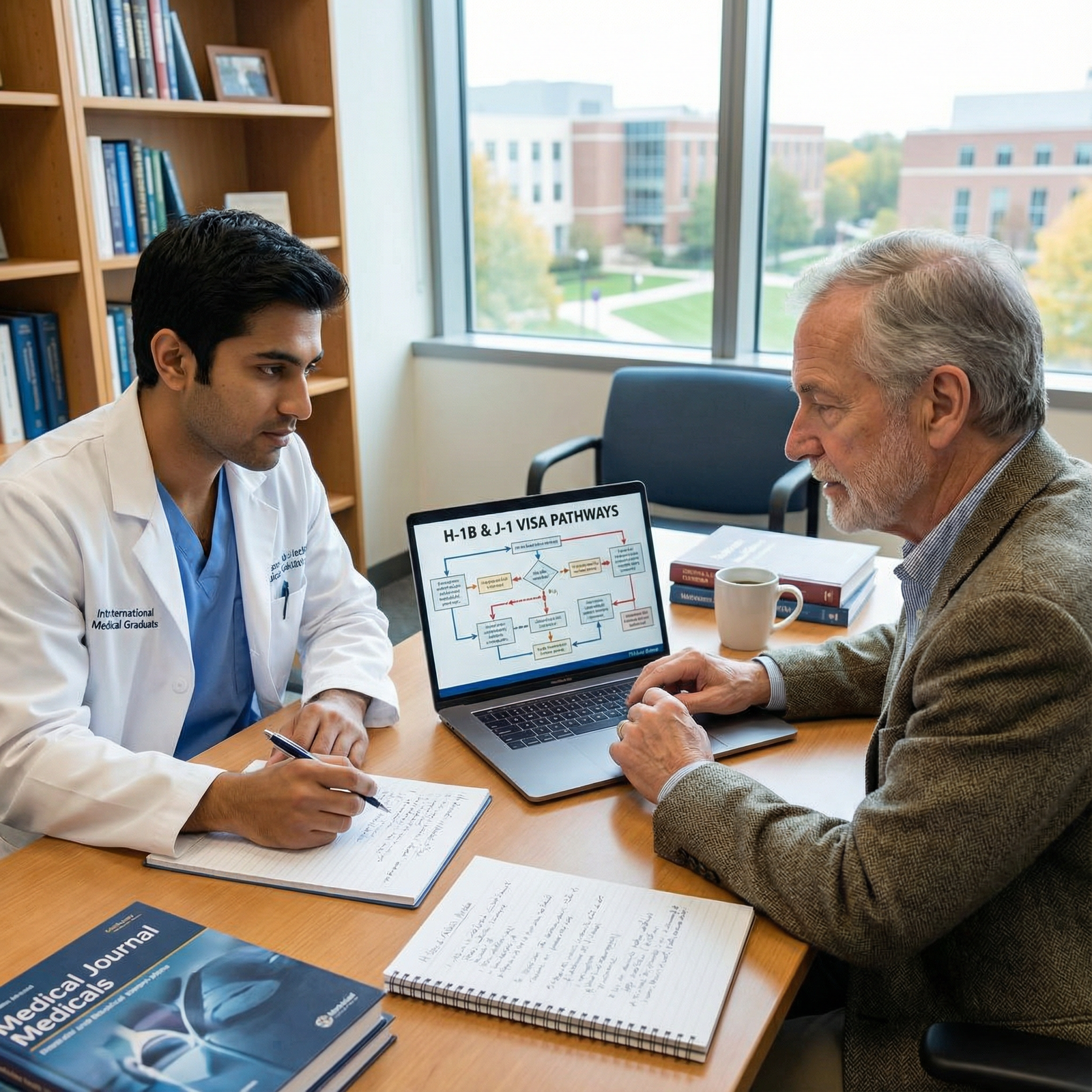
Understanding the Visa Landscape for Caribbean IMGs Aiming for Cleveland
For a Caribbean medical school graduate targeting residency in Cleveland, visa planning is as critical as your USMLE scores and letters of recommendation. Many strong candidates underestimate how much a residency visa strategy can influence where they match, how many programs they can apply to, and even their long‑term career options in the United States.
This article is designed specifically for Caribbean IMGs (including SGU, Ross, AUC, Saba, and other Caribbean medical schools) who want to secure a residency position in Cleveland and Northeast Ohio. We’ll cover how visa types affect your options, how large academic centers like programs affiliated with Cleveland Clinic residency and other Cleveland residency programs usually handle visas, and how to make sure your visa status supports—rather than limits—your residency journey and future practice plans.
You’ll learn:
- The key IMG visa options for residency (with a focus on J-1 vs H-1B)
- How Caribbean medical school graduates can maximize eligibility for both
- How visa policies vary among Cleveland programs
- Common pitfalls and practical planning tips
- Frequently asked questions from other Caribbean IMGs
Core Visa Options for Caribbean IMGs: J‑1 vs H‑1B
Most Caribbean IMGs applying for U.S. residency fall into one of three categories:
- U.S. citizens or permanent residents (green card holders)
- Non‑U.S. citizens requiring a visa
- Dual nationals with flexible options
If you’re in group 1, you do not need a residency visa; you can skip to later sections on matching strategically in Cleveland. For everyone else, your main residency visa pathways are J‑1 or H‑1B.
The J‑1 Visa for Residency: Most Common Pathway
The J‑1 Exchange Visitor visa (ECFMG‑sponsored physician category) is the most common visa for international medical graduates. For a Caribbean IMG, especially from schools like SGU, Ross, or AUC, this will usually be your default option, unless you deliberately plan for H‑1B early.
Key features of the J‑1 residency visa:
- Sponsor: ECFMG (Educational Commission for Foreign Medical Graduates), not the individual hospital
- Purpose: Graduate medical education (residency/fellowship) in ACGME‑accredited programs
- Validity: Generally up to 7 years total for GME (enough for most residencies and at least one fellowship)
- Clinical employment: Allowed only within the approved training program/locations
- Two‑year home residency requirement (212(e)):
- You must return to your home country (or last country of permanent residence) for a total of 2 years after training, unless you obtain a waiver
- You cannot change to H‑1B or permanent residency in the U.S. without satisfying or waiving this requirement
Common benefits of J‑1 for Caribbean IMGs:
- Widely accepted: Most Cleveland residency programs that sponsor IMGs support J‑1.
- Straightforward process: Program must agree to accept J‑1 residents; ECFMG handles most of the paperwork.
- Predictable for training: Extensions for additional years of training are often routine if you’re in good standing.
Key limitations of J‑1:
- The two‑year home residence requirement is the biggest issue. This can be satisfied by:
- Physically living in your home country/last residence for 2 years, or
- Obtaining a J‑1 waiver (often via service in an underserved area under programs like the Conrad 30 waiver, VA waivers, or federal agency waivers)
- You cannot moonlight outside the approved training site(s) unless explicitly authorized and included in your DS‑2019.
- Your spouse’s work authorization (J‑2 EAD) can be obtained, but processing times and rules can change—always check current regulations.
For Caribbean IMGs from Caribbean medical school residency pathways like SGU or Ross, most residents in large U.S. academic centers are on J‑1, especially in internal medicine, pediatrics, and family medicine.
The H‑1B Visa for Residency: More Flexible, But Harder to Get
The H‑1B specialty occupation visa allows foreign professionals to work in the U.S. in specialized fields—medicine qualifies. For residency and fellowship, this is a common second route for IMGs, but it’s more selective and more complex than J‑1.
Key features of the H‑1B residency visa:
- Sponsor: The hospital or health system sponsoring your residency (not ECFMG)
- Purpose: Work as a physician in training (or attending, if later)
- Validity: Usually up to 6 years total (including any non‑residency H‑1B time)
- USMLE requirement: Typically requires USMLE Step 3 passed before H‑1B petition filing
- Cap‑exempt: Most academic medical centers (including those associated with Cleveland Clinic residency and major universities) are exempt from the annual H‑1B cap, which is a major advantage.
Benefits of H‑1B for Caribbean IMGs:
- No two‑year home residency requirement like the J‑1.
- More straightforward path to permanent residency (green card) later on:
- Easier employer sponsorship while you’re on H‑1B
- No need for a waiver-based service job in many cases
- Often viewed as more flexible for certain career trajectories, especially if you plan to stay in the U.S. long‑term and pursue private practice or subspecialty careers.
Key limitations of H‑1B:
- Not all programs will sponsor H‑1B due to:
- Legal cost and complexity
- Timing pressures (you must have Step 3 and credentials ready)
- You must pass USMLE Step 3 early (by the time your program needs to file the petition—usually spring before July 1 start)
- Total time on H‑1B is capped, which can be an issue if you complete long training paths (e.g., internal medicine + multiple fellowships) and then need H‑1B time as an attending before completing your green card.
Comparing J‑1 vs H‑1B: Which Is Better for a Caribbean IMG?
There is no universal “best” choice; it depends on your goals and situation.
J‑1 may be better if:
- You’re open to a J‑1 waiver job in an underserved area after training.
- You don’t want the pressure of taking Step 3 early in medical school or during a busy sub‑internship period.
- You prioritize maximizing the number of Cleveland residency programs that will consider your application. Many programs accept only J‑1 for IMGs.
H‑1B may be better if:
- You have a strong chance of passing USMLE Step 3 early and can get results in time.
- You know you want to stay in the U.S. long‑term and potentially avoid the J‑1 home residency or waiver process.
- You are targeting specific Cleveland programs known to sponsor H‑1B for highly competitive applicants.
Many Caribbean IMGs apply broadly without locking into a specific visa preference and then refine their choice after interviews, based on which Cleveland programs are offering them spots and what those programs support.

How Cleveland Residency Programs Approach IMG Visas
Cleveland is home to major academic institutions and community programs, offering a range of training environments. For a Caribbean IMG, understanding how these Cleveland residency programs handle visas will help you create a more focused application list.
General Patterns in Cleveland and Northeast Ohio
In the Cleveland region, IMGs match into:
- Large academic centers (e.g., programs affiliated with Cleveland Clinic residency and other major hospital systems)
- University‑affiliated community hospitals
- Community programs with varied levels of IMG sponsorship experience
Common patterns:
- Most large academic programs accept J‑1 and often have a standardized ECFMG/visa workflow.
- H‑1B sponsorship is:
- More likely at university‑based or research‑heavy institutions.
- Less common at smaller community programs due to cost/logistics.
- Some Cleveland programs explicitly state:
- “We sponsor J‑1 visas only” or
- “We sponsor J‑1 and occasionally H‑1B for exceptional candidates” on their websites or FREIDA listings.
Researching Program‑Specific Visa Policies
To understand which Cleveland residency programs align with your visa needs:
Start with FREIDA and program websites
- Look for sections titled “International Medical Graduates,” “Visa Policy,” or “FAQ.”
- Note whether they mention “Caribbean medical school graduates” or “U.S.-citizen IMGs” separately from visa‑requiring IMGs.
Confirm J‑1 vs H‑1B options:
- Programs that say “We accept J‑1 visas sponsored by ECFMG” = J‑1 only or primary.
- Programs that say “We may sponsor H‑1B for qualified candidates who have passed USMLE Step 3” = potential H‑1B route.
- When unclear, email the program coordinator with a precise, brief question:
- Example: “Do you sponsor J‑1 and/or H‑1B visas for incoming PGY‑1 residents, and is there any preference based on visa type?”
Ask residents (especially Caribbean IMGs) during interviews
- Whether there are current residents on H‑1B
- How many IMGs are in the program and what visas they hold
- Any challenges they faced during onboarding or extension
Specific Considerations for Caribbean IMGs from SGU and Similar Schools
Many Cleveland programs are familiar with SGU residency match patterns and other Caribbean schools’ track records. As a Caribbean IMG:
- Your visa profile is considered alongside your:
- USMLE performance
- Clinical experience (especially U.S. clinical rotations)
- Letters of recommendation from U.S. attendings
- Some programs prioritize U.S. graduates or green card holders/H‑1Bs but still accept strong Caribbean IMGs on J‑1.
- When you’re from a well‑known Caribbean school (SGU, Ross, etc.), programs may:
- Be more comfortable sponsoring J‑1, knowing ECFMG processes are well established.
- Be more cautious with H‑1B due to Step 3 timing and administrative overhead.
Practical tip:
When you build your list of Cleveland residency programs, label each program as:
- “J‑1 only”
- “J‑1 and potential H‑1B”
- “No visa sponsorship” (if explicitly stated)
This will help you manage expectations and focus your energy on programs where your residency visa goals align with their policies.
Strategically Preparing for Both Visa Pathways
To keep the J‑1 vs H‑1B doors open as a Caribbean IMG, you should plan ahead—ideally starting in your second or third year of medical school.
Step 1: Ensure ECFMG Certification and Documentation
Both J‑1 and H‑1B require solid ECFMG documentation:
- Maintain up‑to‑date ECFMG certification status:
- Pass USMLE Step 1 and Step 2 CK
- Show primary source verification of your Caribbean medical school credentials
- Keep copies of:
- Your medical school transcript
- Diploma and expected graduation date
- Dean’s letter / MSPE
- Passport identity page (valid for at least 6 months beyond expected training start)
For J‑1:
- ECFMG will use your credentials to issue the DS‑2019 form after your residency offer is confirmed and your program initiates the request.
For H‑1B:
- ECFMG certification is usually a pre‑requisite for the H‑1B filing by the program.
Step 2: Plan Your USMLE Step 3 Timing (if H‑1B is a Goal)
If you want H‑1B as an option in Cleveland:
- Aim to take Step 3:
- During your final year of medical school or
- During a dedicated gap period between graduation and residency
- Consider:
- Results can take several weeks. Programs typically need Step 3 passed by March–April before the July 1 residency start to file H‑1B in time.
- Assess your readiness honestly:
- Don’t rush Step 3 if it will jeopardize your score. A failed Step 3 can hurt you more than not taking it at all.
If Step 3 looks difficult to schedule or pass early, you may choose to:
- Focus on maximizing your competitiveness for J‑1‑friendly programs in Cleveland.
- Postpone H‑1B goals to after residency (e.g., for attending positions or fellowship if the institution allows).
Step 3: Align Your Personal Timeline and Long‑Term Goals
Think about:
- Do you strongly want to remain in the U.S. permanently?
- Are you open to working in medically underserved or rural areas after residency, which is common for J‑1 waiver jobs?
- Do you plan to pursue subspecialty fellowships after residency?
Possible paths:
J‑1 + waiver job:
- Complete residency on J‑1 in Cleveland.
- Secure a J‑1 waiver position (often in primary care, psychiatry, internal medicine subspecialties) for 3 years in an underserved area.
- Then transition to H‑1B or green card.
H‑1B from day 1:
- Start and complete residency on H‑1B.
- Transition more easily to H‑1B attending or green card sponsorship.
- Less pressure to find a waiver‑designated position.
For many Caribbean IMGs, the J‑1 → waiver → H‑1B/green card route is the most realistic, especially if matching into competitive programs like those related to Cleveland Clinic residency.

Practical Tips for Caribbean IMGs Targeting Cleveland
Beyond understanding the visa types, you need a tactical plan for your application and match strategy.
1. Build a Visa‑Aware Program List
When identifying Cleveland residency programs:
- Check:
- Internal medicine
- Family medicine
- Pediatrics
- Psychiatry
- Transitional year and prelim positions (if part of your plan)
- For each:
- Note their IMG friendliness (based on current residents, FREIDA data)
- Document their visa policy (J‑1 only, J‑1 and H‑1B, or no sponsorship)
- Prioritize:
- Programs with consistent history of taking Caribbean medical school residency graduates (especially SGU, Ross, AUC, etc.)
- Programs that clearly state ECFMG and visa support
This doesn’t mean you shouldn’t apply to stretch programs, but realism and breadth are important.
2. Address Visa Status Clearly in Your Application
In ERAS:
- Complete the “Citizenship/Visa” section accurately.
- If you’re flexible about visa type:
- You can indicate openness to both J‑1 and H‑1B (if you are eligible or planning for Step 3).
- Avoid contradictions:
- Do not claim eligibility for H‑1B if you are unlikely to complete Step 3 or meet institutional timeframes.
If you’re from a Caribbean school but hold U.S. citizenship or a green card:
- Make this absolutely clear in your application and sometimes in your personal statement as well (to avoid being inadvertently filtered as an IMG requiring a visa).
3. Use Interviews to Clarify Visa Realities
During Cleveland interviews, when given the opportunity to ask questions:
- Ask program leadership or coordinators:
- “Do you currently have residents on J‑1 and/or H‑1B visas?”
- “How does your program support IMG visa needs, especially for Caribbean graduates?”
- “Are there any institutional limits on H‑1B sponsorship for incoming interns?”
Be concise and professional; one well‑phrased question is usually enough. Avoid sounding like visa is your only concern, but ensure clarity before ranking.
4. Think Beyond Residency: Fellowship and Practice in or Near Cleveland
If you want a long‑term future in Cleveland or Ohio:
- Consider whether:
- You’ll pursue fellowship in the region (cardiology, GI, heme/onc, etc.).
- You’ll need to navigate residency visa plus another step for fellowship (J‑1 extension or H‑1B transfer).
- If you’re on J‑1:
- Fellowships are usually possible as extensions within the 7‑year limit.
- You’ll still have the 2‑year home requirement at the end, unless waived.
- For staying in Cleveland or Ohio after training:
- J‑1 waiver jobs may be available in community hospitals or clinics within the state.
- H‑1B holders may find more straightforward transitions to attending roles, but job competition and sponsorship policies vary.
5. Partner Early with an Immigration‑Savvy Attorney (If Possible)
While not mandatory, if you are serious about managing a complex path (e.g., H‑1B + multiple fellowships + early green card), consulting with a qualified immigration attorney can:
- Clarify if you are subject to any other immigration restrictions.
- Help you strategize:
- Step 3 timing
- H‑1B vs J‑1 match strategy
- Long‑term green card route
- Protect you from relying solely on informal online advice or rumors.
Programs will generally handle all routine J‑1 or H‑1B filings, but having your own advisor can help you see the big picture beyond residency.
Navigating J‑1 Waivers and Long‑Term Options After Cleveland Residency
If you match into a Cleveland program on a J‑1 visa, your horizon extends beyond residency: you’ll need a plan to move beyond the two‑year home residency requirement.
Common J‑1 Waiver Options
Conrad 30 (State 30) Waivers
- Each U.S. state can recommend up to 30 J‑1 waivers per year for physicians who agree to work in underserved areas.
- Jobs are often in:
- Primary care (FM, IM, pediatrics)
- Psychiatry
- Some internal medicine subspecialties
- Many Caribbean IMGs who train in Ohio stay nearby by:
- Securing waiver jobs in Ohio or neighboring states like Pennsylvania, West Virginia, or Michigan.
Federal Agency Waivers
- Agencies such as:
- U.S. Department of Health and Human Services (HHS)
- Veterans Affairs (VA)
- Appalachian Regional Commission
- Offer waivers for service in federal or underserved facilities.
- Agencies such as:
Hardship or Persecution Waivers
- Less common, based on:
- Exceptional hardship to a U.S. citizen/LPR spouse or child, or
- Fear of persecution in your home country.
- Less common, based on:
Typical J‑1 → Waiver → H‑1B → Green Card Flow
- Residency (and possibly fellowship) in Cleveland on J‑1.
- Apply for a J‑1 waiver job during final training year.
- Transition from J‑1 to H‑1B for the waiver role (often 3 years).
- Start or complete green card process during or after the waiver employment.
For Caribbean IMGs, especially non‑U.S. citizens who trained in Caribbean medical school residency programs and then in Cleveland, this path is common and workable—but it requires early awareness and planning.
FAQs: Visa Navigation for Caribbean IMGs in Cleveland
1. As a Caribbean IMG, should I tell programs I prefer H‑1B over J‑1?
You can express a preference, but be strategic:
- If you are Step 3‑ready and targeting specific Cleveland residency programs known to offer H‑1B, noting your H‑1B eligibility can help.
- If your Step 3 timing is uncertain, or the program mainly sponsors J‑1, emphasizing flexibility and openness to J‑1 can avoid closing doors.
- In most cases, it’s best not to make a strong H‑1B demand unless:
- The program openly supports H‑1B, and
- You meet all their eligibility criteria.
2. Does being from a Caribbean school (like SGU) hurt my visa chances in Cleveland?
Being a Caribbean graduate can influence competitiveness, but for visa sponsorship itself:
- Programs look primarily at visa type, ECFMG status, and institutional policy.
- Many Cleveland programs already have SGU residency match alumni and other Caribbean graduates on J‑1 visas.
- Strong USMLE scores, U.S. clinical experience, and solid letters can offset concerns about school location; the visa issue is more about program policy than your school.
3. Can I switch from J‑1 to H‑1B during residency?
Generally, no—if you are on a J‑1 physician visa, you are subject to the two‑year home residency rule before you can move to H‑1B or green card, unless:
- You obtain a J‑1 waiver (usually after training) and then transition to H‑1B for the waiver job.
- Switching from J‑1 to H‑1B during the same residency is rare and complicated; do not rely on this as a planned strategy.
4. If I match in Cleveland on H‑1B, can I still do fellowship on J‑1 later?
Switching from H‑1B to J‑1 for fellowship is theoretically possible but not always straightforward:
- You would need to meet ECFMG and consular requirements again for a new J‑1.
- Accepting a J‑1 later could trigger the two‑year home residency requirement at that point.
- Many IMGs who start residency on H‑1B prefer to stay on H‑1B for fellowship, especially at Cleveland Clinic residency or other academic centers that are cap‑exempt.
- Always discuss plans with both the fellowship program and an immigration attorney before switching statuses.
Visa navigation is a crucial part of your strategy as a Caribbean IMG aspiring to train in Cleveland. By understanding J‑1 vs H‑1B, researching how Cleveland residency programs handle IMGs, planning your Step 3 and documentation timeline, and thinking ahead to your post‑residency path, you can turn visa complexity into a manageable part of your overall success plan.