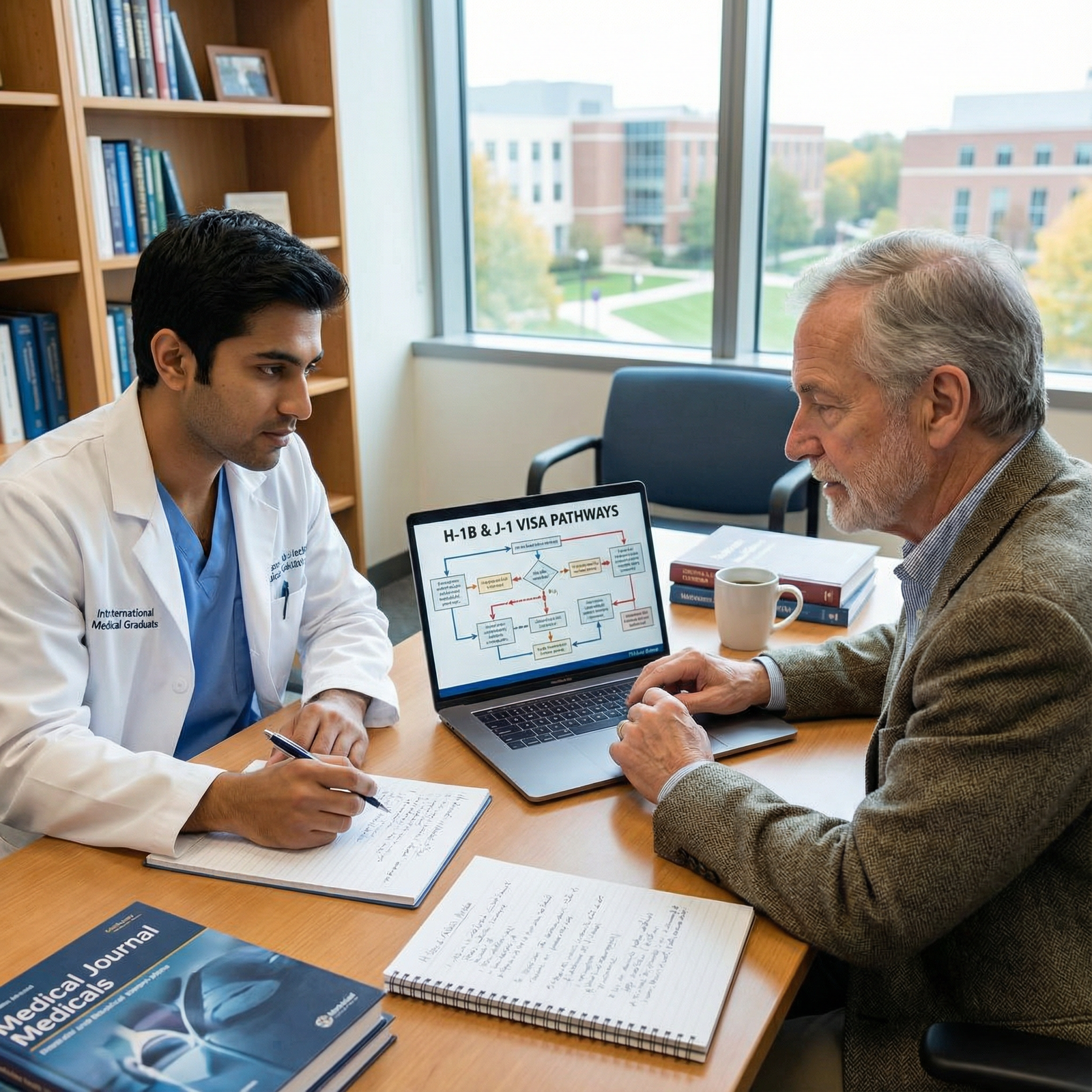
Understanding the Visa Landscape for Caribbean IMGs
For a Caribbean medical school graduate hoping to match into a Great Lakes residency program, understanding visa navigation is just as critical as polishing your personal statement or USMLE scores. Programs in the Great Lakes region (Michigan, Ohio, Illinois, Indiana, Wisconsin, and surrounding states) vary widely in how they sponsor international medical graduates (IMGs) and what they prefer in the J-1 vs H-1B discussion.
This article will walk you through:
- How visas interact with the residency match process
- Key differences between J-1 and H-1B visas
- How Caribbean medical school graduates (including SGU, Ross, AUC, etc.) can strategically build a residency list in the Great Lakes region
- Common pitfalls and practical ways to advocate for yourself
You should think of “visa navigation” as part of your overall application strategy, not a separate afterthought. Too many strong Caribbean applicants lose potential interviews simply because they apply blindly to programs that do not sponsor their visa type.
Core Visa Options for Residency: J-1 vs H-1B
Most Caribbean IMGs entering residency in the US will train on one of two visa types:
- J-1 Exchange Visitor (ECFMG-sponsored physician category)
- H-1B Temporary Worker (Specialty Occupation)
Understanding J-1 vs H-1B—and which is realistic for you—is essential when targeting Great Lakes residency programs.
J-1 Exchange Visitor Visa
The J-1 is the most common residency visa for IMGs, including those from Caribbean medical schools.
Key features:
- Sponsored by ECFMG, not by the individual residency program (though the program must agree to host you)
- Used for graduate medical education (residency and fellowship)
- Duration: typically matches the length of ACGME-accredited training, with extensions possible for fellowship
- Two-year home residency requirement (INA 212(e)): You must return to your home country or country of last permanent residence for two years after training before certain US immigration benefits (like H-1B or permanent residency) unless you obtain a waiver
Advantages:
- Widely accepted: Most IMG-friendly programs in the Great Lakes region are comfortable with J-1 sponsorship
- Streamlined process: ECFMG is highly experienced; the process is well defined
- Less burden on programs: No prevailing wage or complex petition like the H-1B, making some programs more open to considering J-1 candidates
Disadvantages / Considerations:
- The two-year home requirement can complicate long-term US plans if you do not obtain a J-1 waiver
- Less flexibility to moonlight (varies by institution and state licensing rules)
- You are tied to training/research; not a dual-intent visa (not directly designed as a pathway to permanent residence)
For many Caribbean IMGs, especially those early in their planning, the J-1 is the most realistic and broadly available route into a US residency program.
H-1B Temporary Worker Visa
The H-1B is a temporary employment visa for specialty occupations and is sometimes used in residency and fellowship training.
Key features:
- Employer-sponsored (the residency program is your H-1B petitioner)
- Dual-intent (you can pursue permanent residency while on H-1B)
- Requires you to be USMLE Step 3 passed and state license-eligible before the H-1B can start
- Residency programs must meet prevailing wage and other Department of Labor requirements
Advantages:
- No two-year home residency requirement
- Dual-intent: more straightforward for later green card pathways
- Some flexibility in transitioning to non-training employment
Disadvantages / Constraints:
- Fewer Great Lakes residency programs sponsor H-1B, particularly for categorical positions
- Administrative and financial burden on the program (legal fees, wage requirements)
- Timing challenges: You must have Step 3 passed early enough and licensing pieces in place
- Often limited to highly competitive candidates with strong USMLE scores and significant US clinical experience
For Caribbean medical school residency applicants, especially those from SGU, Ross, or other well-known schools with good documentation and USMLE support, H-1B is possible but should be treated as a targeted strategy, not the default assumption.
How Visa Strategy Interacts with the Residency Match
Visa issues shape your application plan from ERAS submission to the rank list—and even beyond, if you plan to stay in the US long-term.
Before ERAS: Clarify Your Status and Timeline
Before you begin applying:
Confirm Your Citizenship and Residency:
- Are you a citizen of a Caribbean country?
- Do you have permanent residence elsewhere (e.g., Canada or the UK)?
- Are you already in the US on F-1, B-1/B-2, or another status?
Know Your Graduate Status:
- Are you an SGU residency applicant graduating this year, or an older Caribbean graduate?
- Do you need to consider visa gaps (time between graduation and Match)?
Define Your Visa Priority:
- Are you open to J-1 and willing to pursue a waiver later?
- Are you strongly preferring H-1B because of family plans, prior immigration history, or past J-1 status?
- Are there any ineligibilities for J-1 or H-1B (e.g., prior J-1 two-year rule not fulfilled)?
Your answers determine how wide your residency net can be in the Great Lakes region.
During Application Season: Targeting Programs Wisely
A common problem among Caribbean IMGs is applying broadly without screening programs for visa policies. This can be costly and ineffective.
Action Steps:
Use Program Websites and FREIDA:
Look for statements like:
- “Sponsorship of J-1 visas only”
- “Sponsorship of both J-1 and H-1B visas”
- “We do not sponsor visas”
- “Only permanent residents and US citizens considered”
Create Separate Lists:
Have three working lists for Great Lakes residency programs:
- List A – J-1 Friendly Programs: Programs that clearly sponsor J-1 and regularly take IMGs.
- List B – J-1 + H-1B Possible: Programs that state they sponsor both or have done H-1Bs in the past.
- List C – Unclear or No Visa: Programs whose policies are vague or appear not to sponsor.
Caribbean medical school residency applicants should ensure that List A is robust, particularly in Great Lakes states where many community and university-affiliated programs are J-1 friendly.
Match Your Profile to Program Type:
- Highly competitive IMG (strong USMLEs, significant US clinical experience, excellent letters, maybe dual degrees):
You can target more H-1B-friendly academic centers, especially in large cities (Chicago, Cleveland, Detroit, Milwaukee). - Average Caribbean IMG profile:
Focus heavily on strong J-1 programs where IMGs have a consistent presence, and treat H-1B as a “bonus,” not a primary filter.
- Highly competitive IMG (strong USMLEs, significant US clinical experience, excellent letters, maybe dual degrees):
Interview Season: Addressing Visa Questions
During interviews, you may be asked about visa needs.
How to respond strategically:
If you are open to J-1, say so clearly:
“I am an international graduate and will require visa sponsorship. I am fully open to J-1 sponsorship and understand the two-year home residency requirement and waiver process.”If you prefer H-1B but will accept J-1, be honest yet flexible:
“My preference would be H-1B if available, but I am fully open to J-1 sponsorship and am committed to meeting all requirements.”If you’re firm on H-1B only, you should have already tailored your applications accordingly:
“I am specifically seeking H-1B sponsorship due to [brief, factual reason], and I am prepared with USMLE Step 3 and licensing steps.”
Programs appreciate clarity and flexibility. A rigid stance without exceptional credentials can be a red flag.
Visa Realities in the Great Lakes Region
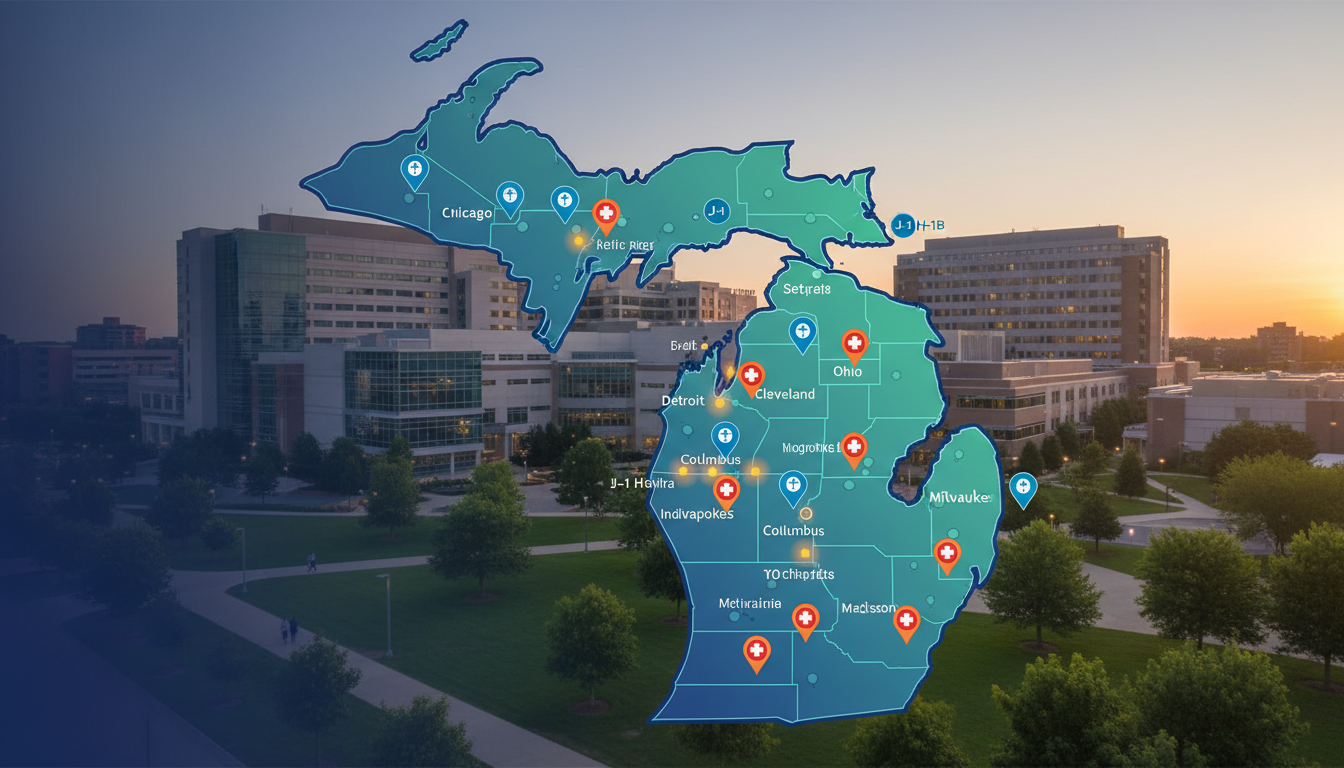
The Great Lakes region includes a mix of large academic centers, mid-size university-linked hospitals, and community-based Midwest residency programs. Understanding regional trends helps you design a realistic plan.
General Trends for Caribbean IMGs in Great Lakes Programs
J-1 Dominates for IMGs:
Most Caribbean IMGs in Great Lakes residency positions are on J-1s, especially in internal medicine, family medicine, pediatrics, and psychiatry.H-1B Mainly at Larger Centers:
H-1B sponsorship is more common at:- Large academic institutions (e.g., university hospitals in Chicago, Cleveland, Ann Arbor, Madison)
- Certain subspecialty-heavy programs with strong institutional immigration infrastructures
Community Programs Often J-1 Only:
Many smaller or purely community-based hospitals in the Midwest region may sponsor J-1 only, citing cost and logistical reasons.
State-by-State Nuances (Great Lakes Focus)
Illinois (Chicago and beyond)
- Numerous university and community-affiliated programs
- Many hospitals comfortable with J-1; a subset (especially major academic centers) consider H-1B, typically for high-performing candidates
- Chicago is highly competitive; strong Caribbean IMGs (including SGU residency match success stories) often cluster here
Michigan
- Good number of IMG-friendly programs, many of which are J-1 sponsors
- Some major systems (in Detroit, Ann Arbor, Grand Rapids) have established immigration offices and may sponsor H-1B in select circumstances
- In smaller cities, expect J-1 to be the main option
Ohio
- Strong presence of large academic and community programs (Cleveland, Columbus, Cincinnati, Toledo, Akron)
- J-1 is widely used; H-1B possible at major centers with established IMG presence
- Some mid-size community programs in Ohio are known for open attitudes toward Caribbean medical school residency applicants
Wisconsin
- Fewer total programs compared to Illinois or Ohio, but several well-structured academic centers
- J-1 sponsorship is generally available; H-1B may be limited to specific departments or candidates with strong research/academic ties
Indiana and Surrounding States
- Primarily J-1 for IMGs, with occasional H-1B sponsorship at major university hospitals
- Community programs that participate in the Great Lakes residency ecosystem often want stable J-1 sponsorship pathways
Building a Visa-Smart Program List as a Caribbean IMG
Your program list is where immigration reality meets career ambition. The goal: maximize interview chances while aligning with your visa needs.
Step 1: Decide Your Visa Flexibility
Use this quick self-classification:
Flexible (J-1 or H-1B acceptable):
- You prioritize matching somewhere in the US over a particular visa type
- You’re willing to pursue a J-1 waiver later if needed
Prefer H-1B, Accept J-1:
- You would like H-1B for long-term planning but won’t risk not matching
- Common among Caribbean IMGs with family ties or long-term US goals
H-1B Only (or J-1-ineligible):
- You have specific personal or immigration reasons to avoid J-1
- This narrows your options considerably; you must be strategic and competitive
Step 2: Overlay Your Profile
Consider:
- USMLE Step 1/2 CK scores (even in pass/fail era, context matters)
- Number and quality of US clinical experiences (electives, sub-Is, observerships)
- Time since graduation
- Research and publications
- Letters of recommendation from US faculty, especially in the Great Lakes region
Practical example:
Candidate A: Recent SGU graduate, Step 2 CK 244, strong IM letters from Chicago rotations, 1 research poster
- Visa: Open to J-1, prefers H-1B
- Strategy: Broad applications to J-1-friendly internal medicine programs across the Great Lakes plus targeted H-1B programs at major academic centers in Illinois and Ohio
Candidate B: Caribbean grad 5 years out, average scores, few US rotations, primarily Caribbean experience
- Visa: Needs J-1 (H-1B unlikely due to profile)
- Strategy: Heavily focus on IMG-friendly community internal medicine and family medicine programs across Midwest residency programs known to sponsor J-1, minimize applications to historically H-1B-only or highly competitive programs
Step 3: Apply Visa Filters to Your Program Research
When reviewing each program:
- Check FREIDA: Visa sponsorship section
- Visit the program website: Look for explicit visa language
- Examine current residents’ bios:
- If many are international graduates, particularly Caribbean, the program is likely open to J-1
- If several mention H-1B or non-US backgrounds, the program might support H-1B in selected cases
Create a simple spreadsheet:
| Program | City/State | Hospital Type | Visa | IMG % | Caribbean IMG present? | Notes |
|---|---|---|---|---|---|---|
| Example IM Program | Chicago, IL | University-affiliated | J-1 only | 40% | Yes (SGU, Ross) | Strong for Caribbean IMGs |
| Example FM Program | Toledo, OH | Community | J-1 & H-1B | 30% | 1 SGU grad | H-1B possible for strong applicants |
This structured approach helps you avoid wasting ERAS applications on programs that would never consider your visa profile.
Planning Beyond Residency: J-1 Waivers and Long-Term Options
Your initial residency visa is only part of the story. Caribbean IMGs should think early about what happens after training—especially if they choose J-1.
The J-1 Two-Year Home Requirement and Waivers
If you train on a J-1 physician visa, you are generally subject to the two-year foreign residency requirement. Many IMGs fulfill this requirement via a J-1 waiver, allowing them to stay and work in the US under H-1B instead of returning home.
Common waiver pathways:
Conrad 30 Waiver (State-Based):
- Each state can sponsor up to 30 J-1 physicians per year to work in underserved areas
- Great Lakes states (like Ohio, Michigan, and Wisconsin) often have strong Conrad 30 programs
- Candidates agree to work 3 years in a designated underserved area (often primary care or needed specialties)
Federal Waiver Programs:
- VA (Veterans Affairs), HHS, or other federal agencies can sponsor waivers for certain positions
- Less common but important for certain specialties and research tracks
Hardship or Persecution Waivers:
- If returning home would cause exceptional hardship to a US citizen/permanent resident spouse or child, or if you’d face persecution
- Legal heavy-lift and case-specific; requires immigration counsel
If you are a Caribbean IMG on J-1, keep a long-term eye on which Great Lakes states tend to have robust waiver programs and attractive underserved practice opportunities. This may influence your choice of residency location.
H-1B to Permanent Residence Pathways
For those on H-1B:
- After residency (and often fellowship), many physicians are sponsored by employers for employment-based permanent residency (EB-2, sometimes NIW – National Interest Waiver)
- Great Lakes academic centers and large health systems often have legal departments experienced in physician green card processing
- Being in a medically underserved area or doing research in areas of national need can enhance long-term options

Practical Tips and Common Pitfalls for Caribbean IMGs
Practical Tips
Start Visa Planning Early (Pre-ERAS Year):
- Attend webinars by ECFMG or your Caribbean medical school’s alumni office about residency visa options
- Speak with recent graduates who matched into Great Lakes residency programs and ask exactly what visas their programs supported
Leverage Alumni Networks:
- For example, if you’re from SGU, look at SGU residency match lists in the Great Lakes and identify where Caribbean graduates have matched historically
- Reach out respectfully to alumni on LinkedIn or via alumni offices to ask about their residency visa and institutional attitude toward IMGs
Prepare Documentation in Advance:
- Have your passport, degree, ECFMG certificate, and other documents readily available to avoid delays once you match
- Keep track of all evaluations and rotation documents; some state licenses in the Midwest can be paperwork-heavy
Be Transparent but Strategic:
- Don’t hide your visa needs or try to appear “easier” by being vague
- Instead, show that you understand the process, are flexible when possible, and are prepared to handle paperwork efficiently
Stay Updated on Policy Changes:
- Immigration policy around IMGs, J-1 waivers, and H-1B caps evolves
- Follow reputable immigration resources, ECFMG updates, and institutional announcements
Common Pitfalls to Avoid
Applying Blindly to Non-Sponsoring Programs:
- Many Caribbean IMGs waste money applying to programs that clearly state “No visa sponsorship” or “US citizens and permanent residents only”
Ignoring Step 3 Timing for H-1B Hopefuls:
- If you want H-1B for PGY-1, you must have Step 3 passed early enough (often by January/February before Match) to ensure paperwork can proceed
- Without this, many programs will not consider H-1B, no matter how strong you are
Being Unrealistic About H-1B Availability:
- A mid-tier Caribbean IMG applying mostly to H-1B-only programs in big cities is at high risk of going unmatched
- Always keep a realistic base of J-1-friendly programs unless you truly cannot take J-1
Not Considering Life After Residency:
- Accepting a J-1 without understanding waiver requirements can lead to stress in PGY-3
- Start learning early about Conrad 30 and underserved opportunities in the Great Lakes if you think you’ll want to stay in the region
FAQ: Visa Navigation for Caribbean IMGs in the Great Lakes Region
1. As a Caribbean IMG, is it safer to aim for a J-1 or an H-1B for residency?
For most Caribbean IMGs, especially those without exceptional profiles or time for early Step 3, J-1 is the more realistic and widely available option. Great Lakes residency programs often have established J-1 processes and familiarity with ECFMG. H-1B is best viewed as a targeted strategy for highly competitive applicants or those with compelling reasons and early Step 3 completion.
2. Do Great Lakes residency programs prefer SGU or specific Caribbean schools for visa sponsorship?
Most programs officially evaluate all Caribbean schools similarly, focusing on individual performance rather than school brand. However, well-established schools like SGU, Ross, and AUC may have more alumni in certain Great Lakes residency programs, making faculty and administration more comfortable with their documentation and training style. This doesn’t guarantee sponsorship, but it can help. Visa decisions are primarily institutional, not school-specific.
3. Can I switch from J-1 to H-1B during residency if I start on J-1?
In general, no. Once you begin residency on a J-1 physician visa, you are expected to complete your training in J-1 status. To change to H-1B in the US, you would typically need to address the two-year home residency requirement first (either by fulfilling it or obtaining a waiver). Some complex exceptions exist but are rare and require legal counsel. Plan as if you will remain J-1 for the entire residency/fellowship pathway, then shift to H-1B after a waiver.
4. How early should I contact programs about my visa needs?
You usually do not need to contact programs before applying just to state your visa type; program websites and FREIDA details usually suffice. However, if their visa policy is unclear and you are investing many applications in that specialty/region, a brief, professional email after submitting ERAS is reasonable. During interviews, you should be ready to clearly and confidently discuss your visa needs and flexibility.
Navigating residency visas as a Caribbean IMG in the Great Lakes region is challenging but manageable with planning, research, and realism. By understanding J-1 vs H-1B, aligning your expectations with your profile, and targeting Midwest residency programs strategically, you can turn “visa” from a source of anxiety into a structured part of your path to training in the United States.