
Understanding the Visa Landscape for Caribbean IMGs in the Northeast Corridor
If you are a Caribbean international medical graduate aiming for an internal medicine, pediatrics, family medicine, psychiatry, or other residency in the Northeast Corridor (Boston to Washington, DC), your visa strategy is just as important as your board scores, letters, and personal statement.
Programs in states like Massachusetts, New York, New Jersey, Pennsylvania, Maryland, Connecticut, and DC receive thousands of applications, heavily from IMGs. For many programs in this region, visa sponsorship policy is a hard screen—you may never be reviewed if you don’t match their visa criteria.
For Caribbean medical school residency applicants—especially from schools like SGU, AUC, Ross, Saba, and others—understanding J-1 vs H-1B visa pathways, IMG visa options, and how Northeast residency programs think about sponsorship will directly affect how you build your ERAS list and rank order list.
This guide focuses specifically on:
- Caribbean IMGs applying to northeast residency programs
- Visa navigation during residency match and applications phase
- Practical steps to maximize chances for a successful residency visa outcome
Core Visa Options for Caribbean IMGs: J-1 vs H-1B
Your main residency visa choices as an IMG are:
- J-1 (ECFMG-sponsored Exchange Visitor)
- H-1B (Employment-based Specialty Occupation)
- Less commonly: O-1 or green card-based pathways
Understanding the J-1 vs H-1B trade-offs early will help you filter where to apply and how to talk with programs during interviews.
J-1 Visa (ECFMG-sponsored): The Default for Most IMGs
For the vast majority of Caribbean IMGs, especially those targeting the Northeast Corridor, the J-1 is the most realistic and frequently used pathway.
Key Features:
- Sponsored by ECFMG, not directly by the hospital
- Specifically designed for graduate medical education (GME)
- Valid for the duration of residency and most fellowships (with annual renewals)
- Widely accepted and familiar to programs in New York, New Jersey, Pennsylvania, and beyond
Pros:
- Most common and predictable: Many northeast residency programs are “J-1 only”
- Programs are very comfortable with J-1 logistics
- Sponsorship process is well-defined, with clear ECFMG guidelines
- Often less administrative burden on the hospital than H-1B
Cons:
- Two-year home-country physical presence requirement (the “2-year rule”) after training
- You must return to your country of last permanent residence (not necessarily where your Caribbean medical school is located) for at least two years
- Unless you obtain a J-1 waiver (e.g., Conrad 30 or other underserved-area waiver)
- Ties you into a future service obligation in underserved areas if you pursue a waiver
- Less flexibility for moonlighting/side jobs depending on program policies
Who typically uses J-1?
- Caribbean IMGs without US permanent residency or citizenship
- Graduates of SGU, Ross, AUC, Saba, etc., seeking primary care or hospital-based specialties in the Northeast
- IMGs who do not yet have Step 3 or are not strong H-1B candidates
H-1B Visa (Employment-based Specialty Occupation): More Selective, More Complex
The H-1B is a work visa category for specialty occupations, including physicians in residency and fellowship.
Key Features:
- Sponsored directly by the residency program/hospital
- Requires you to be fully ECFMG-certified and have passed USMLE Step 3 before starting residency (most programs require Step 3 by rank order or contract signing)
- Not all programs will sponsor H-1B due to cost, complexity, or institutional policy
Pros:
- No automatic two-year home-country physical presence requirement
- Easier transition to O-1 or green card after residency
- More flexibility for career planning in the US after training
- Often seen as more “stable” from a long-term immigration standpoint
Cons:
- Fewer programs in the Northeast Corridor offer H-1B, especially for IMGs
- Higher administrative and legal cost for institutions; some limit this to highly competitive or strategic recruits
- You must have Step 3 completed early (ideally before ERAS or at least before rank lists)
- Some academic centers (especially in New York and Massachusetts) have institutional policies favoring J-1 for residents
Who typically uses H-1B?
- IMGs with strong academic credentials, often with research experience or publications
- Applicants with US ties, prior H-1B status, or a long-term plan to remain in the US
- Some subspecialty fellowship positions at major Northeast academic hospitals (e.g., in Boston, NYC, Philly, Baltimore)
Other, Less Common Pathways
While J-1 vs H-1B will cover nearly all Caribbean IMGs, it’s helpful to be aware of:
- O-1 Visa (Extraordinary Ability)
- For candidates with an exceptional research or academic record (substantial publications, major awards, high-profile positions)
- Occasionally used for physician-scientists at top-tier institutions
- Green Card / Permanent Residency
- If you already have US permanent residency (through family, employment, or diversity lottery), you do not need a J-1 or H-1B for residency
- Some residents transition to a green card mid-training (usually those on H-1B; J-1 is more complex due to the 2-year rule)
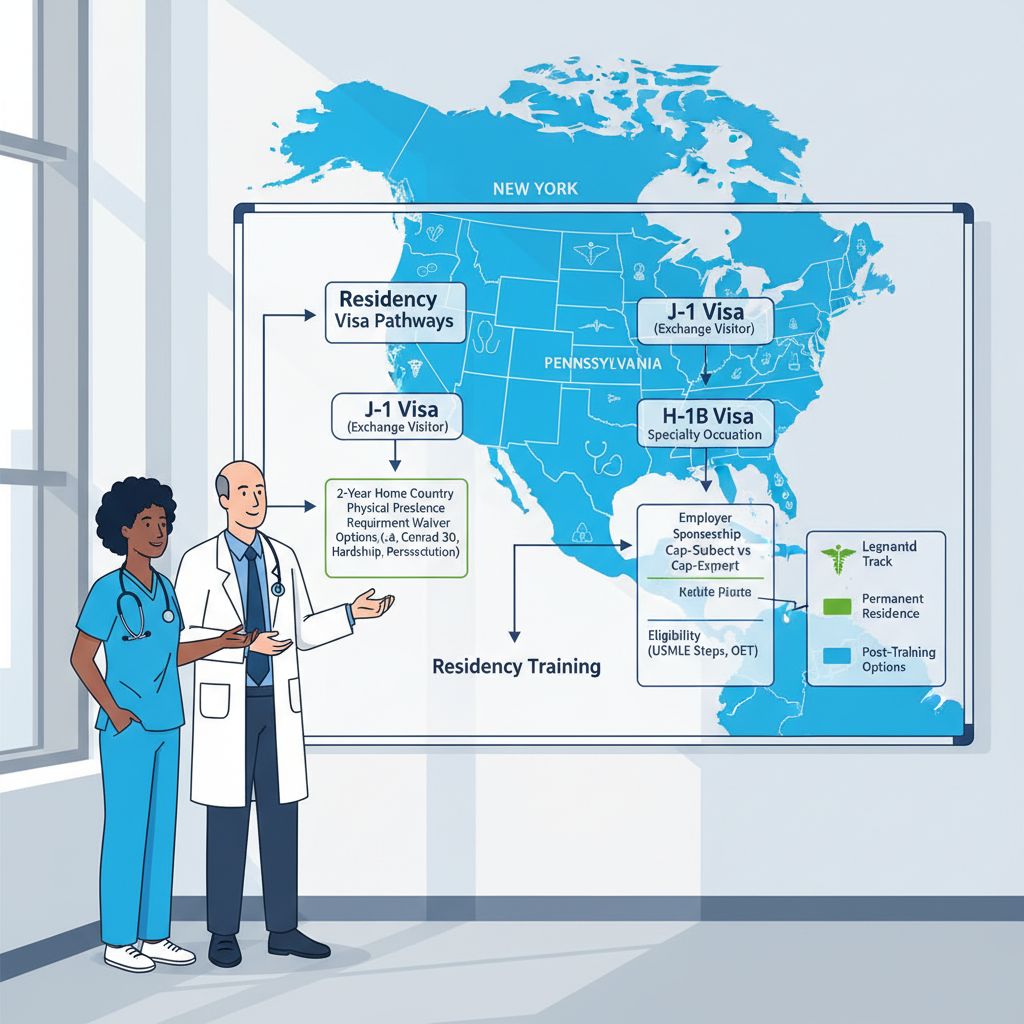
How Northeast Residency Programs View Visa Sponsorship
Every program has its own visa policy, and the Northeast Corridor is highly heterogeneous. A community hospital in New Jersey will not have the same rules as a large academic center in Boston or Manhattan.
Common Visa Policies in Northeast Residency Programs
You’ll see combinations like:
- J-1 only
- J-1 or H-1B (case by case)
- H-1B only (rare for incoming residents)
- No visa sponsorship (US citizens/green card holders only)
For a Caribbean medical school residency applicant, the distinctions matter:
- Many community-based internal medicine and family medicine programs in NY/NJ/PA routinely sponsor J-1 and are IMG-friendly.
- Some university-affiliated hospitals accept J-1 only and are strict about this (e.g., many academic anesthesiology, radiology, or surgical programs).
- A limited number of programs, often more competitive or subspecialty-oriented, are willing to sponsor H-1B, typically for applicants with Step 3 completed and strong credentials.
SGU Residency Match and Visa Patterns in the Northeast
Caribbean schools like St. George’s University (SGU) have large graduating classes and robust match lists heavy in east coast residency placements. For SGU residency match data in the Northeast:
- The majority of SGU graduates matching in New York, New Jersey, Pennsylvania, and Connecticut usually go on J-1 visas.
- A smaller subset, often those with exceptional profiles or early Step 3 completion, secure H-1B positions in internal medicine, psychiatry, or other fields at selective universities or strong community programs.
- Many northeastern programs are now very familiar with SGU, Ross, and other Caribbean IMGs, and have streamlined J-1 workflows for them.
How Programs Decide J-1 vs H-1B
Decisions are driven by:
- Institutional policy: Some hospital systems have blanket rules (e.g., “Only J-1 for residents,” or “We do not sponsor visas for PGY-1”).
- Cost and administration: H-1B requires legal fees, more complex filings, and sometimes prevailing wage issues.
- Timeline: H-1B processing must fit the residency start date; delays can be problematic.
- Candidate value: For an exceptional candidate (strong scores, research, leadership, unique skillset), programs may be more willing to go through H-1B sponsorship.
Practical Step: How to Check a Program’s Visa Policy
Before you submit ERAS, you should:
Review the program’s website
- Look specifically under “International Medical Graduates” or “Application Requirements.”
- Look for explicit terms: “J-1 only,” “ECFMG-sponsored J-1,” “H-1B not sponsored,” or “H-1B considered.”
Check FREIDA and program filters
- FREIDA (AMA) and other directories sometimes list visa types sponsored.
- Cross-check with the program’s official site since FREIDA can be outdated.
Email the program coordinator (if unclear)
Example:Dear [Coordinator Name],
I am an international medical graduate from a Caribbean medical school and am very interested in your internal medicine residency program. I wanted to confirm your current policy on visa sponsorship for incoming PGY-1 residents (specifically regarding J-1 and H-1B).
Thank you for your time,
[Your Name]Use word of mouth
- Speak with current residents (especially other Caribbean IMGs) via LinkedIn, alumni networks, or social media groups.
Strategic Planning: Matching Visa Choice to Your Profile and Goals
Your optimal residency visa plan depends on three major variables:
- Your immigration background
- Your academic and exam profile
- Your long-term career goals in the US
Step 1: Clarify Your Current Immigration Status
Ask yourself:
- Are you a citizen or permanent resident of any country other than the US? (nearly always yes for Caribbean IMGs)
- Do you already have:
- A US green card?
- A US work visa through another route (e.g., H-4 EAD, dependent of H-1B)?
- What is your country of last permanent residence? (this matters for J-1 2-year rule and potential waivers later)
If you already have:
- US green card or citizenship → You do not need a residency visa. Focus purely on program fit.
- A nonimmigrant status with work authorization (e.g., DACA, certain EADs) → You may still be asked to use a J-1; discuss early with programs.
Step 2: Honestly Assess Your Competitiveness
For Caribbean IMGs targeting H-1B, programs generally expect:
- Strong USMLE scores, especially Step 2 CK
- No major red flags (failures, long gaps)
- US clinical experience with strong letters of recommendation
- Preferably Step 3 already passed before interviews or before rank order list submission
If your profile is more moderate (average scores, limited research, typical Caribbean pathway):
- Your best strategy is usually to target J-1 friendly programs in IM, FM, peds, psych, etc.
- Focus on building a robust application rather than chasing H-1B at all costs.
Step 3: Align with Long-Term Career Goals
Ask: “Where do I want to be 5–10 years after residency?”
If you are flexible and open to serving in an underserved area for a few years (which can be rewarding and well-paid):
- J-1 → Waiver → H-1B → green card is a very common path for IMGs.
- Many Caribbean IMGs follow this route via Conrad 30 and end up practicing long-term in the US, often in East Coast or nearby states.
If you strongly prefer academic careers in major urban centers (Boston, NYC, Philly, DC) and wish to minimize service obligations:
- An H-1B from residency may be preferable, but harder to secure.
- Alternatively, J-1 with a post-residency strategy to look for academic J-1 waivers or federal waiver programs (e.g., VA, certain research or underserved academic roles)—these are more complex and competitive.

Tactical Steps for Caribbean IMGs During Application Season
This section focuses on what you should do from ERAS submission through Match Day, specifically around your residency visa strategy.
1. Build a Visa-Aware Program List
You should categorize programs into:
- Category A: J-1 friendly, IMG-friendly
- Category B: J-1 + H-1B considered, IMG-friendly
- Category C: Ambiguous/variable visa policies
- Category D: No visa sponsorship
For a typical Caribbean IMG applying to northeast residency programs (IM, FM, peds, psych):
- The bulk of your list should be Category A and B.
- Use school match lists (e.g., prior SGU residency match lists), FREIDA, and IMG forums to identify where Caribbean graduates have matched on J-1 or H-1B in recent years.
Practical tip:
Create a spreadsheet with columns:
- Program name
- City/State (NY, NJ, PA, MA, CT, MD, DC)
- Visa policy (J-1 only, J-1 & H-1B, unclear, none)
- Historical Caribbean IMG presence (yes/no, likely from your school’s match list)
- Your personal ranking of interest
2. Decide Early on Step 3 (If Aiming for H-1B)
If you are realistically aiming for H-1B:
- Plan to take Step 3 before ERAS or as early as possible in the application cycle.
- Many H-1B-sponsoring programs require Step 3 results before ranking or before issuing a contract.
If Step 3 isn’t feasible before application:
- You can still mention in your CV and interviews:
“I plan to take Step 3 by [month/year], and I am actively preparing.”
However, recognize that delayed Step 3 makes H-1B sponsorship less likely, especially in competitive Northeast markets.
3. How to Talk About Visas on ERAS and in Interviews
On ERAS:
- Be honest and consistent about your citizenship and need for visa sponsorship.
- Do not attempt to “hide” visa needs; it will emerge later and can cause problems.
In interviews:
If a program clearly states “J-1 only,” do not aggressively push for H-1B.
You can say:“I am fully comfortable training on a J-1 visa and am familiar with the waiver process after residency.”
If a program is J-1 + H-1B:
- You can express openness while signaling you are realistic:
“I understand that your program sponsors both J-1 and H-1B visas. I would be grateful for either option and am willing to follow the pathway most feasible for your institution. I have completed [or plan to complete] Step 3 by [date], which I understand can be helpful for H-1B.”
- You can express openness while signaling you are realistic:
If asked directly what you prefer (J-1 vs H-1B):
- Consider a balanced answer:
“From a long-term perspective, H-1B might align better with my career goals, but I understand that institutional policies and feasibility are critical. I am very open to J-1 sponsorship and would be grateful for any option that allows me to train in your program.”
- Consider a balanced answer:
4. Red Flags to Avoid
- Inconsistently stating your visa preference to different programs or in different documents.
- Insisting on H-1B at programs that clearly do not offer it; this can get you filtered out.
- Not understanding the basics of IMG visa options—you should be able to answer simple J-1 vs H-1B questions confidently.
After the Match: From Residency Visa to Long-Term Plans
Once you match into an east coast residency, your visa journey is not over. You must convert your Match result into a timely, valid visa and then look ahead to post-residency options.
J-1 Residents: Immediate and Long-Term Considerations
Before PGY-1 start:
- You and your program will work with ECFMG to obtain your J-1 sponsorship and DS-2019.
- You will attend a US embassy or consulate for your J-1 visa interview, unless you are already in the US and can change status.
During residency:
- You must maintain valid J-1 status (annual renewals, maintain training status, etc.).
- You are tied to your training site(s), with limited flexibility for outside employment.
After residency (and fellowship, if applicable):
You face the 2-year home-country physical presence requirement unless you secure a waiver. The most common path for Caribbean IMGs in the Northeast is:
Conrad 30 Waiver Program (J-1 Waiver Clinical Service)
- Each state (including many in the Northeast and nearby regions) can sponsor up to 30 J-1 physicians per year to work in underserved areas.
- Most positions are in primary care, psychiatry, and some specialty fields.
- The job typically must be full-time, in a designated shortage area, and you commit to 3 years.
Other waiver options (federal agencies, VA, etc.)
- Less common, often more competitive, sometimes in academic settings.
- These are attractive if you want to remain in a major metropolitan region (e.g., NYC, Boston, DC), but opportunities are fewer.
Fulfilling the 2-year requirement abroad
- Often not ideal for those planning a long-term US career.
- Some physicians do a hybrid path (work partially abroad; pursue research or other opportunities).
H-1B Residents: Pathway to Stability
If you start residency on an H-1B:
- You are already in a dual-intent, employment-based category.
- You may be able to transition to a new H-1B employer after residency (e.g., hospitalist, academic job) without a J-1 waiver.
- Employers can often file for a green card (EB-2 or EB-3) during or shortly after residency or fellowship.
However:
- Some Northeast residency programs cap the number of H-1B residents due to cost and administrative constraints.
- H-1B processing must be carefully timed each time you change employers.
Case Examples (Northeast Focus)
Case 1: SGU Graduate, Internal Medicine, J-1 in New York
- Matched into a J-1 only IM residency at a university-affiliated program in NYC.
- Completed 3 years of IM, then a nephrology fellowship, all on J-1.
- Obtained a Conrad 30 waiver job in upstate New York in an underserved region.
- After 3 years, transitioned to H-1B and then obtained a green card through employer sponsorship.
Case 2: Ross Graduate, Psychiatry, H-1B in New Jersey
- High Step scores, Step 3 completed before ERAS.
- Matched into a H-1B-friendly psychiatry program in NJ.
- After residency, moved to a major academic center in Philadelphia on a new H-1B, and employer filed for EB-2 green card.
- Avoided the J-1 2-year requirement entirely.
Both are realistic patterns for Caribbean IMGs in the Northeast Corridor, but Case 1 is more common overall.
Frequently Asked Questions (FAQ)
1. As a Caribbean IMG, is it realistic to expect an H-1B residency visa in the Northeast?
It is possible but selective. Many northeast residency programs (especially in NY and MA) prefer or restrict to J-1 visas for residents. H-1B is more accessible if:
- You have excellent scores and a strong CV
- You complete USMLE Step 3 before or early in the application cycle
- You apply to programs known to support H-1B (often mid-sized or IMG-friendly community/university-affiliated hospitals)
Most Caribbean IMGs still train on a J-1, then pursue a waiver and transition to H-1B or green card later.
2. Do SGU, AUC, or Ross graduates have an advantage in visa sponsorship?
Caribbean schools like SGU have large alumni networks and extensive SGU residency match histories across the Northeast. Programs that regularly match SGU or other Caribbean graduates are often:
- Familiar with ECFMG J-1 sponsorship
- Comfortable with IMG visa processes
- Sometimes open to H-1B for top candidates
However, your individual application strength and the program’s current institutional policy matter far more than your school’s name alone.
3. If I accept a J-1 now, will I be stuck outside the US later?
No—but you must plan carefully. The 2-year home-country requirement can be waived through:
- Conrad 30 or other underserved-area waiver jobs (most common)
- Federal agency waivers (e.g., VA, HHS, DoD), sometimes allowing you to stay in or near major cities
- Other specialized waiver mechanisms
Many Caribbean IMGs complete residency and fellowship on J-1 in the Northeast, then take a waiver job in or near the East Coast, and eventually obtain an H-1B and green card. You are not “stuck,” but you will likely have to serve in an underserved area for several years.
4. How early should I start planning my residency visa strategy?
Ideally 12–18 months before ERAS submission. This gives you time to:
- Understand J-1 vs H-1B
- Target visa-friendly northeast residency programs
- Prepare for and schedule USMLE Step 3 (if aiming for H-1B)
- Gather information from alumni and current residents about program visa realities
Solid early planning can prevent you from wasting applications on programs that don’t fit your visa needs and help you present yourself as an informed, organized candidate.
By approaching your caribbean medical school residency journey with a clear, realistic visa navigation strategy—tailored to the Northeast Corridor and grounded in how programs actually think—you significantly improve your chance of both matching and building a sustainable long-term career in the US.