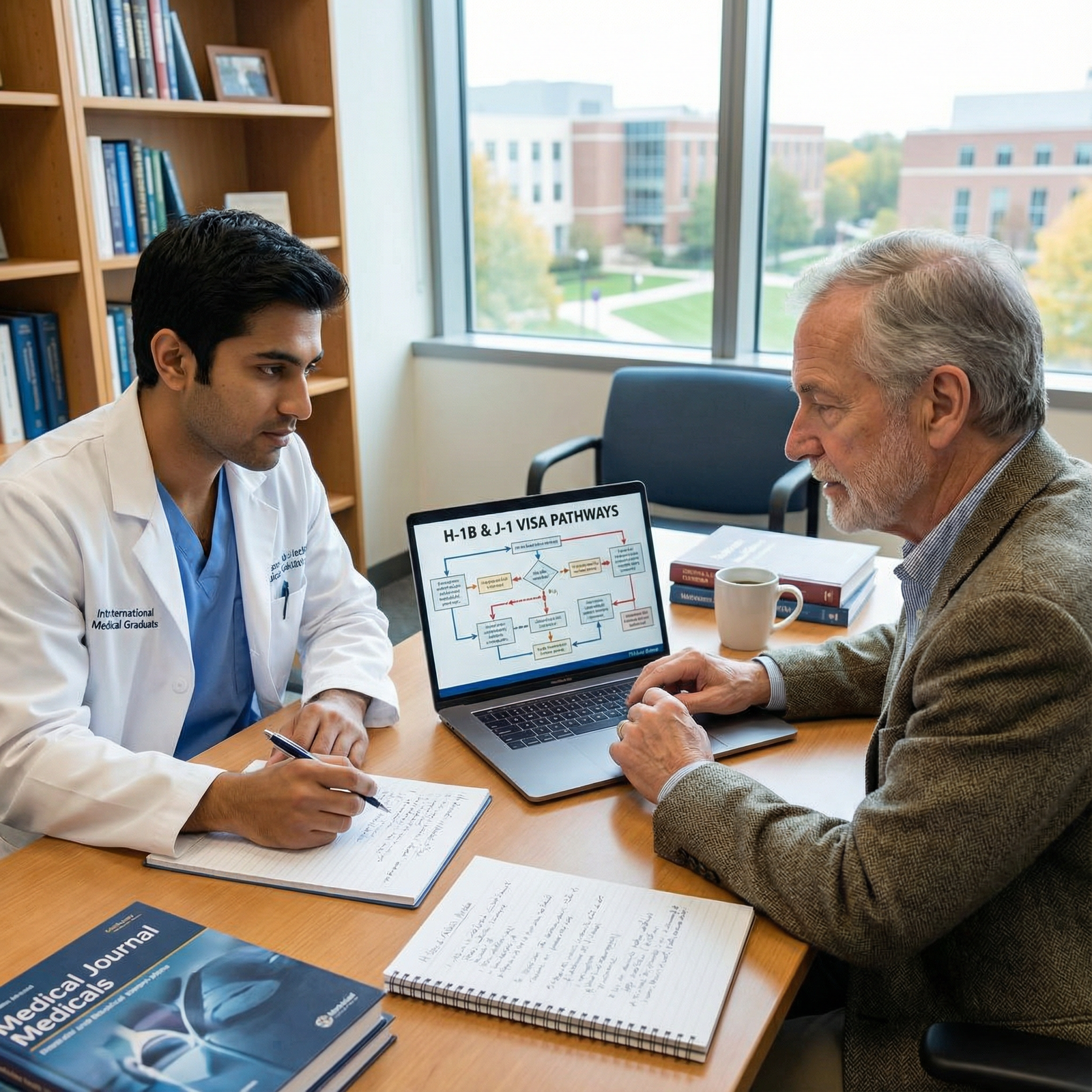
Understanding the Visa Landscape for Caribbean IMGs in NYC
For a Caribbean international medical graduate, matching into a New York City residency program often goes hand-in-hand with navigating complex U.S. immigration rules. You’re not just thinking about programs like NYC residency programs or SGU residency match outcomes—you’re also weighing IMG visa options, especially J-1 vs H-1B, and how each one affects your training and long-term plans.
New York City is one of the most IMG‑friendly regions in the United States, with a large number of training programs that routinely sponsor visas. However, not all programs sponsor the same type of visa, and not all visa types support the same career pathways. Your strategy—what documents you prepare, how you answer application questions, which programs you prioritize—should be informed by visa realities from day one of your residency application process.
This guide focuses specifically on Caribbean medical school residency applicants seeking a New York City residency, with special emphasis on:
- Which visas are used for residency (J-1 vs H-1B)
- How visa sponsorship works within NYC residency programs
- Practical steps to improve your chances as a Caribbean IMG
- Common pitfalls and FAQ
Throughout, remember that immigration rules can change; always verify current requirements on official government and ECFMG/ECFMG|FAIMER (now EPIC/EPIC+ECFMG) websites or with a qualified immigration attorney. This article is for general educational purposes, not legal advice.
Core Visa Options for Residency: J‑1 vs H‑1B
When people talk about “residency visa” sponsorship for physicians, they almost always mean one of two pathways: the J‑1 physician visa or the H‑1B specialty occupation visa. As a Caribbean IMG, these will shape both your residency experience and your post‑training options in the United States.
J‑1 Exchange Visitor (Physician Category)
The J‑1 is the most commonly used visa for international physicians in graduate medical education.
Key features
- Sponsored by: ECFMG (not the hospital directly, though the hospital must support it)
- Primary purpose: Graduate medical education (residency and fellowship)
- Max duration: Usually 7 years total for all GME in the U.S. (some exceptions)
- Full‑time training: Must be in an ACGME‑accredited residency or fellowship
Two‑Year Home Country Requirement (212(e))
The major consequence of the J‑1 is the “two‑year home country physical presence requirement”:
- After finishing all J‑1 sponsored training, you must either:
- Return to your home country (or country of last permanent residence) for a cumulative 2 years, or
- Obtain a waiver of this requirement (often via a J‑1 waiver job in an underserved area)
- While subject to this rule, you cannot:
- Change to certain visa categories in the U.S. (such as H‑1B or L‑1)
- Obtain permanent residency (“green card”)
- Adjust status to certain other non‑immigrant categories
Most Caribbean IMGs are ultimately aiming for a U.S. career, so the key question is: Can I realistically secure a J‑1 waiver job later? In many specialties—particularly primary care—it is possible, but it requires planning.
Advantages of J‑1 for Caribbean IMGs
- Widely available: Most New York City residency programs that sponsor visas will at least sponsor J‑1. This significantly expands your program list.
- Standardized process: ECFMG coordinates the process and requirements across institutions, making it predictable.
- Lower institutional burden: Administrative and financial costs for hospitals tend to be lower than for H‑1B; programs may be more willing.
Disadvantages and constraints
- Two‑year home requirement: The biggest drawback, especially if your long-term plan is permanent U.S. practice.
- Limited moonlighting: J‑1 regulations restrict employment to your sponsoring institution and approved training sites only.
- Duration limits: If you do a long residency plus fellowship, you may hit the 7‑year limit.
H‑1B Specialty Occupation Visa
The H‑1B is an employment‑based visa used for many professional fields, including physicians in residency.
Key features
- Sponsored by: The residency program/hospital directly (with attorney support)
- Purpose: Employment in a specialty occupation—here, physician in training
- Max duration: Up to 6 years total (with certain exceptions for green card processes)
- No two‑year home requirement: You can transition to other employment or immigration pathways more flexibly.
Advantages of H‑1B for Caribbean IMGs
- No 212(e) obligation: You’re not forced to return home for 2 years or secure a J‑1 waiver position.
- More direct path to long‑term U.S. practice: Easier to transition to employment‑based green card or another H‑1B position after residency.
- Potentially more flexibility for post‑residency plans: You can move directly into fellowships or attending roles that sponsor H‑1B or permanent residency.
Disadvantages and constraints
- Less widely available: Many NYC residency programs do not sponsor H‑1B for residents, especially in competitive specialties.
- Higher institutional burden: Legal fees, filing costs, and paperwork are significant; some institutions avoid H‑1B for this reason.
- USMLE Step 3 requirement: Most hospitals require you to have passed USMLE Step 3 before they will file an H‑1B petition for residency.
- Cap issues: Some hospitals are “cap‑exempt,” but others are “cap‑subject,” which can complicate timing and availability.
J‑1 vs H‑1B: Strategic Comparison for NYC Caribbean IMGs
For a Caribbean medical school residency applicant, especially from schools like SGU (St. George’s University), AUC, Saba, or Ross, the trade‑offs often look like this:
Maximizing match chances:
- Being open to J‑1 dramatically increases the number of NYC residency programs that can consider you.
- Limiting yourself to H‑1B only can narrow your options to a small subset of IMG‑friendly hospitals.
Long‑term U.S. career plans:
- H‑1B is usually more desirable if you want a direct route to U.S. practice and eventual permanent residency.
- J‑1 is workable if you are ready to commit to a J‑1 waiver job after training (often in a less urban or underserved setting).
Practical advice:
Most Caribbean IMGs aiming for New York City residency should remain open to both visa options, while strategically strengthening their profile (Step 3, strong scores, clinical performance) to be competitive for H‑1B‑sponsoring programs.

How Visa Sponsorship Works in New York City Residency Programs
New York City is home to a wide range of training programs—from large academic medical centers to community hospitals. Their visa policies vary considerably.
Categories of NYC Programs by Visa Policy
You will commonly see three broad categories:
J‑1 only
- These programs sponsor only the ECFMG‑sponsored J‑1 visa.
- Often state this clearly on their website or FREIDA profile.
- Still very open to Caribbean IMGs, especially in internal medicine, family medicine, pediatrics, psychiatry, and some prelim/transitional years.
J‑1 and H‑1B
- More flexible and generally more experienced with IMGs.
- May have conditions for H‑1B sponsorship, such as:
- USMLE Step 3 passed before ranking or before starting residency
- No repeat attempts on USMLE exams (or limited number)
- Preference for U.S. clinical experience (USCE)
- These are ideal targets if you are serious about H‑1B.
No visa sponsorship
- Require U.S. citizenship, permanent residency, or other independent work authorization (e.g., certain EADs).
- Caribbean IMGs without existing work authorization should usually deprioritize these unless your status is changing soon.
Sources of Information About Visa Policies
To build an effective application strategy, you need accurate, up‑to‑date information:
Program Websites
- Look under “Eligibility,” “International Medical Graduates,” or “FAQ.”
- Keywords to search: “J‑1,” “H‑1B,” “visa sponsorship,” “ECFMG.”
FREIDA and AAMC Residency Explorer
- FREIDA often lists whether programs admit IMGs and what visas they have historically sponsored.
- Not always current—verify directly with programs.
Program Emails
- If unclear, it’s reasonable to send a brief, professional email:
- Introduce yourself (Caribbean IMG, graduation year)
- Ask specifically: “Does your program sponsor J‑1 and/or H‑1B visas for incoming residents?”
- If unclear, it’s reasonable to send a brief, professional email:
Caribbean School Match Data
- For those watching SGU residency match or other Caribbean medical school residency outcomes:
- Your school may publish annual match lists.
- Look for NYC hospitals where recent graduates have matched, then research those programs’ visa policies.
- For those watching SGU residency match or other Caribbean medical school residency outcomes:
Common NYC Hospital System Patterns (High‑Level)
While each individual program is unique, certain trends are seen across large systems:
Large academic centers (e.g., Columbia, NYU, Mount Sinai, Weill Cornell):
- Frequently sponsor J‑1.
- Some, but not all, may offer H‑1B in selected departments.
- Highly competitive; strong scores and USCE crucial.
Community hospitals affiliated with academic centers:
- Often more IMG‑friendly.
- More likely to consider Caribbean IMGs with solid USMLE scores and strong letters.
- Visa policies vary; many are J‑1 only, some offer H‑1B.
Safety‑net and city hospitals:
- Often very IMG‑friendly; regularly sponsor J‑1.
- Occasionally sponsor H‑1B, but policies may change with administration and budgets.
Actionable step: When you compile your NYC residency programs list, tag each program as:
- J‑1 only
- J‑1 + H‑1B
- No sponsorship
- Unknown (follow up)
This simple categorization helps align your application strategy with realistic IMG visa options.
Application Strategy: Aligning Your Profile with Visa Realities
Timing and USMLE Strategy
Your exam strategy influences your visa options:
USMLE Step 1 and Step 2 CK
- Essential for all residency applications.
- For Caribbean IMGs in NYC, competitive programs will expect:
- Passing scores on first attempt
- Strong Step 2 CK, especially if Step 1 is pass/fail or borderline
USMLE Step 3 and H‑1B
- For H‑1B sponsorship, many NYC residency programs require:
- Step 3 passed before the H‑1B petition is filed.
- Because the H‑1B filing process can start as early as spring before your July 1 start date, this effectively means:
- You should aim to take and pass Step 3 before March–April of your start year.
- For current students applying through ERAS:
- Decide early if H‑1B is a priority.
- Some candidates take Step 3 during the gap between graduation and residency if scheduling allows.
- For H‑1B sponsorship, many NYC residency programs require:
Practical scenario:
A 4th-year student at SGU applying to internal medicine in NYC wants H‑1B. They should:
- Take Step 3 as soon as eligible (usually after graduation and completion of some clinical time per state rules).
- Communicate with target programs early about their Step 3 plan.
- Keep in mind that failing Step 3 can hurt overall candidacy—prepare thoroughly.
Crafting Your Program List for NYC
1. Prioritize IMG‑friendly NYC residency programs
- Use school match data (e.g., SGU residency match outcomes) to identify where Caribbean graduates have matched recently.
- Filter for:
- Programs with a history of Caribbean IMGs
- J‑1 sponsorship at minimum; H‑1B if that aligns with your goals
2. Create tiers based on visa flexibility
Consider grouping programs like this:
- Tier A: NYC residency programs that openly sponsor both J‑1 and H‑1B, with documented IMG acceptance.
- Tier B: Programs that sponsor J‑1 only but are IMG‑friendly.
- Tier C: Highly competitive programs that sponsor H‑1B but have limited IMG acceptance (stretch options).
- Exclude/low priority: Programs with no visa sponsorship or highly restrictive criteria.
3. Tailor your application messaging
- In personal statements and interviews, be prepared to discuss:
- Your commitment to U.S. training and patient care
- Your realistic understanding of visa processes
- Your flexibility: You can say you are open to J‑1 but strongly interested in H‑1B, as long as this is true.
NYC‑Specific Considerations for Caribbean IMGs
Cost of living & immigration:
- NYC is expensive; your visa may limit secondary income sources (e.g., J‑1 moonlighting restrictions).
- Build a realistic budget; consider support from family, savings, or loans for the first months.
Support infrastructure:
- Larger NYC hospitals often have international offices or GME offices experienced in J‑1 and H‑1B processing.
- Ask during interviews and second looks what visa support services they provide.

Planning Beyond Residency: J‑1 Waivers, H‑1B Transfers, and Long‑Term Goals
Your choice of residency visa impacts your first job, fellowship options, and eventual pathway to permanent residency.
If You Train on a J‑1 Visa
After completing your residency (and any fellowships) under a J‑1 visa, you will face the 2‑year home residency requirement unless you secure a waiver.
Common J‑1 waiver routes for physicians
Conrad 30 Waiver Program
- Each U.S. state can sponsor up to 30 J‑1 physicians per year to work in underserved areas.
- New York State participates and is highly competitive due to demand.
- Typically requires:
- Full‑time employment in a designated Health Professional Shortage Area (HPSA) or Medically Underserved Area (MUA)
- 3‑year service commitment
- Often used by primary care and some specialty physicians willing to work outside major urban centers.
Federal Programs
- VA (Veterans Affairs), Appalachian Regional Commission, Delta Regional Authority, etc.
- Often concentrated outside NYC in underserved regions.
Hardship or Persecution Waivers
- If you can demonstrate extreme hardship to a U.S. citizen/LPR spouse or child, or risk of persecution if you return— these are complex and require legal support.
Practical implications for Caribbean IMGs
If you accept a J‑1 for New York City residency, you should be prepared that:
- Your first attending job may not be in NYC; it may be in a more rural or underserved area while you complete your waiver.
- After fulfilling your 3‑year waiver job, you can more easily move into other locations (including NYC) on H‑1B or permanent residency.
Plan ahead during residency:
- Network with potential J‑1 waiver‑eligible employers.
- Research New York State and other states’ Conrad 30 requirements early.
- Attend GME‑sponsored visa seminars if offered.
If You Train on an H‑1B Visa
If your residency and/or fellowship are on H‑1B:
- You do not have the 2‑year home stay requirement.
- After finishing training, you can:
- Transfer your H‑1B to a new employer (e.g., first attending job).
- Begin or continue an employment‑based green card process.
- H‑1B years used during residency count toward the 6‑year limit; careful timing is needed if fellowship follows.
Strategies to manage H‑1B time limits
- If you plan to do a long residency plus fellowship:
- Discuss timing with an immigration attorney.
- Some physicians begin a green card process (PERM or NIW) early enough that they can obtain H‑1B extensions beyond 6 years under AC21 rules.
- If you are in a cap‑exempt residency (many academic hospitals are):
- Your first post‑residency job in a cap‑subject setting (e.g., private group practice) may require careful H‑1B cap timing.
Green Card Considerations for Caribbean IMGs
Whether you start on J‑1 or H‑1B, your eventual goal may be permanent residency:
- J‑1 route:
- Typically must first complete a J‑1 waiver job (usually 3 years).
- Then transition to H‑1B or employment‑based green card.
- H‑1B route:
- You can pursue employment‑based green card paths (EB‑2, EB‑3, or EB‑1 if qualifying) once you secure an employer sponsor.
- Some physicians pursue a National Interest Waiver (NIW) for EB‑2.
Because green card and long‑term planning are highly individual and legal in nature, discuss specifics with an immigration attorney familiar with physician cases.
Practical Tips and Common Pitfalls for Caribbean IMGs
Practical Tips
Start visa thinking early
- In 3rd year or early 4th year of Caribbean medical school, begin researching NYC residency programs’ visa policies.
- Use alumni networks to learn where graduates with similar visa needs have matched.
Be honest and consistent
- In ERAS and during interviews, don’t misrepresent your visa status or history.
- If you are open to J‑1 and H‑1B, state that clearly but thoughtfully.
Leverage your Caribbean school’s resources
- Many Caribbean schools with a strong SGU residency match pattern or similar maintain:
- Advising offices
- Visa information sessions
- Match data by hospital and state
- Use this data to shape your New York City residency strategy.
- Many Caribbean schools with a strong SGU residency match pattern or similar maintain:
Consider a consultation with an immigration attorney
- Particularly if:
- You have prior U.S. visa denials or complications.
- You are married to a U.S. citizen/permanent resident.
- You are deciding between strict H‑1B only vs J‑1 openness.
- Particularly if:
Stay updated on policy changes
- J‑1 and H‑1B rules, USCIS fees, and state waiver programs can change with political and regulatory shifts.
- Follow official USCIS, ECFMG, and state health department resources.
Common Pitfalls to Avoid
Being rigid about visa type too early
- Declaring “H‑1B only” without a very strong profile and early Step 3 can severely limit your NYC residency programs pool.
Assuming all programs behave the same way
- Visa policies can differ even between departments in the same hospital system.
- Always verify program‑specific information.
Underestimating timelines
- Step 3 scheduling + score reporting + visa petition preparation can be tight.
- If going for H‑1B, treat Step 3 like a high‑priority project.
Ignoring the financial side
- NYC cost of living plus visa‑related expenses (e.g., medical exams, document translations) can strain your budget.
- Plan savings or support in advance; this is not directly an immigration rule, but it affects your well‑being.
FAQ: Visa Navigation for Caribbean IMGs in New York City
1. As a Caribbean IMG, should I choose J‑1 or H‑1B for a New York City residency?
It depends on your priorities:
- If your top priority is maximizing your chances of matching into a New York City residency, you should usually remain open to J‑1, because more programs sponsor it.
- If your top priority is long‑term U.S. practice without a J‑1 waiver, then working toward an H‑1B (with Step 3 completed early and a strong application) makes sense—but note that fewer programs offer this, and competition may be higher.
Many Caribbean IMGs adopt a flexible approach: target H‑1B‑sponsoring programs but also apply to J‑1‑only programs to maintain options.
2. Do all NYC residency programs sponsor visas for Caribbean medical school graduates?
No. NYC residency programs differ:
- Some sponsor J‑1 only.
- Some sponsor both J‑1 and H‑1B.
- Some offer no visa sponsorship at all.
As a Caribbean IMG, you must research each program’s policy through their website, FREIDA, and/or direct contact. Many community and safety‑net programs in New York City are IMG‑friendly and sponsor at least J‑1.
3. Is USMLE Step 3 mandatory to get an H‑1B for residency?
In practice, yes for most programs. While immigration law does not explicitly say “Step 3” in the H‑1B statute, almost all hospitals sponsoring H‑1B for residency will require:
- ECFMG certification, and
- A passing USMLE Step 3 score before filing the H‑1B petition.
If you’re targeting an H‑1B‑sponsoring New York City residency, plan to take Step 3 as soon as you’re eligible and can realistically prepare, usually around graduation or early post‑graduation.
4. If I complete residency on a J‑1 visa in NYC, can I work in New York City afterward?
Not immediately, unless you:
- Return to your home country and complete the 2‑year requirement, or
- Secure a J‑1 waiver position that happens to be in or near NYC (rare, as most waiver jobs are in underserved areas).
Most J‑1 physicians must take their first job in a Conrad 30 or similar waiver site, which is typically not in central New York City. After finishing that 3‑year waiver commitment, you can more easily move to NYC, transition to H‑1B, or pursue permanent residency.
By understanding the visa landscape, integrating it into your program selection, and planning beyond residency, you can approach the New York City residency match as a Caribbean IMG with clarity and strategy. While the process is complex, thousands of IMGs—many from Caribbean medical schools—have successfully navigated these pathways and built rewarding careers in the United States.