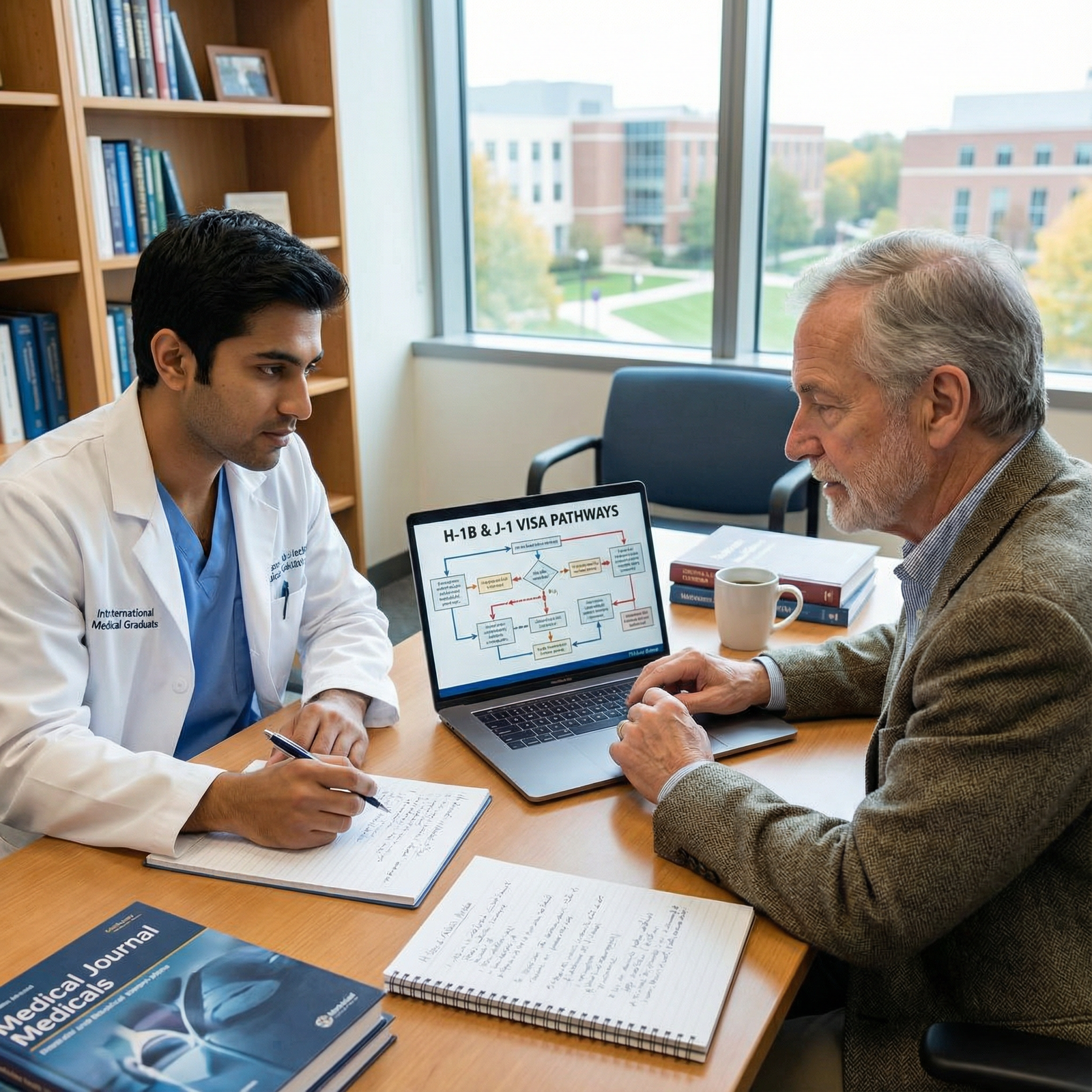
Understanding the Visa Landscape for Caribbean IMGs in Southern California
Caribbean medical graduates targeting a Southern California residency face two parallel challenges: matching into a program and securing the right visa to actually start training. For an SGU residency match or any other Caribbean medical school residency in SoCal, visa planning cannot be an afterthought. Programs in Los Angeles, Orange County, San Diego, and the Inland Empire are highly competitive, and some are cautious about sponsoring visas at all.
This article walks you step by step through:
- The main IMG visa options (J‑1 and H‑1B) and how they affect your training and post‑residency plans
- How visa policies are applied specifically in Southern California residency programs
- Strategies to improve your chances as a Caribbean IMG (including SGU, AUC, Ross, Saba, etc.)
- Practical tips for interviews, documentation, and timing
The focus is on Visa Navigation for Residency for Caribbean IMG in Southern California, but most principles apply nationwide.
Core Visa Options for Residency: J‑1 vs H‑1B for Caribbean IMGs
For clinical residency training, Caribbean IMGs usually navigate just two practical routes: the J‑1 physician visa and the H‑1B professional worker visa. Understanding the differences is essential before you even build your SoCal application list.
1. The J‑1 Physician Visa (Most Common Path)
The J‑1 is sponsored through the Educational Commission for Foreign Medical Graduates (ECFMG) and is the predominant residency visa for IMGs in the United States.
Key Features of the J‑1
- Category: Exchange Visitor – Physician
- Sponsor: ECFMG (not the hospital directly)
- Duration: Typically covers the full length of an accredited residency and fellowship, year‑to‑year
- Requirements:
- Valid and current ECFMG certification
- USMLE Step scores (Step 1 and Step 2 CK; Step 3 not required for J‑1)
- Confirmed residency position in an ACGME‑accredited program
- Sufficient financial support (your residency salary meets this)
- Home country or last country of residence you lived in for at least one year for the “two‑year rule” purposes
Advantages of the J‑1 Visa
- Widely accepted: Many SoCal residencies that take IMGs will only sponsor J‑1.
- No Step 3 requirement: Helpful if you haven’t taken or passed USMLE Step 3 before matching.
- Predictable process: ECFMG and training programs are very experienced with J‑1 processing; timelines are usually well‑established.
- Cap‑exempt: Not subject to the general H‑1B numerical cap/lottery.
Disadvantages and the 2‑Year Home Requirement
The major drawback is the two‑year home-country physical presence requirement (INA 212(e)). After finishing your J‑1‑sponsored training, you must:
- Return to your home country (or country of last permanent residence) for a total of two years, or
- Obtain a J‑1 waiver (commonly via Conrad 30 or similar service programs) before you can change status to H‑1B or obtain some other long‑term immigration statuses.
For Caribbean IMGs:
- If you are a citizen of a Caribbean country, the two‑year requirement typically involves your country of citizenship or last long‑term residence, not the Caribbean medical school’s island per se.
- This has major implications for how and where you’ll work after your SoCal residency, especially if your long‑term plan is to settle in California.
J‑1 and Family (J‑2 Dependents)
Your spouse and unmarried children under 21 can obtain J‑2 status. They may:
- Live with you in Southern California
- Study
- Apply for work authorization (EAD) as J‑2 dependents
This can be a significant advantage for those with partners who plan to work during your residency.
2. The H‑1B Visa for Residency (More Limited, But Powerful)
The H‑1B is a dual‑intent work visa for specialty occupations (including physicians). For residency, the program itself must petition for you.
Key Features of the H‑1B for Residency
- Sponsor: The residency program/hospital directly
- Duration: Typically granted up to 3 years at a time, renewable up to 6 years total (with some exceptions if in a green card process)
- Requirements:
- Must have USMLE Step 3 passed before the institution can file the H‑1B
- ECFMG certification
- State medical license or appropriate permit (varies by state; California has strict rules)
- Program must be willing and able to handle the petition and associated legal costs
Advantages of the H‑1B Visa
- No two‑year home requirement: You avoid the J‑1’s 212(e) obligation.
- Dual intent: You can pursue permanent residency (green card) without the extra hurdle of a waiver.
- Better alignment with long‑term U.S. career plans: Especially if your goal is to stay in California long‑term and move into private practice or academic positions quickly after training.
Disadvantages of the H‑1B Visa
- Fewer programs offer it: Many Southern California residency programs simply do not sponsor H‑1B for residents.
- Need Step 3 early: As a Caribbean IMG, you must pass Step 3 before Match Day (ideally by the fall) for H‑1B‑friendly programs to consider sponsoring you.
- Higher administrative burden and cost: Legal fees and filing costs can be a barrier for some institutions.
- Time‑limited to 6 years total (standard): Residency + fellowship lengths must fit or you need careful planning if you approach the 6‑year maximum.
H‑4 Dependents
Your spouse and children (under 21) can hold H‑4 status. They can:
- Live and study in the U.S.
- Work only if certain conditions related to your green card status are met (often not during residency)
Direct Comparison: J‑1 vs H‑1B for Caribbean IMGs
| Feature | J‑1 Physician Visa | H‑1B Visa for Residency |
|---|---|---|
| Primary Sponsor | ECFMG | Residency program/hospital |
| Common in SoCal? | Yes – most IMG‑friendly programs | Limited subset of programs |
| USMLE Step 3 Required? | No | Yes, usually before petition filing |
| Dual Intent (Immigration)? | No (strictly non‑immigrant) | Yes (can pursue green card) |
| 2‑Year Home Requirement | Yes, unless waived | No |
| Family Work Authorization | J‑2 can apply for EAD | H‑4 usually cannot work (with rare exceptions) |
| Long‑Term Impact | Requires waiver or return home after training | More straightforward path to staying in the U.S. |

How Visa Options Play Out in Southern California Residency Programs
Southern California is desirable for lifestyle, weather, and strong academic centers. That popularity affects both competitiveness and visa policy.
1. Types of Programs in SoCal and Their Visa Tendencies
You’ll find three broad categories when researching Southern California residency programs:
Academic University Programs
- Large UC systems (e.g., UCLA, UC San Diego, UC Irvine), major academic medical centers, and affiliated hospitals.
- Tend to have clear, published policies:
- Some sponsor J‑1 only.
- A subset sponsor both J‑1 and H‑1B but reserve H‑1B for fellowship or subspecialty training.
- Competitive, especially for Caribbean medical school residency applicants.
Community‑Based University‑Affiliated Programs
- Medium‑size internal medicine, family medicine, pediatrics, and other programs in community hospitals affiliated with a university.
- Often more open to Caribbean IMGs, including SGU, AUC, Ross, Saba, etc.
- Many sponsor J‑1 only; a smaller number will consider H‑1B for well‑qualified applicants (especially with Step 3 done early).
Community Programs and Safety‑Net Hospitals
- Often located in the Inland Empire, parts of Orange County, and elsewhere in Greater LA.
- Frequently serve underserved populations and may be IMG‑friendly.
- Some of these institutions participate in J‑1 waiver programs after training, which can influence their willingness to sponsor J‑1 during residency.
2. Program Competitiveness vs Visa Flexibility
Because SoCal is highly sought after, many programs can fill with U.S. graduates and may be more selective about IMGs and visa sponsorship.
For Caribbean IMGs:
- SGU residency match outcomes often show that SoCal positions are a minority of total matches; this reflects both competitiveness and limited visa sponsorship.
- You will generally find:
- More J‑1 options than H‑1B options
- H‑1B sponsorship more likely in fields like internal medicine, family medicine, pediatrics, psychiatry than in ultra‑competitive specialties
3. Researching Visa Policies Program by Program
To target your applications strategically:
Use Program Websites:
- Look under “International Medical Graduates,” “Eligibility & Requirements,” or “FAQ.”
- Check explicitly whether they:
- Sponsor J‑1
- Sponsor H‑1B
- Have any additional conditions for International Medical Graduates
FRIEDA and ERAS Program Descriptions:
- FRIEDA (AMA) has fields for visa sponsorship types.
- ERAS listings often state “J‑1 only,” “J‑1 and H‑1B,” or “No visa sponsorship.”
Email the Program Coordinator (Strategically):
- If not clearly stated, a polite, concise email prior to the season can clarify:
- Whether they accept graduates from Caribbean schools
- Which visas they sponsor
- Whether Step 3 is required for H‑1B consideration
- If not clearly stated, a polite, concise email prior to the season can clarify:
Example email snippet:
Dear [Coordinator Name],
I am a Caribbean medical graduate (ECFMG certified) planning to apply to your [specialty] residency program this cycle. I am currently on [visa status or outside US] and would require sponsorship. Could you please confirm whether your program sponsors J‑1 and/or H‑1B visas for categorical residents?
Sincerely,
[Your Name], MD (Caribbean Medical School)
Keep these responses organized in a tracker so you can prioritize SoCal medical training programs that align with your visa needs.
Step‑by‑Step Visa Navigation Strategy for Caribbean IMGs Targeting SoCal
This section pulls everything into a practical roadmap, from pre‑Match planning through post‑Match processing.
Step 1: Decide Your Visa Priority Early (J‑1 vs H‑1B)
As a Caribbean IMG, ask yourself:
- Is my top priority to train in Southern California, even if that means J‑1 and a future waiver?
- Or is my top priority to avoid the two‑year home requirement and maximize long‑term immigration flexibility, even if that means fewer SoCal options?
If:
- You strongly want SoCal training and are open to underserved or rural practice later → Be open to J‑1, then pursue a J‑1 waiver job later (possibly outside SoCal).
- You strongly want long‑term stability in the U.S. and California and can handle a larger, more competitive application strategy → Start preparing for H‑1B (Step 3 early, target H‑1B‑friendly SoCal programs and possibly other states).
For many, the realistic path is:
J‑1 for residency in SoCal, then Conrad 30 waiver in another part of California or a different state, followed by an H‑1B and eventual green card.
Step 2: Plan USMLE Timing Around Your Visa Goals
For J‑1:
- Step 1 and Step 2 CK are needed for ECFMG certification, which is mandatory for the J‑1.
- Step 3 is optional pre‑residency; you can take it during residency if you wish.
For H‑1B:
- You must pass Step 3 before the program files the petition. Many H‑1B‑sponsoring programs require that Step 3 be passed before ranking you.
- This means:
- Take Step 3 as early as possible, often during your final year or research year.
- Be prepared to explain in your personal statement or interviews why you pursued Step 3 early (e.g., “to enable H‑1B sponsorship and a long‑term career in the U.S.”).
Step 3: Build a Program List with Visa in Mind
When selecting programs that align with Caribbean medical school residency goals:
Start with SoCal dream programs (both J‑1 and H‑1B capable, if possible).
Add backup regions that sponsor the visa you want:
- For J‑1 applicants, this is less critical because J‑1 is common, but some regions may still be more IMG‑friendly than SoCal.
- For H‑1B‑focused candidates, cast a wider geographic net (other states that are more open to H‑1B).
Use a simple spreadsheet with columns for:
- Program name, city, state
- Visa types accepted (J‑1, H‑1B)
- IMG friendliness (historical Caribbean matches, if known)
- Additional notes (e.g., Step 3 required by application deadline)
Step 4: Address Visa Considerations in Your Application and Interviews
You don’t need to write an essay about your visa status, but you should:
- Ensure your ERAS application clearly lists your citizenship, ECFMG status, and any prior U.S. visas.
- Be prepared in interviews to discuss:
- Your understanding of J‑1 vs H‑1B
- Your flexibility: “I am open to J‑1 sponsorship and understand the waiver process” or “I have completed Step 3 and am hoping for H‑1B sponsorship; I have researched the implications carefully.”
- Demonstrate long‑term commitment to serving patients in California or the U.S., especially for programs that are used to J‑1 physicians transitioning to waiver jobs.
Step 5: Post‑Match Visa Processing (Timeline and Pitfalls)
Once you match:
For J‑1:
- You will work with your program and ECFMG to submit:
- DS‑2019 application
- Proof of ECFMG certification
- Contract/offer letter
- Financial support details
- After receiving your DS‑2019, schedule a U.S. consular interview if you are abroad.
- Make sure your passport, police certificates (if required), and other documents are ready to avoid delays.
For H‑1B:
- Your program (and often its legal counsel) will:
- File a Labor Condition Application (LCA)
- Prepare and file the H‑1B petition (Form I‑129 with supporting documents)
- You must provide:
- USMLE Step 3 score report
- ECFMG certificate
- Medical school diploma and transcripts, sometimes with credential evaluations
- If outside the U.S., you’ll attend a consular visa interview after approval.
Timing Tip: Start collecting documents immediately after Match Day. Visa processing can be tight before July 1. Stay in close communication with your GME office.

Life After Residency: J‑1 Waivers, H‑1B Transitions, and Staying in California
Your residency visa is only the first chapter. For Caribbean IMGs committed to a long‑term career in Southern California, you need to plan beyond graduation.
1. Pathways After a J‑1 Residency
If you trained on J‑1 status, you have three main options upon completion:
Return Home for Two Years
- You can fulfill the 2‑year requirement in your home country (or last long‑term residence).
- After that, you may apply again for U.S. visas such as H‑1B or immigrant visas.
Pursue a J‑1 Waiver Job
- Commonly through Conrad 30 programs (state‑sponsored) or other federal waiver programs (e.g., VA, HHS clinical waivers).
- You typically work 3 years in a underserved area on an H‑1B visa, after which the 2‑year requirement is considered waived.
- California has a Conrad 30 program, but it is competitive and may have specific specialty or geographic preferences.
Special Federal Waivers
- For example, certain federal facilities (like VA or HHS‑designated facilities) may offer waiver options that don’t count against a state’s Conrad 30 cap.
For Caribbean IMGs finishing a Southern California residency, it is often easier to:
- Complete residency in SoCal
- Take a J‑1 waiver job in another part of California or a different state (rural areas often have more open positions)
- Later return to Southern California on H‑1B or permanent residency once the waiver obligation is satisfied
2. Pathways After an H‑1B Residency
If your residency was on H‑1B:
- You typically do not have the 2‑year home requirement.
- You can transition to:
- Another H‑1B position (fellowship, hospitalist, private practice)
- Start a green card process through employment (EB‑2/EB‑3) earlier in your career.
In Southern California:
- Large hospital systems and academic centers may sponsor H‑1B and eventually green cards for in‑demand specialties.
- Private groups sometimes sponsor H‑1B for hospitalists, primary care, or other needed specialties.
Planning ahead:
- Discuss immigration timelines with potential employers during fellowship interviews or job negotiations.
- Work with an immigration attorney early, especially if you anticipate long training paths (residency + multiple fellowships).
Common Mistakes Caribbean IMGs Make with Residency Visa Planning (and How to Avoid Them)
Ignoring Visa Policies When Making a Program List
- Applying blindly to SoCal programs without checking if they sponsor your visa type is a major waste of time and money.
Delaying USMLE Step 3 When Targeting H‑1B
- If you want an H‑1B‑sponsoring SoCal program, Step 3 must be strategically timed and passed before ranking in most cases.
Under‑Estimating the J‑1 Home Requirement
- Many Caribbean IMGs accept J‑1 sponsorship without understanding the future need for a waiver or two‑year return. Learn the implications before committing.
Not Using SGU / Caribbean School Resources
- If you are from SGU or a similar school, use their match lists and advising services:
- Identify patterns of Caribbean IMG matches in Southern California
- Learn which programs have historically sponsored J‑1 or H‑1B for their grads
- If you are from SGU or a similar school, use their match lists and advising services:
Poor Communication with GME Offices After Match
- Delays in sending documents, not checking email regularly, or misunderstanding deadlines can jeopardize your visa approval before residency start.
Practical Tips and Actionable Advice for Caribbean IMGs
- Start visa research 12–18 months before the Match.
- If you want H‑1B, book Step 3 as soon as eligible; do not wait for a perfect score. A pass is usually enough for residency.
- Track program visa policies in a live document (Google Sheet or Excel).
- During interviews, show that you:
- Understand J‑1 vs H‑1B
- Are realistic and flexible
- Have a long‑term plan that aligns with patient care needs in California or the U.S.
- Consider a backup plan:
- If SoCal programs are limited for your visa needs, be open to other states initially; you can later move back to Southern California once you have more stable status.
- If possible, consult an immigration attorney with physician visa expertise, especially if you have prior visa complications or multiple status changes.
FAQ: Visa Navigation for Caribbean IMGs in Southern California
1. As a Caribbean IMG, is it realistic to get an H‑1B for residency in Southern California?
It is possible, but more challenging. Only a subset of SoCal programs sponsor H‑1B for residency, and many prefer J‑1. To be competitive for H‑1B, you should:
- Pass USMLE Step 3 early
- Have strong clinical performance, letters, and possibly U.S. clinical experience
- Apply broadly, including outside Southern California, to ensure enough H‑1B‑friendly options
2. If I match into a SoCal residency on a J‑1 visa, can I still eventually settle in California?
Yes, but you’ll likely need to complete a J‑1 waiver job first, usually in an underserved area. Options include:
- Conrad 30 positions (in California or another state)
- Federal waiver positions (e.g., VA or certain HHS facilities)
After fulfilling your waiver obligation (usually 3 years), you can move to Southern California on H‑1B or permanent residency if you secure a suitable job and sponsorship.
3. Do Southern California programs treat Caribbean IMGs differently from other IMGs for visa sponsorship?
Most SoCal programs look primarily at:
- Accreditation and reputation of your school
- Your academic and clinical record
- Visa category (J‑1 vs H‑1B) and internal policies
Caribbean IMGs (including SGU, AUC, Ross, Saba) are fairly common in some SoCal community and university‑affiliated programs, especially where there is a track record of Caribbean medical school residency placements. The key is to target IMG‑friendly programs and understand each program’s residency visa policies.
4. Can I change from J‑1 to H‑1B during residency to avoid the 2‑year requirement?
In most cases, no. Once you are subject to the J‑1 two‑year home requirement, you cannot change to H‑1B or adjust status in the U.S. until you either:
- Fulfill the two‑year physical presence in your home country, or
- Obtain a J‑1 waiver.
Some very narrow exceptions exist, but they are rare and complex. Assume that if you start residency on J‑1, you will remain J‑1 throughout that training and will need to address the 2‑year requirement afterward.
By understanding J‑1 vs H‑1B, researching SoCal medical training programs carefully, and aligning your exam timing and applications with your visa goals, you can significantly improve your chances of both a Caribbean medical school residency match in Southern California and a viable long‑term career path in the United States.