Understanding the Visa Landscape for Caribbean IMGs in the Texas Triangle
Caribbean medical school graduates are a major part of the U.S. resident physician workforce, and many are increasingly drawn to the Texas Triangle—Houston, Dallas–Fort Worth, and San Antonio—for residency training. These cities combine large patient populations, diverse pathology, and competitive but IMG-friendly programs.
If you are a Caribbean IMG targeting a Caribbean medical school residency match in Texas, your number-one legal hurdle is visa navigation. Understanding residency visa pathways early—especially J-1 vs H-1B—can shape where you apply, how you rank programs, and your long-term career and immigration options.
This guide focuses on visa navigation for Caribbean IMGs applying to residency programs in the Texas Triangle, with special attention to:
- Houston, Dallas–Fort Worth, and San Antonio programs
- SGU, AUC, Ross, Saba, and other Caribbean graduates
- Residency visa strategy and timelines
- IMG visa options during and after residency (including waiver jobs in Texas)
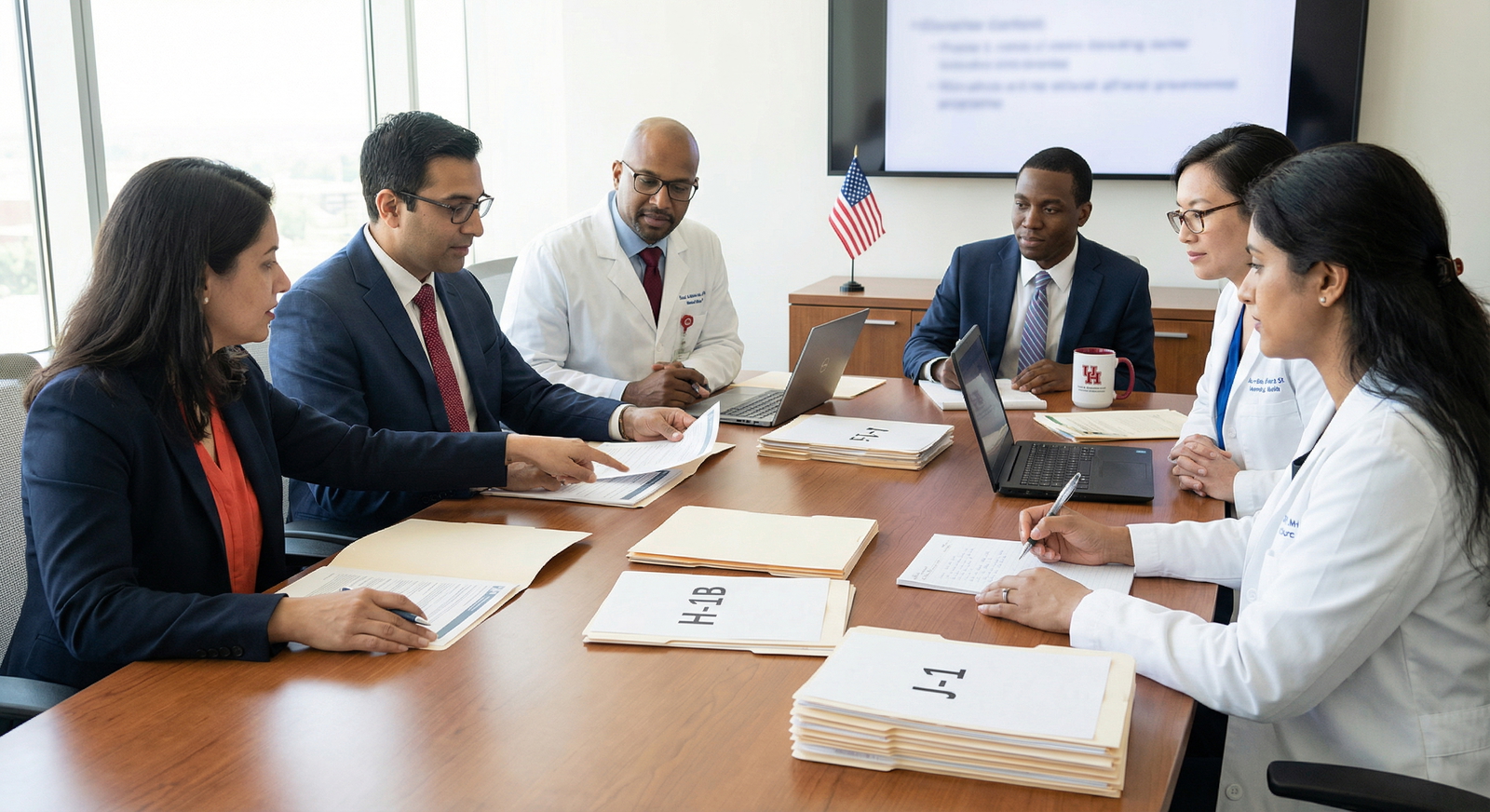
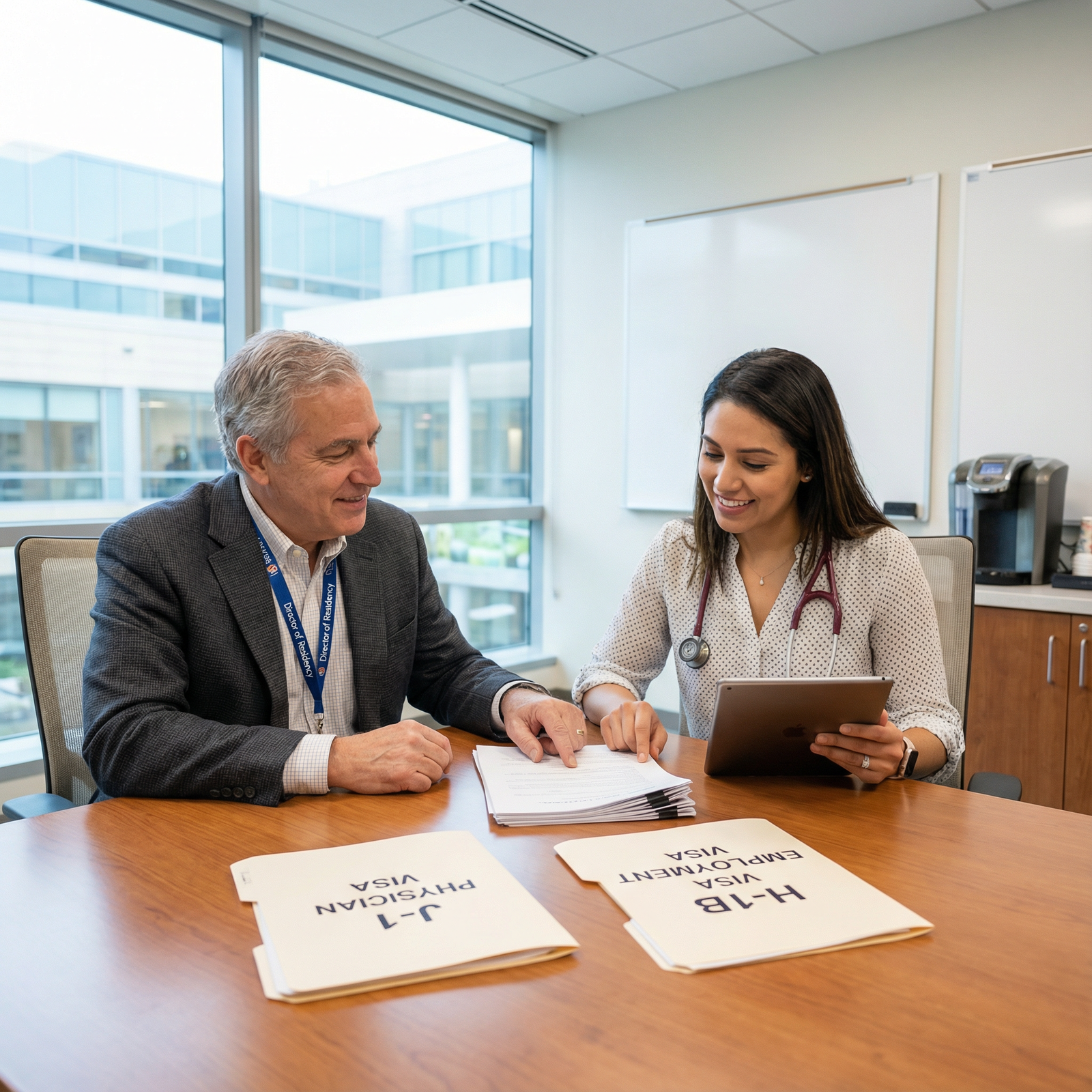
Core Visa Options for Residency: J-1 vs H-1B
For most Caribbean IMGs seeking residency in Texas, two main visa categories are relevant:
- J-1 Exchange Visitor (ECFMG-sponsored)
- H-1B Temporary Worker (Hospital-sponsored)
Understanding both is critical to planning your Texas residency and post-residency career.
1. J-1 Visa for Residency: The Default Path for Most IMGs
For the majority of Caribbean IMGs, the J-1 visa is the standard and most accessible path to residency in the U.S.
Key features of the J-1 for residency:
- Sponsored by ECFMG, not by the program directly
- Used specifically for graduate medical education (GME)
- Supports residency and most fellowships
- Usually capped at 7 years total (enough for most specialties + fellowship)
Eligibility basics:
- Valid ECFMG certification
- Signed contract from an ACGME-accredited residency program
- Proof of adequate financial support (usually from the residency salary)
- Home country or last country of permanent residence details for SEVIS
For Caribbean IMGs, J-1 is often simpler because:
- Most Caribbean medical schools are structured around U.S. residency goals.
- ECFMG is familiar with SGU, AUC, Ross, Saba, etc.
- Texas programs are well-versed in onboarding J-1 residents.
Two-Year Home Residency Requirement (212(e))
The biggest catch of the J-1 is the two-year home country physical presence requirement, commonly called “the 212(e) rule”:
- After you finish training on a J-1, you must:
- Return to your home country (or country of last permanent residence) for a total of 2 years, OR
- Obtain a J-1 waiver (often via service in an underserved area) before changing to H-1B or permanent residence in the U.S.
For a Caribbean IMG whose passport is from, for example, Jamaica, Trinidad & Tobago, Guyana, Haiti, or elsewhere, this requirement means:
- Without a waiver, you cannot:
- Change status to H-1B within the U.S.
- Obtain an immigrant visa (green card) through employment or family sponsorship (with some limited exceptions)
- Adjust status to permanent residence
However, Texas—and particularly the Texas Triangle region—has many J-1 waiver job opportunities, which we’ll cover later.
2. H-1B Visa for Residency: More Complex, More Restrictive
The H-1B visa allows U.S. employers to hire foreign professionals in specialty occupations, including physicians.
For residency, H-1B is:
- Employer-sponsored (the residency program must petition)
- Subject to strict requirements:
- You must have passed USMLE Step 3 before the petition is filed (and ideally before rank list deadlines)
- The program must agree to pay attorney and filing fees (by law, certain fees cannot be paid by the employee)
- The program must have an institutional policy allowing H-1B for residents
Upsides of H-1B during residency:
- No two-year home residency requirement
- More straightforward path from residency → fellowship → employment → green card
- Potentially better long-term immigration flexibility if you stay employed in the U.S.
Downsides for a Caribbean IMG:
- Fewer programs willing to sponsor H-1B, especially in Houston, Dallas, and San Antonio
- Competition is intense for H-1B-friendly spots
- Need a very early Step 3 pass (ideally before ERAS submission or at least before rank list certification)
- Administrative complexity and legal costs for the program
For most Caribbean IMGs aiming at Texas residency programs, the J-1 is the primary practical option; H-1B is realistic mainly for top candidates with strong USMLE scores, early Step 3, and programs that already have a history of sponsoring H-1B.
Texas Triangle Landscape: How Programs View Visa Sponsorship
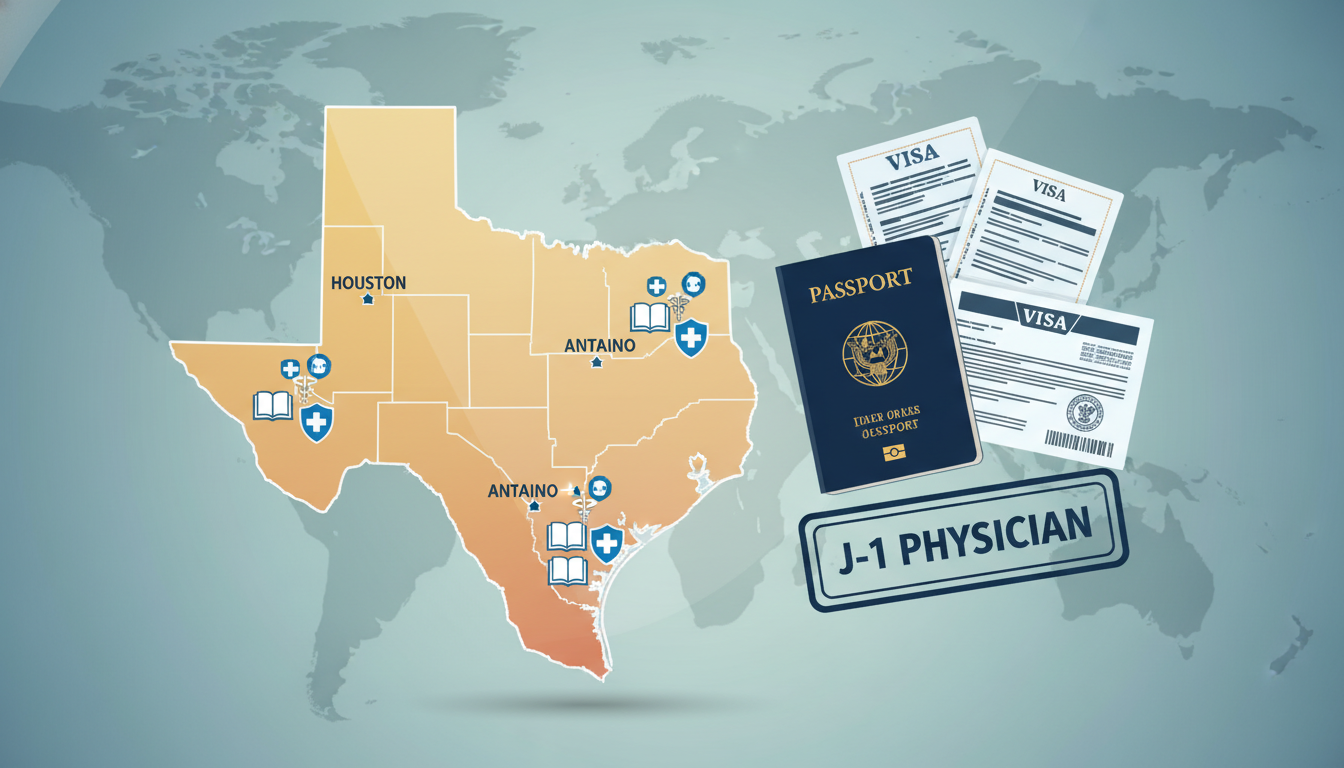
The Texas Triangle—Houston, Dallas–Fort Worth, and San Antonio—includes some of the most active GME hubs in the country. For a Caribbean IMG, it’s important to understand how visa policy varies by region and institution.
1. General Attitude Toward IMGs in Texas
Texas, overall, has:
- A high demand for physicians, especially in primary care and certain subspecialties
- Significant rural and underserved populations that depend on foreign-trained doctors
- Historical openness to IMGs, including Caribbean medical school graduates
However, there is no uniform statewide policy. Each individual residency program sets its own rules about both Caribbean medical school residency eligibility and visa sponsorship.
In the Texas Triangle:
- Houston:
- Large academic centers (e.g., in the Texas Medical Center) and community programs
- Many programs accept IMGs on J-1, but H-1B sponsorship is more selective
- Dallas–Fort Worth:
- Mix of large academic institutions, VA hospitals, and community-based programs
- IMG-friendly programs exist, but some are U.S. citizen/green card only
- San Antonio:
- Strong military presence (for U.S. citizens) and community institutions
- Several programs welcome J-1 IMGs, especially in primary care
2. Common Visa Policies in Texas Residency Programs
When researching Houston, Dallas, San Antonio residency options, carefully check each program’s website and confirm via email. You’ll frequently see one of the following:
- J-1 only
- Program sponsors or accepts only ECFMG J-1 visas
- Most common stance among IMG-accepting Texas programs
- J-1 and H-1B
- Program will consider H-1B for strong candidates (often require Step 3 by a set deadline)
- More common in competitive internal medicine and some subspecialties
- U.S. Citizens / Permanent Residents only
- No visa sponsorship at all
- Still seen in some community or suburban programs
For Caribbean IMGs, the J-1-only and J-1 plus H-1B programs are your main targets.
3. SGU Residency Match and Other Caribbean Schools in Texas
Graduates from major Caribbean schools—like St. George’s University (SGU), AUC, Ross, and Saba—regularly match into:
- Internal Medicine
- Family Medicine
- Pediatrics
- Psychiatry
- Transitional Year / Preliminary Internal Medicine or Surgery
In the Texas Triangle, you’ll find:
- Robust SGU residency match representation in Houston and Dallas, particularly in internal medicine and family medicine
- Caribbean grads in community-based and university-affiliated programs in San Antonio
Most of these positions are filled on J-1 visas, with a smaller minority on H-1B.
Action step:
Search for “Current Residents” pages on program websites in Houston, Dallas, and San Antonio. If you see Caribbean IMGs in their resident list, you can usually assume:
- The program accepts Caribbean medical school degrees
- The program is familiar with ECFMG and at least J-1 visa processes
Strategizing Your Residency Application Around Visa Realities
Your visa path is not a side issue—it can influence everything from which programs to apply to, to how early you take exams, to your long-term practice location in Texas.
1. Decide Early: J-1 vs H-1B Priority
As a Caribbean IMG, you should decide early which of these strategies best fits your goals:
Strategy A: J-1 Focus (Most Common)
- Broad application list across IMG-friendly Texas programs
- No pressure to rush Step 3 before ERAS
- Accept that you will likely need a J-1 waiver job after residency
Strategy B: H-1B Attempt (Selective)
- Aim for programs that clearly sponsor H-1B
- Take USMLE Step 3 early, ideally by late summer or early fall of the application year
- Maintain a viable Plan B (J-1) if H-1B programs are limited or too competitive
For many Caribbean IMGs, Strategy A (J-1 focus) is the safer route, especially if your exam scores or application profile are solid but not top-tier.
2. Building a Program List with Visa in Mind
When building your Texas program list, specifically for Caribbean medical school residency in the Texas Triangle:
Check official program websites under “International Medical Graduates” or “Visa Sponsorship”:
- Note if they say:
- “We sponsor J-1 visas through ECFMG”
- “We sponsor both J-1 and H-1B visas”
- “We do not sponsor visas”
- Note if they say:
Cross-check with FREIDA and program emails:
- FREIDA listings may be outdated; always verify directly with the program coordinator
- Send a concise email to confirm:
- Acceptance of Caribbean IMGs
- Visa types sponsored
- Any Step 3 requirement for H-1B consideration
Consider geographic balance within the Texas Triangle:
- Include a mix of Houston, Dallas–Fort Worth, and San Antonio programs to maximize your chances
- Some smaller community programs near these metros may be even more IMG friendly and more open to J-1 sponsorship.
3. Timing and Documentation for Visa-Eligible Matching
Your overall timeline as a Caribbean IMG aiming at Houston Dallas San Antonio residency should account for:
- USMLE Step 1 and Step 2 CK completed with competitive scores before ERAS submission
- ECFMG Certification in place or pending, with all primary source verification completed
- If aiming for H-1B:
- USMLE Step 3 passed early
- Updated CV and proof of exam pass available for programs to initiate petitions after match
Pro tip:
Even if you are J-1 focused, having Step 3 done before or early in residency can strengthen your profile for later H-1B employment or fellowship.

Post-Residency Options in Texas: J-1 Waivers, H-1B, and Beyond
Visa navigation does not end when you match. For many Caribbean IMGs, especially those on J-1 visas, the real immigration strategy begins after residency or fellowship.
1. J-1 Waiver Basics for IMGs
If you complete residency on a J-1, you are subject to the two-year home residency requirement—unless you obtain a J-1 waiver.
The most common route for physicians is the Conrad 30 program, where each U.S. state can sponsor up to 30 IMGs per year to work in medically underserved areas.
In Texas:
- The Texas Department of State Health Services runs a Conrad 30 waiver program
- Waiver jobs are often in:
- Rural or semi-rural areas
- Urban underserved clinics or health centers
- You must commit to typically 3 years of full-time service in an approved site
For a Caribbean IMG finishing residency in Houston, Dallas, or San Antonio:
- It’s common to train in the Texas Triangle and then move to a Conrad 30 waiver job elsewhere in Texas, often within driving distance of these cities.
- After obtaining the waiver, you switch from J-1 to H-1B status to fulfill the 3-year service commitment.
2. Types of Employers Offering J-1 Waiver Jobs in Texas
Common J-1 waiver employers in Texas include:
- Federally Qualified Health Centers (FQHCs)
- Rural hospitals and critical access hospitals
- Community mental health centers (for psychiatry)
- Some private practices located in Health Professional Shortage Areas (HPSAs)
In practice, this means:
- If you are a family medicine, internal medicine, pediatrics, or psychiatry graduate, Texas has significant J-1 waiver opportunities.
- For subspecialties, positions exist but may be more limited and concentrated around larger metro-adjacent areas.
3. Transitioning from J-1 to H-1B and Beyond
The typical path for a Caribbean IMG who did residency on a J-1 in Texas:
- Complete residency in Houston/Dallas/San Antonio on a J-1
- Secure a J-1 waiver job (often in Texas) sponsored through Conrad 30 or another waiver route
- Employer files H-1B petition, referencing the J-1 waiver approval
- Work 3 years in waiver-eligible service
- During those 3 years, employer may file for PERM labor certification and I-140 immigrant petition (employment-based green card)
- Depending on your country of birth and visa bulletin dates, you may:
- Adjust status to permanent resident during the waiver service, or
- Complete the waiver service first and then proceed
For many Caribbean IMGs, this route provides:
- A clear path from Caribbean medical school residency → Texas Triangle residency → Texas J-1 waiver job → green card
- Long-term stability for practice and family in Texas
4. If You Start on H-1B in Residency
If you are among the smaller group of Caribbean IMGs who start residency on an H-1B:
- You can continue on H-1B for fellowship or employment, up to the 6-year maximum (with exceptions if green card processing is underway).
- You do not face the 212(e) home residency requirement.
- You can pursue a green card more directly with a willing employer—often a hospital or health system in Houston, Dallas, or San Antonio.
However, H-1B residency positions are fewer, so relying solely on this path can narrow your match options.
Practical Tips and Common Pitfalls for Caribbean IMGs
1. Avoid These Common Mistakes
- Ignoring visa sponsorship policies until interview season
- You may waste applications on programs that don’t sponsor any visas.
- Assuming all Texas programs are IMG-friendly
- While many are, some are strictly limited to U.S. grads or permanent residents.
- Delaying Step 3 if you hope for H-1B
- Without Step 3, most programs will not even consider H-1B sponsorship.
- Not planning for the J-1 waiver phase
- If you choose J-1, think ahead about specialties and jobs that have strong waiver demand in Texas.
2. Strengthening Your Profile as a Caribbean IMG
To maximize your chances of matching in the Texas Triangle:
- USMLE performance
- Aim for scores comfortably above the minimum cutoffs commonly seen in IMG-friendly internal medicine and family medicine programs.
- U.S. clinical experience (USCE)
- Electives or core rotations in U.S. hospitals, especially in Texas if possible, help enormously.
- Letters of recommendation
- At least 2–3 U.S. clinical letters, preferably from attendings familiar with residency training in Texas or large academic centers.
- Geographic interest
- In interviews and personal statements, clearly articulate why you want to train in Houston, Dallas, or San Antonio specifically—family ties, familiarity with Texas populations, prior rotations, etc.
3. When to Involve an Immigration Attorney
While many IMGs complete residency on J-1 without ever hiring a lawyer, there are times when legal help is valuable:
- Considering a change of status or complex immigration history
- Moving from J-1 to H-1B with a waiver and coordinating timing
- Dealing with past visa denials, status violations, or inadmissibility issues
- Planning long-term for permanent residence while on H-1B
If your goal is to build a long-term life and career in Texas, early consultation can help you choose between J-1 and H-1B with eyes wide open.
FAQs: Visa Navigation for Caribbean IMGs in the Texas Triangle
1. As a Caribbean IMG, which visa is more realistic for residency in Houston, Dallas, or San Antonio—J-1 or H-1B?
For most Caribbean IMGs, the J-1 visa is more realistic. Many Texas Triangle programs explicitly sponsor J-1 through ECFMG, while only a subset offer H-1B—and those often require early Step 3 and a very strong profile. You can pursue H-1B options if you are highly competitive, but you should not depend solely on them.
2. Do Texas residency programs accept SGU and other Caribbean graduates on the same basis as other IMGs?
In general, yes. Many Texas programs have a track record of SGU residency match and other Caribbean alumni. However, each program sets its own criteria. Some prioritize U.S. grads; others actively recruit Caribbean IMGs. Always confirm on the program website and by reviewing their current residents for Caribbean representation.
3. If I train on a J-1 in Texas, can I still stay in the U.S. long-term, or must I return to my home country?
You do not automatically have to return home if you secure a J-1 waiver job after residency. In Texas, this often means working 3 years in an underserved area via the Conrad 30 program or another waiver route, usually on an H-1B. Many Caribbean IMGs follow this pathway and later obtain green cards while living and working in Texas.
4. When should I take Step 3 if I want to keep H-1B options open?
If you hope to obtain an H-1B residency visa, you should ideally pass Step 3 before or shortly after ERAS submission, and certainly before programs finalize rank lists. Some Texas programs set internal deadlines (e.g., Step 3 passed by January). Even if you ultimately match on J-1, early Step 3 can help with later H-1B employment, including J-1 waiver jobs.
By approaching your Caribbean medical school residency journey with a clear understanding of residency visa rules, J-1 vs H-1B trade-offs, and Texas-specific opportunities, you can design a realistic and strategic path to both residency in the Texas Triangle and long-term practice in the United States.