
Understanding the Visa Landscape as a Caribbean IMG in the Tri-State Area
For a Caribbean international medical graduate (IMG), the path from a Caribbean medical school residency dream to actually starting internship in New York, New Jersey, or Connecticut runs straight through one critical bottleneck: visa navigation. Even with strong scores and clinical experience, misunderstanding U.S. immigration options can delay or derail your tri-state residency goals.
This guide is written specifically for Caribbean IMGs—particularly those from schools like SGU, Ross, AUC, Saba, AUA, and others—who are targeting the competitive New York New Jersey Connecticut residency market. We will focus on:
- The main visa categories used in residency training
- J-1 vs H-1B pros, cons, and decision points
- How visa policy interacts with SGU residency match and other Caribbean medical school residency outcomes
- State- and program-specific realities in NY, NJ, and CT
- Practical steps to improve your visa and match prospects
Throughout, remember: immigration rules can change. Always cross-check with the ECFMG, program websites, and, when needed, an immigration attorney before making final decisions.
Core Visa Options for Residency: J-1 vs H-1B (and Others)
1. J-1 Visa for Clinical Training (ECFMG-Sponsored)
For the vast majority of non-U.S. citizen IMGs, the J-1 exchange visitor visa for graduate medical education (GME) is the default pathway.
Key features:
- Sponsor: ECFMG (not the residency program directly)
- Purpose: Clinical training only (residency and fellowship)
- Duration: Typically up to 7 years of total training (some extensions possible)
- Two-year home residency requirement:
- After completing training, you must return to your home country (or country of last permanent residence) for 2 years before becoming eligible for:
- H-1B
- L-1
- Marriage-based green card (unless waived)
- This requirement can be waived (more on that later)
- After completing training, you must return to your home country (or country of last permanent residence) for 2 years before becoming eligible for:
Advantages for Caribbean IMGs:
- Widely accepted: A large proportion of IMGs in the tri-state area are on J-1
- No cap lottery: The J-1 is not subject to H-1B numeric caps
- Centralized process: One main sponsor (ECFMG) with standardized requirements
- Easier for programs: Less legal/financial burden than H-1B
Disadvantages:
- Two-year home residency requirement is a serious long-term consideration
- Less flexibility if you want to stay in the U.S. immediately after training
- Limited moonlighting in some situations (program-dependent, state law–dependent)
2. H-1B Temporary Worker Visa for Physicians
The H-1B is a work visa for specialty occupations that some residency programs use for IMGs.
Key features:
- Employer-sponsored: The residency program (hospital) petitions for you
- Specialty occupation: Requires at least a bachelor’s degree, but for physicians, typically includes proof of medical degree, ECFMG certification, and USMLE passage
- Duration: Granted in up to 3-year increments; total of 6 years typically allowed
- No two-year home residency requirement
Advantages in residency context:
- No obligation to return home for 2 years after residency
- Potentially smoother transition to future employment or permanent residency (green card)
- Often seen as attractive by IMGs who plan long-term U.S. careers
Disadvantages:
- Fewer programs offer it, especially at the categorical residency level
- Higher cost and administrative work for programs
- Requires full ECFMG certification and all USMLE Steps (including Step 3) by the time of filing in many jurisdictions
- Timing pressure: Step 3 must often be passed before the program can file your H-1B petition
Cap-exempt vs. cap-subject H-1B:
- Many hospitals affiliated with universities or non-profit healthcare entities are cap-exempt, meaning they can sponsor H-1Bs year-round, outside the normal H-1B lottery.
- In the tri-state region, many academic centers (e.g., in NYC and New Haven) fall into this category. For you, this is huge, because it means less risk of losing out on a visa lottery.
3. Other Statuses Sometimes Seen
Although the conversation is usually J-1 vs H-1B, some Caribbean IMGs may already have or qualify for other statuses:
- U.S. Citizen or Permanent Resident: No visa worries; apply like a U.S. grad.
- F-1 students in the U.S.:
- Some Caribbean IMGs complete master’s degrees in the U.S. (e.g., MPH) on F-1 before or after med school.
- F-1 itself is not sufficient for residency; you still usually need J-1 or H-1B (OPT alone rarely covers full residency training).
- TN (for Canadians and Mexicans): Rarely used for residency directly; more common for post-residency employment.
- O-1 (extraordinary ability): Very uncommon in residency; occasionally used by highly accomplished physician-scientists.
For most Caribbean medical school residency applicants aiming for a New York New Jersey Connecticut residency, the practical decision is: J-1 vs H-1B.
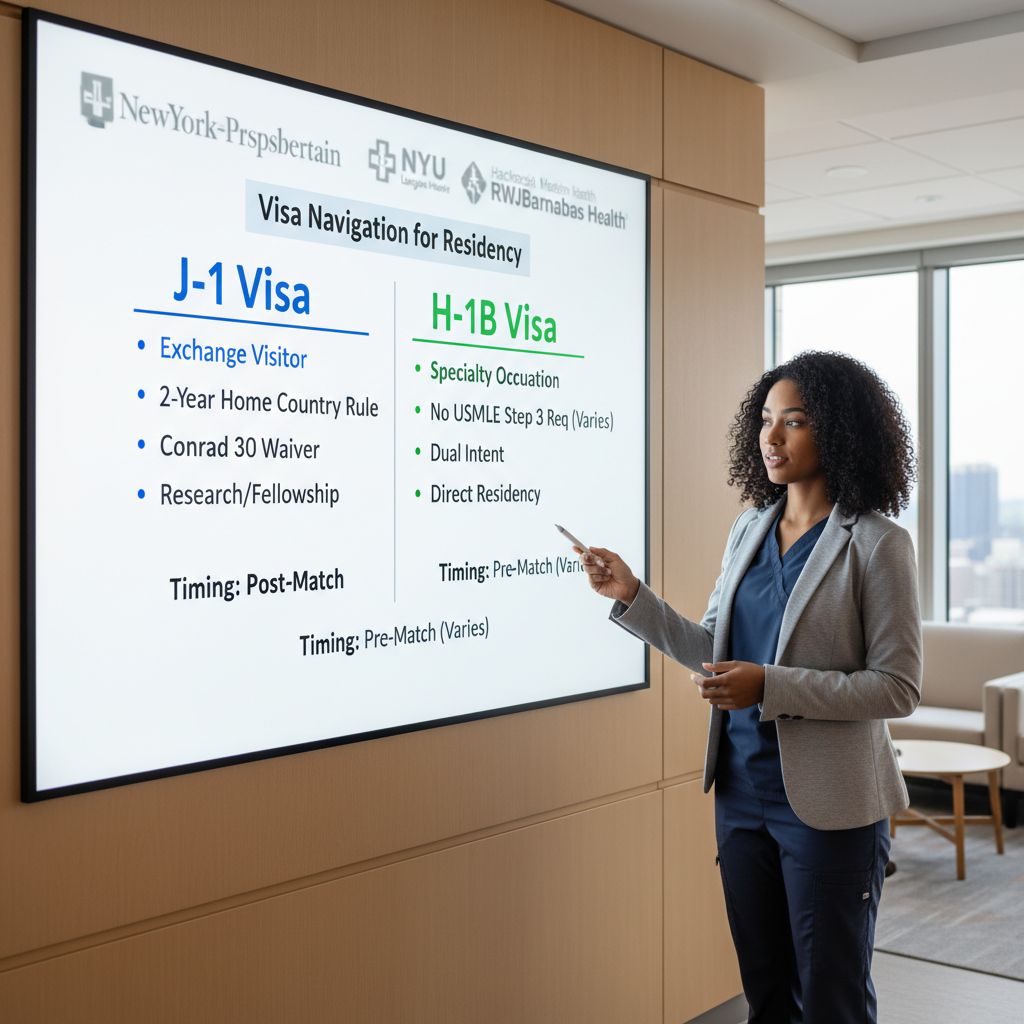
J-1 vs H-1B: How to Choose Strategically as a Caribbean IMG
Academic Realities: Most IMGs End Up on J-1
In the tri-state region, particularly New York, J-1 is far more common than H-1B for residency. Many community and academic programs explicitly state “J-1 only” or “J-1 preferred.”
A Caribbean IMG targeting New York New Jersey Connecticut residency should realistically plan that:
- You may not have the option of choosing H-1B vs J-1 at most programs
- Programs offering H-1B usually have high bar for board scores, CV, and Step 3 timing
However, understanding both options helps you:
- Filter programs more intelligently
- Time your USMLE exams strategically
- Plan for post-training life (e.g., whether you’re open to J-1 waiver service)
Timing: USMLE Step 3 and H-1B Feasibility
For H-1B, many programs require:
- ECFMG certification
- Step 3 passed before they can file your petition
This affects your timeline in several ways:
Before Match season:
- If you want H-1B consideration, aim to pass Step 3 before ranking programs.
- This is especially relevant for SGU residency match candidates who often schedule Step 3 during or right after clinical rotations in the U.S.
Program filtering:
- Some programs automatically screen out H-1B-seeking applicants without Step 3.
- If you apply broadly but don’t have Step 3 yet, assume that J-1 sponsorship is more realistic.
For transitional year or prelim-only positions:
- These may be less likely to invest in H-1B, because the training is short and the paperwork is heavy.
- Categorical positions at academic centers are more open to H-1B for the right candidate.
Career Goals: Long-Term U.S. Plans vs Global Flexibility
Your long-term career vision should strongly influence your choice:
- If your primary goal is to practice in the U.S. as soon as possible after residency without mandatory time abroad, H-1B is attractive.
- If you are open to:
- Returning to your home country
- Working in global health
- Or serving in a U.S. underserved area under a J-1 waiver program
then J-1 may be perfectly acceptable.
For many Caribbean IMG physicians, especially those from citizenships with fewer global mobility restrictions, a J-1 route followed by a waiver job in the U.S. is a standard, workable pathway.
Flexibility and Training Path
Another factor: training length and subspecialization plans.
- J-1 usually allows up to 7 years total
- Enough for: internal medicine (3) + fellowship (3) or surgery (5) + 1–2 years additional
- H-1B allows 6 years total
- Often enough for residency + fellowship, but may require careful planning and sometimes a switch (e.g., starting on J-1, then changing status later)
If you’re planning multiple fellowships, or a long research track, discuss visa implications with mentors early.
Tri-State Specific Realities: New York, New Jersey, and Connecticut
The tri-state area hosts some of the highest concentrations of IMGs in the United States, including many Caribbean graduates. This can be both an opportunity and a challenge.
New York: High IMG Presence, J-1 Friendly, Heavy Competition
New York is one of the most IMG-dense states:
- Numerous academic centers and community hospitals with large residency class sizes
- Many have long-standing relationships with Caribbean medical schools, including SGU residency match partnerships and core rotation affiliations
Visa trends in NY:
- Many programs: J-1 only or “J-1 sponsored; limited H-1B”
- Larger academic centers sometimes:
- Offer H-1B but prioritize exceptional profiles
- Expect Step 3 completion prior to match or early PGY-1
For Caribbean IMGs targeting a tri-state residency, New York can be relatively J-1 friendly. But be prepared for:
- Intense competition (strong USMLE, strong letters from U.S. clinicians)
- Early and clear communication with each program about visa options
New Jersey: Growing Programs, Community Hospitals, and Mixed Policies
New Jersey has a growing number of residency programs, including:
- Community-based internal medicine, family medicine, pediatrics, and transitional year
- Some university-affiliated hospitals with robust subspecialties
Visa patterns in NJ:
- Many community programs: J-1 is the default
- H-1B may be offered selectively, often based on:
- Hospital policy
- Costs and legal support from healthcare system
- Whether they are cap-exempt (many are)
In NJ, Caribbean IMG applicants frequently succeed with J-1 sponsorship, particularly in primary care specialties. If you are H-1B focused, research program-by-program; do not assume statewide norms.
Connecticut: Smaller Market, Academic Centers, Selective H-1B Use
Connecticut has fewer residency programs overall, but they include:
- Well-known academic centers associated with major universities
- Smaller community-based programs
Visa situation:
- Many academic centers:
- Will sponsor J-1 widely
- May sponsor H-1B for strong candidates, especially in needed specialties or research-oriented tracks
- Smaller programs may have more restrictive policies and lean J-1-only
Because Connecticut positions are fewer, and often attached to prestigious institutions, Caribbean IMGs must show especially strong clinical performance and step scores to be competitive for any visa sponsorship.

Practical Strategy for Caribbean IMGs: Step-by-Step Visa Navigation
Step 1: Clarify Your Immigration Baseline
Before you draft a personal statement or choose programs, answer:
What is my current citizenship and status?
- Non-U.S. citizen, non-green card holder
- U.S. permanent resident (no visa needed)
- Dual citizen (may affect J-1 home residency requirement country)
Am I open to completing a J-1 waiver in an underserved area after training?
- If yes, J-1 becomes a much more viable and often simpler route.
Is my long-term goal absolutely to remain in the U.S. immediately post-training?
- If yes, you may want to prioritize programs that consider H-1B, but recognize this will narrow your options.
Step 2: Align USMLE Timeline with Visa Options
For J-1, you need:
- ECFMG certification (Step 1, Step 2 CK, clinical skills pathway, etc.)
- A residency position that accepts J-1
- Compliance with ECFMG’s documentation and health insurance requirements
For H-1B, you often need:
- ECFMG certification
- Step 3 passed early enough for the program to file the petition
- Eligibility to be employed as a physician in the state (temporary permit or license as required)
Actionable advice:
- If you’re already in or completing clinical rotations in the U.S. (e.g., through SGU or another Caribbean school), plan Step 3 as early as realistically possible if H-1B is on your radar.
- If Step 3 would significantly compromise your Step 2 CK performance or clinical grades, consider whether J-1 might be a better primary plan, with H-1B as a future option after a J-1 waiver.
Step 3: Research Program Visa Policies in Detail
Use multiple sources:
- Program websites: Look under “Eligibility and Visa Sponsorship”
- ERAS program descriptions: Many list whether they accept J-1, H-1B, or both
- Networking: Talk to current residents, especially other Caribbean IMGs, about:
- Actual practice vs what’s written online
- How often H-1B sponsorship is granted
- Internal politics or cost barriers
When you build your application list for tri-state residency:
- Label programs as:
- J-1 only
- J-1 + H-1B possible
- Visa assistance unclear
- Create a realistic distribution:
- Majority J-1-friendly, IMG-friendly programs
- A subset of H-1B-possible programs if that’s your preference
Step 4: Present Your Visa Situation Confidently in Applications and Interviews
During application season:
- In your ERAS application, answer visa questions accurately.
- If programs ask about visa preference, consider your flexibility:
- If you’re open to J-1 or H-1B, say so. Being rigidly “H-1B only” can harm your chances.
- You might phrase it as:
- “I am open to both J-1 and H-1B, and understand that visa sponsorship is subject to institutional policy.”
During interviews (especially in the tri-state area):
- Be honest but strategic:
- If you have Step 3 and are a strong candidate, you can mention that you are eligible for H-1B if the program sponsors it.
- If not, emphasize your willingness to train under J-1 and your understanding of J-1 obligations.
- Avoid making visa demands; instead, ask clarifying questions:
- “Could you share how your program typically handles visa sponsorship for IMGs?”
- “Do you currently have residents on J-1 or H-1B status?”
Step 5: Prepare Early for J-1 Processes (If Likely)
Since J-1 is the most common residency visa for Caribbean IMGs:
- Familiarize yourself with ECFMG’s J-1 visa guidelines:
- Financial documentation required
- Health insurance requirements
- Dependent (spouse/children) rules (J-2)
- Have key documents ready:
- Medical diploma and translations (if needed)
- Passport with adequate validity
- Proof of funding (usually the residency contract suffices, but sometimes additional support is needed for dependents)
If you are married or have children:
- Understand J-2 dependent rights (including work authorization for spouses)
- Consider cost-of-living realities in NYC/NJ/CT on a resident salary plus family expenses
Life After Training: J-1 Waiver Options and H-1B Transitions
J-1 Two-Year Home Residency Rule: Your Options
If you complete residency/fellowship on J-1, you face the two-year home residency requirement. To remain in the U.S. without going home for two full years, you usually need a waiver.
Common waiver paths for physicians:
Conrad 30 Waiver Program (state-level):
- Each U.S. state can sponsor up to 30 physicians annually to work in underserved areas.
- You must commit to working typically 3 years in a designated Health Professional Shortage Area (HPSA) or Medically Underserved Area (MUA).
- Many IMGs complete J-1 waiver jobs in rural or semi-rural regions, though some inner-city clinics also qualify.
Federal Programs:
- VA, Department of Health and Human Services (HHS), or other federal agencies can sponsor waivers for certain roles.
Hardship or Persecution Waivers:
- Applicable in special circumstances, requiring detailed legal support.
For a Caribbean IMG in New York, New Jersey, or Connecticut:
- Competitive urban centers may offer fewer J-1 waiver jobs than rural regions in other states.
- Many physicians complete residency in tri-state, then move to another state for a J-1 waiver job, and later return to the tri-state region on H-1B or as permanent residents.
Transitioning from J-1 Waiver to Long-Term Status
Common long-term sequence:
- Residency/Fellowship on J-1
- J-1 waiver job on H-1B in an underserved area
- Employer-sponsored green card (PERM-based or other employment-based category)
- After obtaining green card, freedom to practice anywhere in the U.S., including New York New Jersey Connecticut
If you start residency on H-1B:
- You may move directly to another H-1B role (e.g., attending job) after training
- Your employer can sponsor your green card without needing a J-1 waiver
- However, this path assumes you secured an H-1B-friendly residency from the beginning, which is less common for Caribbean IMGs
Tying It All Together: A Practical Example
Imagine you are an SGU graduate targeting internal medicine in the tri-state area:
- You complete most of your core rotations in NYC and NJ teaching hospitals affiliated with your school.
- You have strong scores (Step 1 pass, Step 2 CK >240), good letters from U.S. attendings, but Step 3 is not yet taken when ERAS opens.
- You research residency programs:
- 25 IMG-friendly internal medicine programs in NY, 10 in NJ, 5 in CT
- Of these, 20 clearly state J-1 sponsorship; only 5 mention H-1B as an option.
- You decide:
- Main plan: J-1 for residency
- Long-term plan: J-1 waiver job, then eventual H-1B/green card
- During interviews, you say:
- “I am open to either J-1 or H-1B, but I understand that most IMGs here train on J-1. I’m fully prepared to meet all J-1 requirements.”
- You match into a New York community program that has many Caribbean graduates on J-1.
- Near the end of residency, you reassess:
- You want to stay in the U.S. long-term
- You apply for a J-1 waiver position in a medically underserved area in Pennsylvania or upstate New York.
- After 3 years on H-1B in your waiver job, your employer sponsors you for a green card. Later, you move back to New Jersey to join a group practice.
This pathway is very common among Caribbean IMGs and illustrates how J-1, H-1B, and J-1 waiver options can all fit into one coherent long-term plan.
FAQs: Visa Navigation for Caribbean IMGs in the Tri-State Area
1. Is it harder to get a residency visa in New York, New Jersey, or Connecticut compared to other states?
Not necessarily harder, but more competitive. The tri-state area has:
- High applicant volume (including many Caribbean and non-Caribbean IMGs)
- Many programs that are comfortable with J-1 sponsorship
- Selective use of H-1B at certain academic centers
If you are open to J-1, your chances in the tri-state region are largely driven by your academic and clinical profile, not by visa difficulty alone.
2. As a Caribbean IMG, should I delay applying for residency until I pass Step 3 to improve my H-1B chances?
It depends on your profile and risk tolerance:
- If you have very competitive scores and are specifically targeting H-1B-friendly programs, an early Step 3 may help.
- However, delaying application for Step 3 alone can be risky; most Caribbean medical school residency applicants succeed on J-1 first, then navigate H-1B later via J-1 waiver.
- Balancing strong Step 2 CK performance and timely application is generally more important than rushing Step 3 purely for H-1B.
3. Do all Caribbean medical school graduates (like SGU) get the same visa options as other IMGs?
Yes. Your visa options are determined by:
- Your citizenship and immigration history, not your school’s location
- Program policies and ECFMG rules
However, some Caribbean schools (e.g., SGU residency match affiliates) have established relationships with certain tri-state hospitals that are very used to processing J-1 paperwork for their graduates. This can indirectly help because the process is smoother and more predictable.
4. If I start residency on J-1, can I switch to H-1B later during residency in the same program?
Sometimes, but it is complex:
- Switching from J-1 to H-1B does not remove the two-year home residency requirement unless you obtain a J-1 waiver.
- Without a waiver, even if you change status in the U.S., you may still be ineligible for certain future statuses (like some green card categories) until the requirement is met.
- Programs are often reluctant to switch visa categories mid-training unless there is a compelling reason and strong legal guidance.
For most Caribbean IMGs, a more straightforward path is: complete residency entirely on J-1, then address the home residency requirement through a J-1 waiver job.
Visa navigation is one of the most technical, high-stakes parts of your residency journey as a Caribbean IMG in the tri-state area. By understanding the core IMG visa options, the J-1 vs H-1B trade-offs, and the specific realities of New York, New Jersey, and Connecticut residency programs, you can structure your application strategy to keep doors open—both for Match Day and for your long-term career in the United States.