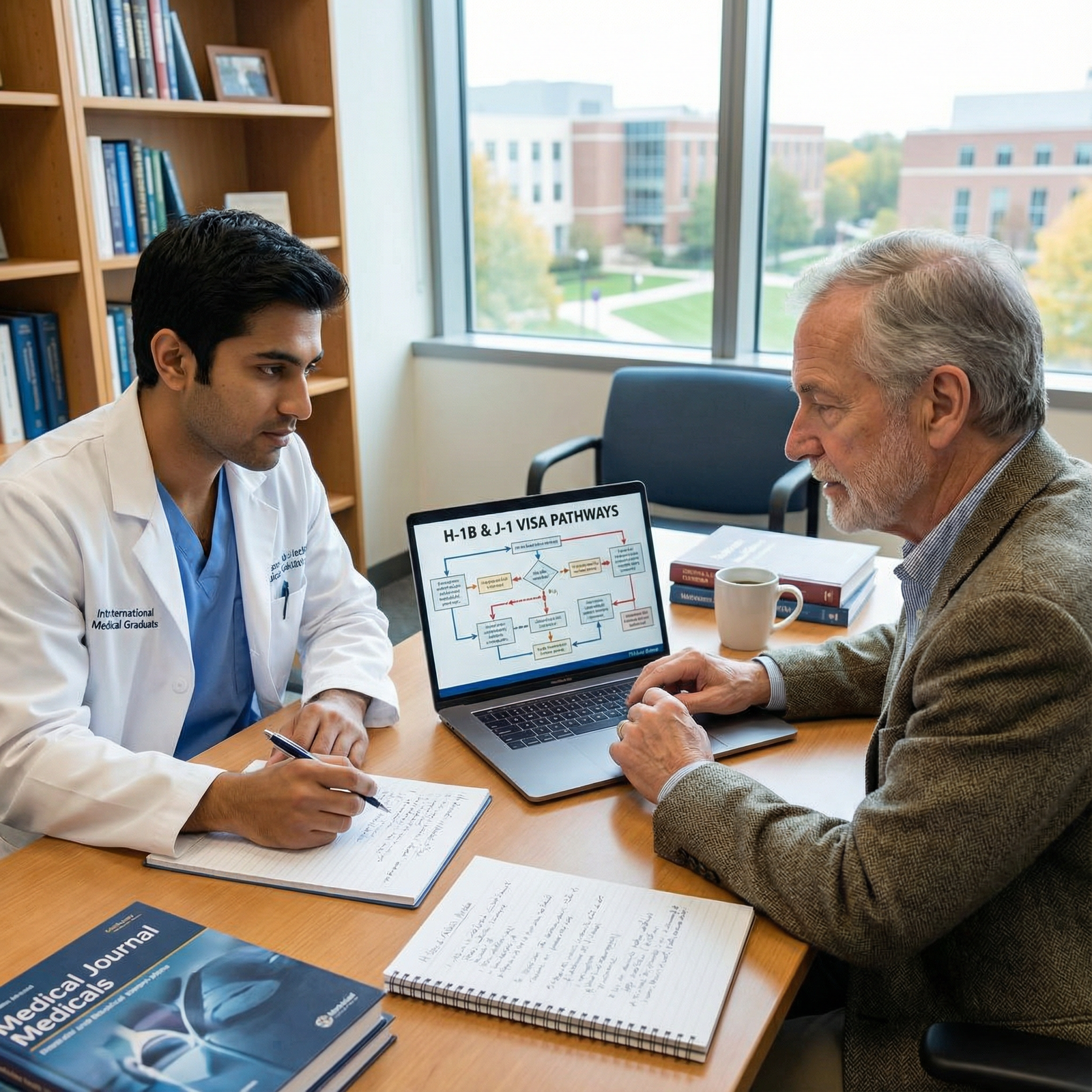
Understanding the Visa Landscape as a Caribbean IMG in the Research Triangle
If you’re a Caribbean medical school graduate aiming to train in the Research Triangle (Raleigh–Durham–Chapel Hill) in North Carolina, visa planning is as important as your personal statement and USMLE scores. Programs at Duke, UNC, and other North Carolina institutions are accustomed to working with IMGs—but each has specific policies, especially around the J‑1 vs H‑1B decision.
This guide focuses on visa navigation for residency for Caribbean IMGs interested in the Research Triangle (NC), with practical advice you can use from MS3/MS4 through Match and beyond. It is especially relevant if you’re coming from schools like SGU, Ross, AUC, Saba, or other Caribbean programs and targeting programs like Duke residency, UNC, ECU/Vidant, or community programs across North Carolina.
We’ll cover:
- Core visa types (J‑1, H‑1B, and others) for residency
- How visa choices intersect with Caribbean medical school residency prospects
- Specific considerations for SGU residency match and other Caribbean schools
- What to know about North Carolina residency programs’ visa attitudes
- Practical timelines and strategies so visa questions don’t derail your Match
Core Visa Pathways for Caribbean IMGs Entering Residency
When US programs evaluate an IMG’s “visa need,” they’re asking: “Can we legally hire and train this applicant?” For Caribbean graduates, three groups exist:
- US citizens/green card holders – no visa needed
- Canadian or other non‑US citizens – will need a residency visa
- Students on F‑1 in the US (e.g., master’s programs) after Caribbean school – may transition to J‑1/H‑1B
This section focuses on residency visa options: J‑1 and H‑1B, plus a quick look at others.
The J‑1 Physician Visa (Most Common for IMGs)
For most non‑US IMGs, the J‑1 physician visa sponsored by the Educational Commission for Foreign Medical Graduates (ECFMG) is the default route.
Key features:
- Purpose: Graduate medical education (residency/fellowship)
- Sponsor: ECFMG (not the residency program itself)
- Tied to training: You must remain in ACGME‑accredited training and progress as expected
- Duration: Up to 7 years in total (can cover residency + many fellowships)
- Two‑year home residency requirement (INA 212(e)):
- After your final J‑1 training, you must return to your home country (or your last permanent residence) for two cumulative years OR
- Obtain a J‑1 waiver (e.g., via a Conrad 30 waiver job, VA, HHS, or other federal programs)
Pros for Caribbean IMGs:
- Widely accepted by programs: Many North Carolina residency programs state “J‑1 only” in their policies.
- Streamlined process: The visa is standardized nationally, and ECFMG is very familiar with Caribbean graduates.
- Good for those undecided about long‑term US plans: You can complete training, then decide if you’ll pursue a waiver job in the US or return home.
Cons:
- Home‑country physical presence requirement: The biggest drawback. Your long‑term practice in the US almost always requires a waiver job in a federally designated underserved area.
- Limited work flexibility: You cannot moonlight or work outside the training program without explicit, narrow authorization.
- No “dual intent”: Technically, J‑1 is not a dual‑intent visa; direct transition to green card paths is more complex and typically involves a waiver job first.
For a Caribbean IMG targeting a North Carolina residency, J‑1 is your most likely option, especially in larger academic centers like Duke residency and UNC.
The H‑1B Visa for Residency (Selective but Powerful)
The H‑1B is a temporary worker visa for specialty occupations, including physicians in training. A subset of residency programs—commonly more resourced academic centers—sponsor H‑1B visas for residents.
Key features:
- Employer‑specific: Sponsored directly by the residency program/hospital
- Dual intent: You can pursue a green card while on H‑1B without legal contradiction
- Duration: Typically up to 6 years total (including any pre‑residency H‑1B time)
- USMLE Step 3 requirement: For almost all H‑1B residency positions, you must have passed Step 3 before the visa petition is filed.
Pros for Caribbean IMGs:
- No 2‑year home requirement: You are not bound by INA 212(e).
- Easier transition to long‑term US practice:
- After residency, you can often transition to an attending job on H‑1B without a waiver.
- Straightforward path to employer‑sponsored green card.
- Better moonlighting flexibility (state and institution dependent): Some institutions allow internal moonlighting on H‑1B.
Cons:
- Limited availability: Many North Carolina programs are J‑1 only. Even within the Research Triangle, only selected programs may offer H‑1B.
- Higher administrative cost and complexity: Some programs simply avoid H‑1B sponsorship.
- Step 3 timing pressure: You must time your Step 3 carefully—delays can jeopardize starting residency on time.
For a Caribbean medical school residency applicant focused on the Research Triangle, an H‑1B is valuable but not guaranteed. If H‑1B is important to you, you must research each program’s policy early and adjust your application strategy accordingly.
Other Visa and Status Considerations
While J‑1 and H‑1B dominate, you might encounter other scenarios:
F‑1 students in the US (e.g., MPH or research programs pre‑residency)
You can do OPT (Optional Practical Training) in some research roles, but residency itself is almost never done on F‑1. You’ll transition to J‑1 or H‑1B for residency.O‑1 (extraordinary ability)
Rare for residents; more common for star faculty or senior researchers.TN (for Canadians and Mexicans)
Generally unsuitable for residency positions; most will still use J‑1 or H‑1B.Permanent resident (green card)
Eliminates residency visa issues entirely. If you’re eligible through family ties or other means, beginning that process early can massively simplify your path.

Visa Policies at Research Triangle and North Carolina Programs
As a Caribbean IMG targeting the Research Triangle (NC), understanding local attitudes toward IMGs and visas is critical. Hospitals here include large academic powerhouses and smaller community partners, each with its own risk tolerance for immigration processes.
Duke Residency and Other Triangle Academic Centers
Duke University Hospital, UNC Hospitals, and affiliated systems are major magnet institutions for IMGs.
While exact policies change, common patterns include:
High familiarity with IMGs (including Caribbean graduates):
- Many Duke and UNC programs have a long track record of matching Caribbean IMGs, including from SGU residency match cohorts.
- They are experienced with ECFMG J‑1 sponsorship.
J‑1 generally accepted, H‑1B more variable:
- Some specialties at Duke or UNC may sponsor H‑1B for highly competitive candidates (particularly in fellowships, sometimes in residency).
- Others are explicitly J‑1 only due to institutional policy or GME office decisions.
Residency visa policies are often specialty‑specific:
- For example, Internal Medicine at one institution might sponsor H‑1B, while General Surgery does not.
- Fellowship programs sometimes have broader H‑1B flexibility than core residencies.
Action point:
Before you apply, check each program’s website or directly email the program coordinator to ask:
“For IMG applicants, do you sponsor J‑1 only, or J‑1 and H‑1B visas?”
Record the answers in a spreadsheet for your ERAS strategy.
North Carolina Residency Programs Beyond the Triangle
If you consider a broader North Carolina residency strategy—for example:
- ECU/Vidant in Greenville
- WakeMed, Cone Health (Greensboro), Novant, Atrium Health affiliates
- Community internal medicine, family medicine, psychiatry programs
—you’ll find a mix of policies:
- Community programs: Often J‑1 only, as they may lack immigration legal resources for H‑1B.
- Larger teaching hospitals: More likely to be open to H‑1B, but policies vary.
For Caribbean IMGs, broadening your list beyond just Duke or UNC can:
- Increase your Match odds, especially if you are visa‑requiring
- Provide more options if you are flexible between J‑1 vs H‑1B
Practical Example: Caribbean IMG Targeting Duke and the Triangle
Imagine you’re an SGU graduate:
- Strong scores (Step 1 pass, Step 2 CK 245+)
- US clinical rotations completed in major US hospitals
- You want Duke residency in Internal Medicine but are also open to UNC and nearby community programs.
Your approach:
Check each program’s visa policy early (MS3/MS4):
- Duke IM: J‑1 and possibly H‑1B (hypothetical; check current policy).
- UNC IM: J‑1 only, or J‑1 + H‑1B, depending on the year.
- Community programs around Raleigh/Durham: Most J‑1 only.
Decide your visa priority:
If you strongly want H‑1B:
- Aim to take Step 3 by early winter of the application year.
- Emphasize your readiness for long‑term US practice in your application.
If you’re comfortable with J‑1:
- Focus primarily on clinical excellence and fit.
- Understand that a future J‑1 waiver job will likely be needed in a more rural or underserved area after training.
Apply broadly within North Carolina and beyond:
- Don’t limit yourself only to Duke/UNC; add other regional programs that sponsor the visa type you’re open to.
J‑1 vs H‑1B: How to Choose as a Caribbean IMG
The J‑1 vs H‑1B question is central to IMG visa options, and the “right” answer depends on your goals and profile.
When J‑1 May Be Better for You
J‑1 is often preferable if:
You prioritize maximum program choice:
- Many top programs only sponsor J‑1.
- Some highly competitive specialties (e.g., dermatology, plastic surgery) may simply not offer H‑1B.
You are not yet sure if you will stay in the US long‑term:
- You may want exposure to US training but are open to returning to the Caribbean, Canada, or another country after.
You don’t have Step 3 yet, or your timeline is tight:
- If Step 3 results won’t be ready in time for H‑1B processing (often several months before residency start), H‑1B may be impractical.
You value ECFMG’s structured oversight:
- The J‑1 system has a well‑defined process and support structure for issues that arise.
Example:
A Caribbean IMG interested in psychiatry or pediatrics at UNC or Duke, with Step 3 not yet taken, and open to going home for a few years eventually. J‑1 makes strategic sense.
When H‑1B May Be Better for You
H‑1B can be advantageous if:
- You are committed to living and practicing in the US long‑term.
- You are willing and able to take and pass Step 3 early.
- Your target programs explicitly offer H‑1B.
Benefits for a long‑term US plan:
No two‑year home requirement:
Vital if you have family, a partner, or other ties in the US.More straightforward green card path:
Your attending job (post‑residency) can sponsor you directly for permanent residency.Flexibility in job market post‑residency:
You’re not constrained to J‑1 waiver jobs (which are largely in underserved or rural areas)—though many H‑1B holders still choose such positions.
Example:
A Caribbean IMG applying to Internal Medicine at Duke, with excellent scores and research, who already passed Step 3, married to a spouse in the US, and focused on subspecialty fellowship plus long‑term US practice. H‑1B sponsorship would be ideal if the program offers it.
Mixed Strategy: Open to Both J‑1 and H‑1B
Many Caribbean IMGs adopt a hybrid strategy:
- Apply broadly to both J‑1‑only and H‑1B‑friendly programs.
- Take Step 3 early enough so that, if an H‑1B‑offering program is interested, you qualify.
- If the best‑fit Match is J‑1, accept the J‑1 and plan strategically for the future (e.g., early waiver job planning).
In practice, this is often the most realistic IMG visa options strategy for Caribbean graduates in the Research Triangle and elsewhere.
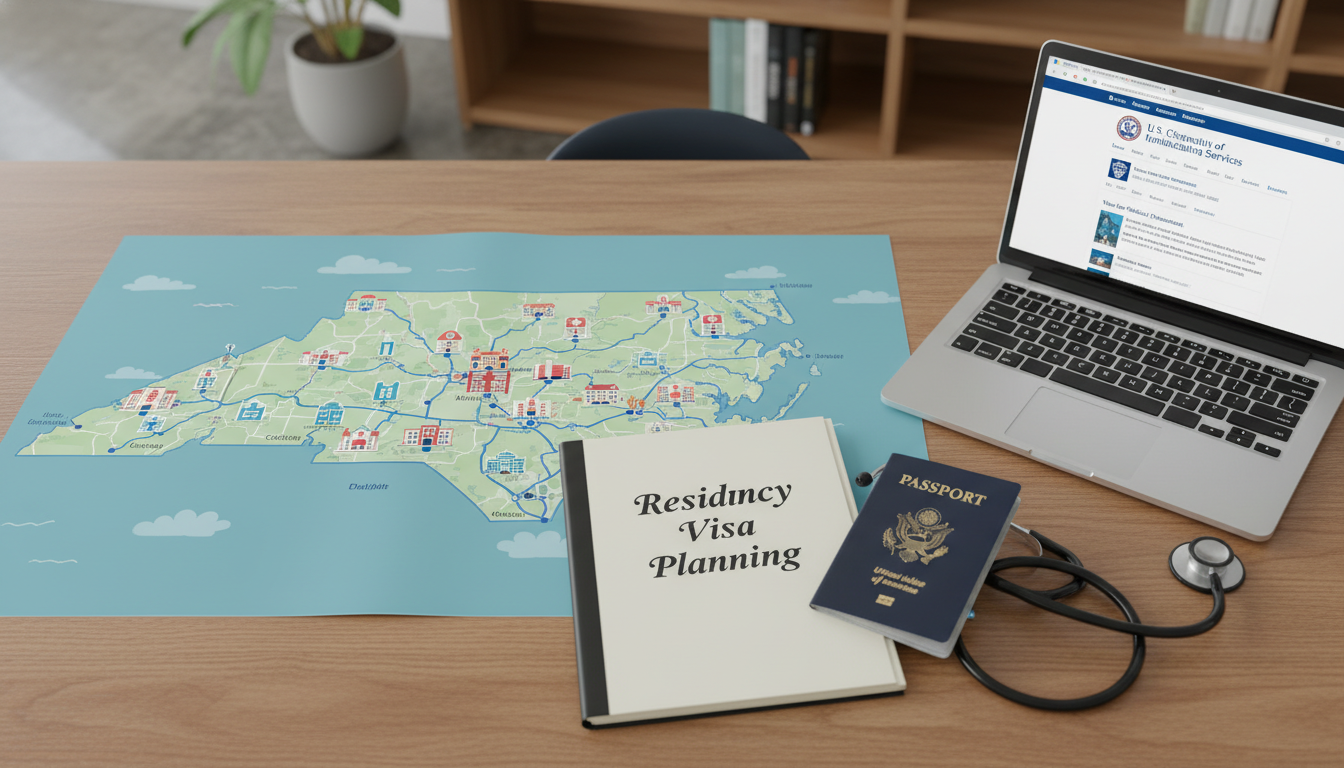
Timeline and Action Plan: From Caribbean School to NC Residency
Visa navigation isn’t something you leave for after Match Day. You must build it into your planning from MS3 onward, especially if you want options like Duke residency or other competitive North Carolina residency programs.
MS3 / Early Clinical Years
Clarify your long‑term goals:
- Do you intend to settle in the US permanently?
- Are you open to living in a medically underserved area after training (for J‑1 waiver jobs)?
Research programs and visa policies:
- Build a spreadsheet of:
- Program name
- City/state (highlight Research Triangle programs)
- Specialty
- Visa policies (J‑1 only vs. J‑1 + H‑1B)
- Pay special attention to Caribbean medical school residency–friendly programs (those with a history of taking SGU, Ross, AUC, etc.).
- Build a spreadsheet of:
Prioritize US rotations in visa‑friendly programs:
- If possible, schedule electives at institutions that:
- Sponsor the visa type you prefer.
- Have a track record of matching Caribbean IMGs.
- If possible, schedule electives at institutions that:
Late MS3 / Early MS4
Plan USMLE Step 3 (if targeting H‑1B):
- Aim to have Step 3 passed by January–March of the year you’ll start residency.
- Carefully check your prospective programs’ deadlines for H‑1B filing with Step 3 proof.
Craft your ERAS and personal statement with clarity about your status:
- Ensure your ERAS citizenship/visa section is accurate.
- Consider addressing your long‑term plans briefly if relevant:
- For example, “I hope to remain in academic medicine in the US, pursuing fellowship after core residency training.”
Reach out to programs for clarification:
- If their website is unclear, email the program coordinator:
- Ask about IMG visa options for the coming cycle (policies sometimes change year to year).
- Confirm if they accept graduates from your Caribbean school.
- If their website is unclear, email the program coordinator:
Interview Season
Prepare to discuss visa during interviews (if asked):
- Be honest, concise, and confident.
- Examples:
- “I am eligible for ECFMG J‑1 sponsorship and understand the two‑year home requirement.”
- “I have passed Step 3 and, while I am open to J‑1, I would also be interested in H‑1B sponsorship if available.”
Ask targeted, professional questions when appropriate:
- During the Q&A or with the program coordinator:
- “Could you clarify whether your program sponsors J‑1 only, or also H‑1B for residents?”
- “Do you have current residents on J‑1 or H‑1B who are international graduates?”
- During the Q&A or with the program coordinator:
Rank List and Match
Build your rank list with visa realism in mind:
- Rank the programs based on:
- Training quality and fit
- Geographic preferences (e.g., desire to be in the Research Triangle)
- Visa feasibility (e.g., no H‑1B‑only programs if you can’t get Step 3 in time)
- Rank the programs based on:
Post‑Match: start visa paperwork immediately:
- Once matched, your program and ECFMG or their immigration attorneys will guide you.
- For J‑1:
- You’ll complete ECFMG’s online application, upload documents, and await DS‑2019.
- For H‑1B:
- The institution’s legal team will file the petition with USCIS; timely cooperation is critical.
Long‑Term Planning: After Training on J‑1 or H‑1B
Your visa decisions at the start of residency will shape your options after residency in North Carolina or elsewhere in the US.
After J‑1: The Waiver Route
If you complete residency/fellowship on a J‑1 and want to remain in the US, you will typically seek a J‑1 waiver job, such as:
Conrad 30 state waivers:
Each state (including North Carolina) can sponsor up to 30 J‑1 physicians per year to work in underserved areas.Federal waivers (VA, HHS, etc.):
Often focused on specific fields or underserved populations.
Key points:
- You must work 3 years full‑time in the waiver job (usually on an H‑1B) to remove the 2‑year home requirement.
- Many waiver positions are outside major metros, though some are in smaller cities near the Triangle.
- After the waiver service, you can seek any job, including in academic centers like Duke or UNC, and pursue a green card.
After H‑1B: Transitioning to Attending Roles and Green Card
If you train on an H‑1B:
- You may transition directly to attending roles in North Carolina or other states on H‑1B.
- Your new employer can sponsor an employment‑based green card:
- Many physicians use EB‑2 with PERM labor certification.
- No mandatory return to home country or waiver job is required.
However, remember your total H‑1B time is capped (typically 6 years) unless you have a pending green card case that allows extensions beyond the 6‑year limit.
Final Practical Tips for Caribbean IMGs Targeting the Research Triangle
- Start visa planning early, ideally during MS3.
- Be honest and clear about your visa status in all applications.
- Use your Caribbean network: SGU, Ross, AUC, and others often have alumni in Duke/UNC or other NC programs who can give up‑to‑date visa insights.
- Check program policies yearly: Institutions sometimes change from “J‑1 only” to “J‑1 and H‑1B” or vice versa.
- Don’t let visa concerns paralyze your application: Many Caribbean IMGs successfully match to North Carolina residency programs every year, including in the Research Triangle.
With preparation, clarity about J‑1 vs H‑1B, and smart targeting of IMG visa options, you can navigate the system and build a strong, sustainable career path in North Carolina.
FAQ: Visa Navigation for Caribbean IMGs in the Research Triangle
1. As a Caribbean IMG, do I have a realistic chance of matching at Duke or UNC on a visa?
Yes. Both institutions have a history of matching Caribbean graduates, often on J‑1 visas. Some specialties may also support H‑1B, but that is program‑specific and can vary year to year. Strong USMLE scores, solid US clinical experience, and good letters are critical; visa need alone does not exclude you.
2. Should I rush to take Step 3 to improve my chances of getting an H‑1B for residency?
Only if:
- Your target programs explicitly sponsor H‑1B
- You can realistically prepare without harming your Step 2 CK performance or application quality
If most of your desired programs are J‑1 only, or if your preparation is not ready, prioritize your core exams and application strength over rushing Step 3.
3. If I match on a J‑1 in North Carolina, can I stay in the Research Triangle after training?
Immediately after training, you would generally need a J‑1 waiver job, which is typically in an underserved area. These positions are often outside the major Triangle hospitals. However, after completing the 3‑year waiver obligation, you may then move to roles in the Research Triangle (e.g., Duke, UNC, or local practices) without the J‑1 restriction, assuming your immigration status (e.g., H‑1B/green card) allows it.
4. Do all Caribbean medical schools have equal visa outcomes for residency?
No. Programs sometimes differentiate based on:
- The school’s accreditation and history in US training
- Performance of past graduates (e.g., SGU residency match outcomes are well‑known to many PDs)
However, visa eligibility (J‑1 vs H‑1B) is primarily a function of your citizenship, exam completion (especially Step 3 for H‑1B), and the program’s policy, not your specific Caribbean school. That said, attending a well‑established Caribbean school with strong US affiliations can help you access better rotations and letters, which indirectly improves your residency and visa options.