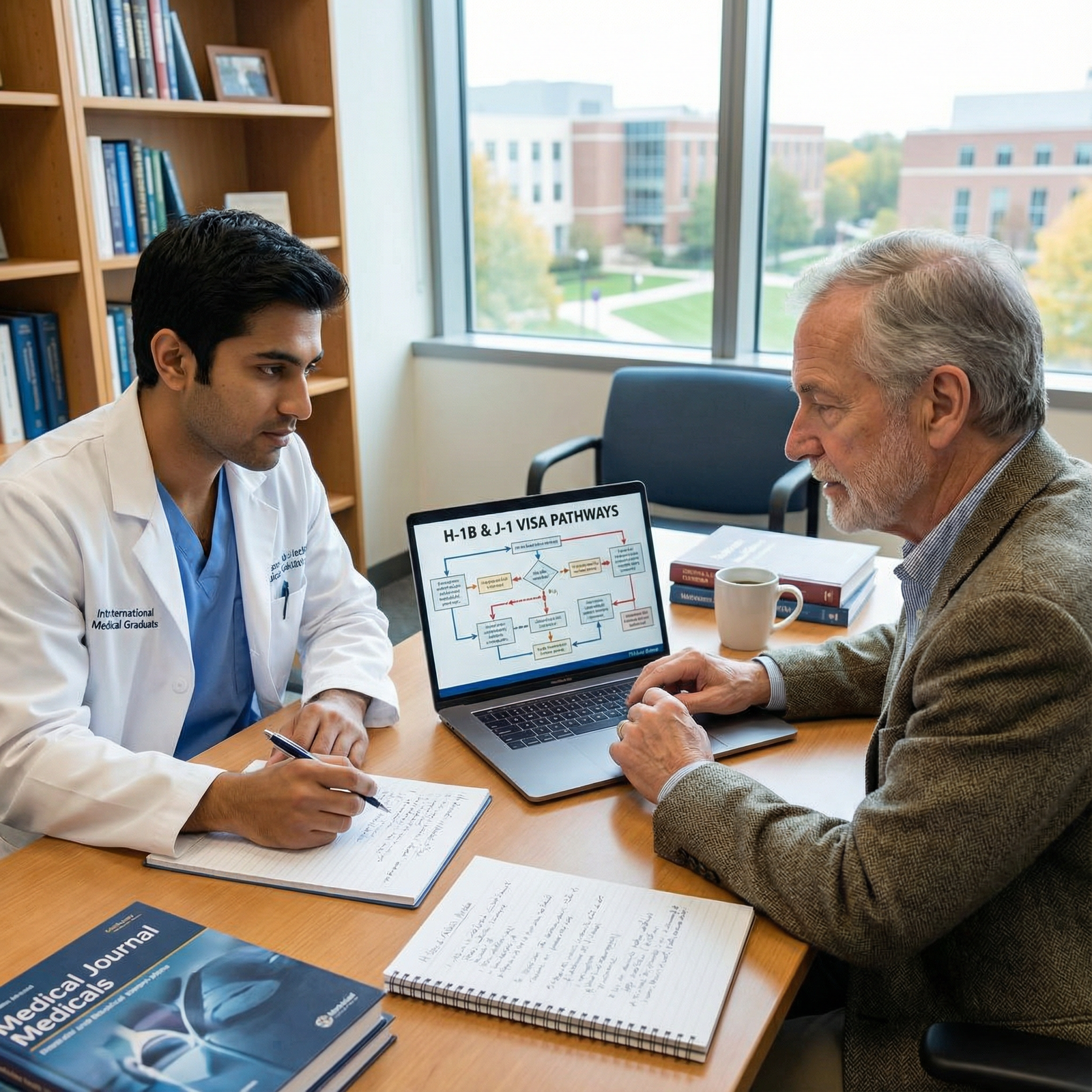
Understanding the Visa Landscape as a Caribbean IMG in Seattle
For Caribbean international medical graduates (IMGs), Seattle is an increasingly attractive destination. Strong academic centers (like UW and its affiliated hospitals), diverse patient populations, and robust primary care and subspecialty training make Seattle residency programs highly competitive. However, for Caribbean medical school graduates—whether from SGU, Ross, AUC, Saba, or other schools—visa navigation can be just as important as board scores and clinical performance.
This guide focuses on practical visa navigation for residency, specifically for Caribbean IMGs targeting Seattle residency programs or broader Washington state residency opportunities. It will help you understand:
- The main residency visa options (J-1 vs H‑1B) and how programs in Seattle typically approach them
- How your Caribbean medical school background (and prior SGU residency match trends, etc.) affect your visa strategy
- How to present yourself as a low-risk, high-value visa candidate
- What to expect before, during, and after residency from an immigration standpoint
Throughout, the emphasis is on actionable steps tailored to a Caribbean IMG aiming for Seattle.
Big Picture: How Visa Status Affects Your Seattle Residency Prospects
Before digging into J-1 vs H‑1B, it’s important to understand how program directors (PDs) in Seattle and across Washington state think about visas.
1. Program perspectives on Caribbean IMGs
Caribbean medical school graduates have a long history of successfully matching into U.S. residencies, including in Washington state. For example:
- Many SGU residency match lists show placements in Pacific Northwest programs (internal medicine, family medicine, psychiatry, etc.).
- Other Caribbean schools likewise match a small but steady stream of applicants to Seattle-area community and academic programs.
Program directors generally look at:
- USMLE scores and first-time pass
- Performance in U.S. clinical rotations (including letters from U.S. attendings)
- Communication skills and professionalism
- Visa complexity and institutional policies
Your Caribbean background is not automatically a barrier, but visa issues can be a tie-breaker if programs perceive higher risk or administrative burden.
2. J‑1 vs H‑1B in Washington State and Seattle
Seattle residency programs fall broadly into three categories regarding visa sponsorship:
- J‑1 only – Many academic programs, particularly university-affiliated (e.g., large university hospitals, some major teaching institutions), strongly prefer or exclusively sponsor J‑1s.
- J‑1 primary, selective H‑1B – Some programs will sponsor H‑1B only for exceptional applicants or specific specialties (e.g., internal medicine, neurology, certain subspecialties) and require all USMLE Steps to be passed before ranking.
- Both J‑1 and H‑1B, flexible – More common in some community-based or independent programs, especially in high-need specialties (family medicine, internal medicine, psychiatry, pediatrics).
From a program’s standpoint, J‑1 is usually simpler, cheaper, and more standardized, whereas H‑1B often requires:
- Higher legal costs and institutional effort
- Proof that the applicant has passed all USMLE Steps (often including Step 3)
- More lead time and coordination
For you as a Caribbean IMG, understanding these dynamics early will let you choose targets and craft your application strategy around realistic IMG visa options in Seattle.
Core Visa Options for Residency: J‑1 vs H‑1B for a Caribbean IMG
The two main residency visa categories for IMGs in graduate medical education (GME) are the J‑1 (Exchange Visitor Physician) and the H‑1B (Temporary Specialty Worker).

J‑1 Visa for Residency: The Standard Path
The J‑1 physician visa is issued via the Educational Commission for Foreign Medical Graduates (ECFMG), which acts as your visa sponsor.
Key Features
- Purpose: Graduate medical education (residency and fellowship)
- Duration: Up to 7 years total of sponsored training (some exceptions exist)
- Sponsorship: ECFMG, with the residency program’s support
- Return requirement: Subject to the two-year home-country physical presence requirement (often called the “2-year rule”)
Eligibility Requirements
To be sponsored for a J‑1 as a Caribbean IMG, you must:
- Have a valid ECFMG certificate
- Have a contract or offer from an ACGME-accredited residency or fellowship program
- Provide adequate financial documentation (usually met by residency salary)
- Prove nonimmigrant intent (you will return home after training unless you later secure a waiver)
Importantly, unlike H‑1B, you do not need USMLE Step 3 for J‑1 sponsorship. This is a major practical difference for Caribbean IMGs applying in their last year of medical school.
Pros of J‑1 for a Caribbean IMG
- Widely accepted: Many Seattle residency programs prefer or exclusively use J‑1
- No Step 3 requirement at time of Match
- Standardized ECFMG process, predictable timelines
- Often faster and logistically easier for the program to arrange
Cons of J‑1
- Mandatory 2-year home-country requirement after completing training (includes time for all fellowships under J‑1) unless you obtain a waiver
- Waiver process can be competitive and location-limiting (especially in Washington state)
- Generally, you cannot convert directly from J‑1 to a green card without addressing the 2-year requirement (either fulfilling it or securing a waiver)
H‑1B Visa for Residency: The Alternative Path
The H‑1B visa is a temporary worker category for specialty occupations.
Key Features
- Purpose: Temporary specialty occupation worker (including physician in training)
- Duration: Up to 6 years total in most cases (with some extension options if in green card process)
- Employer-specific: Sponsored by the residency program directly
- No mandatory home-country stay after completion
Eligibility Requirements for Residency H‑1B
As a Caribbean IMG, H‑1B for residency usually requires:
- ECFMG certification
- USMLE Step 3 passed before petition submission (often before the Rank List deadline, depending on program)
- A specialty occupation job offer from an accredited residency program
- Program willingness to sponsor H‑1B (not all Seattle or Washington state residency programs do)
Pros of H‑1B for a Caribbean IMG
- No 2-year home-country return obligation
- Path to employment-based green card is more straightforward post-residency (e.g., via EB-2 or EB-3)
- Attractive to employers after training, especially in non-underserved urban settings (like central Seattle) that may not participate in J‑1 waiver programs
Cons of H‑1B
- Requires USMLE Step 3, which can be difficult to schedule and pass before Match
- More paperwork, legal cost, and time for the residency program
- Some programs (including competitive Seattle residency programs) do not sponsor H‑1B at all
- Total time limit (6 years) can be constraining if you plan long fellowships plus delayed green card processing
How Visa Choice Affects Long-Term Plans in Seattle and Washington State
Thinking Beyond Residency: Where Do You Want to Work?
Washington state residency and Seattle-based GME will train you, but your post-residency plans should influence which visa you pursue.
If You Expect to Pursue a J‑1
Assume you match on a J‑1 into a Seattle program:
During Residency
- You can complete your full training (residency, plus possibly fellowship) as long as you remain in good standing.
- Each year, your program and ECFMG renew sponsorship.
After Training: The 2-Year Requirement
- By default, you must return to your home country or last permanent residence for two years cumulatively.
- To remain in the U.S. without leaving, you need a J‑1 waiver.
J‑1 Waiver Paths (Post-Training) in Washington State
Common waiver tracks for physicians include:
Conrad 30 Waiver Programs (State-based)
- Each state (including Washington) can sponsor up to 30 J‑1 physicians per year for waiver positions in underserved areas.
- You must usually work 3 years full-time in a designated underserved area (often rural or semi-rural, or certain inner-city clinics/hospitals).
- Many positions are in family medicine, internal medicine, psychiatry, pediatrics, etc.
- For Caribbean IMGs hoping to stay in Washington, this is often the main bridge from J‑1 to long-term U.S. practice.
VA (Veterans Affairs) Facilities
- Some J‑1 waivers are available for physicians working in VA hospitals.
- In the Pacific Northwest, these are more limited and competitive.
Federal agency waivers (e.g., HHS, ARC)
- Programs serving high-need populations sometimes sponsor waivers through federal agencies.
If your priority is to live in central Seattle after training, note that many Conrad 30/HPSA/MUA waiver jobs are outside major metropolitan cores. You may need to work in more rural or small-city Washington for a few years before moving back to Seattle.
If You Expect to Pursue H‑1B
Assume you pursue an H‑1B through your Seattle residency program:
During Residency/Fellowship
- You complete training under H‑1B status, up to the 6-year limit.
- If you do multiple fellowships, you must track total H‑1B time used.
Post-Residency Job and Green Card
- Employers (private groups, hospitals) in Seattle or across Washington can file EB-2/EB‑3 immigrant petitions while you are on H‑1B.
- No 2-year return requirement applies.
- You can continue working in many urban settings without needing a J‑1 waiver job.
However, there are some caveats:
- Some Seattle residency programs simply do not offer H‑1B, restricting your choices.
- If you extend your training (e.g., long fellowships) you might run close to the 6-year H‑1B cap before your green card is approved.
Practical Application Strategy for Caribbean IMGs Targeting Seattle

1. Map Out Your Personal Profile Early
Before applying, evaluate:
- Your Caribbean medical school reputation (SGU, Ross, AUC, Saba, etc.) and historical match trends into Washington state
- USMLE performance (especially Step 1 and Step 2 CK, and whether Step 3 before Match is realistic)
- Clinical experience in the U.S., especially if any rotations were in the Pacific Northwest
- Your long-term goals:
- Do you absolutely want to stay in Seattle post-training?
- Are you open to rural or underserved practice for a few years (for a J‑1 waiver job)?
- How important is a faster path to a green card?
This self-assessment will heavily inform whether to prioritize J‑1 vs H‑1B as your primary residency visa.
2. Research Seattle and Washington State Residency Program Visa Policies
Not all Seattle residency programs advertise detailed visa policies openly, but you can usually find:
- On the program website:
- “We sponsor J‑1 visas only”
- “We sponsor J‑1 and H‑1B visas”
- “We are unable to sponsor visas at this time”
- Through FREIDA, ERAS, or program FAQs
- By emailing the program coordinator directly with a concise, professional question:
- Example:
“I am a Caribbean IMG with ECFMG certification and progressing toward USMLE Step 3. Does your program sponsor J‑1 and/or H‑1B visas for residents?”
- Example:
Focus your applications on programs where your visa category is welcomed:
- If Step 3 before Match is unlikely:
- Prioritize J‑1 friendly programs in Seattle and Washington state.
- If you are certain you can pass Step 3 early and want H‑1B:
- Target programs that have a track record of H‑1B sponsorship for residents.
3. Optimize Your Application to Look “Low-Risk” from a Visa Standpoint
Visa concerns are partly about administrative effort and uncertainty. You can reduce program anxiety by:
- Ensuring all exams are passed on first attempt (or explaining any repeat attempts clearly and briefly).
- Having a valid ECFMG certificate at the time of application.
- Demonstrating strong English communication skills and professional maturity in your personal statement, interviews, and letters.
- For H‑1B hopefuls:
- Scheduling and passing Step 3 as early as realistically possible.
- Mentioning your Step 3 status clearly in ERAS (“Step 3 passed” or “scheduled for [date]”).
Programs in Seattle that have had positive experiences with Caribbean IMGs—for example, previous SGU residency match graduates who performed well—are more likely to sponsor visas for new Caribbean applicants.
4. Timing and Logistics of Visa Processing
J‑1 Timeline (General)
- Match Day (March)
- You confirm your placement in a Seattle or Washington state residency program.
- Spring–Early Summer
- Program sends contract and required documents.
- You submit an online application to ECFMG for J‑1 sponsorship.
- ECFMG issues Form DS‑2019 once documents are approved.
- Visa Interview at U.S. Consulate
- You apply for a J‑1 visa stamp in your passport.
- Once approved, you can enter the U.S. to start residency.
For Caribbean IMGs already in the U.S. on F‑1 or other statuses, you may need to travel home for stamping, depending on your current status and plans. Plan leave and travel carefully.
H‑1B Timeline (General)
- Before Match
- Step 3 passed (ideally well before Rank List deadline).
- Program confirms willingness to sponsor H‑1B if matched.
- Post-Match
- Program’s legal team files an H‑1B petition with USCIS, often under “cap-exempt” category if the hospital is affiliated with a university or nonprofit.
- Visa Stamping (if abroad)
- If outside the U.S., you attend a consular interview for H‑1B visa stamping.
- Start of Residency
- You begin training under H‑1B status once petition is approved and start date is reached.
Because H‑1B petitions can take longer (especially without premium processing), some programs in Seattle prefer J‑1 to avoid start-date uncertainty.
Case Scenarios: Applying the Strategy as a Caribbean IMG
Scenario 1: SGU Graduate, Strong Scores, Unsure About Step 3 Timing
- School: SGU (or similar Caribbean med school with solid match history)
- Scores: Step 1 – 235, Step 2 CK – 245, first attempts
- Step 3: Not yet taken; may not be feasible before Match
- Goal: Internal Medicine in Seattle, long-term goal is to stay in Washington state
Recommended path:
- Focus on J‑1 sponsoring Seattle residency programs, including university and community IM programs.
- Plan your J‑1 waiver strategy early:
- Explore Washington’s Conrad 30 opportunities for IM physicians in rural/small-city Washington.
- Be mentally prepared to spend 3–5 years outside central Seattle after residency before possibly moving back.
Scenario 2: AUC Graduate, High Scores, Able to Take Step 3 Early
- School: AUC or comparable Caribbean school
- Scores: Step 1 – 250, Step 2 CK – 255
- Step 3: Planned for early fall before Rank List submission
- Goal: Psychiatry or Neurology in a Seattle academic program with ultimate long-term goal to remain in Seattle metro post-training
Recommended path:
- Shortlist Seattle residency programs that explicitly state H‑1B sponsorship.
- Take and pass Step 3 before programs finalize rank lists.
- Communicate clearly in ERAS and interviews that:
- You have passed Step 3
- You prefer H‑1B sponsorship due to your long-term plan to remain in the U.S.
- Have a backup plan: include some J‑1 programs in Washington state & nearby states to avoid going unmatched if H‑1B programs are limited.
Scenario 3: Ross Graduate, Mid-Range Scores, Strong Primary Care Interest
- School: Ross or similar
- Scores: Step 1 – 220, Step 2 CK – 228
- Goal: Family Medicine or Pediatrics; open to rural Washington practice long-term; main priority is training and eventual stability, not necessarily Seattle city center
Recommended path:
- Target J‑1 friendly family medicine and pediatrics programs across Washington state, including those outside Seattle.
- Build a story around commitment to underserved populations, which aligns well with J‑1 waiver jobs later.
- During residency, network with clinics/hospitals in HPSA/MUA areas that routinely sponsor J‑1 waiver jobs.
Frequently Asked Questions (FAQ)
1. Is it realistic for a Caribbean IMG to get an H‑1B for residency in Seattle?
Yes, it is possible but more restrictive. To maximize your chances:
- Have strong USMLE scores and pass Step 3 early.
- Target programs that explicitly sponsor H‑1B (many will not).
- Present a strong overall application: solid letters, U.S. clinical experience, and clear communication about your visa needs.
However, many Caribbean IMGs successfully train in Seattle on J‑1 visas, then transition to J‑1 waiver jobs (often outside the city) before eventually settling where they prefer.
2. I’m an SGU graduate; does my school help with residency visa navigation?
Most major Caribbean schools (including SGU) provide:
- Advising on residency applications and visa basics
- Historical data on SGU residency match outcomes across states and specialties
- Guidance on ECFMG processes and documentation
However, the ultimate visa sponsorship decisions lie with the residency programs and, for J‑1s, with ECFMG and U.S. consular officers. Treat your school’s advising as a resource, but always verify visa policies with specific Seattle and Washington state residency programs.
3. If I start residency on a J‑1, can I switch to H‑1B during training?
In theory, changing from J‑1 to H‑1B is possible, but in practice for physician trainees it is:
- Often discouraged by ECFMG and programs
- Legally complex because of the two-year home-country requirement that attaches once you receive J‑1 status
- Dependent on your ability to either fulfill or waive that requirement
Most IMGs complete all training on J‑1 and then pursue J‑1 waiver jobs or home-country return. If your long-term plan strongly favors H‑1B, it’s better to plan that from the start rather than mid-residency.
4. Can I get a green card directly after residency if I’m on a J‑1?
Not without addressing the two-year home-country physical presence requirement. Your options are:
- Fulfill the 2-year requirement by spending two years in your home country (or country of last permanent residence).
- Obtain a J‑1 waiver (e.g., via a U.S. underserved-area job under Conrad 30, VA, or federal agency sponsorship) and then transition to H‑1B or other work status, followed by employer-sponsored green card.
Because of these steps, the path from J‑1 to green card usually involves several years beyond residency, often in underserved areas.
By understanding the nuances of residency visa options, especially J‑1 vs H‑1B, and how they interact with Seattle residency programs and Washington state residency pathways, you can craft a realistic, strategic plan. As a Caribbean IMG, early planning, targeted applications, and clear communication about your visa needs will significantly improve both your chances of matching and your long-term prospects of living and practicing in the Pacific Northwest.