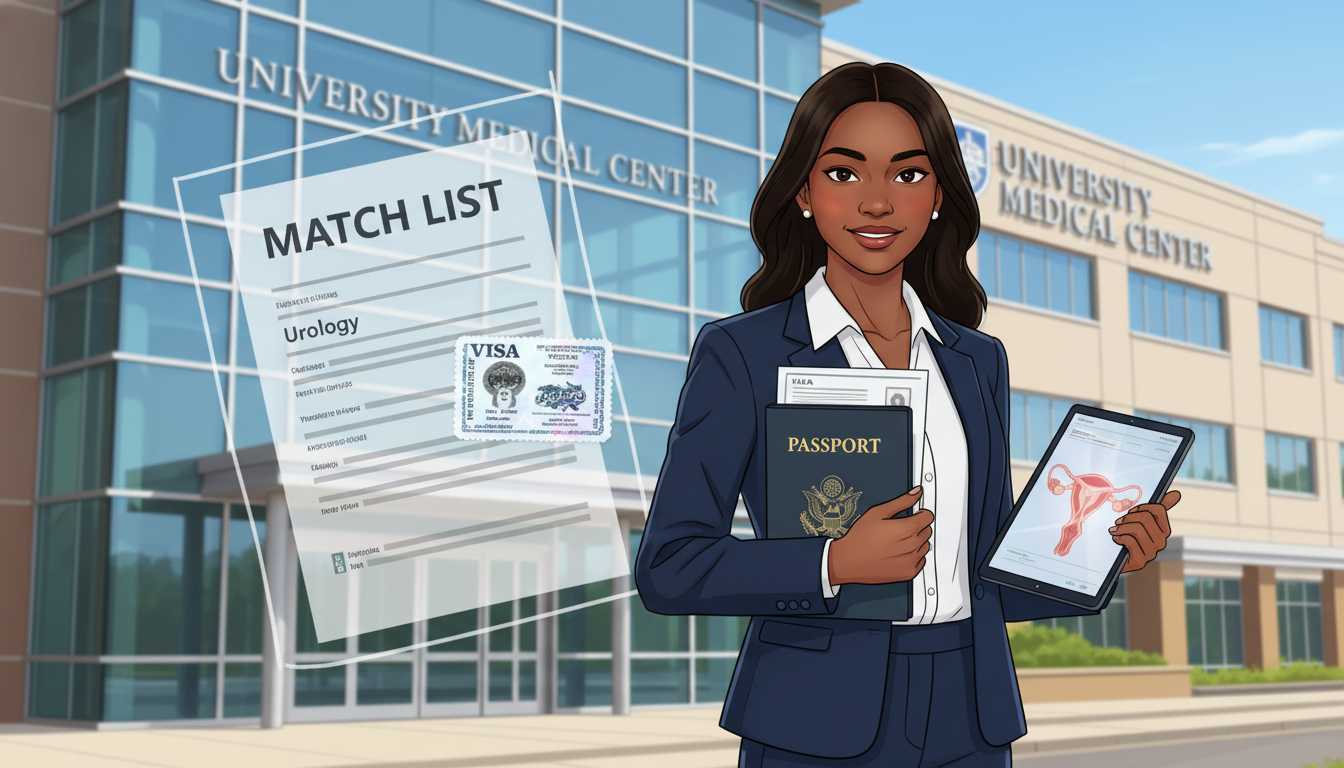
Understanding the Visa Landscape for Caribbean IMGs in Urology
As a Caribbean medical student or graduate with your eye on a competitive urology residency, visa planning is not a side issue—it is a core part of your residency strategy. Programs want to know two things early:
- Can you legally train here?
- Is your visa pathway compatible with a 5–6 year urology residency and future fellowships?
For a Caribbean medical school residency applicant targeting urology, this becomes even more critical because:
- Urology is a competitive early match specialty (via the AUA, not the NRMP main match).
- Many urology programs have limited experience or appetite for complex immigration cases.
- Some programs (especially smaller or community-based) simply do not sponsor visas.
Your goal is to remove as much “visa friction” as possible so programs can focus on your clinical and academic strengths. To do that, you must understand:
- The main IMG visa options for residency (J-1 vs H-1B, plus a few special categories)
- How those visas interact with urologic training length and fellowships
- How to read program policies and filter your application list
- How visa strategy fits into your SGU residency match or broader Caribbean medical school residency plan
Core Visa Types for Urology Residency: J-1 vs H-1B and Beyond
1. The Two Main Workhorse Visas: J-1 vs H-1B
For most IMGs entering graduate medical education, the realistic choices are:
- J-1 Exchange Visitor (ECFMG-sponsored physician category)
- H-1B Temporary Worker (specialty occupation)
J-1 Visa for Residency
Key features:
- Sponsor: ECFMG, not the individual residency program
- Purpose: Graduate medical education (residency and fellowship)
- Duration: Typically up to 7 years total for clinical training
- Requirements:
- ECFMG certification
- Valid training contract
- Return-home requirement (2 years in home country after training) unless you obtain a waiver
- Common in: Academic centers and large teaching hospitals
Why programs like J-1 for urology residents:
- Simple for them administratively (ECFMG handles sponsorship).
- Well-understood and standardized process.
- Flexible across residency and most fellowships, as long as you stay within the 7-year cap.
Challenges for you as a Caribbean IMG:
- The two-year home-country physical presence requirement under INA §212(e). After finishing all J-1 training (including fellowship), you must either:
- Return to your home country for a total of 2 years, or
- Obtain a J-1 waiver (often via a Conrad-30 waiver or similar) and then switch to H-1B or another status for practice.
For urology specifically:
- Standard residency is 5–6 years (one year of general surgery/rotations + 4–5 years of urology).
- Many urology residents pursue fellowships (oncology, endourology, pediatrics, FPMRS). You must ensure your total J-1 time for residency + fellowship(s) will not exceed 7 years or will be justifiable to ECFMG.
Bottom line:
The J-1 is often the most accessible and reliable visa for urology residency, but it carries long-term geographic and career planning implications.
H-1B Visa for Residency
Key features:
- Sponsor: The residency program hospital (your employer)
- Purpose: Temporary specialty occupation worker
- Duration: Typically up to 6 years total in H-1B status (some exceptions if in green card process)
- Requirements for a residency position:
- ECFMG certification
- Passing USMLE Step 3 before H-1B petition filing (important timing consideration)
- State medical training license (or eligibility)
- Cap issue: Most academic hospitals are cap-exempt H-1B employers; they can apply year-round.
Why some Caribbean IMGs prefer H-1B:
- No automatic 2-year home-country requirement.
- More straightforward transition to employment after residency (can continue on H-1B or use it for green card sponsorship).
- Attractive to those planning a long-term career in the U.S. without a forced return.
Why many urology programs avoid H-1B:
- More expensive and administratively complex.
- Requires Step 3 score well before residency start (sometimes even before rank lists).
- Urology programs may worry about:
- Long training length vs six-year H-1B limit.
- Future fellowship sponsorship (some fellowship programs do not sponsor H-1B at all).
- Some institutions have a blanket policy: no H-1B for residents.
Bottom line:
The H-1B can be an excellent strategic choice if you can secure it, but for urology it is often harder to obtain and may reduce the number of programs willing to consider you.
2. Other, Less Common Options
These exist but are usually not the primary path for a Caribbean IMG in urology:
O-1 (extraordinary ability)
For individuals with national or international recognition (significant research, publications, awards). Rarely used for new residents; more common for faculty-level physicians.TN (for Canadian/Mexican citizens)
Possible for physicians but generally restricted to teaching/research roles rather than direct patient care. Not a standard path for categorical residency training.EAD via other status (Green card, asylum, DACA, etc.)
If you already have work authorization independent of a nonimmigrant visa, you are often treated like a U.S. applicant from a visa standpoint (though still an IMG). This simplifies things greatly.
For most Caribbean medical school residency paths in urology, your practical planning should focus on J-1 vs H-1B.

How Visa Strategy Interacts with Urology Training and Career Path
1. Length and Structure of Urology Residency
Urology is not a simple 3-year categorical program; that’s crucial for visa planning.
Typical structure:
- PGY-1: Transitional or general surgery/urology-intern year
- PGY-2 to PGY-5/6: Core urology years
That’s generally 5 or 6 total years of training.
With a J-1 Visa
- The 7-year cap usually covers:
- Urology residency (5–6 years)
- Plus up to 1–2 years of fellowship, if planned carefully.
- If you know you want subspecialty urology (oncology, robotics, pediatrics), discuss early with:
- Your urology department
- Your program’s GME office
- Immigration/ECFMG advisors
to map out whether all planned training fits within J-1 limits.
With an H-1B Visa
- You have 6 years in H-1B (unless you start green card steps during training).
- If urology residency is 5–6 years, you may have little to no H-1B time left for fellowship.
- Some fellows switch back to J-1 for fellowship, which can create a complex immigration trajectory.
2. Long-Term Practice Goals: Academic vs Community
Your ideal visa for residency should align with your long-term career.
If you want academic medicine (major university center):
- J-1 is widely accepted for training.
- You may pursue a J-1 waiver job afterwards in an academic or hybrid setting, though many waiver spots are in underserved or community settings.
- You’ll need to be open to geographic flexibility initially.
If you want community urology practice:
- Having been on H-1B from residency can make the transition smoother (no J-1 waiver needed).
- But fewer urology programs will sponsor H-1B up front.
Many Caribbean IMGs choose J-1 initially for access to more urology programs, then manage the waiver and subsequent H-1B/permanent residency later.
3. The Urology Match Timeline and Visa Constraints
The urology match (AUA) happens earlier than the NRMP main match, typically:
- Interviews: late fall/early winter
- Rank lists: January
- Match announcement: end of January
- PGY-1 year starts in July
This timing has consequences:
For H-1B hopefuls:
You likely need USMLE Step 3 done before programs finalize rank lists, so by December–January of your application year. That’s tight for most Caribbean students, especially if you’re still finishing rotations or preparing Step 2 CK.For J-1 applicants:
Step 3 is not required to start residency, giving you more flexibility.
Practical take:
As a Caribbean IMG in urology, unless you have Step 3 done early and a strong CV, betting everything on an H-1B-only strategy can drastically shrink your program pool.
Building a Visa-Conscious Urology Application Strategy
1. Researching Program Policies on Visas
Each urology program has:
- Institutional GME-level visa policies
- Department-specific history and preferences
Actions:
Check official sources:
- Program’s website (look for “international medical graduates” or “visa sponsorship” sections).
- FREIDA and AUA program listings.
- Institution’s GME office site.
Common statements you’ll see:
- “We accept J-1 visas only.”
- “We sponsor J-1 and H-1B visas.”
- “We do not sponsor visas for residency.”
- “All IMG applicants must be eligible for J-1 sponsorship through ECFMG.”
Email clarification for ambiguous programs:
- Use a concise email template to the program coordinator:
- Identify yourself (Caribbean IMG, urology applicant).
- Ask: “Do you sponsor J-1 and/or H-1B visas for urology residents?”
- Avoid complex immigration questions; keep it simple.
- Use a concise email template to the program coordinator:
Then organize programs into:
- J-1 friendly
- H-1B possible
- No visa sponsorship
2. Deciding Your Default Visa Ask
You don’t usually “apply for a specific visa” in your ERAS or AUA application, but:
- Programs may ask you to indicate your visa preference.
- Your emails and interviews will communicate whether you’re:
- “Open to J-1 or H-1B”
- “J-1 only”
- “H-1B only”
For most Caribbean IMGs in urology, the most realistic and flexible statement is:
“I am eligible for and open to J-1 sponsorship through ECFMG. I am also interested in H-1B sponsorship if institutionally supported and timing for USMLE Step 3 allows.”
This helps because:
- You don’t scare away J-1-only programs.
- You signal to H-1B-accepting programs that you’re a candidate who understands the process.
3. Coordinating Step Exams with Visa Plans
If you seriously want H-1B for a urology residency:
- Plan USMLE Step 3 early:
- Ideally within the first half of your final medical school year (or during a research year).
- Remember scheduling delays and score reporting times (4–6 weeks).
If your timeline makes early Step 3 unrealistic:
- Lean into the J-1 path.
- Focus your energy on clinical excellence, research, and strong letters rather than forcing an H-1B.
4. Using SGU or Other Caribbean School Resources
If you’re at SGU (St. George’s University) or a similar large Caribbean medical school:
- Ask your dean’s office or career services:
- Historical data on SGU residency match in urology by visa type.
- Which urology programs have successfully sponsored SGU graduates with J-1 or H-1B.
- Seek alumni mentors:
- SGU or other Caribbean alumni currently in urology training in the U.S.
- Ask specifically about visa experiences and program attitudes.
These data points can help you:
- Target programs that are historically Caribbean-IMG and visa friendly.
- Avoid programs that list “visa sponsorship” but rarely, if ever, rank Caribbean IMGs.

Practical Steps to Optimize Your Visa Position as a Caribbean IMG
1. Secure a Strong Immigration Foundation Early
Even during medical school:
- Maintain lawful U.S. status during electives or observerships (B-1/B-2, F-1, etc. as appropriate).
- Keep all I-94 records, DS-2019 forms, and past visa stamps organized.
- Avoid:
- Unlawful presence
- Unauthorized employment
- Status violations
Residency programs want “low-risk” immigration profiles. Clean, well-documented status history matters.
2. Align Your Electives and Networking with Visa-Friendly Programs
During your clinical years:
- Prioritize urology electives at:
- Institutions that sponsor J-1 and/or H-1B.
- Programs with a history of taking Caribbean IMGs.
- Show them you’re a strong clinical fit and that your visa pathway is straightforward:
- Clearly explain your citizenship and visa situation in your away rotation introductions.
- For J-1: Emphasize that you understand the 2-year rule and waiver options.
- For H-1B-possible programs: Mention if you already have or are planning Step 3.
3. Use Your Personal Statement and Interviews Wisely
You don’t need to turn your personal statement into an immigration essay, but:
- A short, clear line can help:
- “As a citizen of [country] and a graduate of a Caribbean medical school, I am eligible for J-1 sponsorship through ECFMG and am committed to fulfilling all related obligations.”
- In interviews, if asked about visa:
- Answer calmly and factually.
- Show that you’ve researched IMG visa options, understand J-1 vs H-1B basics, and are thoughtfully flexible.
Programs are reassured by candidates who:
- Take responsibility for their own visa planning.
- Do not demand one specific solution without understanding institutional constraints.
4. Planning for the End of Training: J-1 Waivers and Beyond
If you pursue urology residency on a J-1 visa, you must think two steps ahead:
During residency/fellowship:
- Build a strong CV (case volume, research, letters).
- Network with potential J-1 waiver employers (often in underserved or rural areas).
As you near completion:
- Explore:
- Conrad-30 statewide J-1 waiver jobs (some states have needs for urologists).
- Federal waivers (VA, HHS, ARC, DRA where applicable).
- Consult an immigration attorney 12–18 months before completion of training:
- To map out your J-1 waiver → H-1B → green card pathway.
- Explore:
For urology, which is in demand in many underserved regions, you may have more waiver opportunities than some other subspecialties.
Frequently Asked Questions (FAQ)
1. As a Caribbean IMG applying in urology, should I aim for J-1 or H-1B?
For most, J-1 is the default starting point because:
- More urology programs accept J-1.
- You do not need Step 3 before starting residency.
- The 7-year limit usually covers residency and at least one fellowship.
Aim for H-1B only if:
- You have or can realistically obtain USMLE Step 3 well before the urology match.
- You’re targeting institutions known to sponsor H-1B for residents.
- You’re willing to accept a smaller pool of potential programs for the long-term immigration benefit.
Many Caribbean IMGs keep both doors open: presenting as J-1 eligible and Step 3–ready for H-1B where possible.
2. Does being from a Caribbean medical school hurt my chances of getting a visa-sponsored urology residency?
Being from a Caribbean school does not directly affect your visa eligibility; that is based on your citizenship and immigration history. However:
- Some programs are more comfortable sponsoring visas for IMGs from schools with which they already have experience (e.g., SGU, Ross, AUC).
- Strong performance (USMLE scores, strong letters, robust clinical evaluations, and urology exposure) can overcome initial hesitations.
Focus on:
- Rotating at urology programs with a history of taking Caribbean IMGs.
- Building a track record that makes you an obvious asset, visa or not.
3. If I match into urology on a J-1 visa, can I still do a fellowship afterward?
Yes, many urology fellows are on J-1 visas. Key considerations:
- Total J-1 duration (residency + fellowship) must typically stay within 7 years.
- You must:
- Work closely with your GME office and ECFMG.
- Plan early if you anticipate more than one fellowship or additional research years.
- After all J-1 training is complete, the 2-year home-country requirement or waiver process applies.
If you know you’re interested in a long training path (e.g., residency + 2–3 years of research + fellowship), raise this early with an immigration specialist.
4. Do I need an immigration lawyer before I start residency?
You don’t always need a personal attorney for the initial J-1 or H-1B process:
- For J-1, ECFMG and the institution’s GME office typically guide the process.
- For H-1B, the hospital’s legal or HR team usually handles the petition.
However, consulting a qualified immigration attorney can be very helpful:
- If you have any prior status issues, visa denials, or complicated history.
- If you’re trying to plan a long-term pathway: residency → fellowship → waiver → green card.
- Especially 12–24 months before the end of your training, if you’re on J-1 and aiming for a waiver and permanent practice in the U.S.
Navigating visas as a Caribbean IMG in the urology match is complex, but not impossible. Approach it like you would a challenging surgical case: understand the anatomy (J-1 vs H-1B), plan your steps (exam timing, program selection), and anticipate complications (waiver needs, training length). With early planning and realistic flexibility, your immigration strategy can support—rather than limit—your path to becoming a urologist in the United States.