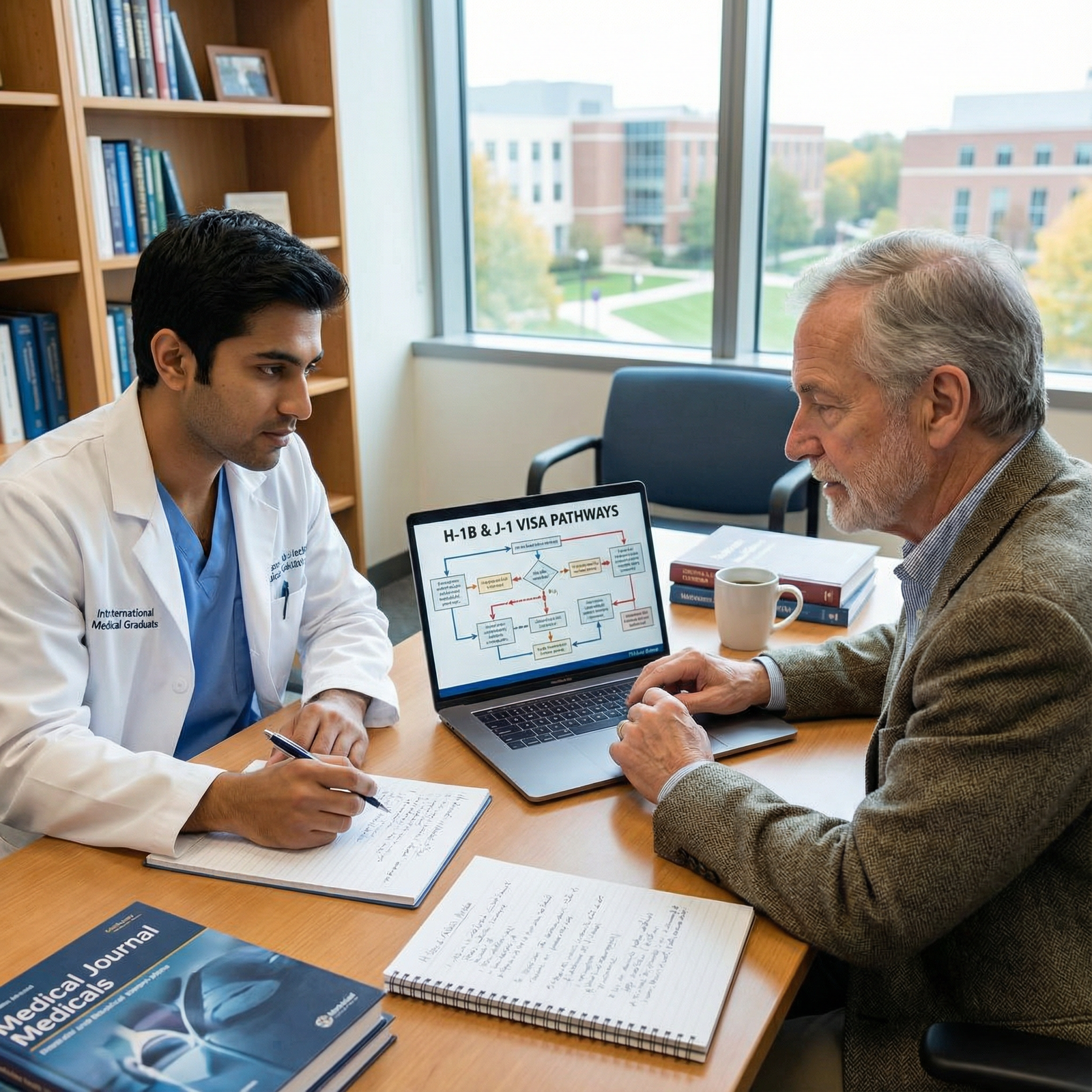
Understanding the Visa Landscape for Caribbean IMGs in Denver
For a Caribbean medical school graduate aiming for a residency in Denver, navigating U.S. visa options can feel as complex as mastering an entire new curriculum. Between J-1 vs H-1B, waivers, deadlines, and state-specific nuances, it’s easy to feel overwhelmed. The good news: with early planning and a clear strategy, you can absolutely secure a training position in Denver and build a long-term career in the United States.
This guide is written specifically for Caribbean IMGs targeting Denver residency programs (and broader Colorado residency options), including those from schools like SGU, AUC, Ross, Saba, and others. It focuses on visa navigation for residency, from choosing the right pathway to maximizing your match chances and planning for life after training.
We’ll walk through:
- The main visa types for IMGs in U.S. residency
- How J-1 vs H-1B really differ in practice for a Caribbean IMG
- State and regional considerations for Denver and Colorado programs
- Strategic planning for the Match, including SGU residency match insights
- Practical steps, documents, and timelines you should follow
1. Core Visa Options for Caribbean IMGs Entering Residency
When it comes to Caribbean medical school residency in Denver or elsewhere in the U.S., almost all non–U.S. citizen IMGs enter training on one of three statuses:
- J-1 Exchange Visitor (ECFMG-sponsored)
- H-1B Temporary Worker (Program-sponsored)
- U.S. Permanent Resident or Other Immigration Status (e.g., EAD)
Because this article focuses on residency visa pathways, we’ll center on J-1 and H-1B as the primary IMG visa options.
1.1 J-1 (ECFMG-Sponsored) Physician Visa – The Default Path
For most Caribbean IMGs, the J-1 physician visa is the most common route into residency.
Key features:
- Sponsor: ECFMG (Educational Commission for Foreign Medical Graduates)
- Purpose: Graduate medical education (residency/fellowship)
- Duration: Up to 7 years (total) for clinical training
- Requirement: Two-year home-country physical presence requirement after training, unless you obtain a waiver
- Dependents: J-2 status for spouse/children; work authorization possible for spouse (EAD)
Advantages for Caribbean IMGs:
- Widely accepted: Most Denver and Colorado residency programs are familiar with and comfortable sponsoring J-1 residents through ECFMG.
- Predictable process: ECFMG has standardized forms and procedures.
- Less financial/administrative burden on the hospital: The program doesn’t handle USCIS filings directly; ECFMG takes the lead.
Limitations:
- Two-year home-residence requirement (INA 212(e)): After completing training, you must either:
- Return to your home country for 2 years, or
- Obtain a J-1 waiver (often via Conrad 30 or federal programs).
- Restricted moonlighting: Some J-1 programs strictly limit or forbid moonlighting.
- Less flexibility long-term if your goal is immediate permanent residency after training.
For a Caribbean IMG—especially one who might want to remain in the U.S. after training—understanding how J-1 waivers work is essential (we’ll return to this in a later section).
1.2 H-1B Visa – Less Common, More Strategic
The H-1B visa is a “specialty occupation” work visa that some residency programs sponsor instead of, or in addition to, J-1.
Key features:
- Sponsor: The residency program/hospital (not ECFMG)
- Purpose: Employment in a specialty occupation (physician in graduate medical education qualifies)
- Duration: Usually granted in up to 3-year increments, maximum 6 years (with exceptions if in green card process)
- No 2-year home residence requirement
- Dependents: H-4 status for spouse/children (work authorization for spouse typically requires separate eligibility, e.g., pending green card)
Advantages:
- No two-year home-return requirement.
- Can often transition more straightforwardly into other U.S. jobs after residency.
- Easier pathway to permanent residency (green card) compared to J-1 without waiver.
Challenges for Caribbean IMGs:
- Not all Denver residency programs sponsor H-1B due to:
- Higher legal and administrative burden
- Filing fees and need for immigration counsel
- Stricter requirements (e.g., passing USMLE Step 3 before H-1B filing)
- Timing is tight: You typically must have Step 3 passed and all documents ready before the program files your H-1B petition.
- Some programs have an explicit policy: “J-1 only” or “J-1 preference.”
If you’re aiming for an H-1B in Denver, you must plan early, be explicit in communication with programs, and focus on those that historically support H-1B sponsorship.
2. J-1 vs H-1B: What Caribbean IMGs Should Consider for Denver
Understanding J-1 vs H-1B in theory is helpful, but you need to understand how these options actually play out in Denver residency programs and across Colorado residency opportunities.
2.1 Comparing the Two in Practical Terms
Training Entry Requirements:
J-1:
- Valid ECFMG certification
- Signed contract from an accredited residency program
- Proof of financial support (your stipend is usually enough)
- DS-2019 issued by ECFMG
H-1B:
- Requires Step 3 passed before filing (in almost all cases)
- State medical license or eligibility letter (often temporary or training license from Colorado)
- Program must file Form I-129 with USCIS; requires more time and fees
Flexibility During Training:
J-1:
- Tied to ECFMG and your specific program.
- Limited ability to switch programs or extend training beyond 7 years total.
H-1B:
- Tied to your employer, but transfers to other employers (including fellowship or jobs) are more straightforward.
- Facilitates green card sponsorship during or after training.
Post-Training Options:
J-1:
- Must either return home for 2 years or secure a waiver (e.g., Conrad 30 in Colorado, VA, federal programs).
- If you want to work in Denver after training, you’ll often need a waiver job first or return home.
H-1B:
- Can directly transition to an attending position on H-1B or begin a green card process.
- No mandatory return home.
2.2 What Denver/Colorado Programs Tend to Do
Each program has its own policies, and they can change from year to year. However, some general patterns:
- Many university-affiliated teaching hospitals in large metro areas (like Denver) are comfortable with J-1 sponsorship via ECFMG.
- Some Colorado programs may offer H-1B only for highly competitive candidates or not at all.
- Certain Denver residency programs may specify on their website:
- “We sponsor J-1 visas only”
- “We sponsor J-1 and H-1B visas”
- “We are unable to sponsor visas” (more common in community or smaller rural programs)
Action step for you:
As a Caribbean IMG targeting Denver, create a spreadsheet of programs and, for each one, record:
- Visa types supported (J-1 only? J-1 and H-1B? None?)
- Any notes on Caribbean IMG or SGU alumni presence (e.g., from an SGU residency match outcomes report)
- Contact for GME or program coordinator to confirm visa details for the upcoming cycle

3. Matching to Denver/Colorado as a Caribbean IMG: Visa-Aware Strategy
Securing a residency position in Denver is competitive, but Caribbean IMGs match there every year—particularly from larger schools like SGU with strong U.S. clinical networks. Your visa strategy should align with your application strategy from the very beginning.
3.1 Step 1: Clarify Your Visa Priorities
Before you build your rank list or even your ERAS program list, ask yourself:
- How important is staying in the U.S. immediately after training?
- Am I comfortable with the possibility of a 2-year home return or needing a waiver job?
- Realistically, can I complete USMLE Step 3 early enough to qualify for H-1B before Match?
If:
- You strongly want to avoid the 2-year home requirement and aim for H-1B, then:
- Prioritize taking USMLE Step 3 as early as possible (ideally before applications or interviews).
- Focus your applications on programs known to sponsor H-1B (especially within Denver and other Colorado residency sites).
- Be prepared to clearly communicate your visa preference and readiness.
If:
- You’re open to the J-1 path and potential waivers later:
- Cast a wider net among programs that sponsor J-1.
- Use SGU residency match lists or other Caribbean school match data to identify Denver/Colorado programs familiar with IMGs on J-1.
3.2 Step 2: Research Denver and Colorado Programs with Caribbean IMG History
Leverage:
- SGU residency match outcomes (and similar data from other Caribbean schools) to identify:
- Denver-area institutions that have matched SGU or Caribbean grads
- Specialty-specific matches in internal medicine, family medicine, pediatrics, psychiatry, etc.
Why this matters for visa navigation:
- Programs that regularly accept Caribbean IMGs are more accustomed to managing visa sponsorship.
- Alumni from your school already in those programs can give you real-time insight into:
- Whether the program is J-1 only or open to H-1B
- How supportive they are in handling visa paperwork
- How IMGs are treated overall
3.3 Step 3: Communicate Early and Professionally About Visa Needs
When you’re applying to Denver residency programs:
- ERAS Application: Some programs ask you to indicate if you will need visa sponsorship.
- Email or Interview: It’s acceptable—and often wise—to ask:
- “Does your program sponsor J-1 and/or H-1B visas for incoming residents?”
- “For IMGs in past cycles, which visa types were typically supported?”
Be concise and respectful. Example email to a program coordinator:
Dear [Name],
I am an international medical graduate from [Caribbean school] applying to your [specialty] residency program. I anticipate requiring visa sponsorship for residency and wanted to confirm which visa types your program currently sponsors (e.g., J-1, H-1B).
Thank you very much for your time and assistance.
Sincerely,
[Your Name], MD
Use their response to update your program spreadsheet and refine where you interview and eventually rank.
4. J-1 Waivers, Colorado Options, and Long-Term Planning
If you enter a Denver residency program on a J-1, you must think ahead about how you’ll handle the 2-year home requirement. Many IMGs choose the J-1 waiver path to remain in the U.S.
4.1 The Core J-1 Waiver Concept
The U.S. generally requires J-1 physicians to return to their home country for 2 years after training. However, waiver programs allow you to bypass this requirement if you:
- Agree to work in an underserved area or in specific federal facilities, usually for 3 years full-time, and
- Secure sponsorship from a state or federal agency.
Major waiver routes include:
- Conrad 30 Waiver Program (State-based)
- Federal Agency Waivers (e.g., VA, HHS, Delta Regional Authority, etc.)
4.2 Colorado’s Conrad 30 and Regional Realities
Colorado, like other states, participates in the Conrad 30 J-1 Waiver Program:
- Each state can sponsor up to 30 J-1 physicians per year in shortage areas (HPSAs/MUAs).
- Generally requires:
- A full-time employment contract (often 3 years)
- Service in primary care or certain specialties
- Practice in an underserved area (rural or inner-city)
For a Caribbean IMG who completes residency in Denver:
- Many waiver jobs may be outside Denver—in more rural or underserved parts of Colorado or neighboring states.
- Some urban or suburban opportunities may be available if they qualify as shortage areas, but competition can be higher.
Strategic advice:
- During residency, network with faculty and mentors who understand Colorado residency pathways and rural health.
- Consider electives in rural or underserved settings in Colorado to:
- Build contacts
- Understand practice environments
- Position yourself as a strong candidate for a Conrad 30 job
4.3 Federal Waiver Options
Beyond Colorado’s state waivers, you can look at federal options:
- Veterans Affairs (VA) medical centers
- Health and Human Services (HHS) programs (often for research or public health roles)
- Other designated federal shortage area programs
These may allow you to work within or closer to major cities, possibly including Denver, depending on the specific facility.
4.4 Timing and Transition
Typical J-1 to H-1B sequence via waiver:
- Complete residency (and possibly fellowship) on J-1.
- Secure a waiver job offer in an approved site (Colorado or another state).
- Employer obtains a J-1 waiver sponsorship (Conrad 30 or federal) and then files H-1B for you.
- Once waiver and H-1B are approved, you work your 3-year commitment.
- After completing the waiver service, you’re:
- Free of the 2-year home requirement, and
- Typically able to pursue permanent residency (green card) and jobs anywhere in the U.S.
Planning this path early in residency is key, especially if your long-term goal is to eventually return to or remain near Denver.

5. Practical Steps and Timelines for Visa Navigation
To move from theory to action, Caribbean IMGs need a stepwise plan aligned with the residency timeline.
5.1 During Medical School (Pre-Application)
Confirm Your IMG Status and Documentation:
- Ensure your Caribbean school is recognized by ECFMG and meets accreditation requirements.
- Keep transcripts, dean’s letters, and clinical evaluations organized.
Take USMLE Exams Strategically:
- Step 1 and Step 2 CK: Aim for competitive scores for Denver programs.
- If strongly considering H-1B, plan to take Step 3 early (ideally by late MS4 or early post-graduation).
Research Visa Policies:
- Visit residency websites for Denver and Colorado programs.
- Reach out to current residents, especially other Caribbean IMGs, for real insights.
5.2 ERAS Application Season
ERAS Setup:
- Indicate you are an IMG needing visa sponsorship.
- Highlight strong U.S. clinical experiences—especially in Colorado or nearby states, if available.
- Use your personal statement to explain your commitment to training in Denver/Colorado (without focusing only on lifestyle).
Program List Construction:
- Include a mix of:
- Denver academic programs that may be more IMG/visa friendly.
- Community or regional Colorado residency programs with a history of Caribbean IMGs.
- Tag each program with its residency visa policy (J-1 vs H-1B vs none).
- Include a mix of:
Communication:
- Send concise emails to clarify visa options when not clearly stated online.
- Keep all responses and notes in a centralized document.
5.3 During Interview Season
Be Prepared to Discuss Your Visa Needs Confidently:
- Explain you are ECFMG-certified or will be by the start of training.
- If Step 3 is done, mention it, particularly with programs open to H-1B.
Questions You Can Ask:
- “What visa types does your program currently sponsor for IMGs?”
- “Do you anticipate any changes to your visa sponsorship policy in the coming year?”
- “Do you have recent experience with Caribbean graduates entering on J-1 or H-1B?”
Observe Program Culture:
- Are there multiple IMGs in the program?
- Do residents seem well supported regarding immigration and licensing issues?
5.4 Ranking and Post-Match
When Ranking:
- Factor in both the training quality and the visa environment.
- A superb program that cannot or will not sponsor your needed visa may not be a realistic choice.
After the Match:
If J-1:
- Begin the ECFMG J-1 visa sponsorship process quickly.
- Monitor deadlines carefully for DS-2019 issuance and visa interview.
- Coordinate with your new Denver program’s GME office.
If H-1B:
- Work closely with your program’s HR/legal office.
- Provide all required documents promptly (USMLE score reports, diploma, ECFMG certificate, license/permit information).
- Track USCIS filing and approval timelines—this is especially time-sensitive if you’re outside the U.S.
6. Common Mistakes and How to Avoid Them
Caribbean IMGs aiming for Denver often stumble on the same issues. Being aware can help you avoid them.
6.1 Assuming All Programs Sponsor All Visas
Reality: Some Denver programs only sponsor J-1. Others may not sponsor any visas at all. A minority sponsor H-1B.
Solution: Always verify each program’s policy directly from:
- Official website
- Program coordinator
- Current residents
6.2 Waiting Too Long to Take Step 3 (If You Want H-1B)
If your H-1B plan hinges on Step 3, you must have the score before your program starts the H-1B petition—ideally even before the Match.
Solution:
Treat Step 3 as a strategic exam, not an afterthought. If you can’t realistically complete it in time, strongly consider J-1 as your primary path and plan around waivers later.
6.3 Ignoring Long-Term Plans
Some IMGs focus only on “getting into any Denver residency program” and ignore what happens after. This can lead to stress and limited options later, especially on J-1.
Solution:
From day one, think about:
- Do I want to stay in Colorado long-term?
- Am I open to rural or underserved practice for a few years?
- How will I approach the waiver process if I’m on J-1?
FAQs: Visa Navigation for Caribbean IMGs in Denver
1. As a Caribbean IMG, is it realistic to get an H-1B for a Denver residency program?
Yes, but it depends on the specific program. Some Denver residency programs are open to H-1B sponsorship, especially for strong candidates who already passed USMLE Step 3. However, many programs default to J-1 because it’s administratively easier. If H-1B is a priority, identify and target those specific programs early and prioritize completing Step 3.
2. If I match into a Denver residency on a J-1, can I still stay in Colorado after training?
Potentially, yes, but you’ll need a J-1 waiver. You would typically complete your residency in Denver, then secure a waiver job—often through Colorado’s Conrad 30 program or a federal waiver. Many of these jobs are in underserved or rural areas of Colorado, though some may be within or near urban centers. After completing the 3-year waiver commitment, you’re free from the 2-year home requirement and can pursue more flexible employment options.
3. Do Denver residency programs prefer Caribbean IMGs from specific schools like SGU?
Many U.S. programs—including some in Denver—are familiar with large, established Caribbean schools (SGU, AUC, Ross, Saba). SGU residency match data often shows placements in Colorado and the Mountain West region. While school name is one factor, programs focus most on individual performance: USMLE scores, clinical evaluations, letters of recommendation, and professionalism. Being from a well-known Caribbean school can help, but your overall application still matters most.
4. Can my spouse work in Denver while I’m on a residency visa?
It depends on your visa type:
- J-1: Your spouse on J-2 can typically apply for an EAD (Employment Authorization Document) and work once approved.
- H-1B: Your spouse on H-4 generally cannot work unless you reach certain stages of a green card process (which often doesn’t apply during residency).
If your spouse’s career is an important factor in your decision, weigh this when comparing J-1 vs H-1B options and plan accordingly.
By understanding these visa pathways and planning strategically, a Caribbean IMG can successfully navigate residency visa challenges and build a rewarding training and career path in Denver and across Colorado residency programs. Early research, clear communication, and long-term thinking will be your greatest assets.