
Understanding the Visa Landscape as a Caribbean IMG
For many Caribbean medical school graduates, county and safety net hospital residency programs are attractive targets: they see a broad range of pathology, often have a history of supporting international medical graduates (IMGs), and can be pathways to strong fellowships and long-term U.S. practice. Yet one critical barrier remains: navigating residency visas.
If you are a Caribbean IMG aiming for a county hospital residency or safety net hospital residency, you must understand early how IMG visa options affect where you can apply, how programs rank you, and your long-term career and immigration path. This article focuses on practical, step-by-step guidance tailored to:
- Graduates of Caribbean medical schools (including large schools like SGU, Ross, AUC, Saba, etc.)
- Applicants targeting county hospital and safety net residency programs
- Those needing a visa to train in the United States
We will review J-1 vs H-1B, how residency visa sponsorship works, common patterns at county hospitals, and strategies to build a sustainable long‑term plan.
The Big Picture: How Visa Status Interacts with County Hospital Programs
Why County and Safety Net Hospitals Matter for Caribbean IMGs
County and safety net hospitals are publicly funded or mission‑driven institutions that primarily care for underserved populations, including uninsured and underinsured patients. Examples include:
- County hospital systems (e.g., large urban public hospitals)
- City‑owned or state‑owned safety net hospitals
- Some private not-for-profit hospitals designated as essential community providers
For Caribbean IMGs, these programs often:
- Have a strong history of accepting IMGs
- Value clinical grit, adaptability, and strong service-oriented motivation
- Offer exposure to complex pathology, social medicine, and high-acuity care
- Sometimes have more flexible views on USMLE attempts and Caribbean medical school backgrounds
However, their visa policies can vary widely. Some county hospitals are very IMG-friendly and sponsor J-1 and H-1B. Others may be constrained by budgets, institutional policies, or state rules that limit H-1B sponsorship.
How Visa Status Influences Residency Opportunities
Before you send a single ERAS application, you should know how your immigration status affects you:
If you are a U.S. citizen or permanent resident (green card holder)
- Visa issues do not affect your application.
- You can broadly apply, including to programs that do not sponsor visas.
If you are on another status (F-1, pending asylum, TPS, etc.)
- You will effectively be competing as a noncitizen needing a residency visa.
- Programs will classify you under “requires sponsorship,” often pushing you into the same bucket as J-1/H-1B candidates.
If you are outside the U.S. and need a residency visa to enter
- You must secure either a J‑1 or H‑1B to train.
- Many county hospital residency programs sponsor J‑1 only; some sponsor both; a minority sponsor H‑1B only (less common in county programs).
When you see high SGU residency match numbers into county and safety net hospitals, remember: a large portion of those matches happened on J-1 visas, not H-1B. Understanding that reality helps set realistic expectations and limits wasted effort on programs that do not fit your visa needs.
Core IMG Visa Options: J‑1 vs H‑1B for County Hospital Residencies
The J-1 Visa for Graduate Medical Education
The J‑1 exchange visitor visa (sponsored via ECFMG for physicians) is the most common residency visa for IMGs, including Caribbean graduates, especially at county and safety net hospitals.
Key features:
- Sponsor: ECFMG (Educational Commission for Foreign Medical Graduates), not the hospital directly.
- Purpose: Graduate medical education (residency/fellowship).
- Duration: Typically matches the length of residency/fellowship, with a maximum of 7 years (some exceptions).
- Eligibility requirements include:
- Valid ECFMG certification.
- USMLE exams (Step 1, Step 2 CK, and OET where applicable).
- Contract or offer letter from an ACGME-accredited program.
- Proof of sufficient financial support.
- Proof of home country residence and intent to return (at least on paper).
Critical drawback: 2-year home residence requirement
Most J-1 physicians are subject to the two-year home residency requirement (INA 212(e)), meaning:
- After training, you must return to your home country (the country of last permanent residence at J-1 issuance) for a total of 2 years, or
- Obtain a waiver before you can:
- Change to H‑1B, L, or some other nonimmigrant statuses in the U.S.
- Obtain permanent residency (green card).
This requirement drives much of the strategic decision-making about J-1 vs H-1B for Caribbean IMGs.
The H-1B Visa for Residency
The H‑1B is a specialty occupation visa. Some residency programs sponsor H‑1B visas, but the proportion is generally lower in county/safety net hospitals than in large academic tertiary centers.
Key features:
- Sponsor: The hospital/program directly.
- Purpose: Employment in a specialty occupation (physician/house staff).
- Duration: Up to 6 years total (in 3-year increments, with some exceptions).
- Eligibility requirements:
- USMLE exams passed (Step 1, Step 2 CK, typically Step 3 before H‑1B petition filing).
- ECFMG certification.
- State medical board eligibility/limited license requirements (varies by state).
- Hospital willing and financially able to sponsor and handle legal costs.
Pros of H‑1B for Caribbean IMGs:
- No automatic two-year home return requirement.
- Can potentially transition directly from residency to:
- H‑1B employment in an underserved area.
- Permanent residency applications (e.g., EB-2 NIW, employer-sponsored green card).
- For some, this avoids the complex and competitive J-1 waiver process after training.
Cons and challenges:
- Many county hospital residency and safety net hospital residency programs do not sponsor H‑1B, often due to:
- Cost of legal fees.
- Administrative burden.
- Institutional or state rules.
- Some will only sponsor H‑1B for fellowship but not residency.
- You may have to pass USMLE Step 3 before ranking or before issuing the H‑1B petition—tight timelines, especially for Caribbean students on accelerated calendars.
J‑1 vs H‑1B at County and Safety Net Hospitals
Patterns you are likely to see:
Large academic county hospitals:
- Often J-1 friendly.
- Some sponsor both J‑1 and H‑1B, especially in high‑demand specialties.
- May have institutional rules (e.g., “H‑1B only for internal candidates” or “H‑1B only in subspecialty fellowships”).
Smaller county/safety net hospitals:
- More likely to be J‑1 only or J‑1 plus permanent residents/citizens.
- H‑1B sponsorship may be rare due to budgetary and administrative constraints.
For Caribbean IMGs looking at SGU residency match lists or similar data, you will often see that most matches into county hospitals occurred on J-1 visas, even among very strong applicants.
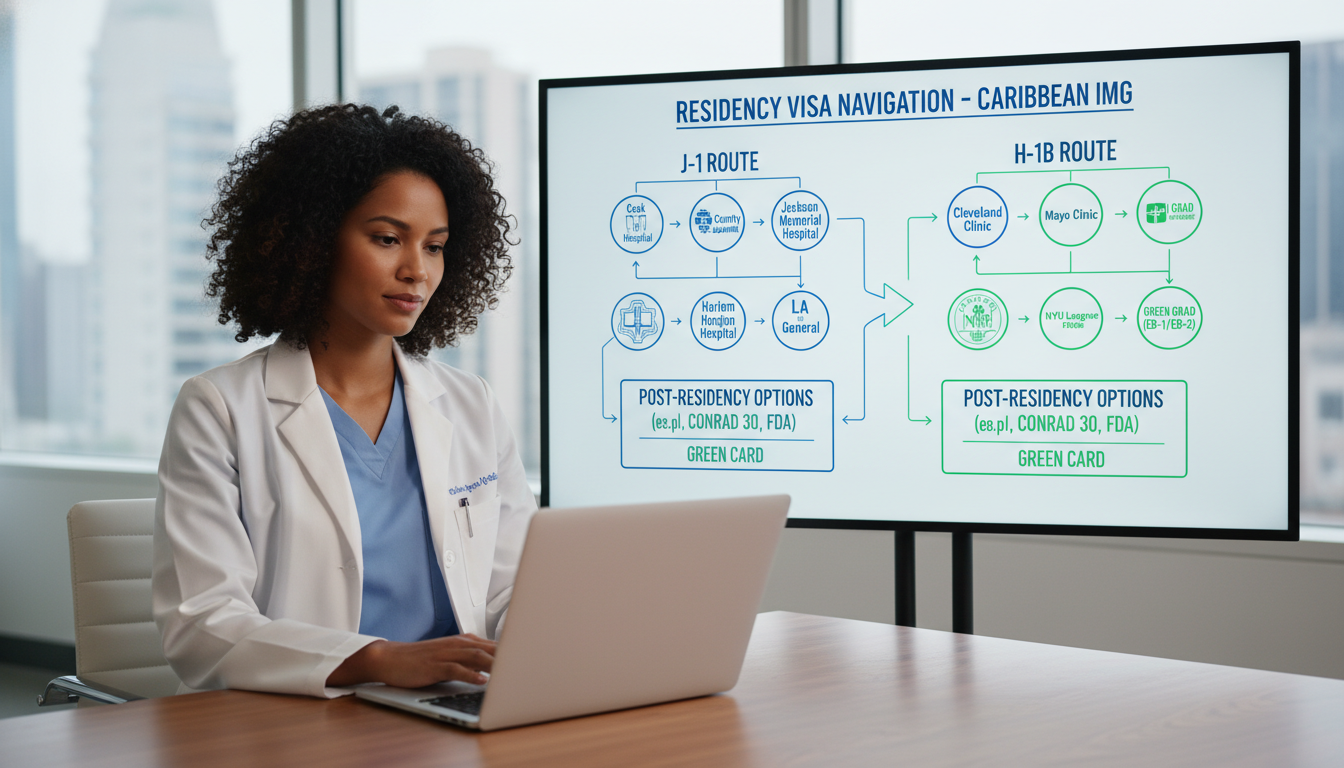
How County Hospital Programs Actually Handle Visa Sponsorship
Reading Program Policies Correctly
When you browse ERAS or program websites, you will find statements such as:
- “We sponsor J‑1 visas only through ECFMG.”
- “We sponsor J‑1 and H‑1B visas.”
- “We are unable to sponsor visas at this time.”
- “The program will consider candidates requiring visa sponsorship on a case‑by‑case basis.”
For a Caribbean IMG, you must interpret these carefully:
J‑1 only
- Suitable for you if you are comfortable with the J‑1 route and two-year home requirement (with expectation of a waiver later).
- Typical for many county hospital residency programs.
J‑1 and H‑1B
- Attractive if you aim to avoid J‑1 waivers later.
- But you should ask:
- “Do you actively sponsor H‑1B for residents?”
- “Do you require USMLE Step 3 by the rank list deadline?”
- “How many H‑1Bs did you sponsor for residents in the last 2–3 years?”
No visa sponsorship
- Not an option if you need a residency visa, unless you have or will have a status not needing sponsorship (e.g., green card, some EAD categories).
Case‑by‑case
- Could mean they rarely sponsor but have made exceptions.
- Could also be a polite way of saying “almost never.”
Practical Example: Two County Programs, Different Visa Cultures
Program A: Large urban county hospital with academic affiliation
- Website: “We sponsor J‑1 and H‑1B visas.”
- Historically high IMG intake, including many Caribbean graduates.
- Residents report:
- Most IMGs are on J‑1.
- 1–2 H‑1Bs per year, usually for highly competitive candidates who already passed Step 3 and can start H‑1B without delay.
Program B: Mid-size safety net hospital
- Website: “We sponsor J‑1 visas only.”
- Program coordinator notes: budget and state limitations for H‑1B.
- SGU residency match outcomes show multiple Caribbean grads there annually—all reportedly on J‑1.
If you are a Caribbean IMG without Step 3 and limited time to prepare, Program B is more straightforward, while Program A could be a realistic J‑1 option or, with careful planning and strong scores, a possible H‑1B route.
Funding and Institutional Considerations
County and safety net hospitals operate with tight margins and must justify visa expenditures:
J‑1 visas:
- Administrative burden is shared with ECFMG.
- Often cheaper and more standardized.
- Seen as the default IMG visa.
H‑1B visas:
- Require attorney involvement, filing fees, compliance systems.
- May be harder to justify, especially if the hospital can easily fill slots with J‑1 or visa‑independent applicants.
As a result, even supportive county hospitals may default to J‑1 unless you present a compelling reason and a low‑risk, well-prepared profile (e.g., already passed Step 3, clear long-term goals, and timely documents).
Strategic Planning: Choosing Between J‑1 and H‑1B as a Caribbean IMG
Step 1: Clarify Your Long-Term Goals
Before you decide your preferred visa pathway, answer:
Where do you ultimately want to practice?
- If you plan to return to your home country soon after residency, a J‑1 may align well.
- If your goal is long-term practice in the U.S., especially in urban or academic settings, an H‑1B can simplify things—but it’s not the only viable path.
How flexible are you about location and specialty after residency?
- J‑1 waiver jobs often cluster in:
- Rural or semi-rural locations
- Federally Qualified Health Centers (FQHCs)
- Safety net hospitals serving underserved populations
- This aligns surprisingly well with many IMGs’ interests in service and broad clinical exposure, but may not match everyone’s lifestyle preferences.
- J‑1 waiver jobs often cluster in:
What is your risk tolerance and financial situation?
- H‑1B pursuit often means:
- Early Step 3 preparation (exam fees, time).
- Potentially applying to fewer programs (limited H‑1B sponsors).
- J‑1 path:
- Broader program pool.
- Future need to compete for J‑1 waiver jobs or consider return home/other options.
- H‑1B pursuit often means:
Step 2: Align Your Application Strategy With Visa Reality
Scenario A: You prioritize broad match chances
- You are open to J‑1, intend to pursue a waiver job later, and want to maximize interview offers.
- Strategy:
- Apply widely to J‑1 sponsoring county hospital residency and safety net hospital residency programs.
- Focus on a strong overall profile: solid USMLE scores, meaningful clinical experience in underserved settings, strong letters.
- Consider Step 3 later—more for competitiveness and future flexibility than as a precondition for visa.
Scenario B: You strongly prefer to avoid J‑1 waivers
- You want an H‑1B for residency if at all possible.
- Strategy:
- Take USMLE Step 3 early, ideally before or during application season.
- Create a filtered list of programs that clearly sponsor H‑1B for residents.
- Reach out to programs directly with precise questions about:
- Step 3 deadlines.
- Recent history of H‑1B sponsorship for IMGs.
- Accept that you may:
- Apply to a smaller pool of programs.
- Face more competition for fewer H‑1B spots.
Scenario C: Hybrid approach
- You would prefer H‑1B but are realistic that J‑1 may be the practical route.
- Strategy:
- Apply to:
- All J‑1 programs you like.
- H‑1B‑sponsoring programs where you meet their Step 3 and eligibility requirements.
- Decide after interviews where to rank J‑1 vs H‑1B programs based on fit, training quality, and your evolving immigration plans.
- Apply to:

Practical Tips for Caribbean IMGs Targeting County Hospital Residencies
1. Be Honest and Clear About Your Visa Needs Early
In ERAS and during interviews:
- Always indicate accurately that you require visa sponsorship.
- If you strongly prefer H‑1B but are open to J‑1, you can say:
- “I would prefer an H‑1B if available, but I understand many programs use J‑1 and I am open to J‑1 sponsorship.”
- For SGU residency match and other Caribbean school applicants, trying to “hide” visa needs rarely helps; programs check citizenship/residency status carefully.
2. Use Past Match Data Wisely
If you attend a Caribbean school like SGU, Ross, AUC, or Saba:
- Ask your dean’s office or alumni group:
- Which county hospital residency programs have historically taken graduates from your school?
- What visas those graduates used (J‑1 vs H‑1B)?
- Many SGU residency match lists show:
- Strong representation in county and safety net hospitals.
- High utilization of the J‑1 route, with some H‑1B successes—often for those with earlier Step 3 completion.
This can guide your target list and help you identify truly IMG‑friendly, visa‑familiar institutions.
3. Tailor Your Application to the County/Safety Net Mission
County and safety net hospitals value:
- Commitment to underserved populations
- Comfort with diverse, low‑resource settings
- Cultural competency and language skills
- Resilience and teamwork in high‑volume environments
As a Caribbean IMG, you can emphasize:
- Rotations in inner-city or public hospitals (especially U.S. clinical rotations).
- Volunteer work with marginalized communities (locally or in the Caribbean).
- Personal experiences with health disparities that motivate your career choices.
Align this narrative with your visa story:
For J‑1:
- Highlight your interest in serving underserved communities in the U.S. and/or your home region.
- Show awareness of the J‑1’s exchange mission.
For H‑1B:
- Emphasize long‑term commitment to serving needy populations in the U.S.
- Mention openness to practicing in safety net settings post-residency.
4. Plan Ahead for Post‑Residency Immigration Steps
If you pursue J‑1:
Start learning about J‑1 waiver options early, ideally by PGY‑1 or PGY‑2:
- Conrad 30 programs (state-by-state waiver positions).
- Federal programs (e.g., VA, HHS for certain specialties, ARC, DRA).
- Hardship or persecution waivers (less common, more complex).
Many waiver jobs are at:
- Rural community hospitals
- FQHCs and community health centers
- Some urban safety net hospitals designated as underserved
If you pursue H‑1B:
- Clarify with your program whether:
- They will extend H‑1B beyond PGY‑3 (e.g., for chief year or fellowship).
- They support green card sponsorship.
- Consider:
- EB-2 NIW (National Interest Waiver) if you are committed to working in underserved or research settings.
- Employer-sponsored permanent residency if you join a hospital or group practice post-residency.
Both paths can lead to long‑term U.S. careers, but the sequence, constraints, and geographic options differ.
5. Work With Competent Advisors
Visa navigation is complex and individual-specific. Seek:
- Your medical school’s international office or dean’s office with IMG experience.
- Current residents from your school who matched in county/safety net hospitals—ask them specifically:
- “What visa are you on?”
- “What would you do differently in hindsight?”
- When needed, a qualified immigration attorney who has handled physician cases (J‑1 waivers, H‑1B for residents, EB‑2 NIW, etc.).
Avoid relying solely on:
- General online forums with anecdotal, outdated, or incomplete information.
- Non-lawyer consultants giving definitive “legal advice.”
Frequently Asked Questions (FAQ)
1. As a Caribbean IMG, is J‑1 or H‑1B better for county hospital residency?
“Better” depends on your priorities:
- J‑1 is more commonly available at county and safety net programs, maximizing your interview pool. It often fits well for those open to underserved or rural jobs after residency (for J‑1 waivers).
- H‑1B may provide a more direct path to long-term U.S. practice without the two-year home return rule, but:
- Fewer county hospitals offer it.
- You almost always need Step 3 early.
- Competition for limited H‑1B slots can be intense.
Most Caribbean IMGs matching into county hospitals do so on J‑1 visas, then pursue waiver jobs or transition later.
2. Do all SGU or Caribbean medical school graduates get J‑1 visa support easily?
No. ECFMG will sponsor J‑1 visas if you meet their requirements and have a contract from an accredited program that accepts J‑1s. But:
- You still need:
- A matched residency position in a J‑1 sponsoring program.
- All ECFMG and USMLE requirements met.
- Appropriate financial and documentation evidence.
- Some programs or states may have additional limitations.
Your Caribbean school’s high SGU residency match statistics do not guarantee individual visa success; they only suggest patterns. You must individually qualify and secure a program that sponsors the visa you need.
3. How do I know if a specific county hospital residency sponsors H‑1B?
Use a multi-step approach:
- Check the program website and FREIDA for explicit statements.
- Email the program coordinator with clear, concise questions:
- “Do you sponsor H‑1B visas for incoming PGY‑1 residents?”
- “How many residents are currently on H‑1B?”
- “Is USMLE Step 3 required by the rank list deadline for H‑1B candidates?”
- Talk to current residents, especially any Caribbean IMGs, to confirm actual practice versus website wording.
Don’t assume that “we sponsor H‑1B” means they will sponsor it for you; policies can change year to year, and some programs reserve H‑1B for specific situations.
4. If I start residency on a J‑1, can I later switch to H‑1B in the same program?
For most J‑1 physicians, if you are subject to the two-year home country requirement, you generally cannot switch directly to H‑1B in the U.S. without first obtaining a J‑1 waiver (or fulfilling the 2-year home residency requirement). This is a legal restriction, not just a program policy.
Some limited exceptions or complex strategies exist, but they are rare and require specialized legal advice. Plan your visa pathway assuming you will either complete your training entirely on J‑1 and then get a waiver job, or start on H‑1B from the beginning if the program offers it and you qualify.
By understanding J‑1 vs H‑1B, carefully researching county hospital residency policies, and aligning your long‑term goals with realistic IMG visa options, you can navigate the visa landscape strategically as a Caribbean IMG. Early planning, honest communication with programs, and informed use of your school’s alumni network can transform visa challenges into a manageable—though complex—part of your journey to U.S. residency.