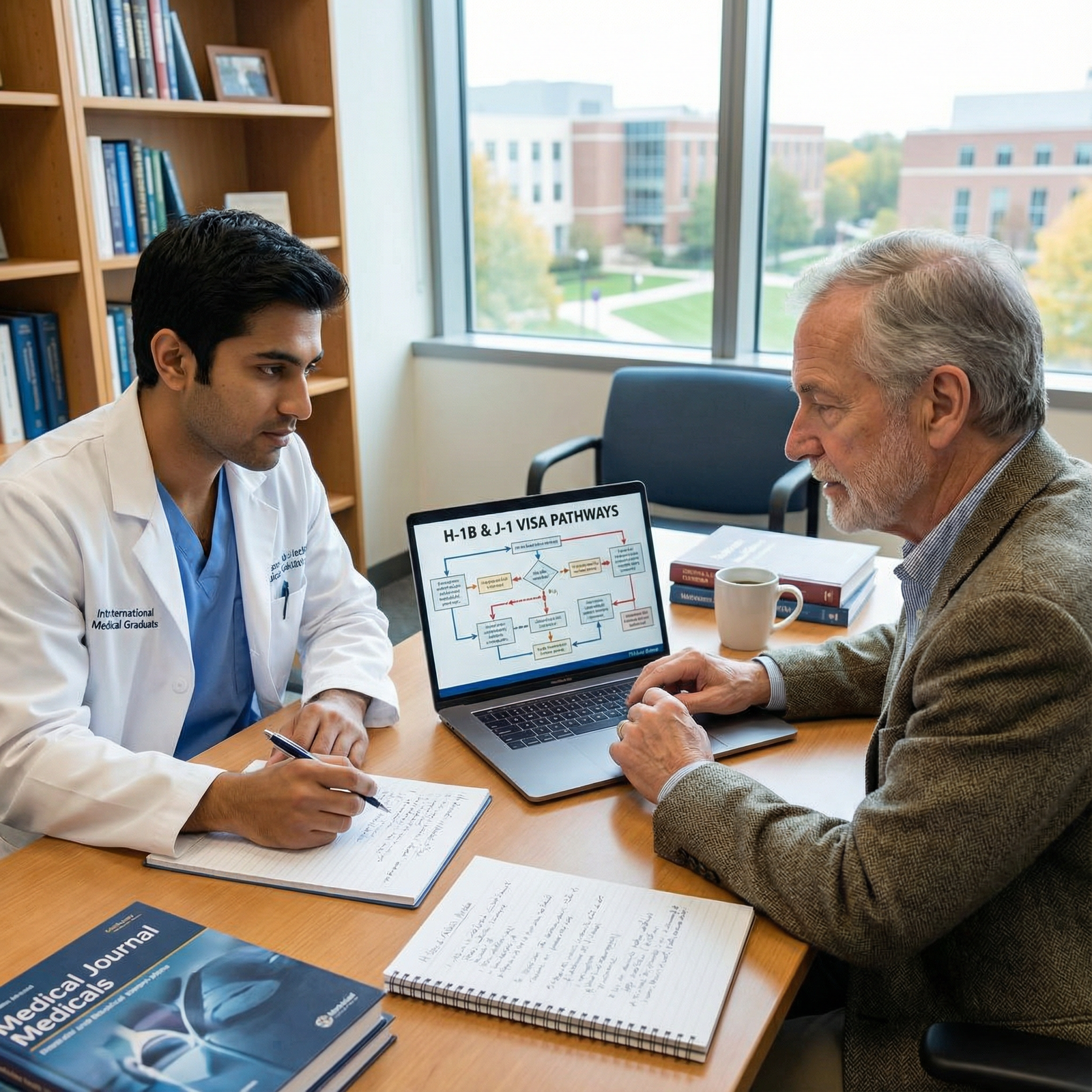
Understanding the Visa Landscape for Non‑US Citizen IMGs in New York City
New York City is one of the most IMG‑friendly regions in the United States, but it’s also one of the most complex when it comes to visa navigation. As a non‑US citizen IMG or foreign national medical graduate, your ability to train in NYC residency programs depends on choosing the right pathway early and aligning every step of your application process with that visa strategy.
This article breaks down the main residency visa options, common NYC‑specific patterns, and practical strategies to help you match successfully and transition smoothly into training.
We’ll focus on:
- How J‑1 and H‑1B visas work in the residency context
- How NYC teaching hospitals typically handle non‑US citizen IMGs
- How to time your exams, ECFMG certification, and paperwork
- Long‑term planning (waivers, green card strategy, and career implications)
Core Residency Visa Options: J‑1 vs H‑1B for IMGs
For almost all non‑US citizen IMGs entering graduate medical education, the viable visa categories are:
- J‑1 Exchange Visitor (ECFMG‑sponsored)
- H‑1B Temporary Worker (employer‑sponsored)
Other statuses (e.g., O‑1, TN, F‑1 OPT) appear occasionally, but J‑1 and H‑1B dominate NYC residency programs.
J‑1 Visa for Residency: Overview
The J‑1 clinical visa for physicians is sponsored only by ECFMG, not by individual hospitals. It allows you to:
- Enter the US for GME training only (residency, fellowship)
- Train in ACGME‑accredited programs
- Remain in the US up to 7 years total (with annual renewals)
Key features for a non‑US citizen IMG:
- Sponsor: ECFMG
- Required exams:
- USMLE Step 1 & Step 2 CK passed
- ECFMG Certification (must be issued before start date)
- Visa issuance: J‑1 is tied to the specific program and training level
- Renewal: Yearly, based on good standing and continued training
Pros of the J‑1 for NYC Residency
Widely accepted in New York City
- Many large NYC residency programs (Mount Sinai, Montefiore, NYC Health + Hospitals, some NYU and Columbia‑affiliated sites, etc.) are very familiar with J‑1 sponsorship.
- For a foreign national medical graduate, J‑1 is often the default path into New York City residency programs.
Relatively straightforward process
- ECFMG has standardized procedures and clear documentation requirements.
- Programs’ GME offices are used to coordinating with ECFMG each year.
No USMLE Step 3 required to start residency
- Unlike H‑1B, you do not need Step 3 for J‑1 sponsorship.
- This gives you more flexibility in your exam timeline.
Available even for prelim and transitional years
- Acceptable for preliminary and categorical positions.
- Also common for fellowships after residency.
Cons and Constraints of the J‑1
Two‑Year Home Residency Requirement (INA 212(e))
After completing training on a J‑1, you are typically subject to a two‑year home country physical presence requirement.- You must either:
- Return to your home country for a total of 2 years, or
- Obtain a J‑1 waiver before transitioning to an H‑1B or permanent residency.
- You cannot change status to H‑1B or get a green card in the US until this is resolved.
- You must either:
Limited total training time (usually 7 years)
- ECFMG usually permits up to 7 years of total J‑1 clinical training.
- This can be tight if you plan long training pathways (e.g., Internal Medicine → Cardiology → Interventional Cardiology, or General Surgery → Surgical subspecialties).
Tied exclusively to training (not employment)
- You cannot moonlight or work outside the approved training site(s) unless it’s specifically authorized and fits within ECFMG rules.
Family impact
- Spouses and children receive J‑2 status, but J‑2 dependents have limited work options and may face their own visa planning challenges.
H‑1B Visa for Residency: Overview
The H‑1B is a dual‑intent work visa that can be used for residency and fellowship. It is:
- Sponsored directly by the hospital or university (not by ECFMG)
- Categorized as temporary worker in a specialty occupation
For NYC residency programs, H‑1B positions are much more limited than J‑1. Many institutions either:
- Do not sponsor H‑1B at all for residents, or
- Only offer H‑1B for select specialties or exceptional candidates.
Core Requirements for H‑1B in Residency
Most NYC institutions that sponsor H‑1B insist on:
- Pass USMLE Step 3 before match ranking deadline
- Many programs require Step 3 before considering an H‑1B request.
- Valid ECFMG Certification (if you graduated from a non‑US/Canadian school)
- NY State medical licensure eligibility (training license or full license depending on the year of training)
Pros of H‑1B for a Foreign National Medical Graduate
No two‑year home residency requirement
- You avoid the J‑1 212(e) obligation.
- You can transition more directly from residency to:
- H‑1B in an attending job, or
- Permanent residency (green card) sponsorship.
Dual intent
- H‑1B allows you to pursue a green card while in status.
- This can be a major strategic advantage if your long‑term plan is to stay in the US.
Greater flexibility after training
- You can take jobs in urban or suburban settings, not only in underserved areas (unlike many J‑1 waiver jobs that are in rural/underserved regions).
Multiple employers over career
- Throughout your career, different employers can file H‑1Bs or transfer your H‑1B, subject to overall time limits and regulations.
Cons and Challenges of H‑1B in NYC Residency Programs
Limited availability
- Many NYC teaching hospitals either:
- Do not sponsor, or
- Sponsor only in rare cases (e.g., when J‑1 is not possible or a candidate is exceptionally strong).
- Some programs explicitly state in FREIDA or their website: “J‑1 only” or “we sponsor J‑1 visas only.”
- Many NYC teaching hospitals either:
Step 3 timing pressure
- You must pass USMLE Step 3 before program deadlines (often before ranking or even before interview consideration).
- This is a major constraint for non‑US citizen IMGs who may be outside the US and have limited Step 3 testing site options.
Higher administrative and legal cost
- Employers must pay legal fees and file an H‑1B petition with USCIS.
- Some NYC residency programs consider this administrative burden too high for resident positions.
Time limits
- General maximum: 6 years total in H‑1B status (with some exceptions for green card processes).
- Long subspecialty training pathways may squeeze this timeline.
How NYC Residency Programs Typically Handle Visa Sponsorship
New York City has a dense concentration of academic medical centers, community hospitals, and safety‑net institutions, all with different visa policies. As a non‑US citizen IMG, you must understand how these patterns affect your application strategy.
Common Visa Patterns in NYC
J‑1 as the default for IMGs
- Many NYC residency programs default to J‑1 only for non‑US graduates.
- This is especially common in:
- Internal Medicine
- Pediatrics
- Psychiatry
- Family Medicine
- Pathology
- For a non‑US citizen IMG, this means J‑1 is often the most realistic route into a New York City residency.
Selective H‑1B sponsorship
- Some large academic centers (e.g., certain programs at NYU, Columbia, Cornell, Mount Sinai) may sponsor H‑1B for:
- Candidates who already have H‑1B from research positions
- Candidates with prior US training
- Candidates with exceptional profiles AND Step 3 completed
- This is not guaranteed even if the institution sponsors H‑1Bs for faculty or fellows.
- Some large academic centers (e.g., certain programs at NYU, Columbia, Cornell, Mount Sinai) may sponsor H‑1B for:
Program‑by‑program variation
- Within the same hospital system, different departments may follow different visa policies.
- Example: Internal Medicine at Hospital X might be J‑1 only, while Anesthesiology at the same institution might occasionally sponsor H‑1B.
Fellowships sometimes more flexible
- After residency, some NYC fellowships show greater willingness to sponsor H‑1B than residency programs, especially for highly competitive applicants.
How to Research Visa Policies in NYC Programs
To strategically target NYC residency programs, you must explicitly verify their visa policies.
1. Use FREIDA (AMA Residency & Fellowship Database)
- Filter by “Sponsorship of visas” and confirm:
- Does the program sponsor J‑1?
- Does the program sponsor H‑1B?
- Remember: FREIDA data can be outdated—always cross‑check.
2. Check program websites
Look for sections like:
- “International Medical Graduates”
- “Visa Information”
- “Eligibility and Requirements”
You might see statements such as:
- “We sponsor J‑1 visas only.”
- “H‑1B sponsorship is considered on a case‑by‑case basis.”
- “We do not sponsor work visas for residency training.”
3. Contact program coordinators or GME office
When information is unclear, send a polite, concise email. For example:
Subject: Visa Sponsorship Question – [Your Name], IMG Applicant
Dear [Coordinator Name],
I am a non‑US citizen IMG interested in applying to your [Specialty] residency program. Could you please confirm whether your program sponsors J‑1 visas, H‑1B visas, or both for incoming residents?
Thank you for your time and assistance.
Sincerely,
[Your Name], MD
Keep records of all responses to guide your application targeting.
Strategic Planning: Choosing Between J‑1 and H‑1B as an IMG in NYC
For most non‑US citizen IMGs, the practical question becomes: Is it worth pushing for H‑1B, or should I accept J‑1 and plan a waiver strategy later?
Step 1: Clarify Your Long‑Term Career Goals
Ask yourself:
- Do I plan to stay in the US long‑term after training?
- Am I willing to work in an underserved/rural area for a few years after training to obtain a J‑1 waiver?
- How competitive is my profile for NYC residency programs that offer H‑1B?
Your answers shape your approach to J‑1 vs H‑1B.
Step 2: Understand the J‑1 Waiver Landscape After NYC Residency
If you choose J‑1 for your New York City residency, you must anticipate the post‑training phase:
J‑1 Waiver Jobs (Conrad 30 and others)
- Most physicians complete their 2‑year home requirement by:
- Working 3 years full‑time in a designated underserved area on an H‑1B
- Through programs like Conrad 30, federal waivers (VA, HHS), or state‑sponsored initiatives.
- Many of these positions are outside NYC, often in smaller cities or rural areas.
- Most physicians complete their 2‑year home requirement by:
Impact on specialty choice
- Some specialties (e.g., primary care, psychiatry) have more J‑1 waiver job opportunities than ultra‑subspecialized fields.
- When planning your specialty, consider the job market for J‑1 waiver positions.
Timeline
- Typical path:
- NYC residency → fellowship (often also on J‑1) → J‑1 waiver job in underserved area → later transition to more flexible positions or green card
- This can add 3+ years of geographic constraint to your career.
- Typical path:
Step 3: Evaluating the H‑1B Path
If your priority is to avoid the 2‑year home requirement and have more flexibility after residency:
Complete USMLE Step 3 early
- To be considered for H‑1B by NYC residency programs, you need Step 3 done—ideally before applications open or at least before rank lists are made.
- This may require:
- Planning travel to a US test center if you are abroad.
- Scheduling early to secure a date.
Target programs that explicitly sponsor H‑1B
- Use FREIDA and program websites to build a focused list of NYC residency programs open to H‑1B.
- Even then, expect competition; these spots can be limited.
Prepare for a narrower list of programs
- Insisting on H‑1B may reduce the number of programs willing to rank you highly.
- You may need to apply more broadly across the US, not only NYC, to have realistic H‑1B opportunities.
Step 4: A Practical, Balanced Strategy
For many non‑US citizen IMGs targeting New York City:
- Primary objective: Match into a solid ACGME‑accredited NYC residency program.
- Secondary objective: Optimize visa for long‑term goals.
A common, realistic strategy:
Accept J‑1 as the default for NYC residency, unless:
- You already have USMLE Step 3 and
- You identify multiple NYC (or nearby) programs with a strong track record of H‑1B sponsorship.
Plan early for post‑J‑1 options:
- Familiarize yourself with Conrad 30 and other waiver programs.
- Network and research states with abundant J‑1 waiver positions in your specialty.
If you strongly prefer H‑1B, consider:
- Applying beyond NYC to increase H‑1B match opportunities (e.g., academic centers in other states more open to H‑1B residents).
- Returning to NYC later as an attending or fellow once you are on H‑1B or have a green card.
Practical Steps and Timelines for Visa Navigation as a Non‑US Citizen IMG
Understanding theory is only half the battle. You also need a clear sequence of actions throughout the residency application cycle.

1–2 Years Before Application: Build Eligibility
Complete core ECFMG requirements
- Graduate from a recognized medical school listed in the World Directory.
- Pass USMLE Step 1 and Step 2 CK.
- Obtain ECFMG Certification (ideally before applying, but absolutely before residency start).
Clarify your desired status: J‑1 vs H‑1B
- If leaning J‑1:
- Focus on strong USMLE scores, clinical experience, and letters.
- If leaning H‑1B:
- Add Step 3 to your plan early.
- If leaning J‑1:
Gain US clinical experience if possible
- Observerships, externships, or research positions in NYC can help both your match chances and your networking for future visa planning.
ERAS Application Year (June–September)
Research NYC programs’ visa policies thoroughly
- Create a spreadsheet with columns for:
- Program name
- Specialty
- J‑1? (Y/N)
- H‑1B? (Y/N)
- Notes (from emails or website statements)
- Create a spreadsheet with columns for:
Draft your personal statement with visa awareness (subtly)
- Emphasize your commitment to training in the US healthcare system.
- You do not need to explicitly discuss your visa preference unless asked, but be prepared to answer during interviews.
Submit ERAS applications broadly
- If J‑1 is acceptable, target a wide range of NYC residency programs that sponsor J‑1.
- If aiming for H‑1B, add programs across the country known to sponsor H‑1B, not just NYC.
Interview Season (October–January)
Be ready to discuss visa questions professionally
Common questions:- “What is your current immigration status?”
- “Are you eligible for J‑1 sponsorship?”
- “Have you passed Step 3 (if you asked about H‑1B)?”
Answer briefly, accurately, and without sounding demanding.
Clarify specifics when offers seem open‑ended
If a program says “we can consider H‑1B,” ask:- Is Step 3 required before signing rank list?
- Does the GME office have any restrictions on first‑year residents on H‑1B?
Keep documentation organized
- Passport, medical school diploma, transcripts, ECFMG certificate, exam score reports; you may need them early for preliminary visa preparations.
Post‑Match (March–June): Moving Toward a Residency Visa
Once you match into a New York City residency program:
Confirm your visa category with GME early
- Within days of Match Day, programs typically send a welcome packet with visa instructions.
- Respond quickly and clarify:
- “I am a non‑US citizen IMG and will require [J‑1 / H‑1B] visa sponsorship for residency.”
For J‑1 (ECFMG‑sponsored):
- The program’s GME office will guide you through the ECFMG J‑1 application process, including:
- Form DS‑2019 request
- Uploading required documents
- Proof of financial support (often your contract)
- You then schedule a consular interview to obtain your J‑1 visa.
- The program’s GME office will guide you through the ECFMG J‑1 application process, including:
For H‑1B (employer‑sponsored):
- The hospital’s legal/HR team will prepare and file an H‑1B petition with USCIS.
- You will need to supply:
- ECFMG certificate
- USMLE Step 3 proof
- Degree and transcripts
- After approval, you may need to obtain an H‑1B visa stamp at a US consulate abroad before starting (if you are not already in the US on an eligible status).
Do not delay immigration paperwork
- Visa processing timelines can be tight, especially if:
- You need to travel for a consular interview.
- Your country has long wait times.
- Visa processing timelines can be tight, especially if:
NYC‑Specific Considerations for Non‑US Citizen IMGs
Because you are targeting New York City residency, keep these local factors in mind:
High competition but strong IMG representation
- NYC attracts many US and international graduates, but NYC Health + Hospitals, Bronx, Brooklyn, and Queens institutions have long traditions of supporting IMGs, including non‑US citizen IMGs on J‑1 visas.
Cost of living and financial planning
- Visa processing is only part of the picture. The cost of living in NYC is high, and while on J‑1 or H‑1B you may have limitations in working outside training.
- Plan carefully for housing, commuting, and dependents’ expenses.
Family visas and dependents
- Spouses and children can join you as:
- J‑2 (for J‑1 holders) or
- H‑4 (for H‑1B holders).
- Work authorization options differ; J‑2 can often apply for an EAD, H‑4 may have more restrictions depending on circumstances.
- Spouses and children can join you as:
Networking for post‑residency opportunities
- Use your time in New York City to:
- Network with faculty who know J‑1 waiver employers.
- Attend job fairs and specialty society meetings.
- Even if your post‑residency waiver job is outside NYC, your NYC mentors can be extremely valuable in connecting you.
- Use your time in New York City to:
Frequently Asked Questions (FAQ)
1. As a non‑US citizen IMG, is J‑1 or H‑1B better for New York City residency?
There is no universal “better”—it depends on your priorities. J‑1 is more commonly sponsored by NYC residency programs and doesn’t require Step 3, making it the more accessible path for most foreign national medical graduates. H‑1B avoids the 2‑year home requirement and is more compatible with long‑term US immigration plans, but is harder to obtain, requires Step 3, and is offered by fewer NYC programs. Many applicants prioritize J‑1 simply to secure a strong New York City residency and address immigration strategy later via J‑1 waivers and H‑1B transitions.
2. Do all NYC residency programs sponsor visas for non‑US citizen IMGs?
No. While NYC is relatively IMG‑friendly, not all programs sponsor visas, and some sponsor only J‑1. A smaller subset may sponsor H‑1B for residents. You must check each program individually via FREIDA, program websites, or direct communication with the program coordinator. Never assume visa sponsorship—always verify early in your application planning.
3. Can I switch from J‑1 to H‑1B during or after residency without doing the 2‑year home requirement?
Generally, no. If you are subject to the J‑1 two‑year home residency requirement under INA 212(e), you cannot change status to H‑1B or apply for a green card in the US until you either:
- Complete the 2 years of physical presence in your home country, or
- Obtain a J‑1 waiver (e.g., Conrad 30, federal waiver).
This is why long‑term planning for J‑1 waiver jobs is crucial if you start residency on a J‑1.
4. Do I really need USMLE Step 3 for residency if I plan to use a J‑1 visa?
For J‑1 residency via ECFMG, Step 3 is NOT required. You only need Step 1, Step 2 CK, and ECFMG Certification. However, Step 3 can still be valuable for your profile and may be required later for state licensure, fellowships, or if you decide to pursue H‑1B later in your career. If your plan is strictly J‑1 and your timeline is tight, you can prioritize matching first and then consider Step 3 during residency.
Navigating residency visas as a non‑US citizen IMG in New York City is complex but manageable with early planning, accurate information, and clear priorities. Understand the trade‑offs between J‑1 vs H‑1B, research NYC residency programs’ policies in detail, and align your exam schedule, application strategy, and long‑term career goals accordingly.