
Understanding the Visa Landscape for IMGs in County Hospital Residency Programs
County and safety net hospitals are often among the most IMG-friendly training environments in the United States. They serve diverse, underserved communities and typically value the linguistic ability, cultural competence, and resilience that many international medical graduates bring.
However, even the most supportive county hospital residency program must operate within strict immigration and institutional rules. As an IMG, understanding your residency visa options early—and how they intersect with county hospital policies—can determine which programs you can realistically apply to and how you rank them.
This IMG residency guide focuses specifically on:
- County hospital residency and safety net hospital residency settings
- The most common IMG visa options (J-1 and H-1B)
- How to research and target programs based on visa sponsorship
- Practical strategies to avoid common visa pitfalls during the residency match and application phase
By the end, you should have a clear roadmap to navigate visa issues alongside your residency strategy.
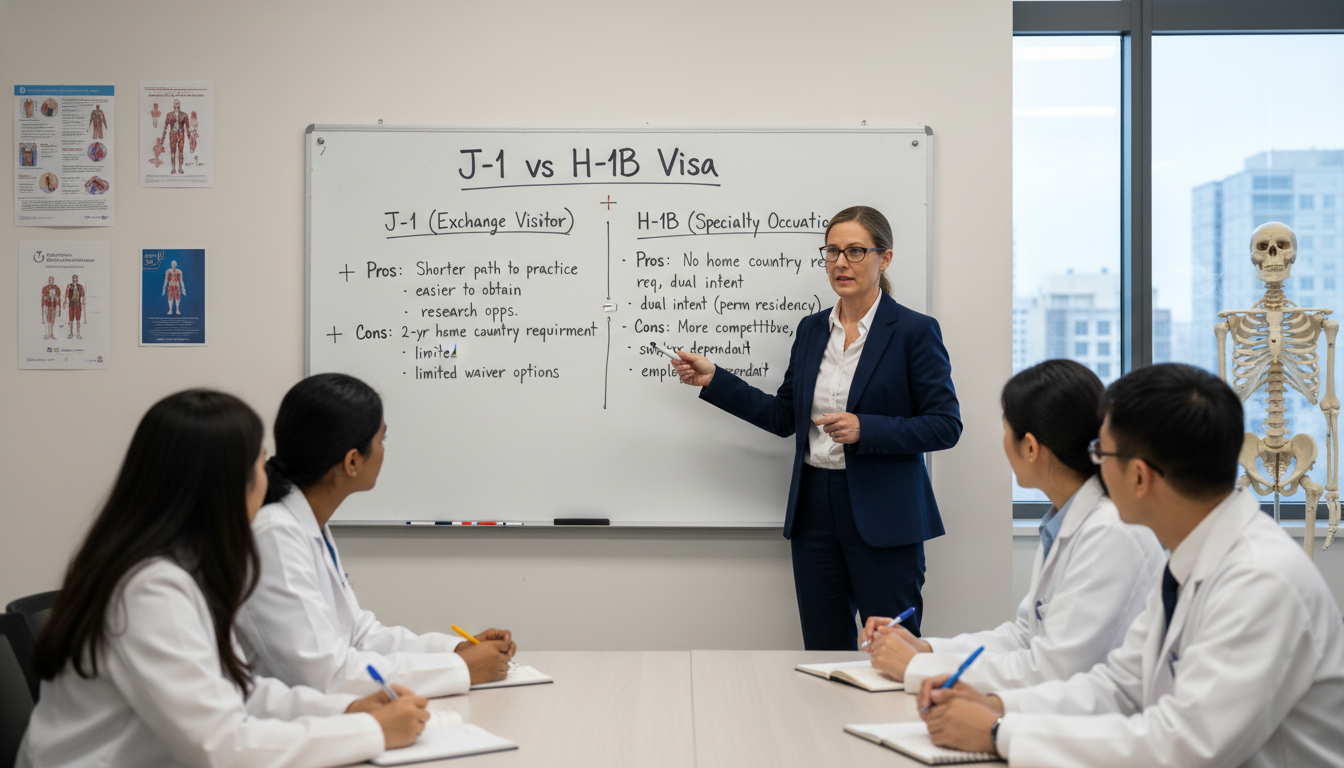
Core Visa Options for Residency: J‑1 vs H‑1B
Most international medical graduates will train in U.S. residency programs on one of two main visa types:
- J‑1 visa (Exchange Visitor – sponsored by ECFMG for physicians)
- H‑1B visa (Temporary Specialty Worker – employment-based)
Each has advantages and trade-offs, and county hospital programs often have strong preferences based on funding, policy, and institutional experience.
The J‑1 Visa for IMGs
The J‑1 physician category is the most common visa for IMGs entering residency.
Key features:
- Sponsor: ECFMG (Educational Commission for Foreign Medical Graduates), not the hospital itself
- Purpose: Graduate medical education/training
- Duration: Up to 7 years of clinical training (with documentation)
- Home residence requirement: 2-year “home country physical presence” requirement after training
Advantages of the J‑1 Visa
Widely Accepted in County Programs
Many county hospital residency and safety net hospital residency programs only sponsor J‑1 visas because:- ECFMG handles most immigration logistics
- Less legal and financial burden on the hospital
- Fewer institutional caps than H‑1B
Predictable Process
J‑1 processes are standardized by ECFMG:- Clear document list
- Known timelines
- Dedicated ECFMG support channels
Multiple Transitions Allowed
You can complete:- A primary residency
- Possibly one or more fellowships
…within the 7-year cap, if well planned.
Disadvantages of the J‑1 Visa
2-Year Home Country Requirement
After finishing all J‑1 training, you must either:- Return to your home country for a cumulative 2 years, or
- Obtain a J‑1 waiver (common route), such as a Conrad 30 waiver, by committing to work in an underserved U.S. area.
No “Dual Intent”
The J‑1 is not a dual-intent visa, so:- It is not designed as a direct pathway to a green card.
- Immigration strategies must be carefully planned with the waiver and later permanent residency in mind.
Dependence on ECFMG Rules
- ECFMG policies can change.
- All training changes (switching specialties, extending training) require ECFMG approval.
The H‑1B Visa for Residency
The H‑1B is an employment-based visa for “specialty occupations,” including physician roles in residency and fellowship.
Key features:
- Sponsor: The employing hospital (not ECFMG)
- Purpose: Employment (can include training roles)
- Duration: Up to 6 years total (including previous H‑1B time in the U.S.)
- Dual intent: Can pursue permanent residency while on H‑1B
Advantages of the H‑1B Visa
No 2-Year Home Return Requirement
Unlike J‑1, the H‑1B does not impose a 2-year home residence requirement after training.Dual Intent
You can:- Pursue a green card (PERM, NIW, etc.) while in training
- Transition more smoothly into post-training jobs in some cases
Attractive for Long-Term U.S. Plans
For those strongly committed to a U.S. career without J‑1 waiver obligations, H‑1B can be a more flexible long-term platform.
Disadvantages of the H‑1B Visa
Less Common in County Hospitals
Many county hospital residency programs:- Do not sponsor H‑1B at all,
- Or do so only for very specific positions (e.g., select PGY-2+ or fellowship spots).
Reasons include:
- Legal fees
- Complex compliance requirements
- Potential cap issues in some institutions
USMLE Step 3 Requirement
Most programs sponsoring H‑1B require:- USMLE Step 3 passed before the start of residency, and often before they file the petition.
For an IMG, this means:
- You should plan to take Step 3 early (even before Match) if targeting H‑1B-friendly programs.
Limited Total Time
With only 6 years total of H‑1B time:- Long residencies + fellowship(s) may push you close to or over the limit.
- Some physicians find it harder to fit multiple fellowships on H‑1B without extending via green card processes.
County Hospital & Safety Net Programs: How They View IMG Visa Options
County hospital residency programs have unique characteristics that shape their visa policies. As safety net institutions, they often:
- Serve a high proportion of uninsured or underinsured patients
- Rely on complex funding streams (county, state, federal, and grants)
- Have mission-driven, community-focused priorities
This context matters for IMGs when evaluating residency visa options.
Why County Hospitals Often Prefer J‑1
Many county and safety net hospital residency programs adopt a “J‑1 only” policy for IMGs. Common reasons:
Lower Administrative Burden
- ECFMG handles sponsorship and much of the paperwork.
- Program staff are familiar with the ECFMG DS-2019 process.
Cost Considerations
- H‑1B petitions require attorney fees, filing fees, and sometimes premium processing.
- County-funded institutions may have tighter budgets and limited support for these costs.
Policy and Equity Concerns
- Some public or county systems have uniform policies to treat all IMGs similarly regarding visa type.
- Offering only J‑1 can simplify system-wide rules and perceived fairness.
When County Hospitals Sponsor H‑1B
Some county hospital residency or fellowship programs do sponsor H‑1B visas, especially:
- In highly competitive specialties trying to attract top talent
- At university-affiliated county programs with robust legal and HR infrastructure
- For advanced positions (PGY-2+ or fellowship) where Step 3 completion is expected
In such cases, you may see:
- Program websites explicitly stating “J‑1 and H‑1B sponsorship available”
- Requirements like:
- USMLE Step 3 passed
- Strong academic record
- Occasionally preference for U.S. clinical experience
Practical Example: Two County Programs with Different Policies
Program A: Large county hospital IM program
- Policy: “We sponsor J‑1 visas only. We do not sponsor H‑1B visas.”
- Implication:
- If you require or strongly prefer H‑1B, this program is not an option.
- If you’re open to J‑1 and eventual waiver service, this is IMG-friendly.
Program B: University-affiliated county safety net hospital
- Policy: “We sponsor J‑1 visas and limited H‑1B visas for highly qualified applicants with USMLE Step 3.”
- Implication:
- You must plan to take Step 3 early.
- You may still end up on a J‑1 even if the program occasionally uses H‑1B, depending on internal priorities.
Understanding where each program falls on this spectrum is critical for an effective application strategy.
Step-by-Step Strategy to Research and Plan Your Residency Visa Path
Visa navigation should be integrated into your overall residency strategy, not handled as an afterthought. Below is a structured approach tailored to IMGs targeting county hospital residency and safety net hospital residency programs.
Step 1: Clarify Your Long-Term Goals
Before deciding on J‑1 vs H‑1B, ask yourself:
- Do I plan to build my career long-term in the U.S.?
- Am I open to working in an underserved area for several years (J‑1 waiver) after training?
- Is taking Step 3 before Match realistic for me?
- Am I willing to accept a J‑1 if an H‑1B option fails?
Your answers shape your strategy:
If yes to long-term U.S. career and willing to work in underserved areas:
- J‑1 is highly workable, especially through waiver programs (e.g., Conrad 30), which frequently place physicians in community, rural, and safety net settings.
If yes to long-term U.S. career but not comfortable with underserved obligation:
- Stronger incentive to target H‑1B, but this will limit the number of programs you can apply to.
If Step 3 before Match is not feasible:
- H‑1B becomes unlikely for PGY-1 entry.
- Focus on J‑1-friendly programs.
Step 2: Understand Program-Level Visa Policies
For each county or safety net hospital program on your list, collect the following:
What visas do they sponsor?
- J‑1 only?
- J‑1 and H‑1B?
- No visa sponsorship?
Are there conditions?
- “H‑1B sponsorship only for applicants with Step 3.”
- “We sponsor H‑1B only for advanced positions or current J‑1 transfers.”
Where to Look
Program Website
- Check sections like “For International Medical Graduates,” “Visa Information,” or “Eligibility.”
- Sometimes information is hidden under FAQ pages.
FREIDA (AMA Residency Database)
- Many programs specify visa sponsorship details.
Email the Program Coordinator (PC)
- If unclear online, send a polite, concise email:
- Introduce yourself
- Ask specifically: “Do you sponsor J‑1, H‑1B, or both for incoming PGY‑1 IMGs?”
- If unclear online, send a polite, concise email:
Current or Recent Residents
- Connect via LinkedIn, program alumni lists, or social media.
- Ask what visa types current IMGs are on and how supportive the institution has been.
Step 3: Categorize Programs by Visa Feasibility
Create a spreadsheet and tag each program:
- Group 1: J‑1 only
- Group 2: J‑1 and H‑1B
- Group 3: H‑1B only (rare for residency; more common for post-residency jobs)
- Group 4: No visa sponsorship
For a typical IMG targeting county hospital residency:
- Expect many programs to fall into Group 1 (J‑1 only).
- A smaller but important subset in Group 2 (J‑1 and H‑1B).
Match this list with your goals and Step 3 status:
- No Step 3 → Focus on Group 1 + Group 2 (but understand you might still be offered J‑1 at Group 2 programs).
- Step 3 completed → Group 2 becomes your main opportunity for H‑1B, but be flexible about J‑1.
Step 4: Plan for Documentation and Timelines
Regardless of visa type, you will need:
- Valid ECFMG certification (or clear timeline to certification before residency start)
- USMLE scores and transcripts
- Medical school diploma and transcripts
- Dean’s letter / MSPE
- Passport valid for the entire training period initially (preferably > 1 year validity at start)
For J‑1:
- ECFMG will require additional forms from you and your residency program after you match (e.g., Form DS-2019 request).
For H‑1B:
- The hospital will:
- File a Labor Condition Application (LCA)
- Prepare the H‑1B petition (Form I‑129 and supporting evidence)
- You must typically provide:
- Step 3 score report
- Proof of medical degree and ECFMG certification
- CV, license-in-progress documents (or limited permit instructions, depending on state)
Starting early and having your documents organized improves your visa processing timeline and reduces anxiety.

Avoiding Common Visa Pitfalls for IMGs in County Hospital Programs
Even well-prepared candidates can encounter problems if they miss key details. Being proactive can prevent delays or even loss of a training spot.
Pitfall 1: Assuming All IMG-Friendly Programs Sponsor H‑1B
Many IMGs equate “IMG-friendly” with “H‑1B-friendly.” For county hospitals, this is often incorrect.
- A program may rank many IMGs and proudly highlight diverse residents—but still strictly sponsor J‑1 only.
- Always confirm the visa type and do not rely solely on match statistics or word-of-mouth.
Action:
In your spreadsheet, treat “IMG-friendly” and “H‑1B-friendly” as separate categories.
Pitfall 2: Taking Step 3 Too Late
If you are aiming for H‑1B:
- Taking Step 3 after Match may be too late for some institutions to file timely petitions.
- Delays can:
- Complicate your visa start date
- Risk your ability to begin PGY‑1 on time
Action:
If H‑1B is central to your plan, prioritize Step 3 before ERAS submission or at least before interviews.
Pitfall 3: Not Anticipating the J‑1 Two-Year Home Requirement
Many applicants accept J‑1 sponsorship without a clear strategy for the post-residency phase:
- How will you obtain a waiver (e.g., Conrad 30, VA, Federal programs)?
- Are you willing to work in a rural or underserved area for 3+ years after training?
County and safety net hospital experiences often prepare IMGs well for later waiver positions, but you must be mentally and practically ready.
Action:
Learn about J‑1 waiver pathways early—even during residency application—so your expectations are realistic.
Pitfall 4: Ignoring Institutional and State-Level Nuances
Even within county hospital systems:
- Different departments or programs may have different visa preferences.
- Some states have licensing rules impacting H‑1B timing (e.g., requiring Step 3 or certain levels of training for licenses/permits).
Action:
- Check not just the hospital policy, but the specific residency program’s stance.
- Read the state medical board’s licensing requirements early in your planning.
Practical Tips to Strengthen Your Application as an IMG with Visa Needs
While visa navigation is critical, you must still be a strong overall candidate. County and safety net hospital programs often value:
- Commitment to underserved populations
- Resilience and adaptability
- Language skills and cultural competence
Here are ways to align your profile with their mission while managing visa constraints.
Highlight Your Fit for County and Safety Net Settings
In your personal statement and interviews:
Emphasize any experience with:
- Public hospitals, government clinics, or charity health services
- Rural or low-resource settings in your home country
- Caring for vulnerable communities (migrants, uninsured, refugees)
Connect these experiences to their institutional mission:
- Serving diverse, high-acuity, often complex patients
- Working in interprofessional teams with limited resources
Programs are more likely to go the extra mile with visa sponsorship when they see a long-term, mission-driven fit.
Be Transparent but Strategic About Visa Preferences
When asked about visa type during interviews:
If you are open to both J‑1 and H‑1B:
- Say so clearly; flexibility is often appreciated.
If you strongly prefer H‑1B:
- Explain why (e.g., long-term family plans, difficulty with home return)
- Also demonstrate understanding of J‑1 constraints, so you appear informed rather than rigid or uninformed.
Avoid giving the impression that:
- You see the program only as a stepping stone
- You expect special exceptions against long-standing institutional policies
Maintain Backup Plans
Given how complex the U.S. immigration and Match systems can be, wise IMGs:
- Apply broadly to a realistic mix of J‑1-only and J‑1/H‑1B programs
- Consider preliminary or transitional year spots if appropriate
- Explore research positions or observerships (where legal and feasible) if they need more U.S. exposure before a successful Match
Flexibility, preparation, and early planning are your best allies.
FAQs: Visa Navigation for IMGs in County Hospital Residency Programs
1. Do most county hospital residency programs sponsor visas for IMGs?
Many county and safety net hospital residency programs are open to IMGs and sponsor J‑1 visas through ECFMG. However, not all will sponsor H‑1B visas. Some public systems also have limits on the total number of visa-holding trainees. Always verify each program’s current policy rather than assuming.
2. Is it realistic to get an H‑1B for residency at a county or safety net hospital?
Yes, but it is less common than J‑1 sponsorship. H‑1B sponsorship at county hospitals tends to occur at:
- University-affiliated programs
- Certain specialties with high recruitment needs
- Programs where institutional legal resources are robust
You will usually need USMLE Step 3 and a strong application. Even then, many programs will still prefer or default to J‑1 for most IMGs.
3. If I start residency on a J‑1, can I switch to H‑1B later?
In some cases, yes—but it is complex and not guaranteed. Some fellows or advanced residents move from J‑1 to H‑1B for fellowship or post-residency jobs after obtaining a J‑1 waiver or through specific legal strategies. However, as long as you are in J‑1 training status, ECFMG is your sponsor, and switching mid-residency to H‑1B is uncommon and requires both institutional support and immigration counsel. You should not assume this will be an option.
4. How early should I start planning my visa strategy as an IMG?
Begin before you submit ERAS, ideally 12–18 months before your desired residency start date. By then, you should:
- Understand J‑1 vs H‑1B basics
- Decide whether you will attempt Step 3 before Match
- Research which county and safety net hospital programs fit your visa needs
- Prepare necessary documentation (ECFMG, transcripts, passport, etc.)
Early planning allows you to align your exam schedule, program list, and personal goals with the realities of U.S. residency visa pathways.
Navigating residency visas as an international medical graduate—especially within county hospital and safety net environments—requires both knowledge and strategy. By understanding the practical differences between J‑1 and H‑1B, researching each program’s policies, and aligning your long-term goals with the realities of the system, you place yourself in the strongest possible position to train and thrive in the U.S. health care safety net.