
Understanding the Visa Landscape for IMGs in Houston
Houston is one of the most IMG‑friendly cities in the United States. With the Texas Medical Center residency ecosystem (including programs at UTHealth Houston, Baylor College of Medicine, MD Anderson, and others), the city attracts international medical graduates from all over the world. But to convert that opportunity into a residency position, you must navigate a complex visa environment.
This IMG residency guide focuses specifically on visa navigation for residency in Houston, explaining what you need to know about residency visas, major IMG visa options, and practical strategies to discuss J‑1 vs H‑1B with Houston residency programs.
Key points you’ll learn in this guide:
- How US visas intersect with the residency match process
- The core differences between J‑1 vs H‑1B for residency
- How Houston programs and Texas Medical Center residency institutions typically handle visas
- Practical steps to make yourself a stronger candidate as an international medical graduate
- What to plan for after residency if you train on a J‑1 or H‑1B
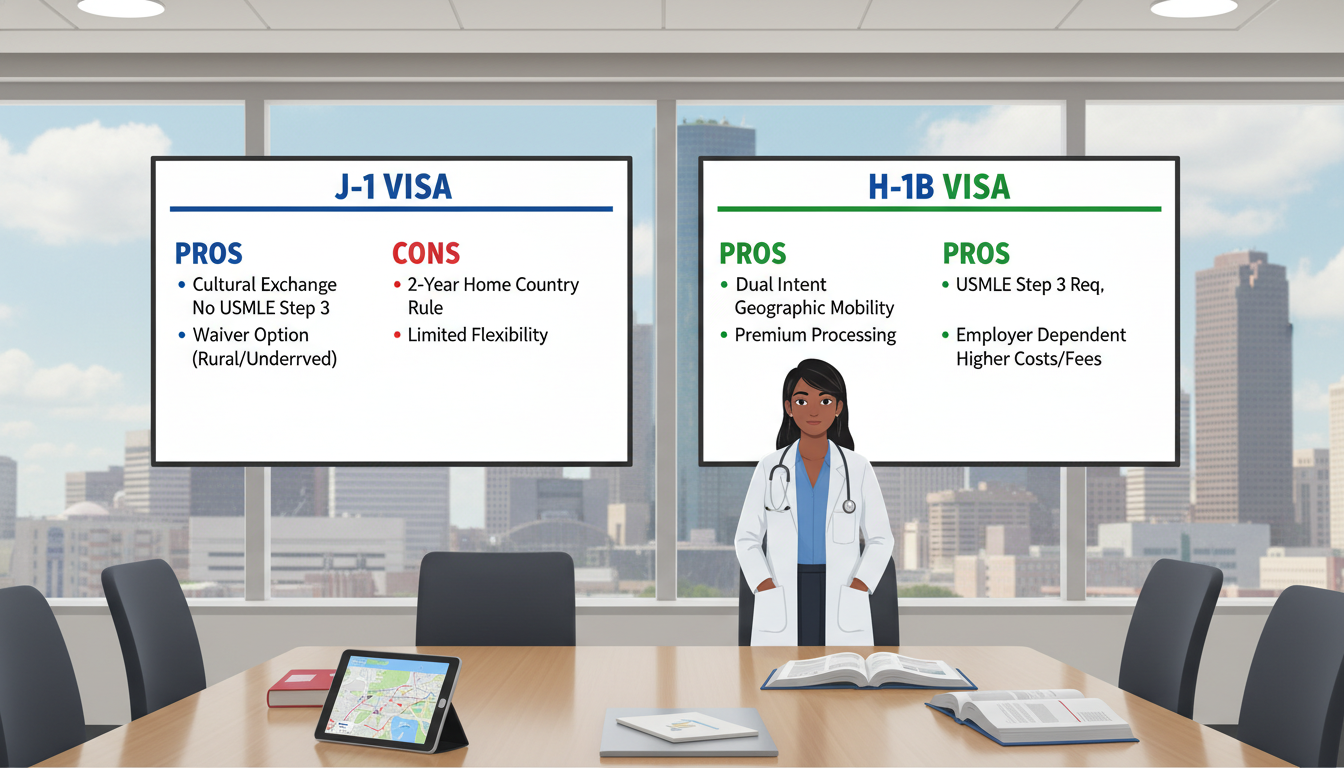
Core Visa Options for Residency: J‑1 vs H‑1B
Most IMGs entering Houston residency programs train on either a J‑1 (Exchange Visitor) or H‑1B (Temporary Worker) visa. Very few programs support other types for GME (graduate medical education).
1. J‑1 Physician Visa for Residency
The J‑1 physician visa is sponsored by the Educational Commission for Foreign Medical Graduates (ECFMG), not directly by the residency program or employer. It is specifically designed for graduate medical education and training.
Key Features:
- Sponsor: ECFMG
- Purpose: Clinical training (residency/fellowship) in ACGME‑accredited programs
- Duration:
- Granted year‑by‑year
- Up to 7 years total for most specialty training (with possible extensions)
- USMLE requirement: At least USMLE Step 1 and Step 2 CK (or equivalent) passed prior to issuing the DS‑2019
- ECFMG certification: Required
- Home country requirement:
- Most J‑1 physicians are subject to the two‑year home residency requirement (INA 212(e))
- You must return to your home country (or country of last legal permanent residence) for two years at the end of training OR obtain a waiver before changing to H‑1B or applying for permanent residence
Advantages of the J‑1 Visa:
- Widely accepted:
- Many Houston residency programs, especially large academic centers, are J‑1 only.
- Lower direct cost to the program:
- Sponsorship is handled by ECFMG, making it administratively easier for institutions.
- Predictable framework:
- Well‑established rules and timelines; programs are familiar with the process.
Disadvantages of the J‑1 Visa:
- Two‑year home residency requirement:
- Major consideration for long‑term career planning.
- Unlocking options in the US usually requires a J‑1 waiver job or other waiver types.
- Limited research/“moonlighting” flexibility:
- Activities are constrained to those approved by the training program and ECFMG.
- Family considerations:
- Spouses on J‑2 can sometimes work (with EAD), but the principal physician faces movement and status limitations until a waiver is obtained.
2. H‑1B Visa for Residency
The H‑1B visa is a “specialty occupation” visa sponsored directly by the residency employer (e.g., hospital or medical school). For residency, it is used for graduate medical training positions but is more administratively demanding.
Key Features:
- Sponsor: Individual institution (e.g., Baylor College of Medicine, UTHealth Houston)
- Purpose: Employment as a resident/physician in a “specialty occupation”
- Duration:
- Initially up to 3 years, with extension up to a maximum of 6 years (including all H‑1B time in the US)
- USMLE requirement:
- Requires passing USMLE Step 3 before H‑1B filing in almost all residency cases
- ECFMG certification: Required for GME positions
- No automatic home residency requirement:
- Unlike J‑1, there is no built‑in two‑year home rule baked into the H‑1B category.
Advantages of the H‑1B Visa:
- More direct path to a green card:
- Easier to transition from H‑1B to employment‑based permanent residency than from J‑1 (which usually needs a waiver first).
- No two‑year home requirement:
- Offers more flexibility for fellowships and post‑residency employment.
- More flexibility for academic and clinical roles:
- Research, teaching, and sometimes outside clinical work are more straightforward (subject to program/employer rules).
Disadvantages of the H‑1B Visa:
- Not all Houston programs offer it:
- Many Texas Medical Center residency programs are J‑1 only to minimize administrative burdens.
- Requires USMLE Step 3 before Match or quickly after:
- You must complete Step 3 early if you want to be seriously considered for an H‑1B position.
- Time limits:
- Total of 6 years (including any prior H‑1B), which may be tight for longer residency + fellowship pathways unless planning carefully.
- Higher cost and complexity:
- Legal and filing fees (borne by program/employer), institutional caps, and internal policies can limit availability.
3. Other, Less Common Visa Scenarios
Occasionally, IMGs may pursue residency while on other statuses:
- F‑1 OPT (Optional Practical Training):
- Rarely used for full residency; sometimes for short research roles.
- O‑1 (Extraordinary Ability):
- Possible for highly accomplished researchers, but uncommon among first‑year residents.
- Green Card holders / US Permanent Residents:
- Not a visa category but worth noting: If you obtain a green card through family or other means, visa concerns mostly vanish from the residency equation.
In nearly all cases for Houston residency programs, your realistic options are J‑1 or H‑1B.
How Visa Status Interacts with Houston Residency Programs
Each residency program in Houston sets its own policies regarding visa sponsorship. Understanding these differences early can save you time and frustration.
1. Typical Visa Policies in the Texas Medical Center
Houston’s Texas Medical Center residency institutions commonly fall into one of these categories:
J‑1 only
- Many university‑affiliated and large teaching hospitals—especially in primary care and core specialties—choose this.
- They rely on ECFMG to manage the immigration component.
J‑1 and limited H‑1B
- Some programs will sponsor H‑1B visas for highly competitive candidates, often with conditions:
- USMLE Step 3 already passed
- No prior significant H‑1B usage
- Adequate lead time before residency start
- Some programs will sponsor H‑1B visas for highly competitive candidates, often with conditions:
H‑1B only (much less common for GME)
- Typically not the case for large Houston programs, but some specialized fellowships or institutions might prefer H‑1B.
To align your strategy with specific Houston residency programs, you should:
- Check their official GME or residency website
- Look at the “For IMGs” or “International Applicants” section
- Email the program coordinator when information is unclear
2. Timing: When to Think About Visa During the Match Process
For an international medical graduate, visa strategy should begin before you apply to ERAS, not after the Match.
Key timing points:
12–18 months before Match season
- Confirm if you plan to target J‑1, H‑1B, or be flexible.
- If you want H‑1B: schedule USMLE Step 3 early.
- Collect documents for ECFMG certification and plan for Step 1 & 2 CK.
During ERAS application preparation
- Research which Houston residency programs accept IMGs and what visas they sponsor.
- Prioritize programs that align with your visa profile (e.g., J‑1 friendly vs possible H‑1B sponsors).
Interview season
- Be prepared to discuss visa status clearly and confidently.
- Never assume a program will sponsor H‑1B if not explicitly stated.
Post‑Match, pre‑start
- For J‑1: work with ECFMG and the program to obtain your DS‑2019 and schedule your visa interview.
- For H‑1B: program’s HR/legal team will file the petition; you must provide all documents promptly.
J‑1 vs H‑1B: Strategic Considerations for IMGs in Houston
You cannot decide solely based on “which visa is better.” The choice is deeply tied to your personal background, career goals, and the policies of Houston programs you’re targeting.
1. When J‑1 Might Be the Better Fit
J‑1 tends to be more realistic if:
- You are early in exams and do not yet have Step 3
- Most of your preferred Houston residency programs are J‑1 only
- You are open to working in an underserved area after training to obtain a J‑1 waiver (e.g., Conrad 30, VA, or other federal waiver programs)
- You are flexible about:
- Potentially returning to home country for two years
- Rural or smaller‑city employment for waiver jobs (often outside Houston initially)
Example scenario:
You are an IMG applying to Internal Medicine programs in Houston with:
- USMLE Step 1 and Step 2 CK passed
- Strong clinical experience but no Step 3 yet
- ECFMG certification in progress
Most IM residency programs at the Texas Medical Center you’re targeting are J‑1 only. In this case, planning for a J‑1 is practical and opens far more interview opportunities than insisting on H‑1B.
2. When H‑1B Might Be Strategic
H‑1B may fit better if:
- You already passed USMLE Step 3 (or will do so before rank lists are finalized)
- You aim to settle long‑term in the US and want to avoid the J‑1 home return requirement
- Your shortlisted Houston programs explicitly sponsor H‑1B for residents
- You are willing to limit your application list to programs that are H‑1B friendly
Example scenario:
You have:
- Strong US clinical experience in Houston
- Step 1, Step 2 CK, and Step 3 all passed
- research ties with a Texas Medical Center residency program that has previously sponsored H‑1B for selected IMGs
You can candidly discuss during interviews that you are eligible for H‑1B and ask about their openness to this route, while still indicating flexibility if they prefer J‑1.
3. Long‑Term Career Planning: How Visa Choice Impacts Your Path
With J‑1:
- After residency/fellowship, you usually need a J‑1 waiver job to remain in the US without returning home for two years. Common routes include:
- Conrad 30 state waivers (each state can sponsor up to 30 J‑1 physicians per year for underserved areas)
- Federal programs (e.g., VA, HHS, ARC, Delta Regional, etc.)
- Many waiver jobs are in rural or underserved communities, often outside major metropolitan areas like Houston.
- After working in the waiver job (commonly 3 years full‑time), you can transition to other H‑1B or permanent residency pathways.
With H‑1B:
- Easier to:
- Stay in the same institution for fellowship
- Move to another institution or job still on H‑1B
- Begin employment‑based green card processes during training or early practice
- However, you must keep an eye on the 6‑year total cap; long residencies plus fellowships may nearly exhaust this timeframe unless you reach certain green card milestones that allow extensions.
In both cases, if your goal is to eventually establish a long‑term practice in Houston, you should:
- Build a track record in Texas (research, rotations, network)
- Understand Texas physician workforce needs—primary care and some subspecialties may be more in demand
- Engage early with hospital systems and physician groups that commonly hire IMGs on J‑1 waivers or H‑1B
Practical Steps: From Planning to Residency Visa Approval
To convert knowledge into action, follow a structured, step‑wise approach.
Step 1: Clarify Your Visa Profile and Constraints
Ask yourself:
- Do you already have USMLE Step 3?
- Have you used any H‑1B time before (research, prior job)?
- Are you subject to any prior J‑1 home residency requirement from earlier programs or exchanges?
- Are you married, and is spouse’s career or immigration status a factor?
Document your current status and limitations. This will guide conversations with Houston residency programs.
Step 2: Research Houston and Texas Medical Center Residency Visa Policies
For each program on your target list:
- Visit their GME / residency webpage:
- Look for sections like “International Medical Graduates,” “Visa Sponsorship,” or “Eligibility Criteria.”
- Note for your spreadsheet:
- Accepts IMGs?
- Visa types: J‑1 only / J‑1 + H‑1B / other
- Any USMLE Step 3 requirement for H‑1B?
- Any history of sponsoring H‑1B for residents (ask current residents/IMGs if possible).
This will help you choose where to invest application fees and interview energy.
Step 3: Optimize Your Exam Timeline Based on Target Visa
If targeting J‑1 primarily:
- Focus on strong performance on Step 1 and Step 2 CK to be competitive.
- Ensure you are on track for ECFMG certification in time for ranking and Match.
If seriously targeting H‑1B:
- Schedule USMLE Step 3 early—ideally before the ERAS application opens or before interviews.
- Mention Step 3 scores in your ERAS when available; this signal is important for H‑1B‑friendly programs.
Step 4: Communicate Clearly During Interviews
When asked about your visa needs:
- Be transparent and concise. Example phrasing:
- “I am currently on [status] and will require visa sponsorship. I am eligible for J‑1 through ECFMG, and I have already passed USMLE Step 3, so I would also be eligible for H‑1B if your institution supports it.”
- Avoid demands like “I will only accept H‑1B,” especially if the program is historically J‑1 only—this may harm your ranking.
- Ask politely:
- “Does your program sponsor J‑1 only, or have you also sponsored H‑1B for residents in the past?”
Remember that some Houston programs may have a central GME or institutional policy that even the program director cannot override.
Step 5: After Match — Executing the Visa Process
Once you match to a Houston residency program:
For J‑1:
- Your program confirms your appointment and provides necessary forms.
- ECFMG works with you to issue Form DS‑2019.
- You pay the SEVIS fee and schedule a J‑1 visa interview at the US consulate.
- Enter the US and attend your GME orientation on the correct start date.
For H‑1B:
- The program’s HR/legal office will initiate the Labor Condition Application (LCA) and H‑1B petition.
- You submit:
- Medical diploma, ECFMG certificate, USMLE score reports (including Step 3)
- CV, passport copies, prior I‑94 or US visa documents
- Once USCIS approves the petition, you schedule your H‑1B visa interview (if outside the US) or change of status (if inside).
- Start residency under valid H‑1B status on the program’s specified date.

Common Pitfalls and How to Avoid Them
1. Assuming All Programs Sponsor H‑1B
Not all Houston or Texas Medical Center residency programs are willing or able to sponsor H‑1B. Applying broadly while expecting H‑1B everywhere will lead to disappointment.
Solution:
- Treat H‑1B as a bonus option; assume J‑1 is the default unless clearly stated otherwise.
2. Taking Step 3 Too Late
If you sit for Step 3 after rank lists are submitted, many programs cannot realistically process an H‑1B petition in time.
Solution:
- If H‑1B is important to you, schedule Step 3 before or during interview season, not after.
3. Ignoring the Home Residency Requirement on J‑1
Some applicants underestimate the impact of the J‑1 INA 212(e) requirement, only to realize later that it affects fellowship and job possibilities.
Solution:
- Understand J‑1 waiver options before committing; consider whether you are open to working in underserved or rural areas after training.
4. Relying on Informal Advice Only
Chat groups and anecdotal stories can be misleading or outdated, especially as immigration policies and institutional practices evolve.
Solution:
- Confirm all crucial details through:
- Official GME websites
- ECFMG resources
- Direct communications with residency program coordinators
- When necessary, consultation with a qualified immigration attorney
FAQs: Visa Navigation for IMGs in Houston Residency
1. Is it easier to match into Houston residency programs on J‑1 or H‑1B?
Typically, J‑1 is easier from a match perspective. More programs in Houston, especially within the Texas Medical Center residency ecosystem, are comfortable sponsoring J‑1 through ECFMG. H‑1B sponsorship is often limited to specific programs and usually requires candidates to have USMLE Step 3 completed and a particularly strong application.
2. Can I switch from J‑1 to H‑1B after I finish my residency in Houston?
You generally cannot simply switch from J‑1 to H‑1B after training if you are subject to the two‑year home residency requirement, unless you first:
- Fulfill the two‑year home stay in your home country, or
- Obtain a J‑1 waiver (e.g., Conrad 30, federal waiver program).
After the waiver is approved and you work in the required position (often 3 years), you may then move into H‑1B or permanent residency more freely.
3. Do Houston residency programs prefer IMGs with USMLE Step 3?
Yes, particularly if they are open to H‑1B sponsorship. Step 3 is mandatory for H‑1B in most residency contexts, and having it signals higher readiness. Even for J‑1‑only programs, Step 3 can still strengthen your application, though it is not required for the visa itself.
4. If my ultimate goal is to live and work long‑term in Houston, which visa should I target?
Both paths can eventually lead to a long‑term career in Houston, but the strategies differ:
- J‑1 path:
- Train in Houston → obtain a J‑1 waiver job (often outside Houston) → complete required service → later seek opportunities back in Houston.
- H‑1B path:
- Train in Houston → possibly stay for fellowship/employment on H‑1B → pursue employer‑sponsored green card → remain in Houston.
Your decision should weigh program availability, your exam status (especially Step 3), and your willingness to work in underserved areas for a waiver period if you choose J‑1.
By understanding how residency visa rules align with Houston residency programs and the broader Texas Medical Center residency environment, you can position yourself as a prepared, realistic, and attractive candidate. As an international medical graduate, mastering IMG visa options—especially the nuances of J‑1 vs H‑1B—is just as important as your exam scores and clinical experience.