Understanding the Visa Landscape for IMGs in the Bay Area
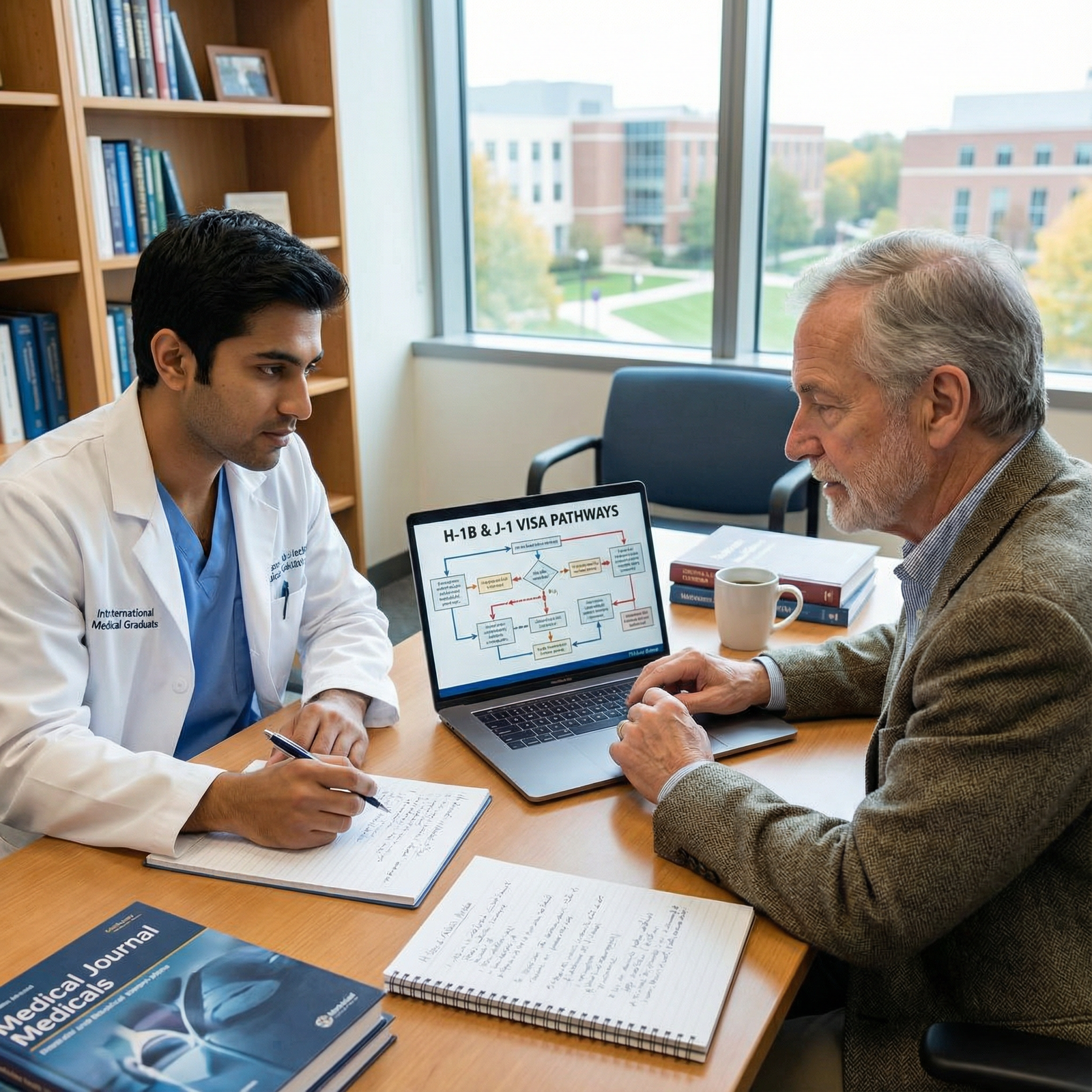
International medical graduates face two simultaneous challenges: getting into residency and being able to legally train in the United States. In high-demand regions like the San Francisco Bay Area—home to programs at UCSF, Stanford, Kaiser, Sutter, Santa Clara Valley, and community hospitals—visa navigation is often as critical as the rest of the application.
This IMG residency guide focuses specifically on visa navigation for residency in the San Francisco Bay Area, helping you understand:
- The most common IMG visa options
- How J-1 vs H-1B decisions affect your training and career
- Program-specific trends in Bay Area residency and San Francisco residency visa sponsorship
- Practical timelines, documentation, and strategies to avoid visa-related pitfalls
This article is written for international medical graduates inside and outside the U.S., including those on F-1, F-2, B-1/B-2, or no current U.S. status.
Core Visa Options for IMGs: J‑1 vs H‑1B (and Others)
1. The J‑1 Visa for Clinical Residency
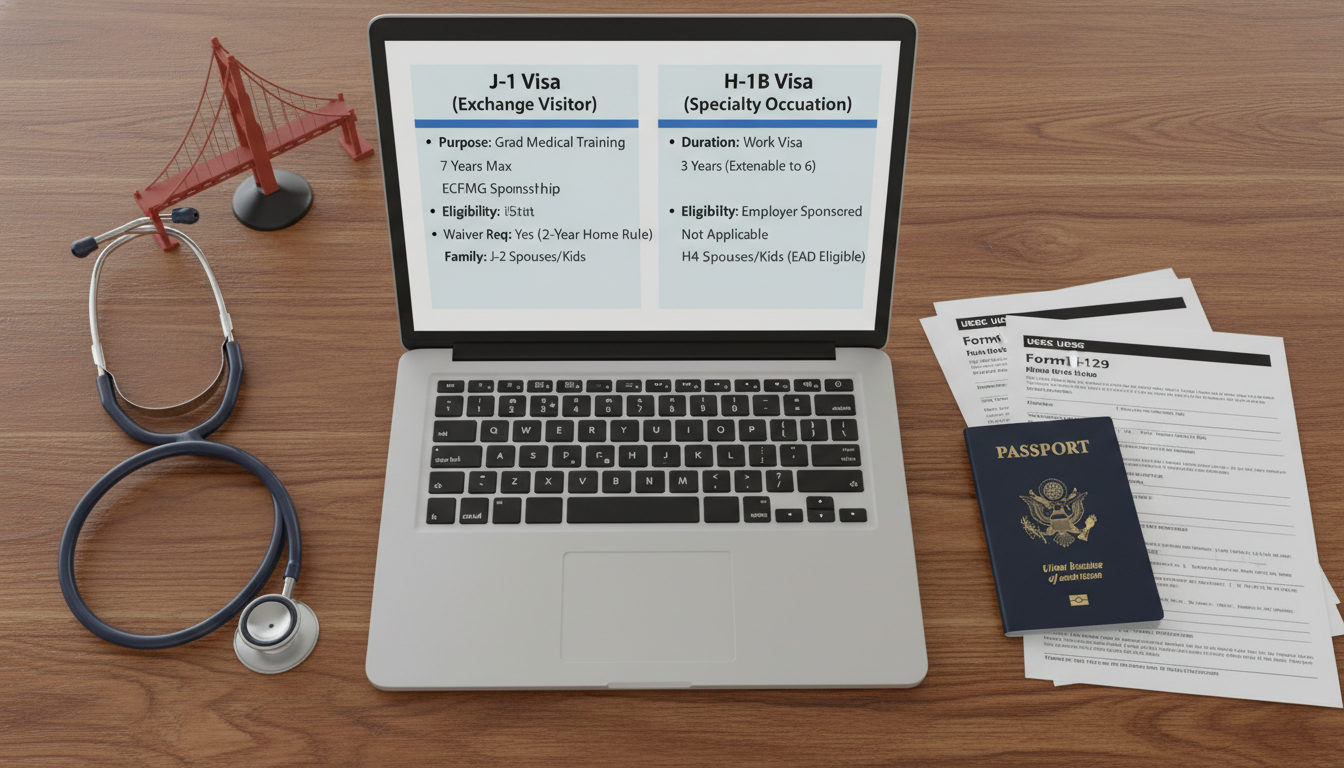
The J‑1 Exchange Visitor visa (ECFMG-sponsored) is the most common pathway for IMGs entering U.S. residency.
Key features:
- Sponsor: ECFMG (not the hospital itself)
- Purpose: Graduate medical education (residency/fellowship)
- Typical validity: Length of your training program, up to 7 years for clinical training
- Work site: You are limited to your approved training program and sites listed on your DS‑2019
Two-year home-country physical presence requirement (Section 212(e))
Most J‑1 physicians are subject to the two-year home-country return requirement after training:
You must return to your country of last legal permanent residence for an aggregate of two years before:
- Changing to H‑1B, L‑1, or permanent resident status (green card)
- Adjusting status within the U.S.
You can still take USMLE, moonlight (if allowed by program & ECFMG), or attend conferences, but you cannot change to certain immigration categories until the requirement is satisfied or waived.
Pros of J‑1 for Bay Area residency:
- Widely accepted by teaching hospitals and university programs
- Less institutional cost and complexity (ECFMG handles sponsorship)
- Often easier and faster to process compared with H‑1B
- Many San Francisco residency and Bay Area residency programs default to J‑1 for IMGs
Cons of J‑1:
- Two-year return requirement (unless you secure a J‑1 waiver after residency, typically through service in an underserved area)
- No “dual intent” status (intention to immigrate and train at the same time is more sensitive)
- Restricted ability to moonlight or work outside of approved training
For many IMGs, the J‑1 is the most realistic and timely route to begin residency—especially in competitive regions like the Bay Area.
2. The H‑1B Visa for Residency Training
The H‑1B specialty occupation visa allows hospitals to directly sponsor you for clinical work as a resident or fellow.
Key features:
- Sponsor: The residency program/hospital (not ECFMG)
- Purpose: Employment in a “specialty occupation” (physician)
- Dual intent: Allows clear intention to eventually apply for a green card
- Validity: Up to 6 years total (initial periods often 3 years, then extension)
Pros of H‑1B for IMGs:
No automatic two-year home-country return requirement
Generally considered more flexible for transitioning to:
- Fellowship
- Long-term employment
- Green card sponsorship
Can be beneficial if you:
- Already have a long-term plan to remain in the U.S.
- Intend to move quickly toward permanent residency
Cons and limitations of H‑1B:
- USMLE Step 3 is almost always required at time of petition filing for residency
- Programs must pay higher legal and filing fees and often a prevailing wage
- Some institutions’ HR or legal offices do not support H‑1B for residents, only for faculty or attending positions
- Not all IMG-friendly Bay Area programs will sponsor H‑1B; many explicitly state “J‑1 only”
Cap-exempt status for university-based programs
Academic medical centers and some teaching hospitals associated with universities are H‑1B cap-exempt, which is beneficial:
- They can file H‑1B petitions any time of year (not restricted to the April lottery)
- Many large Bay Area institutions, such as UCSF or Stanford-affiliated hospitals, may fall under this category for certain positions
However, being cap-exempt does not mean the program will automatically sponsor H‑1B for residents. That’s still a policy choice.
3. Other Statuses You Might Already Have
These are not primary training visas, but they influence your options:
F‑1 Student Visa (with or without OPT)
- Many IMGs in U.S. medical schools or U.S. master’s/PhD programs are on F‑1.
- For residency, you generally must switch to J‑1 or H‑1B.
- OPT may occasionally bridge a gap while you wait for visa processing but is not a long-term training solution.
O‑1 Visa (Extraordinary Ability)
- Uncommon for residency unless you have significant research and publications.
- More relevant for higher-level research or faculty positions.
Dependent statuses (F‑2, H‑4, J‑2)
- Typically do not authorize independent clinical work.
- You would still need to convert to a proper residency visa (J‑1/H‑1B).
J‑1 vs H‑1B: Strategic Decisions for San Francisco Bay Area IMGs
Program Policies in the Bay Area
Not all residency programs in the Bay Area treat visa sponsorship the same way. Policies can vary even within the same health system.
Common patterns you might see:
J‑1 Only Programs
- Many community hospitals and some university-affiliated programs accept only J‑1 for IMGs.
- Example language: “We sponsor J‑1 visas through ECFMG only; we do not sponsor H‑1B for residency.”
J‑1 Preferred, Limited H‑1B
- Some university programs may sponsor H‑1B case by case, typically for:
- Exceptional applicants
- Those who cannot obtain J‑1 for specific reasons
- These are often competitive and require early communication.
- Some university programs may sponsor H‑1B case by case, typically for:
H‑1B and J‑1 Both Accepted
- Less common but ideal for visa-flexible IMGs.
- In such programs, you may choose based on long-term goals.
No Visa Sponsorship
- Some community or smaller suburban programs may accept only residents who are:
- U.S. citizens
- U.S. permanent residents
- Those with independent work authorization (e.g., TPS, asylee, refugee)
- Some community or smaller suburban programs may accept only residents who are:
For a San Francisco or broader Bay Area residency search, always verify each program’s current visa policy:
- Program website “International Applicants” or “Eligibility” section
- FREIDA listings (filter by visa sponsorship)
- Direct email to program coordinator or GME office
How Your Long-Term Plans Affect the J‑1 vs H‑1B Decision
Choose J‑1 if:
- You primarily need a reliable way to start residency in a competitive region like the Bay Area
- Most of your target programs explicitly sponsor J‑1 but not H‑1B
- You are open to:
- Returning to your home country for two years
- OR pursuing a J‑1 waiver job (often in underserved or rural areas) after residency
Choose H‑1B if realistically possible and if:
- Your top-choice programs in the Bay Area do sponsor H‑1B for residents
- You have USMLE Step 3 completed early (before Rank Order List deadline is ideal)
- You want to:
- Minimize immigration transitions between residency, fellowship, and attending positions
- Move more directly toward a green card without the J‑1 home residence requirement
Keep in mind: The Bay Area has fewer underserved locations than many other parts of California, which can complicate finding an in-region J‑1 waiver job. Many physicians complete residency in the Bay Area, then move to rural California or out of state for J‑1 waiver service.
Practical Barriers to H‑1B for Residency
Even if you prefer H‑1B, common obstacles include:
Late or missing USMLE Step 3
- Many GME offices won’t start H‑1B petitions without Step 3 already passed.
- If you plan for H‑1B, prioritize Step 3 before or early in the application cycle.
Institutional policy limits
- Some Bay Area teaching hospitals have a strict “J‑1 only for trainees” rule due to cost, administrative burden, or union contracts.
Timing with NRMP Match
- You will not know your matched program until March, leaving a short window for H‑1B processing before July 1.
- J‑1 processing via ECFMG is more standardized and often better aligned with residency timelines.
As an international medical graduate, remain flexible: apply broadly, understand visa policies, and be prepared to accept a J‑1 even if your long-term ideal is H‑1B.
Step-by-Step Visa Navigation Timeline for Bay Area Residency
1. 12–18 Months Before Residency Start (Application Year)
Clarify your goals and constraints:
- Do you have home-country ties that make returning two years feasible?
- Is your long-term plan clearly to remain in the U.S. post-training?
- Are you in a position to take USMLE Step 3 before or during application season?
Research programs with visa in mind:
Build a spreadsheet listing:
- Program name and location
- University vs community
- Stated visa policy (J‑1 only, J‑1 + H‑1B, no visas)
- Any notes from communication with coordinators
For the San Francisco Bay Area, consider:
- UCSF-affiliated hospitals (San Francisco General, Fresno if broadening region, VA SF)
- Stanford-affiliated programs (Palo Alto, Stanford Health Care, Lucile Packard)
- Kaiser Bay Area programs (San Francisco, Oakland, Santa Clara, etc.)
- County and community programs (e.g., Santa Clara Valley Medical Center, Highland Hospital/Alameda Health System, Sutter affiliates)
2. During ERAS Application & Interview Season
In your ERAS application:
- Clearly indicate your citizenship and visa need.
- If you have Step 3: highlight this prominently if you’re aiming for H‑1B-capable programs.
During interviews:
Ask specific, respectful questions:
- “Could you share your current policy on visa sponsorship for international medical graduates?”
- “Do you sponsor both J‑1 and H‑1B visas, or J‑1 only?”
- “Have you sponsored H‑1B for residents in recent years?”
Listen for:
- Whether the GME office or HR controls the decision
- Whether H‑1B is truly an option or extremely rare
Document the responses immediately after each interview.
3. Rank Order List Strategy
When ranking Bay Area programs:
- High priority on J‑1 or H‑1B sponsoring programs if you need a residency visa.
- Weigh the risk of ranking “no-visa” programs highly if you do not have independent work authorization.
If H‑1B is a realistic possibility:
- Preferentially rank programs that:
- Confirmed H‑1B sponsorship possibility
- Have a track record of doing so
- Are cap-exempt academic institutions (more flexible H‑1B filing timelines)

After Matching: From Match Day to Visa Approval
1. Immediately After Match Day (March)
Once you match into a Bay Area residency:
- Carefully review your offer letter and any accompanying documents.
- Look for explicit language about your visa type (J‑1 vs H‑1B) or “ECFMG sponsorship.”
Communicate with your program coordinator and GME office:
- Confirm the expected visa category:
- “Based on my status, will I be sponsored for a J‑1 visa through ECFMG or an H‑1B?”
- Ask about:
- Internal deadlines for visa paperwork
- Any program-specific requirements (Step 3 deadlines, translations, notarization, etc.)
2. J‑1 Process Through ECFMG
If your program sponsors only J‑1 or chooses J‑1 for you:
Key steps typically include:
ECFMG Online Application (EVSP)
- You and your program’s training program liaison (TPL) submit information online.
- Provide proof of your medical degree, ECFMG certification, contract/offer, and identity documents.
Financial documentation
- You must show sufficient financial support:
- Salary from residency contract usually counts.
- If bringing dependents (J‑2), you may need additional proof of support.
- You must show sufficient financial support:
Issuance of DS‑2019
- ECFMG sends your DS‑2019 form (certificate of eligibility).
- You use this to schedule a visa interview at a U.S. embassy/consulate if you’re abroad.
Visa interview and travel
- Prepare to show:
- DS‑2019
- Residency contract
- ECFMG certificate
- Ties to home country (varies by consulate)
- Prepare to show:
Arrival in the U.S.
- You can enter usually up to 30 days before the start date listed on DS‑2019.
- Report to your program, complete I‑9 (employment eligibility), and attend orientation.
If you are already in the U.S. on another status (e.g., F‑1):
- You may either:
- Apply for a change of status within the U.S. (if timing allows), or
- Travel abroad to obtain a J‑1 visa stamp and re-enter.
Discuss with both ECFMG and an immigration attorney to choose the safer route given timing.
3. H‑1B Process for Residency Programs
If your program agrees to sponsor an H‑1B:
Typical steps:
Confirm institutional policy and cost coverage
- Most programs pay the required filing fees, but policies differ.
- Some may ask you to cover premium processing (if allowed by law and union rules at that time).
Gather documents:
You’ll usually need:
- Valid passport
- Medical diploma and transcripts (and translations if needed)
- ECFMG Certificate
- USMLE Step 1, 2 CK, and Step 3 score reports
- Current immigration documents (I‑94, current visa stamps, DS‑2019/ I‑20 if applicable)
- Updated CV
Prevailing wage and LCA (Labor Condition Application)
- The program’s immigration counsel will file an LCA with the Department of Labor.
- This certifies that your wage meets prevailing wage standards.
I‑129 Petition for H‑1B
- Filed by the hospital to USCIS, with supporting documents and fee.
- Premium processing may significantly speed up adjudication.
Consular processing vs change of status
- If abroad, you’ll attend a visa interview to receive the H‑1B visa stamp.
- If already in the U.S. on another status, the program may request a change of status.
Timing considerations for Bay Area programs:
- Orientation and start dates are rigid (often late June or July 1).
- Delays in H‑1B approval may:
- Delay your start
- Require emergency premium processing
- Cause stress for both you and the program
For most Bay Area institutions, early completion of paperwork and rapid response to document requests is essential.
Special Considerations: Family, Waivers, and Future Planning
Bringing Family Members
Both J‑1 and H‑1B allow dependents, but their rights differ.
J‑2 (Dependents of J‑1 Physicians):
- Spouse and unmarried children under 21
- J‑2 spouses can apply for work authorization (EAD), though processing can take months.
- Children can attend school in the U.S.
H‑4 (Dependents of H‑1B Physicians):
- Spouse and unmarried children under 21
- Historically, limited work rights for H‑4 spouses (depend on evolving DHS rules and whether the principal H‑1B is on the path to green card).
- Children may study.
Factor these details into your visa preference if your spouse needs immediate work authorization or if you have school-aged children.
Planning Beyond Residency: J‑1 Waivers and Green Cards
If you complete residency in a San Francisco residency program on a J‑1 visa, you will almost certainly face the two-year home-country requirement unless you seek a waiver.
Common J‑1 waiver options:
Conrad 30 Waiver (State Department of Health)
- Each state, including California, can sponsor up to 30 J‑1 physicians per year to work in underserved areas.
- Most positions are:
- Rural or medically underserved
- Typically not in central San Francisco or main Bay Area metros
Federal Programs (e.g., VA, HHS)
- U.S. Department of Health and Human Services (HHS) for certain research or clinical roles
- Veterans Affairs (VA) facilities in underserved areas
Hardship or Persecution Waivers
- Based on extreme hardship to a U.S. citizen/LPR spouse or child, or likelihood of persecution in your home country.
- Complex, often requiring an experienced immigration attorney.
A realistic sequence for many J‑1 IMGs:
- Residency in the Bay Area →
- J‑1 waiver job in rural or underserved California (or another state) →
- H‑1B with the waiver employer →
- After some years, employer-sponsored green card.
For H‑1B residents:
- Your institution or future employers in the Bay Area may directly sponsor you for a green card, often via:
- EB‑2 (Advanced degree professionals)
- EB‑1 (in rare cases of extraordinary ability or outstanding researchers)
Planning early with a qualified immigration attorney, especially if you aim to remain in California long-term, is crucial.
Practical Tips and Common Pitfalls for IMGs Targeting the Bay Area
Start visa planning early in your IMG residency guide process.
Think about visa type before you choose your exam schedule or program list.Don’t assume all prestigious programs offer all visa options.
A top-tier university in San Francisco might sponsor only J‑1 for residents but H‑1B for faculty.Take USMLE Step 3 early if H‑1B is important to you.
Aim for Step 3 results before interviews to maximize H‑1B eligibility.Ask programs directly and politely about visa sponsorship.
Program websites can be outdated; coordinators and GME offices provide current policy details.Maintain a clean immigration history.
Overstays, unauthorized employment, or status violations may complicate both J‑1 and H‑1B.Keep copies of everything.
Save every I‑20, DS‑2019, I‑94, visa stamp, employment contract, and ECFMG document for future petitions.Use institutional resources.
Bay Area academic centers often have international offices; attend their orientations and info sessions.Consider consulting an immigration attorney.
Especially if you have:- Complex prior status (e.g., asylum, TPS, prior J‑1 in another category)
- Family considerations
- Long-term plans for permanent residency in the U.S.
FAQs: Visa Navigation for IMGs in the San Francisco Bay Area
1. Is it easier to get into a Bay Area residency program if I choose J‑1 instead of H‑1B?
Residency selection is based primarily on your academic and clinical profile, not your visa choice. However, many Bay Area programs only sponsor J‑1, and some may be more willing to rank an IMG highly if the visa process is straightforward (J‑1 via ECFMG) versus more complex (H‑1B). If most of your desired programs are J‑1 only, being flexible about J‑1 can make your overall application process smoother.
2. Can I switch from J‑1 to H‑1B during residency in the Bay Area?
In most cases, no, if you are subject to the J‑1 two-year home-country requirement. You cannot change to H‑1B (or permanent resident) status until you either:
- Fulfill the two years physically in your home country, or
- Obtain a J‑1 waiver.
There are limited exceptions, but for clinical J‑1 physicians, assume you must complete residency on J‑1 and address waiver/home residence requirements afterward.
3. I am currently on F‑1 in a U.S. master’s program. Do I still need a J‑1 or H‑1B for residency?
Yes. F‑1 is a student visa and does not authorize clinical employment in a residency. For residency, you must transition to J‑1 (via ECFMG) or H‑1B (via your program). In some cases, you might use F‑1 OPT to bridge a short timing gap, but your long-term status as a resident must be J‑1 or H‑1B.
4. Does choosing an H‑1B residency guarantee I can stay in San Francisco long-term?
No. While H‑1B avoids the J‑1 home-country requirement and can simplify the path to a green card, your ability to remain in San Francisco or the broader Bay Area depends on:
- Availability of post-residency jobs
- Employer willingness to sponsor H‑1B or a green card
- Evolving immigration laws and quotas
H‑1B provides more flexibility, but not certainty. Long-term planning with potential employers and possibly an immigration attorney is still essential.
By understanding the nuances of residency visa pathways—especially J‑1 vs H‑1B—and how they play out in the San Francisco Bay Area, you can strategically navigate both the Match and U.S. immigration systems. Thoughtful preparation, early action on exams and documentation, and clear communication with programs will position you to start training on time and move toward the career in California you envision.