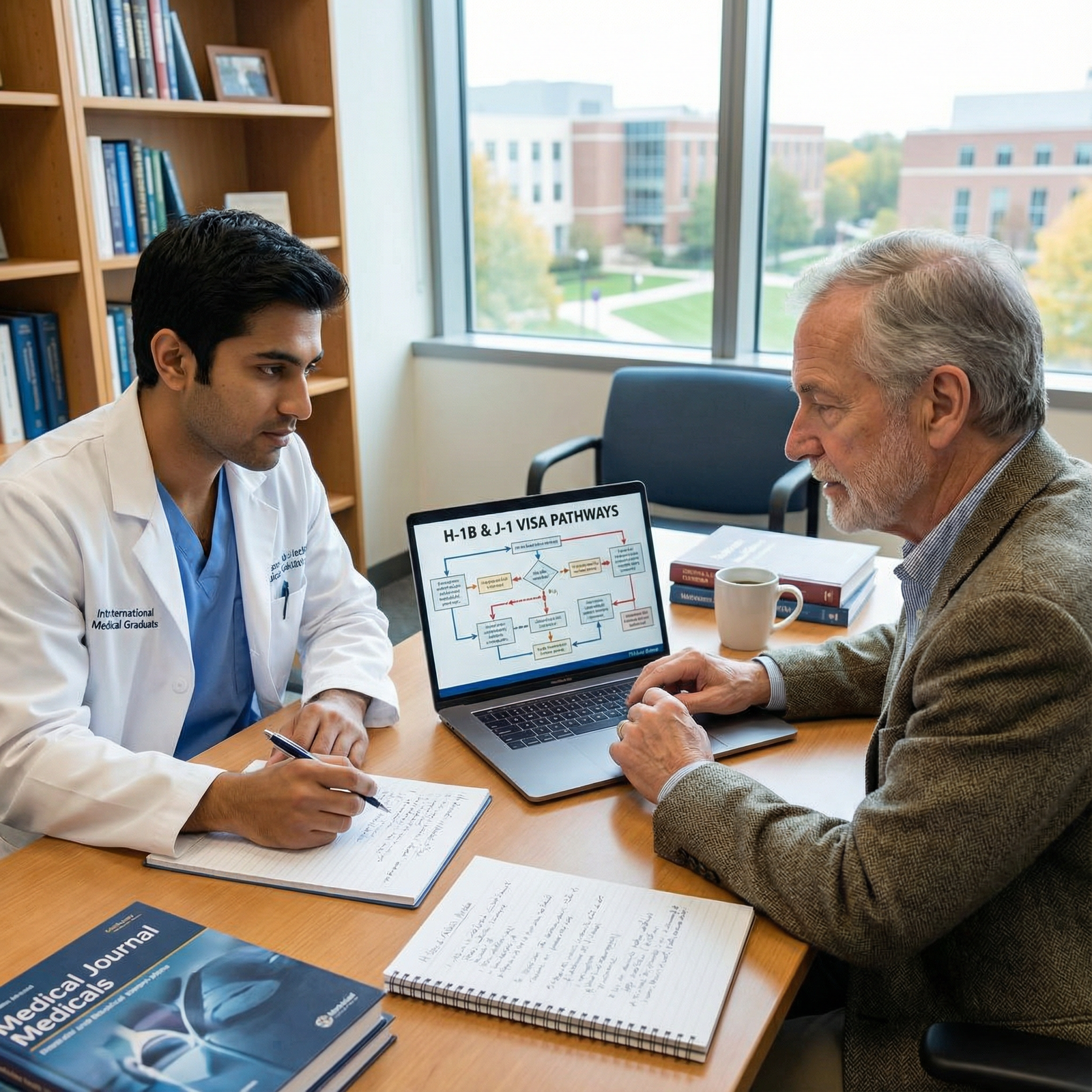
Understanding the Visa Landscape for IMGs in Boston
Boston is one of the most competitive and rewarding places in the United States for graduate medical education. World‑renowned hospitals like Massachusetts General Hospital, Brigham and Women’s, Boston Children’s, Beth Israel Deaconess, and Boston Medical Center host highly sought‑after Boston residency programs. For an international medical graduate (IMG), however, success in this environment depends on more than test scores and letters of recommendation—it also hinges on navigating residency visa requirements correctly.
This IMG residency guide focuses on visa navigation for residency in Boston, with special attention to J‑1 vs H‑1B, Massachusetts residency regulations, and practical steps you should take before and during the application cycle. Think of this as your structured roadmap to safely and strategically securing the right visa for training.
Core Visa Options for IMGs in Boston Residency Programs
For most IMGs, residency in Boston will involve one of three main visa pathways:
- J‑1 Exchange Visitor (Physician) Visa
- H‑1B Temporary Worker (Specialty Occupation) Visa
- Alternative paths (e.g., Green Card, other statuses like E‑2, L‑2, etc.)
Most Boston residency programs that sponsor IMGs use either J‑1 or H‑1B, with J‑1 being the more common route for GME nationwide.
1. The J‑1 Physician Visa: The Default Pathway for Many IMGs
The J‑1 physician visa is administered through the Educational Commission for Foreign Medical Graduates (ECFMG) as the “J‑1 Exchange Visitor” for physicians.
Key characteristics:
- Primary sponsor: ECFMG (not the individual hospital)
- Validity: Typically 1 year at a time, renewable for each year of accredited training
- Maximum duration: Usually up to 7 years total of clinical training
- Employment: Only at the specific ACGME‑accredited program and location(s) approved on your DS‑2019
- Funding: Typically salary from the hospital; also compatible with institutional stipends
Major advantage:
- Widely accepted: Many Boston and Massachusetts residency programs sponsor only J‑1 visas. This makes it the most straightforward option for many IMGs.
Major limitation:
- Two-year home residence requirement under U.S. immigration law (INA 212(e)):
- After completing J‑1 training, you must either:
- Return to your home country for a cumulative two years, or
- Obtain a J‑1 waiver before transitioning to a longer-term U.S. status (e.g., H‑1B or permanent residency).
- After completing J‑1 training, you must either:
This requirement shapes long‑term career planning, especially if you aim to stay in Massachusetts or elsewhere in the U.S. after residency.
Eligibility Requirements for the J‑1 Physician Visa
To be sponsored by ECFMG for J‑1 status, you generally must:
- Have ECFMG certification (or be eligible at the time of sponsorship)
- Hold a valid medical license or training license, as required by the state (Massachusetts uses a limited license for residents)
- Have an accepted offer of appointment in an ACGME‑accredited Boston residency program
- Demonstrate adequate financial support (usually your residency stipend meets this)
- Possess sufficient English language proficiency
Your Boston program’s GME office and ECFMG will guide the specific documentation:
- Form DS‑2019 (issued by ECFMG)
- Training contract
- Financial support letter
- Passport, photographs, and SEVIS fee payment
J‑1 Visa in Boston: Program Culture and Norms
Many Boston hospitals—especially those with large academic and safety‑net missions—have a long tradition of hosting J‑1 physicians. Common features you’ll see:
- Well‑defined internal processes for J‑1 sponsorship via ECFMG
- Orientation sessions on immigration, travel, and compliance
- Clear expectations about moonlighting (often restricted or prohibited under J‑1 policy and institutional rules)
- Structured support for J‑1 waiver planning (especially in primary care, psychiatry, and other shortage specialties)
This institutional familiarity makes the J‑1 a relatively predictable route for IMGs entering Boston residency programs.
2. The H‑1B Visa: A More Restrictive but Flexible Alternative
The H‑1B is a temporary worker visa in a specialty occupation, directly sponsored by the hospital, not ECFMG. A few highly resourced Boston programs will offer H‑1B sponsorship for residents and fellows, but many do not, often because of cost, timelines, and legal complexity.
Key characteristics:
- Sponsor: The specific hospital or institution where you train
- Eligibility requirement: You must have passed USMLE Step 3 before the H‑1B petition is filed
- Validity: Typically issued for 3 years initially, extendable to a total of 6 years
- Job‑specific: Authorized only for the employer and role stated in the petition
- No two‑year home residency requirement: Unlike the J‑1, there is no automatic requirement to return home after training
For an IMG in Boston, H‑1B can be more attractive long‑term, but less available upfront.
H‑1B Pros and Cons for Boston Residency
Advantages:
- No 2‑year home return requirement, offering a smoother path to:
- Longer‑term H‑1B clinical roles
- Employment‑based green card sponsorship
- More flexible for moonlighting/secondary sites, though each site may still require approval and possibly an H‑1B amendment
- Frequently preferred by IMGs with clear long‑term U.S. career plans in Massachusetts or other states
Challenges:
- Many Boston programs do not sponsor H‑1B for residency, or restrict H‑1B to certain departments
- Requires USMLE Step 3 passed early (often by the Rank Order List deadline or before contract signing)
- Higher legal and filing costs for the hospital
- Time‑sensitive government filing windows and processing delays
When exploring Boston residency programs, your IMG visa options depend heavily on whether a specific institution actually sponsors H‑1B for residents.
J‑1 vs H‑1B: Choosing the Right Route
From an IMG perspective, the J‑1 vs H‑1B decision is strategic:
You prioritize getting any U.S. training in Boston:
- J‑1 is usually more accessible.
- Many programs simply do not offer H‑1B to first‑year residents.
You have strong exam scores, early Step 3, and multiple H‑1B‑friendly program options:
- H‑1B can reduce future immigration hurdles and avoid the J‑1 waiver process.
You want to remain long‑term in Boston/Massachusetts after training:
- H‑1B is often more straightforward post‑residency.
- J‑1 is still workable but requires careful J‑1 waiver planning (more on this below).
In practice, most IMGs aiming for Boston should stay flexible, apply broadly, and be prepared to accept J‑1 sponsorship if H‑1B is not feasible.

3. Other Statuses: Green Card and Alternative Visas
Although less common at the residency entry stage, some IMGs in Boston match while in other U.S. immigration statuses:
Lawful Permanent Residents (Green Card holders):
- Treated as U.S. graduates for visa purposes.
- No need for residency visa sponsorship.
- Programs may still verify authorization to work (I‑9 form), but the process is simple.
Other nonimmigrant statuses (e.g., F‑1 with OPT, E‑2, L‑2, H‑4 with EAD):
- Rare but possible in specific circumstances.
- Some institutions require you to transition into J‑1 or H‑1B for the residency.
- This can be complex; always consult both program GME staff and an immigration attorney.
If you are already in the U.S. in a non‑J‑1/H‑1B status, you must discuss your specific case early with the GME office of any Boston residency programs that offer you interviews or rank you highly.
How Visa Status Interacts with Massachusetts Residency Training
Understanding how Massachusetts residency requirements, licensing rules, and institutional policies intersect with your visa status is critical.
Limited Licensure for Residents in Massachusetts
Massachusetts uses a “Limited License” for residents and fellows in ACGME‑accredited programs:
- Required for you to practice under supervision in Boston residency programs.
- Issued by the Massachusetts Board of Registration in Medicine (BORIM).
- Requires:
- Proof of medical education
- ECFMG certification for IMGs
- Appointment letter from the training program
- Visa status or proof of work authorization (J‑1 DS‑2019, H‑1B approval, etc.)
Both J‑1 and H‑1B are compatible with Massachusetts limited licensure, but any delays in your visa can delay the license issuance and thus your official start date.
Institutional Policies in Boston Teaching Hospitals
Each Boston institution may have its own policy about which visa types are supported:
- Some hospitals are J‑1 only for residents (H‑1B allowed only for faculty).
- Others offer J‑1 and selective H‑1B sponsorship for residents with specific criteria (e.g., Step 3 early, strong academic profile).
- Some programs within the same hospital may differ (e.g., internal medicine might accept H‑1B, while another specialty does not).
When researching Boston residency programs, always:
- Visit each program’s website and look at the “Applicants” or “International Medical Graduates” section.
- Search specifically for:
- “Visa sponsorship”
- “J‑1 vs H‑1B” policies
- “IMG visa options” or “residency visa”
If their website is unclear, email the program coordinator or GME office with focused questions (sample language later in this guide).
Step‑by‑Step Visa Navigation Timeline for IMGs Targeting Boston
Visa navigation is not a single event—it’s a process that spans multiple phases of the residency application cycle. Here is a practical, chronological roadmap.
Step 1: Pre‑ERAS Planning (12–18 Months Before Match)
Clarify your preferred visa strategy (flexible vs H‑1B‑focused).
- If you are open to J‑1:
- You can prioritize clinical and academic fit of programs.
- If you strongly prefer H‑1B:
- You must plan to pass USMLE Step 3 early and target H‑1B‑friendly institutions.
- If you are open to J‑1:
Research Boston programs early.
- Make a spreadsheet of:
- Each program (e.g., MGH, BWH, BMC, BIDMC, Tufts Medical Center, etc.)
- Visa types supported (J‑1, H‑1B, both)
- Any restrictions specific to IMGs (e.g., graduation year limits, USCE requirements)
- Make a spreadsheet of:
Prepare for ECFMG certification and documentation.
- Ensure your medical school credentials are verified.
- Keep passport and civil documents up to date.
- Maintain accurate records of your clinical experience and exams.
Step 2: ERAS Application Phase
In your ERAS application:
Indicate your visa needs honestly.
- Do not claim U.S. work authorization you do not have.
- You may note “J‑1 or H‑1B” if you are open to both.
Highlight strengths important to IMG‑friendly Boston programs:
- Strong USMLE scores, especially Step 2 CK
- U.S. clinical experience in teaching hospitals
- Letters from U.S. faculty
- Research, particularly if it involves Boston or New England institutions
Step 3: Interview Season – Asking the Right Visa Questions
During interviews with Boston residency programs, you must balance professionalism with necessary clarity about visa sponsorship.
Appropriate questions (ask the program coordinator or PD, not every interviewer):
- “Does your program sponsor visas for international medical graduates?”
- “Is sponsorship limited to J‑1, or do you also consider H‑1B for residents?”
- “If you sponsor H‑1B, what are your requirements regarding USMLE Step 3 timing?”
Avoid implying that visa is your only interest, but ensure you understand:
- Which visa they typically use for IMGs
- How many IMGs are currently in the program and on what visas
- Whether they anticipate any changes in visa policy
Step 4: Rank List Strategy with Visa in Mind
When creating your NRMP rank order list:
Consider visa feasibility as a key factor.
- If you must have H‑1B, you may choose to rank only programs that explicitly support it—but recognize this may significantly limit your match chances.
- If you’re flexible (open to J‑1), rank programs based on overall fit while understanding that many offers will come with J‑1 sponsorship.
Be realistic.
- Highly competitive Boston programs may rarely offer H‑1B at the entry level.
- A good J‑1‑based match is often better than no match at all.
Step 5: Post‑Match: Securing Your Residency Visa
After Match Day, you’ll enter the visa processing phase with your matched Boston hospital.
For J‑1:
- The program confirms your appointment and forwards documentation to ECFMG.
- ECFMG issues your Form DS‑2019.
- You:
- Pay the SEVIS fee
- Schedule your J‑1 visa interview at the U.S. embassy/consulate (if outside the U.S.)
- Prepare supporting documents (contract, DS‑2019, financial support, etc.)
- On approval, you:
- Enter or re‑enter the U.S. with your J‑1 visa
- Attend hospital and GME orientation
- Maintain full compliance with ECFMG and SEVIS rules
For H‑1B:
- The Boston hospital works with immigration counsel to file an H‑1B petition on your behalf.
- You must have:
- USMLE Step 3 passed
- Required documents for the petition (diplomas, ECFMG certificate, transcripts, etc.)
- After USCIS approval:
- If outside the U.S., you attend an H‑1B visa stamping appointment.
- If already inside the U.S. with valid status, you may change status to H‑1B without leaving.
- You begin training on or after the H‑1B start date defined in the approval.
Planning Beyond Residency: J‑1 Waivers, H‑1B Transitions, and Staying in Boston
Many IMGs who complete residency in Boston hope to remain in the region for fellowship or early‑career practice. Your residency visa will shape these options.
Staying After a J‑1 Residency
Because of the two‑year home residence requirement, a J‑1 physician must either:
- Return home for two cumulative years, or
- Secure a J‑1 waiver that removes the requirement and allows a switch to H‑1B or permanent residency.
Common J‑1 waiver pathways include:
Conrad 30 waiver (State‑sponsored):
- Each U.S. state can sponsor up to 30 J‑1 physicians per year to work in underserved areas.
- Massachusetts participates and may sponsor certain specialties willing to work in shortage communities.
- Typically requires:
- A contract for 3 years of full‑time employment
- Practice in a Health Professional Shortage Area (HPSA) or similar designation
- If you want to remain in Boston specifically, note that many waiver jobs are in less central or underserved communities, though not always far from Boston proper.
Federal agency waivers (e.g., VA, HHS, ARC):
- Sponsored by a federal agency rather than the state.
- Often focused on specific populations (e.g., veterans, underserved rural communities).
Hardship or persecution waivers:
- Based on demonstrating that you or your U.S. citizen/LPR family would face exceptional hardship or persecution if you had to return home for two years.
- Complex and heavily fact‑specific; requires specialized legal advice.
Once a waiver is approved, you can usually switch to H‑1B and continue working clinically in the U.S., possibly within or near the Boston area.
Transitioning from H‑1B Residency to Long‑Term Status
If you complete Boston residency on H‑1B, your path may look like:
H‑1B clinical employment or fellowship in Massachusetts:
- If your H‑1B is “cap‑exempt” due to employment at a nonprofit hospital or university, you can often move to another cap‑exempt institution more easily.
- You may still need to manage the 6‑year H‑1B maximum, unless a green card process is underway.
Employment‑based green card sponsorship:
- Many physicians on H‑1B pursue EB‑2 or EB‑2 National Interest Waiver (NIW) green card categories.
- Some continue working at academic institutions or hospitals that support sponsorship.
Planning for this should begin during residency or early fellowship, particularly if you desire long‑term Massachusetts residency status.

Practical Tips and Example Scripts for IMGs Navigating Visas in Boston
How to Research Boston Residency Programs’ Visa Policies
Use a structured approach:
Program websites
Look under:- “Prospective Residents/Fellows”
- “International Medical Graduate”
- “Eligibility and Requirements”
GME office pages
Many Boston hospitals have a GME page explaining:- Whether they sponsor J‑1, H‑1B, or both
- Any institutional limitations (e.g., “We do not sponsor H‑1B for residency positions”)
NRMP and FREIDA databases
These sometimes list visa types accepted, but may be outdated. Always confirm directly.
Sample Email to Confirm Visa Sponsorship
You might send an email like this to a program coordinator:
Subject: Visa Sponsorship for International Medical Graduate Applicant
Dear [Coordinator’s Name],
I am an international medical graduate planning to apply to your [specialty] residency program for the upcoming Match. I am very interested in training at [Program Name] due to [brief, genuine reason].
Could you please let me know which visa types your program sponsors for IMGs (e.g., J‑1, H‑1B)? If H‑1B sponsorship is possible, are there specific requirements regarding timing of USMLE Step 3?
Thank you very much for your time and guidance.
Sincerely,
[Your Name]
[Medical School]
[AAMC ID or ECFMG ID, if available]
Common Mistakes to Avoid in Visa Navigation
- Waiting too long to ask about visa policies.
- Do your homework before ranking programs.
- Assuming all Massachusetts residency programs have the same rules.
- Policies vary widely even within the same city.
- Failing to plan for J‑1 waivers if you want to remain in the U.S. long‑term.
- Start learning about waiver options by PGY‑2 or PGY‑3.
- Not consulting a qualified immigration attorney when issues arise.
- Program GME offices know a lot, but they do not represent you legally.
FAQ: Visa Navigation for IMGs in Boston Residency Programs
1. Which visa is more common for IMGs in Boston residency programs, J‑1 or H‑1B?
In Boston, as nationwide, J‑1 is more common for residency positions. Many large teaching hospitals in Massachusetts use J‑1 almost exclusively for IMGs at the residency level. H‑1B sponsorship is available in some programs but is less frequent, often limited, and may require early USMLE Step 3.
2. Can I switch from J‑1 to H‑1B during or immediately after residency in Boston?
You can only switch from J‑1 to H‑1B if you satisfy or waive the 2‑year home residence requirement. That typically means either:
- Spending two cumulative years in your home country, or
- Obtaining a J‑1 waiver (e.g., Conrad 30, federal agency waiver, hardship/persecution waiver).
Without a waiver or fulfillment of the requirement, you are ineligible for H‑1B or permanent residence status, though you may sometimes obtain other nonimmigrant statuses in limited circumstances.
3. Do I need to pass USMLE Step 3 to get a J‑1 residency visa in Boston?
No. USMLE Step 3 is not required for the J‑1 physician visa. You must, however, be ECFMG certified (or demonstrate eligibility per ECFMG timelines) and meet all other program and state licensing requirements. Step 3 is required only if you are pursuing H‑1B sponsorship for residency.
4. Is it realistic to aim for H‑1B residency sponsorship as an IMG in Boston?
It can be realistic, but it is more competitive and logistically demanding. You should:
- Verify that specific Boston programs actively sponsor H‑1B for residents.
- Plan to take and pass USMLE Step 3 early, ideally before interviews or rank list finalization.
- Recognize that limiting yourself only to H‑1B‑sponsoring programs may reduce your overall match chances.
Many IMGs adopt a flexible strategy: pursue H‑1B where possible but remain open to J‑1 to secure high‑quality training in Boston.
By understanding J‑1 vs H‑1B, how Boston residency programs approach IMGs, and what steps you must take at each phase of the Match process, you can approach visa navigation with confidence. Combining strong academic preparation with informed immigration planning will give you the best chance of building a successful career in Boston’s world‑class medical community.