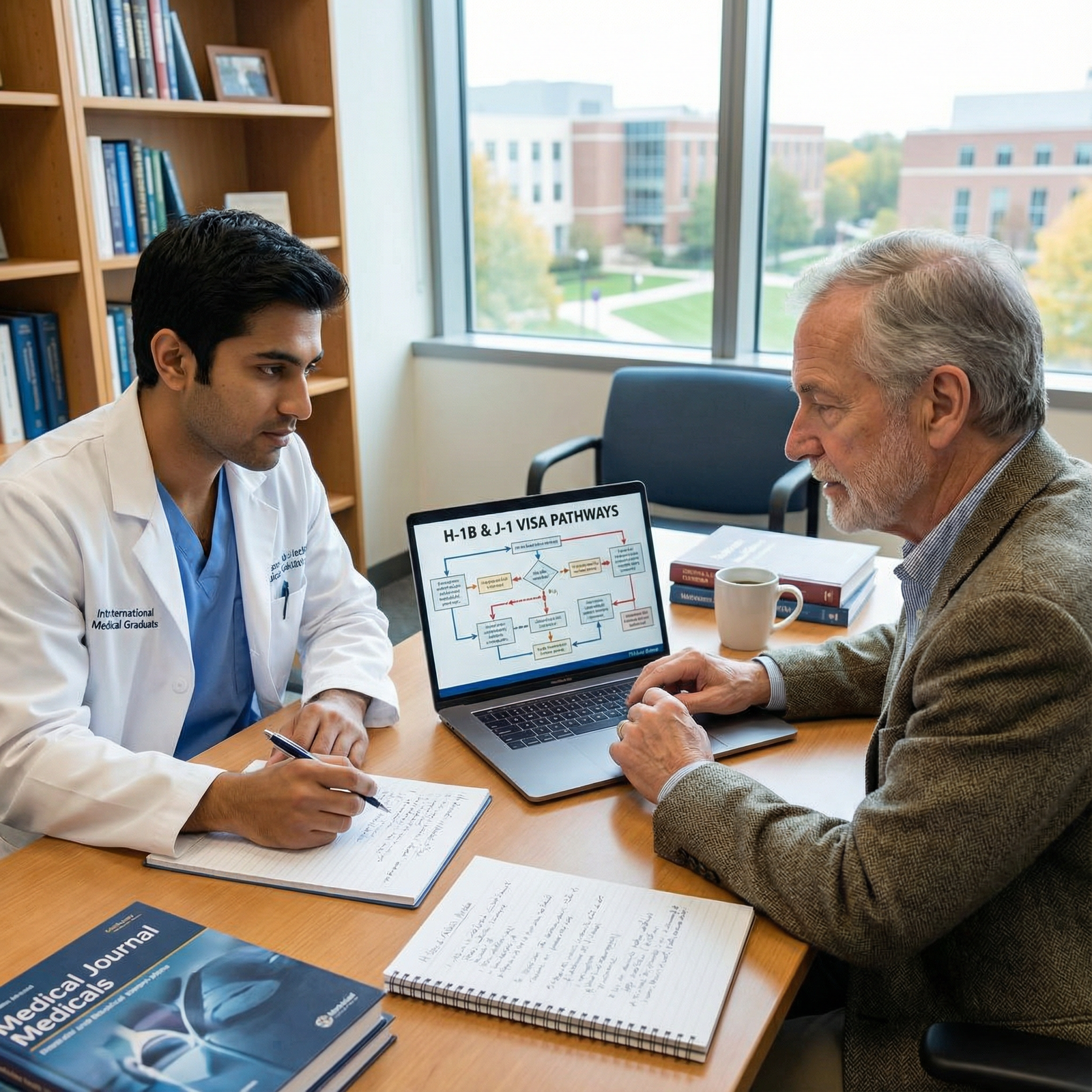
Understanding the Denver Landscape for IMGs
Denver has become an increasingly attractive destination for international medical graduates. With a mix of major academic centers, community hospitals, and subspecialty programs, Denver residency programs offer strong clinical training and quality of life. For IMGs, however, the path to a Denver residency is tightly linked to understanding and securing the right residency visa.
In this IMG residency guide, we will focus on the visa navigation process specifically for Denver and broader Colorado residency programs, highlighting common pathways, institutional preferences, and practical strategies to avoid immigration pitfalls.
Why Visa Strategy Matters in Denver
Visa status can directly affect:
- Which Denver programs you can apply to
- Your competitiveness compared with U.S. graduates
- Your ability to moonlight, change programs, or pursue fellowship
- Long‑term plans for staying in the United States
Each institution in Denver may have different policies on IMG visa options, and these policies can change from year to year. Your job is to understand:
- What J‑1 vs H‑1B really means in practice
- What Denver programs typically sponsor
- How your exam scores, graduation year, and credentials interact with visa preferences
- How to plan early so visa issues do not derail an otherwise strong application
Core Visa Options for IMGs: J‑1 vs H‑1B
Understanding J‑1 vs H‑1B is the foundation of visa navigation for residency. Nearly all IMGs in U.S. graduate medical education (GME) are on one of these two visa types.
J‑1 Exchange Visitor Visa (ECFMG-Sponsored)
The J‑1 physician visa is the most common route for IMGs in residency and fellowship.
Key characteristics
- Sponsor: Educational Commission for Foreign Medical Graduates (ECFMG)
- Purpose: Graduate medical education training
- Duration: Length of approved training, usually up to 7 years total (with some exceptions)
- Home residency requirement: 2‑year home country physical presence requirement after completion of training, unless you obtain a waiver
Advantages
- Widely accepted by most Denver and Colorado residency programs
- Application and sponsorship standardized through ECFMG
- No need for USMLE Step 3 before residency
- Less institutional cost and administrative burden; programs often prefer this
Limitations
- No “dual intent” – formally expected to return home after training (though waivers are common)
- Subject to the 2‑year home residency requirement unless waived
- Requires prior ECFMG certification and a formal training contract or offer
- Moonlighting options can be more limited and often require specific approval
Common misconception
Many IMGs think J‑1 automatically means they must leave the U.S. for 2 years. In practice, a significant number obtain a J‑1 waiver job (often in underserved or rural areas, including some parts of Colorado) and transition to H‑1B or permanent residency afterward. However, planning for this must start early.
H‑1B Specialty Occupation Visa (Employer-Sponsored)
The H‑1B is a work visa for specialty occupations, including residency positions.
Key characteristics
- Sponsor: The residency program (employer), sometimes via their university or hospital system
- Purpose: Employment in a specialty role (resident physician is recognized as such)
- Duration: Up to 6 years total (usually approved in 3-year increments)
- Dual intent: You can pursue permanent residence while on H‑1B
Advantages
- Not subject to the 2‑year home residency requirement
- Often perceived as more flexible for long-term U.S. immigration plans
- Easier transition from residency to fellowship or attending roles that also sponsor H‑1B
- Dual intent allows you to pursue a green card during training or afterward
Limitations
- Not all Denver residency programs sponsor H‑1B due to cost, complexity, and institutional rules
- Requires USMLE Step 3 before H‑1B petition approval (effectively before residency start)
- Some institutions or states have salary/funding or licensing constraints
- Cap issues may arise in some cases (though many academic hospitals are cap-exempt)
Practical tip
If you are strongly aiming for H‑1B, take USMLE Step 3 as early as possible, ideally before application season, so you can list it on your ERAS and make yourself a straightforward H‑1B candidate.

Visa Policies in Denver and Colorado Residency Programs
Denver and the rest of Colorado offer a range of program types: academic programs anchored by major universities and VA hospitals, and community-based programs spread across urban and semi-rural areas. Visa policies can differ significantly among them.
Typical Patterns in Denver
While individual details change, some overall patterns are common:
Most large academic Denver programs (e.g., internal medicine, pediatrics, family medicine, psychiatry, certain surgical specialties) typically:
- Accept IMGs
- Sponsor J‑1 visas reliably through ECFMG
- May sponsor H‑1B only selectively (often for higher-demand specialties or exceptionally strong candidates)
Smaller community or rural Colorado residency programs may:
- Accept J‑1 only
- Accept both J‑1 and H‑1B, but in limited numbers
- Place specific requirements on Step scores and ECFMG certification timelines for visa sponsorship
Because policies are institution-specific, the first step in visa navigation is to systematically research each program.
How to Research Denver Programs’ Visa Policies
Use a structured approach:
Program websites
- Look under “Eligibility,” “Application Requirements,” or “International Medical Graduates” tabs.
- Note whether they state:
- “We sponsor J‑1 visas only”
- “We sponsor J‑1 and H‑1B visas”
- “We do not sponsor visas”
FREIDA and other databases
- FREIDA frequently lists whether programs sponsor J‑1, H‑1B, or both.
- Cross-check this with the program’s own website, as FREIDA can be outdated.
Email the program coordinator (if unclear)
Example template:Dear [Program Coordinator’s Name],
I am an international medical graduate interested in applying to your [specialty] residency program in Denver. Could you please confirm what visa types your program sponsors for categorical residents (J‑1 vs H‑1B)? Additionally, are there any recent policy changes affecting IMG visa sponsorship?
Thank you for your time and assistance.
Sincerely,
[Your Name], MDSpeak to current residents
- Reach out via LinkedIn, program social media, or alumni networks.
- Ask specifically: “What is the current IMG visa policy?” Programs sometimes adjust policies before updating websites.
Balancing Visa Type vs. Competitiveness
In some Denver programs, H‑1B is reserved for:
- Candidates with very strong credentials (high USMLE scores, recent graduation, research, or U.S. clinical experience)
- Candidates in critical shortage specialties
- Candidates already on H‑1B (e.g., transferring from research jobs)
You may increase your match chances by being flexible and open to J‑1 unless you have compelling personal or professional reasons to pursue H‑1B alone.
Strategy example
- If your top priority is matching in Denver and building U.S. experience, consider applying broadly to J‑1-friendly programs first.
- If your priority is long-term U.S. immigration stability, target a mix of:
- Programs that list H‑1B sponsorship explicitly
- Programs that historically have IMGs on H‑1B (you can infer from current residents’ profiles)
- But still keep the door open to J‑1 as a backup if your profile is not extremely competitive.
Step-by-Step Timeline: Visa Navigation Through the Match
To make this IMG residency guide practical, here is a suggested timeline specifically tailored for an international medical graduate targeting Denver or other Colorado residency programs.
1–2 Years Before Applying
1. Solidify exam strategy
- Complete USMLE Step 1 and Step 2 CK with scores that make you competitive for your target specialty.
- If possible, start planning for USMLE Step 3 early if you intend to seek H‑1B.
2. Obtain or plan U.S. clinical experience
- Aim for 2–3 months of U.S. clinical rotations or observerships, preferably:
- In settings familiar with IMGs
- In specialties you intend to apply to
- In regions where you might want to match, including Colorado if possible
3. ECFMG certification planning
- Confirm your exams and documents will allow you to secure ECFMG certification well before the Match rank order list deadline. Without this, you cannot receive J‑1 sponsorship.
The Application Year (ERAS & Interviews)
1. Early ERAS season (June–September)
Identify 30–60 programs (or more, depending on competitiveness) that:
- Accept IMGs
- Match your visa needs (J‑1 vs H‑1B flexibility)
- Are in Denver or Colorado if location is important to you
Segment programs:
- Group A: J‑1 and H‑1B both sponsored
- Group B: J‑1 only
- Group C: H‑1B only (less common, but exists in some systems)
2. Personal statement and ERAS details
- If you have a strong preference (e.g., you already passed Step 3 and seek H‑1B), you may mention being “eligible and prepared for H‑1B sponsorship” in your application.
- Otherwise, keep it simple and emphasize:
- You are an ECFMG-certified international medical graduate or will be by the start date
- You are open to J‑1 sponsorship if that is true
3. During interviews
Be prepared for common questions related to visa status:
- “Are you eligible for J‑1 sponsorship through ECFMG?”
- “Have you already taken Step 3?”
- “Would you require H‑1B sponsorship, or are you open to J‑1?”
General approach:
- Answer honestly and concisely.
- If you are flexible, say so: “I am open to J‑1 sponsorship, and I understand ECFMG requirements. If your institution offers H‑1B for residents, I have completed Step 3 (or plan to take it on [date]) and would welcome that option as well.”
After Interviews and Before the Match
1. Clarify any remaining policy questions
If a program’s visa policy is still unclear:
- Politely email the coordinator after your interview to confirm visa sponsorship type.
- This can help you rank programs accurately based on feasibility.
2. Rank list strategy
- Rank programs in order of where you genuinely want to train, but avoid ranking programs that:
- Have confirmed they do not sponsor any visas and you have no other U.S. work authorization.
- Require H‑1B only when you know you will not be able to secure Step 3 in time.
After the Match
If you match into a J‑1 program in Denver
- The program will send information to ECFMG for J‑1 sponsorship.
- You’ll submit required documents to ECFMG:
- Valid passport
- ECFMG certification
- Training contract/Match confirmation
- Other biographical and financial forms
- You will receive Form DS‑2019 from ECFMG, then schedule a visa interview at the U.S. consulate.
If you match into an H‑1B program in Denver
- The program’s legal/HR department will initiate your H‑1B petition. Usually, they handle:
- Labor Condition Application (LCA) with the Department of Labor
- Form I‑129 petition to USCIS
- You must:
- Provide proof of USMLE Step 3
- Provide medical degree, ECFMG certificate, and any required state licensing documents
- Once approved, you will use the H‑1B approval notice (I‑797) to apply for the visa at a U.S. consulate (if outside the U.S.).
Common Pitfalls and How to Avoid Them
Even strong candidates can face serious delays or denials if they overlook key immigration details. Here are critical issues for an international medical graduate aiming for Colorado residency.
1. Delayed ECFMG Certification
Risk: Without ECFMG certification by the stated deadline, your program cannot move forward with J‑1 sponsorship.
Prevention
- Track ECFMG processing times for your medical school credentials early.
- Avoid last-minute exam scheduling, especially for Step 2 CK.
- Regularly check your ECFMG account for missing or incomplete documents.
2. Late USMLE Step 3 for H‑1B
Risk: You match to a program willing to sponsor H‑1B, but you do not have Step 3 results in time for them to file. This may force you to switch to J‑1 (if allowed) or jeopardize your start date.
Prevention
- Take Step 3 well before Match Day if you are seriously considering H‑1B.
- Check state rules: some states or institutions require a temporary training license linked to Step 3 or other exams.
3. Assuming All Programs Sponsor All Visa Types
Risk: You apply heavily to Colorado residency programs that do not sponsor your visa type, leading to wasted applications and limited interview offers.
Prevention
- Maintain a detailed spreadsheet with each program and its:
- Visa policy
- IMG acceptance history
- Special requirements (e.g., graduation year cutoffs, minimum scores)
4. Underestimating the J‑1 Home Residency Requirement
Risk: You complete a J‑1-based residency and only later discover how restrictive the 2‑year home requirement can be for your personal situation.
Prevention
- Learn early about J‑1 waiver programs (e.g., Conrad 30, VA waivers, federal underserved waivers). Many Colorado positions in rural or underserved areas qualify.
- Speak to current or former J‑1 physicians who went through waivers in Colorado; understand timelines and trade-offs.
5. Visa Denial or Security Administrative Processing
Sometimes, even with a solid application, a U.S. consulate may subject you to additional security checks (administrative processing).
Prevention and mitigation
- Apply for your visa interview as soon as you receive DS‑2019 or I‑797.
- Ensure your CV and DS‑160 form are completely accurate and consistent.
- If you have research in sensitive fields (e.g., dual-use technologies), be prepared with clear documentation and letters explaining your work.
Long-Term Planning: After Residency in Denver
Visa navigation does not end once you start training. For many IMGs, residency is only the first stage of a longer U.S. career. Your initial choice of J‑1 vs H‑1B has long-term implications.
For J‑1 Physicians
Common paths after residency
J‑1 waiver jobs
- Apply for a waiver of the 2‑year home residency requirement by committing to work in a designated underserved area for a set number of years, often 3.
- Conrad 30 waivers are state-based; Colorado participates and can be competitive but manageable in certain specialties (primary care, psychiatry, etc.).
- After waiver approval, you typically transition to H‑1B with the sponsoring employer.
Return to home country
- Fulfill the 2‑year requirement by physically residing and working there.
- Afterward, you may return to the U.S. on a different visa (including immigration routes).
Planning tips
- Start networking with potential waiver employers during your PGY‑2 or PGY‑3 years.
- Attend state and national conferences where Colorado health systems recruit.
- Familiarize yourself with Colorado’s own Conrad 30 timelines and specialty priorities.
For H‑1B Physicians
Next steps after residency
Fellowship on H‑1B
- Many academic fellowship programs can sponsor H‑1B, especially in teaching hospitals.
- You must track your total H‑1B time (6-year maximum, including residency + fellowship).
Employment and green card sponsorship
- Hospitals or large health systems in Colorado may sponsor you for permanent residency (e.g., EB‑2, NIW, or employer-sponsored I‑140).
- Since H‑1B is dual intent, you can start this process while still in training.
Planning tips
- Keep all H‑1B documents and approval notices organized; you’ll need them for future petitions.
- If you anticipate needing more than 6 years on H‑1B, explore I‑140-based extensions or green card strategies early.
Practical Example Scenarios for IMGs Targeting Denver
Scenario 1: Recent Graduate, Strong Scores, Open to J‑1 or H‑1B
- You are a 2023 graduate with high Step 1 and 2 CK scores, ECFMG certified, and some U.S. clinical experience.
- You plan to apply to internal medicine in Denver and Colorado.
Strategy
- Take Step 3 prior to ERAS submission to keep H‑1B on the table.
- Apply broadly to Denver residency programs that sponsor either J‑1 or H‑1B.
- During interviews, communicate flexibility: J‑1 is acceptable, but you are fully prepared for H‑1B.
- After matching, refine your long-term plan (waiver route vs. green card path), depending on the visa and program.
Scenario 2: Older Graduate, Limited Time, Needs a Predictable Path
- You graduated more than 10 years ago and your primary goal is to secure a training position, preferably in Denver, without excessive delays.
Strategy
- Focus on J‑1-friendly Colorado residency programs, as J‑1 tends to be more standardized and predictable.
- Highlight your clinical experience, possibly in underserved settings, to align later with J‑1 waiver opportunities.
- Accept that J‑1 may be the more realistic route, then plan proactively for a waiver job after residency.
Scenario 3: IMG with Family Already in the U.S., Strong Desire to Avoid J‑1 Waiver Obligation
- You have close family ties in the U.S. and want to minimize disruption.
Strategy
- Prioritize H‑1B-sponsoring Denver programs and prepare aggressively:
- Early Step 3
- Strong letters from U.S. faculty
- Clear statement of interest in long-term practice in the region
- Still apply to some J‑1 programs as a safety net, with a realistic understanding of future waiver requirements if matched there.
FAQs: Visa Navigation for IMGs in Denver
1. Do most Denver residency programs sponsor J‑1 or H‑1B?
Most Denver academic programs routinely sponsor J‑1 visas through ECFMG for international medical graduates. H‑1B sponsorship is available but more limited and often tied to institutional policy, funding, and candidate strength. Always verify directly with each program, as policies evolve.
2. Is it harder to match into Denver residency programs on H‑1B compared to J‑1?
In many cases, yes. Because H‑1B is more complex and costly, some Colorado residency programs either limit H‑1B slots or simply prefer J‑1. This does not mean H‑1B is impossible, but you must present a particularly strong profile and ensure you have USMLE Step 3 completed early.
3. If I start residency in Denver on J‑1, can I later switch to H‑1B?
Generally, you cannot change from J‑1 to H‑1B for the same training program without addressing the 2‑year home residency requirement or obtaining a waiver. However, after completing your J‑1 training and securing a J‑1 waiver job (typically in an underserved area), you can transition to H‑1B with that new employer.
4. How early should I start planning my visa strategy for a Denver residency?
Ideally 1–2 years before you apply. This allows enough time to complete the necessary USMLE exams (including Step 3 if aiming for H‑1B), secure ECFMG certification, gather U.S. clinical experience, and research Colorado residency programs’ visa policies. Early planning significantly reduces the risk of last-minute complications.
By understanding your IMG visa options, carefully researching Denver residency programs, and planning for the realities of J‑1 vs H‑1B, you can align your immigration path with your training and long-term career goals in Colorado. Thoughtful preparation will help you move from uncertainty to a clear, actionable strategy for building your medical career in Denver.