
Navigating the U.S. immigration system is one of the most complex parts of the journey for any international medical graduate (IMG). When you add the competitive nature of residency programs in the Tri-State Area—New York, New Jersey, and Connecticut—the visa process becomes even more critical to understand and plan early.
This IMG residency guide focuses specifically on visa navigation for residency in the Tri-State region, explaining practical details for New York, New Jersey, and Connecticut residency programs and how to make smart choices around J-1 vs H-1B and other IMG visa options.
Understanding the Big Picture: How Visas Fit Into Your Residency Strategy
Before diving into specific visa types, it is crucial to understand how visas fit into your overall residency and career planning.
Why visa planning matters early
For an international medical graduate applying to tri-state residency programs, visa status affects:
- Where you can apply – some programs sponsor only J-1, some only H-1B, some both, some none.
- Competitiveness – H-1B spots are often more limited and more selective.
- Long‑term career plans – fellowship opportunities, academic vs community jobs, and the green card path.
- Geographic flexibility – especially important if your goal is to stay in the New York–New Jersey–Connecticut area after training.
Ideally, you should:
- Decide your preferred visa pathway (if you have a choice) before building your ERAS program list.
- Confirm the visa policies of each program you apply to in the Tri-State Area.
- Understand any state-specific licensing or contractual obligations connected to your visa (e.g., J‑1 home‑country requirement, Conrad 30 waivers later).
Core Residency Visa Options for IMGs in the Tri-State Area
When you think about IMG visa options for U.S. residency, three common pathways dominate:
- J-1 Exchange Visitor (ECFMG-sponsored)
- H-1B Temporary Worker (Program/Institution-sponsored)
- Other statuses (e.g., green card holders, EAD, dependent visas)
1. J-1 Exchange Visitor Visa (Most Common for IMGs)
The J‑1 visa is the most widely used visa for IMGs entering U.S. residency training, especially in New York and New Jersey academic centers.
Key features:
- Sponsored centrally by ECFMG, not directly by each individual residency program.
- You must have a valid ECFMG certification (or meet specific criteria at the time of sponsorship).
- Limited to graduate medical education (GME) or training.
- Subject to the two-year home-country physical presence requirement (often called the “J‑1 home return rule”).
Pros of J-1 for Tri-State IMGs:
- Broad acceptance: Many New York and New Jersey programs sponsor or accept J-1 by default.
- Well-established process: GME offices are very familiar with ECFMG J-1 procedures.
- Easier for many programs: Since ECFMG is the sponsor, institutional burden is lower compared to H‑1B.
Cons of J-1:
- Two-year home residency requirement (Section 212(e)), meaning:
- You must return to your home country for two years after finishing training or
- Obtain a J-1 waiver (e.g., through Conrad 30, federal agencies, hardship, or persecution).
- Can limit immediate transition to certain non-training visas or green card categories until the requirement is addressed.
- Fellowships and advanced training often still require J‑1 extension or a switch in status.
J-1 implications specifically in NY/NJ/CT:
- New York, New Jersey, and Connecticut all participate in Conrad 30 J-1 waiver programs, which can later help you remain in the region after training.
- There are many underserved and medically underserved communities in the Tri-State area that sponsor J‑1 waiver jobs, especially:
- Upstate or non-metro New York
- Parts of New Jersey outside NYC suburbs
- Certain regions of Connecticut
For many IMGs targeting tri-state residency, starting on J-1 and then planning for a Conrad 30 waiver job in the region is a realistic long-term pathway.
2. H-1B Temporary Worker Visa for Residency
The H-1B is another key route, especially for IMGs who want to avoid the J‑1 home-country requirement and aim for a more direct green card pathway after residency.
Key features:
- Employer-sponsored by your residency program or sponsoring institution.
- Dual intent: allows you to pursue permanent residency (green card) without conflicting with your nonimmigrant status.
- Requires passing USMLE Step 3 before the H-1B petition is filed (timing is crucial for applicants).
- Salary and position must meet certain Department of Labor prevailing wage requirements.
Pros of H-1B for tri-state residents:
- No J‑1 home-country return requirement.
- More straightforward transition to:
- Hospital or academic jobs in New York, New Jersey, or Connecticut.
- Employment-based green card categories (e.g., EB-2, EB-3).
- Attractive to applicants intending to settle permanently in the U.S.
Cons of H-1B:
- Not all programs sponsor H‑1B; some categorically exclude it due to cost/administrative burden.
- Requires USMLE Step 3 early (often by the rank list deadline or before contract signing).
- Limited years of H-1B status (typically 6 years total, including residency and fellowship time).
- Must comply with annual H‑1B cap rules unless the sponsoring institution is cap-exempt (many academic and non-profit hospitals are, but not all).
H-1B in the Tri-State Area:
- Many large academic centers in New York City (e.g., major university hospitals) are cap-exempt due to nonprofit or educational status and are familiar with H‑1B sponsorship for residents and fellows.
- Some community programs in New Jersey or Connecticut may not sponsor H‑1B for residency but may do so for attending positions.
- Programs in the tri-state region that offer H‑1B often apply stricter screening (higher USMLE scores, stronger CVs) due to limited H-1B slots.
For an IMG targeting tri-state residency, the H‑1B is attractive but requires strategic timing of Step 3 and focusing on programs known to sponsor H‑1B.
3. Other Statuses: Green Card, EAD, and Dependent Visas
Some IMGs do not need a J‑1 or H‑1B because they already hold a status that allows employment:
- U.S. permanent residents (green card holders) – can apply like U.S. graduates, no visa sponsorship issues.
- Asylees, refugees, TPS with EAD, or DACA recipients – can often work using an Employment Authorization Document (EAD).
- Spouses/Dependents of other visa holders (e.g., H‑4, L‑2, E‑2) – some may be eligible for work authorization depending on the principal’s status.
If you already have independent work authorization, tri-state programs may still ask about your long-term visa stability, but your application is significantly simplified compared with typical IMG visa paths.
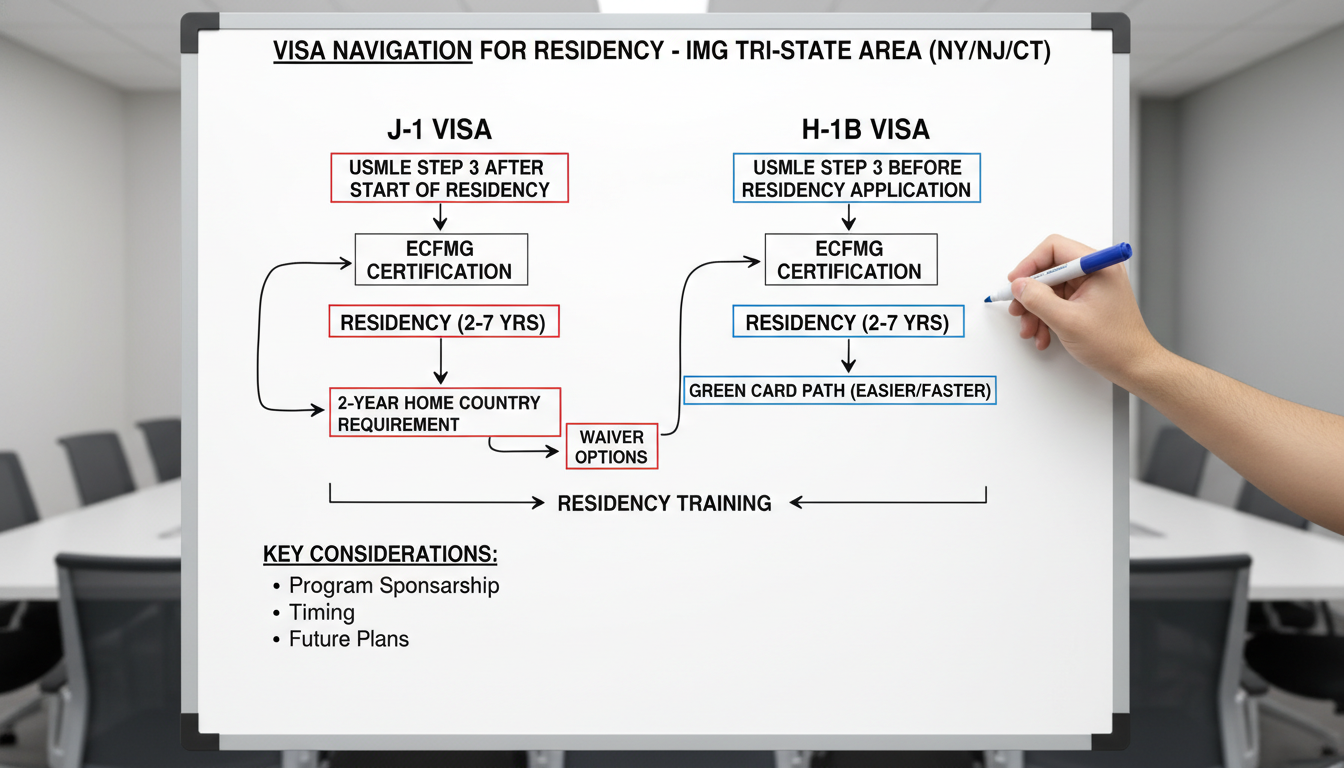
J-1 vs H-1B: Strategic Comparison for Tri-State IMGs
The J-1 vs H-1B decision is central to any IMG residency guide, especially in a competitive region like the Tri-State Area. While you may not always have a choice (your status often depends on what each program offers), understanding the differences helps you:
- Build a smart, targeted program list
- Communicate clearly in interviews
- Plan your long-term career in New York, New Jersey, or Connecticut
Key comparison factors
1. Sponsorship source
- J‑1: Sponsored by ECFMG; programs simply agree to host a J‑1 trainee.
- H‑1B: Sponsored directly by the hospital or institution; they must handle petitions, legal fees, and compliance.
2. Requirements
- J‑1:
- ECFMG certification
- Valid contract/offer from an approved training program
- Proof of sufficient funds and adequate health insurance
- H‑1B:
- ECFMG certification
- USMLE Step 3 passed (timing is critical)
- Program willing to sponsor and meet wage/labor requirements
3. Long-term outlook
- J‑1:
- Must deal with the 2-year home requirement or obtain a J‑1 waiver.
- Conrad 30 and other waivers are available in NY, NJ, and CT, but positions may be:
- In more rural or underserved areas
- Subject to service commitments
- H‑1B:
- Easier to move into attending roles in the same region.
- More straightforward path to an employer-sponsored green card, especially in New York City, Northern New Jersey, and urban Connecticut.
4. Where each is common in the Tri-State region
- New York:
- Large academic centers (NYC and major upstate institutions) often sponsor both, but may prefer J‑1 for most residents and reserve H‑1B for exceptional candidates or specific departments.
- Community programs and smaller hospitals are frequently J‑1 only.
- New Jersey:
- Many community programs accept J‑1; only select hospitals offer H‑1B for residency.
- Some institutions may sponsor H‑1B only for fellowship or attending positions, not for core residency.
- Connecticut:
- Major academic centers (e.g., associated with large universities) may be more open to H‑1B.
- Smaller community sites typically prefer J‑1.
How to decide which path to pursue (if you can choose)
Ask yourself:
- How fast can I realistically pass USMLE Step 3?
- If you cannot complete Step 3 before rank list deadlines or contract dates, H‑1B may be unrealistic for PGY‑1 entry.
- How important is staying in the U.S. long-term, especially in the tri-state region?
- If you are strongly committed to staying and want the most flexible green card route, H‑1B has advantages.
- If you are more open to rotation back to your home country or comfortable navigating J‑1 waivers, J‑1 is a solid path.
- Do the programs I like in NY/NJ/CT actually offer H‑1B?
- Many highly competitive tri-state programs may list “H‑1B sponsorship case-by-case,” which often means limited and selective.
In practice, many IMGs apply broadly, indicating willingness to accept either J‑1 or H‑1B, then negotiate details if they receive multiple offers.
How to Research Visa Policies of Tri-State Residency Programs
Understanding New York New Jersey Connecticut residency visa policies is essential for building your ERAS list strategically.
Step 1: Check official program websites
Most residency programs have a “International Medical Graduates” or “Eligibility / Requirements” section. Look for:
- Exact wording on visa sponsorship:
- “We sponsor J-1 only”
- “We sponsor J-1 and H-1B”
- “We do not sponsor visas”
- Any mention of:
- Step 3 requirement for H‑1B
- Prior U.S. clinical experience
- Cutoffs for date of graduation
Make a spreadsheet with columns like:
- Program Name
- State (NY/NJ/CT)
- Visa types allowed (J-1 only / J-1 + H-1B / None)
- Notes (Step 3 deadline, H-1B only for PGY‑2+, etc.)
Step 2: Use ACGME/AMA/FREIDA and NRMP filters (with caution)
Tools like FREIDA and NRMP program directories sometimes list visa sponsorship information. However, they may be:
- Outdated
- Incomplete
- Not fully describing case-by-case decisions
Use them as a starting point, but always cross-check with the program’s own website or contact the GME office.
Step 3: Email or call the program coordinator when information is unclear
If a program website is vague (e.g., “visa sponsorship considered” or “case-by-case”), send a short, professional email:
- Introduce yourself briefly (name, IMG, graduation year).
- Ask a specific question:
“Does your Internal Medicine residency program sponsor H‑1B visas for incoming PGY‑1 residents, or only J‑1 visas?”
This will help you:
- Avoid wasting ERAS applications on incompatible programs.
- Clarify if H‑1B is truly available or very rare.
Step 4: Network with current or recent residents
For tri-state programs, use:
- Alumni from your medical school
- Social media (e.g., LinkedIn, X/Twitter, Facebook groups for IMGs)
- Hospital or program-specific resident profiles
Ask targeted questions:
- “Which visas are common in your program?”
- “Are many residents on H‑1B or mostly J‑1?”
- “Have visa policies changed recently?”
Practical Timeline: Integrating Visa Planning Into Your Application Cycle
To align visa navigation for residency with your actual Match timeline, consider this year-by-year and month-by-month strategy.
12–24 months before ERAS (early planning)
- Clarify your immigration goals:
- Are you open to returning home for at least two years?
- Do you prioritize long-term U.S. settlement in the Tri-State Area?
- Start gathering information on:
- J‑1 requirements (ECFMG, documentation).
- H‑1B requirements (Step 3, program sponsorship).
- Begin preparing for USMLE Step 3 if you are targeting H‑1B.
6–12 months before ERAS opens
- Finalize your USMLE Steps 1 and 2 (and OET if applicable).
- If aiming for H‑1B:
- Schedule Step 3 early enough so that results are available before rank list deadlines.
- Build a target program list focusing on:
- Tri-state programs that match your profile.
- Visa types each program supports.
ERAS submission season (September–December)
- In your ERAS application and personal communication:
- Be honest about your current visa status.
- Indicate flexibility if you are open to both J‑1 and H‑1B.
- For interviews:
- Prepare concise explanations of your visa preferences and timeline.
- Do not dominate the interview with visa talk; keep it professional, brief, and confident.
Rank order list period (January–February)
- Reconfirm visa policies of programs you are seriously considering, especially if:
- Step 3 results are pending.
- The program had ambiguous or conditional H‑1B statements.
- If you have multiple interviews at both J‑1-only and J‑1/H‑1B programs:
- Weigh the visa type alongside training quality, location, and personal fit.
After Match (March and beyond)
- Once matched, the GME office will guide you through:
- J‑1 sponsorship steps with ECFMG (DS‑2019, SEVIS, consulate appointment).
- Or H‑1B petition process (LCA, I‑129 filing, premium processing if necessary).
- For consular processing:
- Schedule your visa interview early (especially if you are outside the U.S.) due to potential delays at U.S. embassies.
Common Pitfalls and How to Avoid Them
1. Ignoring Step 3 timing for H-1B
Many IMGs interested in H‑1B underestimate:
- How quickly Step 3 seats fill.
- How long it can take to get results.
Actionable advice:
- If H‑1B is important to you, aim to pass Step 3 before ERAS submission or at least before interviews.
- Communicate clearly with programs about your expected test date and result release window.
2. Applying heavily to programs that don’t sponsor your visa type
Sending many applications to non-sponsoring programs wastes money and time.
Actionable advice:
- Maintain a meticulous spreadsheet of tri-state residency programs and their IMG visa options.
- Prioritize programs that clearly list “We sponsor J‑1 and H‑1B” if that aligns with your goals.
3. Over-focusing on H-1B at the expense of your Match chances
In the highly competitive Tri-State Area, narrowing your list only to H‑1B programs might significantly reduce your Match probability.
Actionable advice:
- Balance your list: include J‑1-heavy programs where your profile is strong.
- Consider J‑1 as a viable path with good long-term options via Conrad 30 in NY, NJ, or CT.
4. Lack of long-term planning around J-1 waivers
If you choose J‑1 without understanding the home-country requirement, you may face surprises at the end of residency.
Actionable advice:
- Early in residency (PGY‑1/PGY‑2), start learning about:
- Conrad 30 programs in each of the three states.
- Federal J‑1 waiver options (VA, HHS, etc.).
- Network with senior J‑1 residents and graduates who have successfully obtained waivers in the tri-state region.
Long-Term Pathways After Residency: Staying in NY/NJ/CT
Your residency visa choice strongly influences your options after completion of training.
If you trained on J-1
You must either:
- Return to your home country for two years, then:
- Apply later for H‑1B or immigrant visa, or
- Pursue fellowships under new visa arrangements where allowed
(details depend on ongoing immigration regulations),
OR
- Obtain a J‑1 waiver and change to another status (commonly H‑1B).
Conrad 30 Waiver in Tri-State Area:
- New York, New Jersey, and Connecticut each have their own Conrad 30 program:
- Up to 30 J‑1 waiver spots per state per year.
- Typically require:
- Full-time clinical employment in a Health Professional Shortage Area (HPSA) or Medically Underserved Area (MUA), or
- Service to a medically underserved population.
- Commitment of 3 years in that position.
- Many waiver jobs exist outside major city centers, but some can be within commuting distance to NYC or urban hubs.
If you trained on H-1B
At the end of residency:
- You may transition directly into:
- Attending roles in New York, New Jersey, or Connecticut.
- Fellowships that also sponsor H‑1B (or in limited cases J‑1, if a change is allowed and advisable).
- Your employer may sponsor an employment-based green card (e.g., EB‑2 NIW, EB‑2 PERM, or EB‑3), considering:
- Your total H‑1B time (6-year limit).
- Whether they are cap-exempt or cap-subject institutions.
Many IMGs who train on H‑1B in the Tri-State region ultimately settle there permanently due to the density of hospital systems and abundant employment opportunities.
Frequently Asked Questions (FAQ)
1. Is it easier to match into residency in New York, New Jersey, or Connecticut on J-1 or H-1B?
For most IMGs, it is generally easier to match on J‑1 because:
- More programs in the tri-state region sponsor J‑1 than H‑1B.
- J‑1 imposes less administrative and financial burden on the program.
- H‑1B positions are often fewer and more selective.
If you are a very strong applicant (high scores, strong research, U.S. experience), you may still target H‑1B-friendly programs, but be careful not to over-limit your options.
2. Can I start residency on J-1 and later switch to H-1B in the same program?
Sometimes yes, but it is complicated and program-dependent. Issues include:
- Whether the program is willing and able to file H‑1B for you later.
- How the J‑1 home-country requirement will be handled (it usually still applies).
- Institutional policies and legal advice.
In many cases, switching from J‑1 to H‑1B during residency does not eliminate the 2-year rule; it simply changes your immediate work status. Always consult an immigration attorney and your GME office before planning such changes.
3. Do tri-state residency programs favor one visa type in selection?
Most programs claim to be “visa-neutral”, but practical factors matter:
- Some programs clearly prefer J‑1 due to familiarity and reduced cost.
- Programs that sponsor H‑1B may reserve it for:
- Highly competitive applicants.
- Subspecialties or advanced positions.
- A few programs may prefer H‑1B if they have strong institutional support for long-term retention.
In interviews, present yourself as a strong candidate first; discuss visa issues briefly and professionally only when appropriate.
4. Should I hire an immigration lawyer before applying for residency?
You do not need an attorney to apply to residency programs themselves. However, an immigration lawyer can be very helpful when:
- You have complex immigration history (prior visa denials, out-of-status periods, multiple country ties).
- You are choosing between J‑1 vs H‑1B and want personalized risk assessment.
- You are planning for J‑1 waiver options (Conrad 30) or a green card strategy in the tri-state area.
For straightforward cases, many IMGs rely on:
- GME office guidance
- ECFMG resources
- Official USCIS information
and consult an attorney only when a specific issue arises.
By understanding the nuances of residency visa options and carefully aligning them with your timeline and career goals, you can approach the New York, New Jersey, and Connecticut residency landscape with clarity and confidence. Thoughtful planning around J-1 vs H-1B, proactive research on program policies, and early integration of visa strategy into your application process will greatly improve both your Match success and your long-term ability to build a life and career in the Tri-State Area.