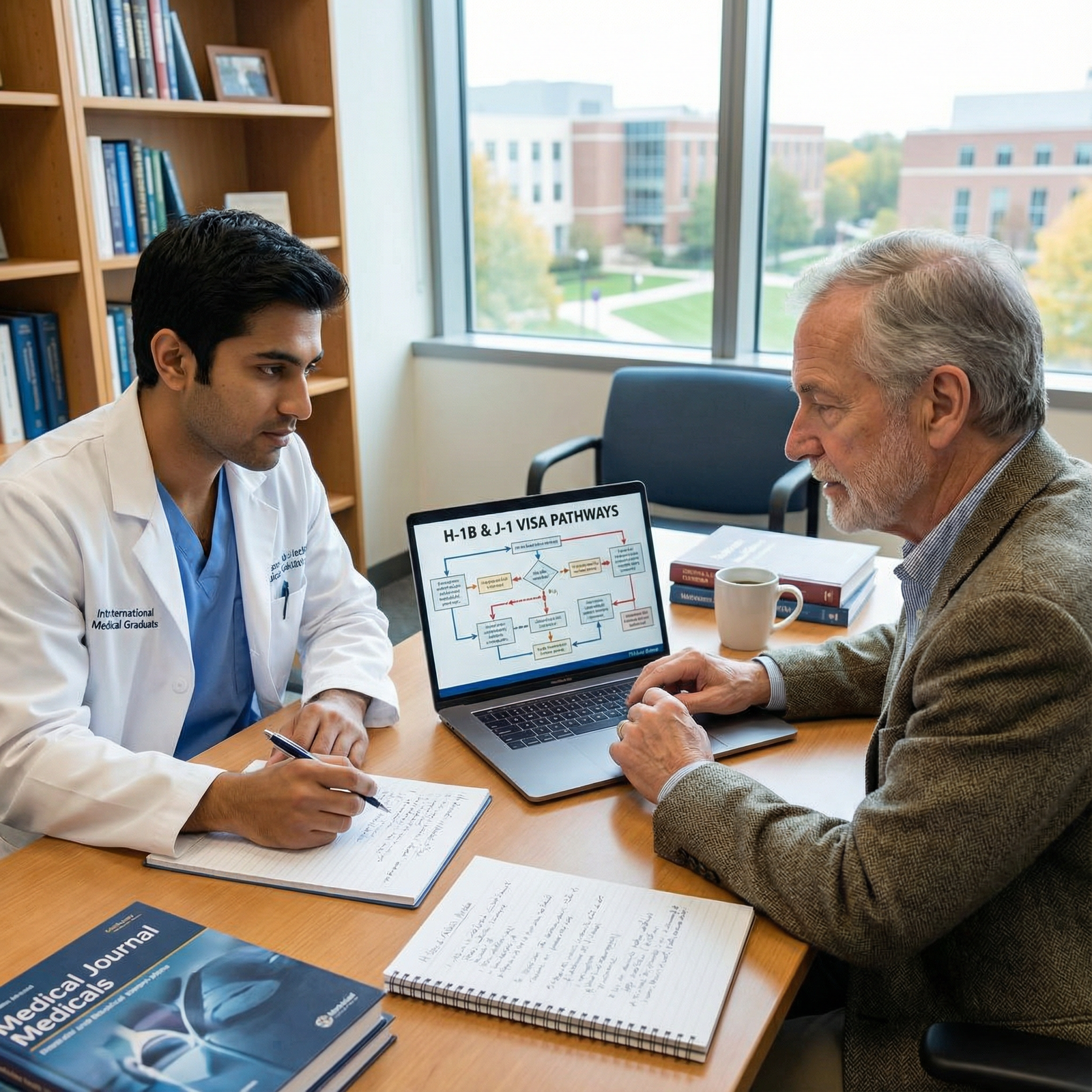
Understanding the Visa Landscape for IMGs Seeking Rural Midwest Residency
Navigating visas as an international medical graduate is complex even in large academic centers; adding the specific environment of a rural Midwest residency (e.g., Iowa, Nebraska, the Dakotas, Kansas, rural Illinois, rural Minnesota, Missouri) adds unique twists. This IMG residency guide focuses on how to approach visa navigation strategically if you’re targeting smaller community or rural programs.
You will need to answer three core questions early:
- What visa types are realistic for me?
- Which rural Midwest programs support those visa options?
- How do my long‑term plans (stay in the U.S. vs return home) affect my choices now?
This article will walk you step by step through residency visa basics, J‑1 vs H‑1B trade‑offs, regional nuances in Iowa/Nebraska and neighboring states, and practical strategies to improve your chances of both matching and staying compliant with U.S. immigration rules.
Core Residency Visa Options for IMGs in the Rural Midwest
For most IMGs entering U.S. graduate medical education, there are three main visa categories to understand:
- J‑1 (Exchange Visitor – Clinical)
- H‑1B (Temporary Worker – Specialty Occupation)
- Permanent residents/other statuses (if already in the U.S.)
This section focuses on J‑1 vs H‑1B because they are central to residency decisions.
The J‑1 Clinical Visa: Default Pathway for Many IMGs
The ECFMG‑sponsored J‑1 visa is the most common residency visa for IMGs.
Key features:
- Sponsored by ECFMG, not the residency program (though the program must support J‑1s).
- Easier to obtain than H‑1B for residency:
- Standardized process
- No prevailing wage issues
- No cap lottery for residency training
- Can usually be used for the entire length of accredited training, including fellowships.
Critical downside: the two‑year home residence requirement (212(e)).
Most J‑1 clinical visa holders must:
- Return to their home country for a cumulative two years after training
OR - Obtain a J‑1 waiver (for example, a Conrad 30 waiver) by agreeing to work in an underserved area, typically for three years.
For an international medical graduate specifically targeting rural Midwest residency and long‑term U.S. practice, this “J‑1 → waiver → rural job” pipeline can actually be a strategic advantage, because:
- Rural Midwest regions (Iowa, Nebraska, the Dakotas, Kansas, rural Missouri, etc.) need physicians.
- Many hospitals and clinics there actively recruit J‑1 waiver physicians.
- Primary care and core specialties (FM, IM, pediatrics, psychiatry, OB/GYN) are especially in demand.
Pros and Cons of the J‑1 for Rural Midwest–Bound IMGs
Advantages:
- Accepted by most community and university‑affiliated programs, including smaller hospitals.
- Application is relatively predictable and standardized.
- Often easier for programs in the rural Midwest that may not have the HR/legal infrastructure to manage H‑1Bs.
Disadvantages:
- Two‑year home requirement unless you secure a waiver.
- Less flexibility if you want to:
- Transition immediately to academic careers in big cities
- Avoid mandatory service obligations
- Dependents (J‑2) can often work, but you must maintain valid J‑1 status.
If your long‑term goal includes serving in rural or underserved areas (which align with many J‑1 waiver programs), the J‑1 path may fit your strategy well.
The H‑1B Visa: Attractive but Harder in Rural Programs
The H‑1B is a temporary worker visa for “specialty occupations,” which includes physicians.
Key features in residency context:
- Does not automatically create a two‑year home return requirement.
- Employer‑sponsored: the residency program must file and pay for the H‑1B petition.
- Requires passage of USMLE Step 3 before H‑1B filing in many states and institutions.
- Subject to prevailing wage requirements and institutional policies.
Some IMGs prefer an H‑1B because:
- It can facilitate a more straightforward transition to an employment‑based green card.
- Avoids the complexity of the J‑1 waiver process and the mandatory service period.
- No J‑1‑specific restrictions on moonlighting or research (though your residency program’s rules still apply).
H‑1B in the Rural Midwest: Realistic or Not?
For rural Midwest residency programs, H‑1B has mixed feasibility:
- Many smaller community programs in Iowa and Nebraska are willing to sponsor J‑1 but not H‑1B.
- Reasons include:
- Limited in‑house immigration/legal support
- Budget constraints for filing fees and attorney costs
- Institutional policies favoring J‑1 for training programs
That said, there are exceptions:
- Some university‑affiliated programs in Midwestern states (even if located in smaller cities) do sponsor H‑1B for selected residents, especially in high‑need specialties or for exceptional candidates.
- A few community programs in states like Kansas, Missouri, or the Dakotas may be open to H‑1B if they have experience with it.
For your residency application strategy:
- Check every program’s website and FREIDA profile for “residency visa” or “IMG visa options”.
- If a program doesn’t explicitly mention H‑1B, assume J‑1 only until you confirm otherwise.
- Email the program coordinator directly with a concise question:
- “Do you sponsor J‑1 and/or H‑1B visas for residents?”
Other Statuses: F‑1, Green Card, and More
Some IMGs might already be in the U.S. on:
- F‑1 with OPT (e.g., graduates of U.S. medical schools or other graduate programs)
- Green card (permanent residents)
- Dependent visas (e.g., H‑4, L‑2, etc.)
For these candidates:
- If you have a green card or U.S. citizenship, you do not need a residency visa; apply like a U.S. graduate.
- If you are on F‑1 OPT, you must confirm with programs how they will sponsor you after OPT expires (often J‑1 or H‑1B).
- If you’re on H‑4 or L‑2, you may still switch to an ECFMG J‑1 or be sponsored for H‑1B by a program; consult an immigration attorney early.
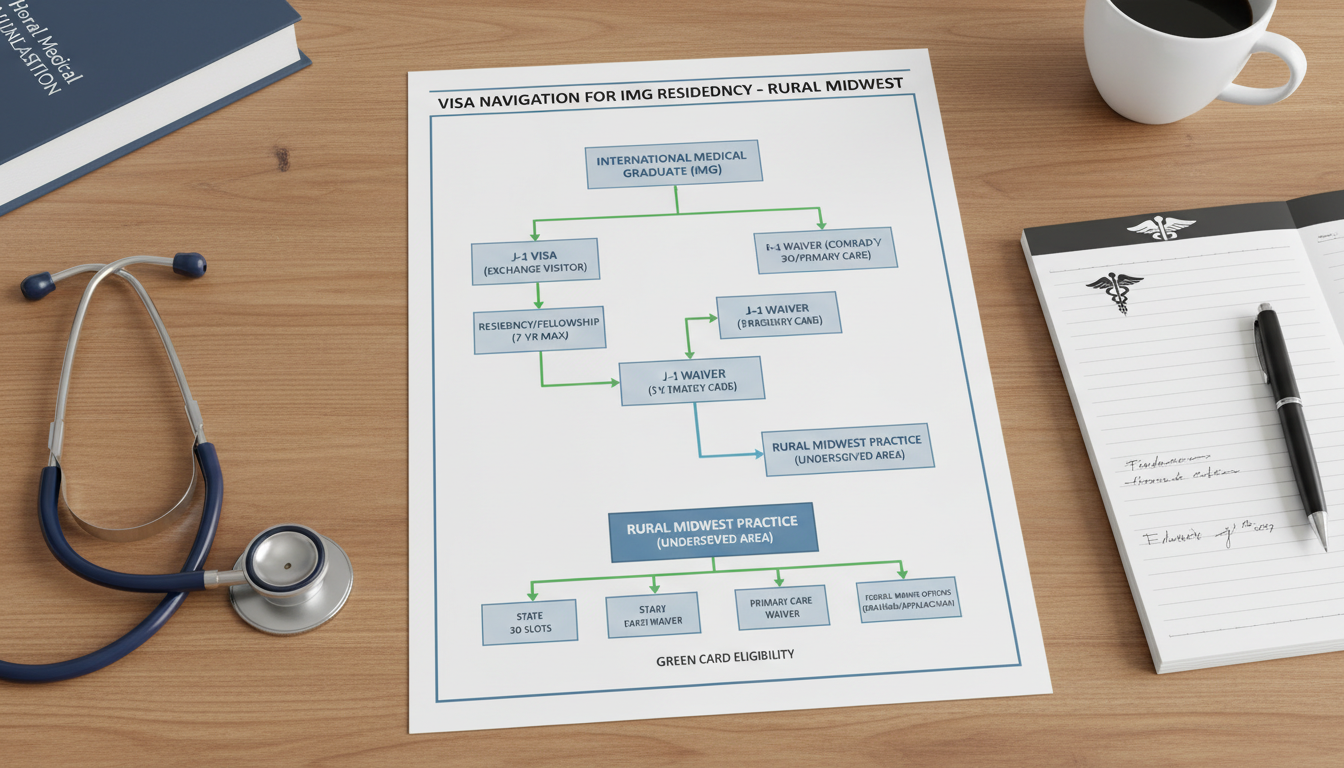
J‑1 vs H‑1B: Strategic Choices for the Rural Midwest
The J‑1 vs H‑1B decision is not just a legal question; it shapes your career path, geography, and timing.
Key Comparison: J‑1 vs H‑1B for an International Medical Graduate
1. Long‑Term Career Flexibility
- J‑1:
- You must either return home for two years or secure a J‑1 waiver job, usually in a Health Professional Shortage Area (HPSA) or Medically Underserved Area (MUA).
- This often means practicing in rural or underserved locations for at least three years after training.
- H‑1B:
- No two‑year home requirement.
- You can seek jobs anywhere an employer will sponsor H‑1B or green card, including urban academic centers.
Implication for rural Midwest:
- If you are open to—or prefer—working in rural Iowa, Nebraska, Kansas, Dakotas, etc., the J‑1 → waiver path aligns well with local workforce needs.
- If your dream is a major coastal academic center immediately after residency, you may aim for an H‑1B, but your residency program choices will be more limited.
2. Availability in Rural Midwest Residency Programs
- J‑1:
- Supported by most IMG‑friendly rural Midwest programs.
- Considered the “default” for many community hospitals.
- H‑1B:
- Less commonly supported in small programs.
- More likely in:
- University‑affiliated programs
- Larger health systems with internal legal counsel
- Certain specialties with critical shortages
3. Timing and Requirements
- J‑1:
- Requires ECFMG sponsorship, proof of contract, adequate insurance, etc.
- Process is fairly standardized and known to most GME offices.
- H‑1B:
- Often requires USMLE Step 3 before filing.
- Must meet prevailing wage and state licensure requirements.
- Legal and filing timeline more complex.
Practical tip: If you think you might be competitive for H‑1B, make sure you attempt Step 3 early enough (ideally by late fall of the application year) so that an H‑1B is at least possible.
Matching Your Personal Goals to Visa Strategy
Ask yourself these four questions early:
Do I see myself practicing in rural or underserved areas for at least several years?
- If yes, J‑1 with a future waiver job in Iowa/Nebraska or similar regions may be ideal.
How risk‑tolerant am I about immigration uncertainty?
- H‑1B can reduce the J‑1 waiver stress later but may be harder to secure initially.
Am I willing to limit my residency applications only to programs that sponsor H‑1B?
- Doing so can drastically shrink your program list, especially in the rural Midwest.
Do I have the academic profile (scores, research, U.S. experience) to be competitive at H‑1B‑sponsoring programs?
- If you’re marginally competitive, a broader J‑1‑friendly list may give you better match odds.
Rural Midwest Realities: Iowa, Nebraska, and Neighboring States
Understanding the local context is crucial. The rural Midwest has distinctive patterns in both residency training and post‑residency employment for IMGs.
Why Rural Midwest Programs Often Prefer J‑1
Many rural hospitals and community‑based residencies in Iowa, Nebraska, and surrounding states:
- Serve smaller populations with limited financial margins.
- Rely heavily on residents and attending physicians to deliver core services.
- Have slim HR and legal departments with limited immigration expertise.
Given this:
- J‑1 is seen as simpler and more predictable.
- It avoids the need to manage complex H‑1B wage and documentation issues.
- Some institutions have system‑level policies: “Residents = J‑1 only, faculty/staff = H‑1B or green card.”
If you search specifically for an “Iowa Nebraska residency” as an IMG, you will notice:
- Family medicine, internal medicine, psychiatry, pediatrics, and some surgery programs may welcome IMGs.
- Many of them explicitly state J‑1 only on their websites.
Post‑Residency: J‑1 Waiver Jobs in the Rural Midwest
If you train on a J‑1 and then look for a waiver job, the rural Midwest becomes extremely relevant.
Common waiver pathways include:
- Conrad 30 State Program: Each state can sponsor up to 30 J‑1 physicians per year for waivers, usually in shortage areas.
- Federal programs (e.g., VA facilities, HHS waivers for primary care, etc.), though these are more specialized.
For Iowa, Nebraska, and neighbors:
- Many states routinely use all or most of their Conrad 30 slots.
- Priority often goes to:
- Primary care (FM, IM, Peds, OB/GYN)
- Psychiatry
- Sometimes general surgery and hospitalist roles
If you train in a rural Midwest residency, you have several advantages when later seeking a J‑1 waiver job:
- You already understand rural practice realities.
- You have regional connections with community hospitals and clinics.
- State health departments may be more inclined to support waivers for physicians already integrated into the area.
Example:
A J‑1 internal medicine resident in a community program in rural Nebraska finishes residency and applies for a hospitalist position in a critical access hospital in Iowa. The hospital and state health department collaborate to file a Conrad 30 waiver, allowing the physician to stay in the U.S. under H‑1B without returning home for two years.

Building a Residency Application Strategy Around Visa Considerations
Visa issues must be woven into every stage of your residency planning—program selection, ERAS documents, and interview conversations.
Step 1: Research Program Visa Policies Systematically
Create a spreadsheet with columns for:
- Program name and ACGME ID
- City and state
- Type (university, community, university‑affiliated)
- Specialty
- IMG percentage (from FREIDA or program site)
- Visa sponsorship:
- J‑1 only
- J‑1 and H‑1B
- No visa sponsorship
- Notes from emails/calls
Use FREIDA, program websites, and email confirmations to fill this in. Pay particular attention to:
- Programs in Iowa, Nebraska, Kansas, the Dakotas, rural Missouri, and similar areas that mention being “IMG‑friendly.”
- Whether they explicitly state “J‑1 only” or list “J‑1 vs H‑1B” options.
Step 2: Define Your Visa Priority
Create tiers based on your preferences:
- Tier 1: Programs that sponsor both J‑1 and H‑1B in the rural Midwest (rare but valuable).
- Tier 2: J‑1‑only programs in regions where you’d be happy to live and work (e.g., Iowa Nebraska residency programs with good teaching and support).
- Tier 3: Programs with unknown policies; consider emailing them early.
Apply broadly, but in a targeted manner, ensuring:
- Enough programs that definitely sponsor your acceptable visa type.
- A geographically diverse list, but with a solid cluster in the rural Midwest if you’re drawn to that lifestyle.
Step 3: Prepare to Answer Visa‑Related Questions in Interviews
Program directors may ask about your visa expectations and long‑term plans. Prepare concise, honest statements, for example:
If open to J‑1 and rural service:
“I am comfortable with a J‑1 visa and, in fact, I’m very interested in eventually practicing in a rural or underserved community in the Midwest. I see the J‑1 and waiver process as compatible with my long‑term goals.”If hoping for H‑1B but flexible:
“I would prefer an H‑1B if possible, especially given my long‑term plans to settle in the U.S. However, I also understand many excellent programs only sponsor J‑1, and I am open to J‑1 if that is what your institution supports.”
Avoid sounding rigid (“H‑1B only or I won’t come”) unless that truly is your bottom line—and you are willing to shrink your match chances accordingly.
Step 4: Align Your ERAS Application With Your Visa Story
While you don’t usually discuss visa plans directly in your personal statement, you can:
- Highlight genuine interest in rural medicine and underserved populations.
- Show commitment to continuity of care and long‑term community relationships.
- Mention experiences in resource‑limited settings or rural rotations (in your home country or elsewhere).
Program directors in the rural Midwest are more likely to invest in your training—and later consider supporting a J‑1 waiver or H‑1B transition—if they believe you actually want to stay and serve similar communities.
Practical Tips and Common Pitfalls in Visa Navigation
Work With Professionals Early
- Consider at least one consultation with a U.S. immigration attorney experienced in physician visas.
- Some issues (prior J‑1 status, home country funding, complex personal immigration history) are high‑stakes and require expert review.
Avoid These Frequent Mistakes
Ignoring visa policies until after interviews.
Result: You end up ranking programs that cannot legally sponsor you.Assuming any program that takes IMGs will give you H‑1B.
Many are strictly J‑1 only.Not taking Step 3 early if H‑1B is a priority.
Missing Step 3 can automatically knock you out of H‑1B consideration at otherwise suitable programs.Underestimating the importance of timing.
Delays in ECFMG certification or DS‑2019 paperwork can jeopardize your ability to start residency on July 1.
Leverage the Rural Midwest Advantage
- Emphasize your willingness to live outside major metropolitan areas.
- Learn about the culture and lifestyle of the rural Midwest:
- Cost of living, weather, community dynamics
- Rural practice benefits (broader scope of practice, closer patient relationships)
- Connect with alumni IMGs who trained or are practicing in Iowa, Nebraska, or neighboring states to understand:
- How they handled J‑1 vs H‑1B
- Their real‑world experience with J‑1 waivers and Conrad 30 processes
FAQs: Visa Navigation for IMGs Targeting Rural Midwest Residency
1. As an IMG, is it realistic to get an H‑1B for a rural Midwest residency?
It is possible but less common than J‑1. Many rural programs in states like Iowa and Nebraska sponsor only J‑1 due to simplicity and institutional policy. H‑1B is more likely at larger or university‑affiliated programs, even if they are located in smaller cities. To keep H‑1B as an option, take Step 3 early, and build a competitive profile. But expect that most rural Midwest offers will be J‑1‑based.
2. If I do residency on a J‑1, can I still stay in the U.S. afterward without going home for two years?
Yes—if you obtain a J‑1 waiver. The most common route is a Conrad 30 waiver through a state health department, which typically requires a 3‑year full‑time job in an underserved area on H‑1B. The rural Midwest has many such opportunities, especially in primary care, psychiatry, and hospital medicine. Planning early with mentors and potential employers can make this transition smoother.
3. Do Iowa and Nebraska have good opportunities for J‑1 waiver jobs after residency?
Generally, yes. Both states (and their neighbors in the rural Midwest) face physician shortages and often use much or all of their Conrad 30 allotment. They prioritize specialties like family medicine, internal medicine, pediatrics, psychiatry, and OB/GYN in rural or small‑town settings. Training in the region can help you build local connections and demonstrate commitment, which can strengthen your waiver applications later.
4. Should I limit my residency applications only to programs that offer H‑1B if I want to avoid the J‑1 waiver requirement?
That depends on your risk tolerance and competitiveness. Restricting yourself to H‑1B‑sponsoring programs—especially in the rural Midwest—can significantly reduce the number of programs you can apply to, potentially lowering your match chances. A more balanced approach for many IMGs is:
- Prioritize H‑1B programs where you are genuinely competitive, and
- Apply broadly to strong J‑1‑friendly programs while staying open to the J‑1 → waiver → rural job pathway.
By understanding your residency visa options, the J‑1 vs H‑1B trade‑offs, and the specific dynamics of rural Midwest institutions, you can craft a realistic, strategic plan that maximizes your chances of both matching and building the long‑term career you envision in the United States.