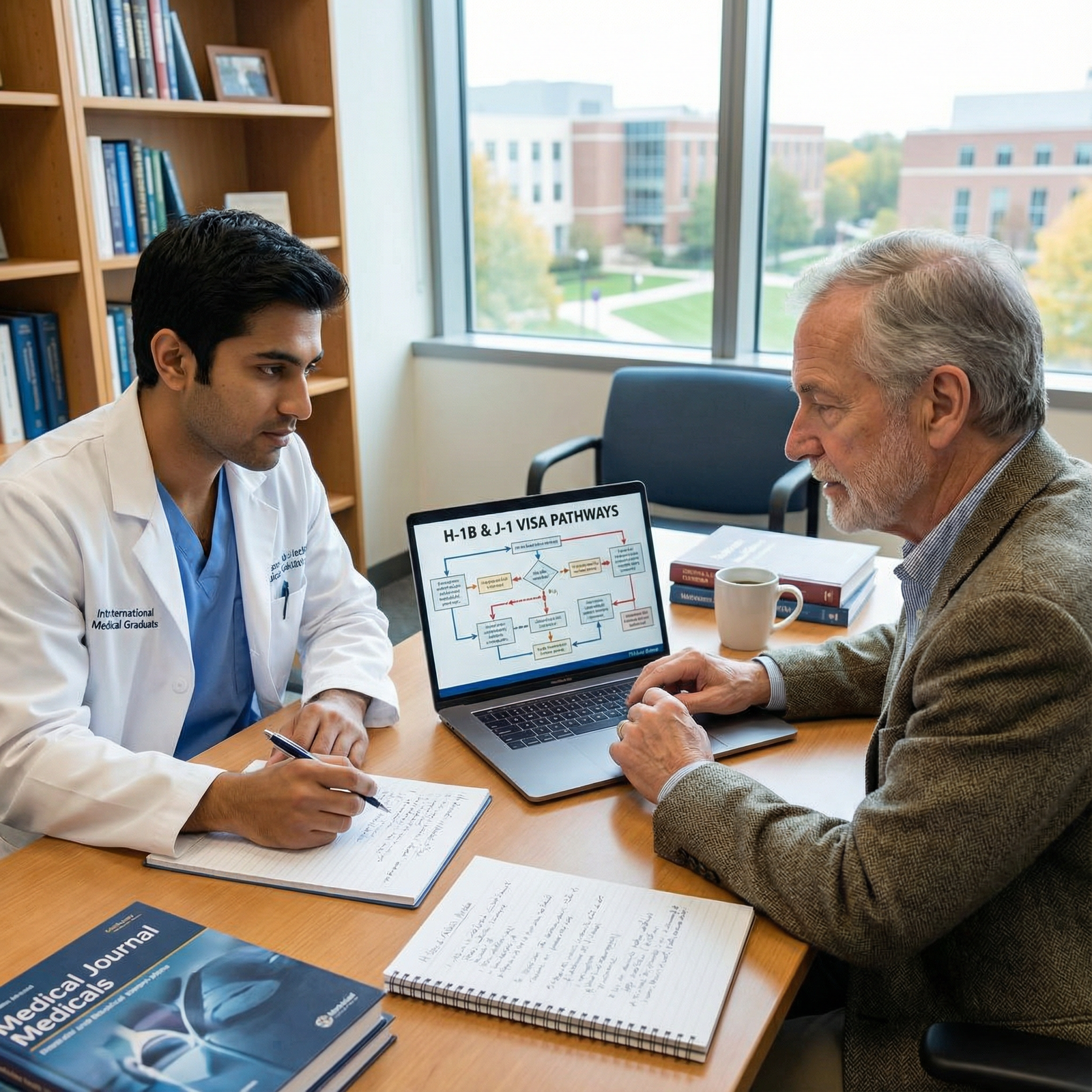
Navigating visas as an international medical graduate (IMG) can feel as complicated as mastering a new clinical specialty—especially when you’re targeting a specific region like the California Central Valley. This IMG residency guide focuses on practical, step-by-step strategies to help you understand IMG visa options, choose between J-1 vs H-1B, and make informed decisions as you apply to Central Valley residency programs, including those in Fresno residency and surrounding communities.
Understanding the U.S. Visa Landscape for IMGs
The vast majority of IMGs in U.S. graduate medical education train on one of two visas:
- J-1 Exchange Visitor Visa (ECFMG-sponsored)
- H-1B Temporary Worker Visa (institution-sponsored)
A small minority may qualify for other pathways (e.g., green card holders or other nonimmigrant categories), but for residency and fellowship, the J-1 vs H-1B decision dominates.
Why This Matters Specifically in the California Central Valley
The California Central Valley (including cities like Fresno, Bakersfield, Modesto, Visalia, Merced, and Stockton) has:
- Large medically underserved and rural populations
- High demand for primary care and certain specialties
- A mix of academic-affiliated and community-based programs
- Strong interest in physicians who may eventually work long-term in the region
For you as an international medical graduate, that means:
- Programs may be open and experienced with IMGs and visa sponsorship.
- There can be excellent opportunities later for J-1 waiver jobs (especially in underserved areas).
- Visa decisions you make now can strongly affect where you work after training in this region.
Core Visa Options: J-1 vs H-1B for IMGs
This section breaks down key features of each option and how they play out for Central Valley–focused applicants.
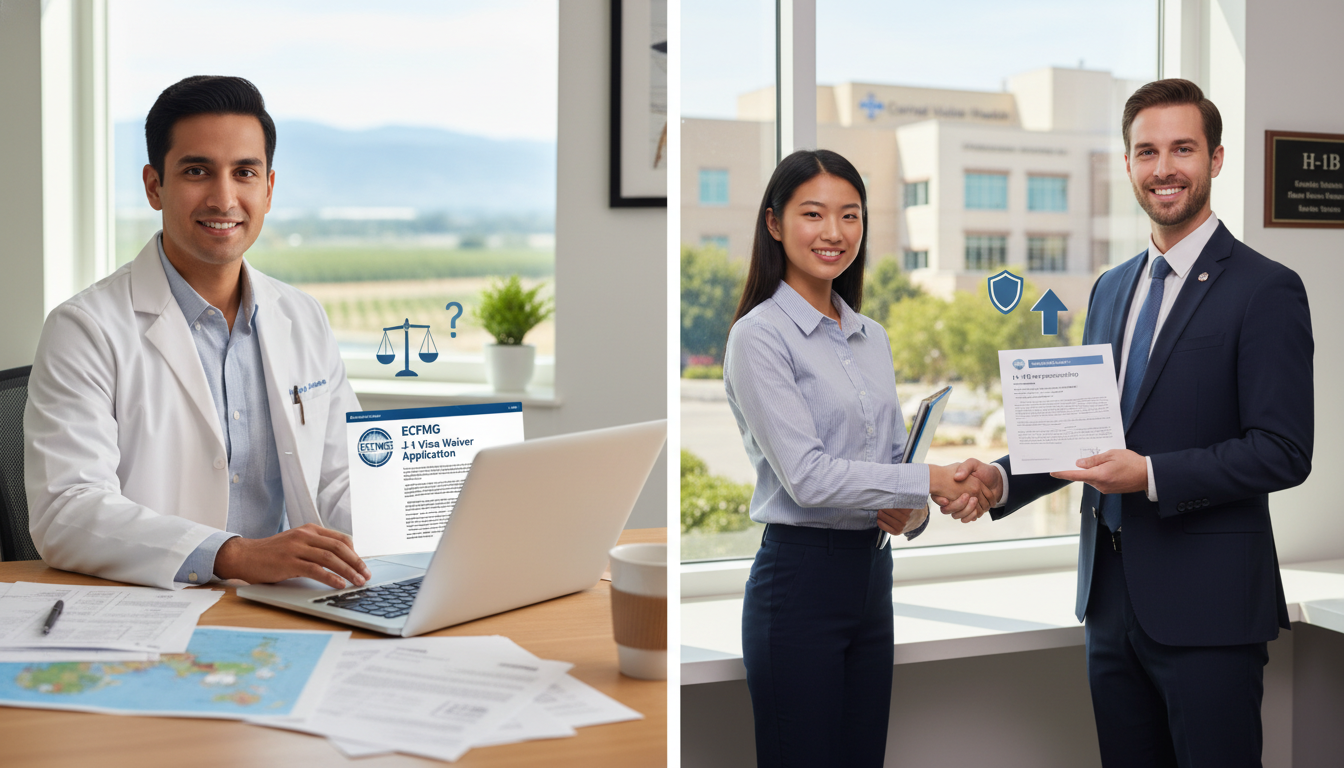
J-1 Visa (ECFMG-Sponsored)
What it is:
A nonimmigrant visa under the Exchange Visitor Program, specific category “Alien Physician.” For residency and fellowship, the sponsor is ECFMG (Educational Commission for Foreign Medical Graduates), not the hospital directly.
Key Features:
Common and widely accepted
- Many Central Valley residency programs, including some Fresno residency programs, are comfortable with J-1 sponsorship.
- Often easier to obtain than H-1B for PGY-1.
Requirements
- Valid ECFMG certification
- USMLE exams completed as required by the state and program (e.g., Step 1 & 2 CK; some require Step 3 but not always for J-1)
- Accepted residency position with a program willing to support your J-1 sponsorship
- Documented financial support (usually via residency contract)
- DS-2019 issued by ECFMG, then U.S. consulate interview (if outside U.S.)
Two-Year Home Country Physical Presence Requirement
- After training, you must:
- Return to your home country for two cumulative years, or
- Obtain a J-1 waiver (e.g., through Conrad 30, federal programs, or hardship/persecution waivers).
- This is extremely relevant for the California Central Valley:
- Many J-1 waiver jobs are in underserved, rural, or semi-rural communities.
- Central Valley locations often qualify for these waiver positions (e.g., primary care, psychiatry, sometimes other specialties).
- After training, you must:
Duration
- Limited to the normal length of training plus a short grace period.
- Extensions are possible when moving from residency to fellowship, with ECFMG approval.
Pros of J-1 for Central Valley–focused IMGs:
- More programs accept J-1 than H-1B for residency, given simpler sponsoring logistics.
- Streamlined through ECFMG, so less paperwork burden on programs.
- Easier to match into residency in competitive regions like California when you are flexible about J-1.
- Good alignment with post-residency J-1 waiver opportunities in the Central Valley (Conrad 30 and similar programs often prioritize underserved areas like this region).
Cons:
- Two-year home return or waiver requirement can delay or complicate long-term U.S. plans.
- More limited ability to moonlight in some states or programs (varies by training stage and policies).
- Some long-term immigration strategies (e.g., green card during training) are more complex compared with H-1B.
H-1B Visa (Specialty Occupation)
What it is:
An employment-based, nonimmigrant visa for specialty occupations (including physicians), sponsored directly by the residency program or institution.
Key Features:
Less commonly available for PGY-1 than J-1, especially in community and smaller programs.
Requires:
- Passing USMLE Step 3 before visa filing (critical timing issue).
- State medical license or eligibility (often at least a training license).
- Employer (residency program) willing and able to sponsor H-1B (including legal and filing fees).
No two-year home residence requirement
- You can transition to employment-based immigration paths (e.g., green card) more directly after training.
- Attractive for IMGs who want flexibility and fewer return-home conditions.
Cap-exempt vs Cap-subject
- Many teaching hospitals and academic-affiliated programs are H-1B cap-exempt, meaning:
- No annual lottery constraint.
- Filing can occur year-round.
- Some community-based programs or affiliates may still be subject to the cap.
- Many teaching hospitals and academic-affiliated programs are H-1B cap-exempt, meaning:
Pros of H-1B for IMGs:
- No J-1 two-year home requirement – easier to stay in the U.S. after training.
- More straightforward transition to employment-based green card.
- Potentially easier to change employers after residency compared with J-1 waiver requirements.
- Some institutions allow more moonlighting options, depending on license and policies.
Cons:
- Fewer programs in the Central Valley sponsor H-1B, especially smaller or budget-limited ones.
- You must have Step 3 passed early enough for visa filing.
- Higher administrative/bureaucratic burden for programs.
- If your program is cap-subject, H-1B timing and lottery can complicate things.
J-1 vs H-1B: How to Decide as a Central Valley-Focused IMG
When selecting programs (including Fresno residency and other Central Valley residencies), consider:
Program Sponsorship Policies
- Check program websites and contact coordinators:
- Do they accept J-1 only?
- Do they accept both J-1 and H-1B?
- Do they not sponsor any visas?
- Academic and larger systems are more likely to consider H-1B, but always confirm.
- Check program websites and contact coordinators:
Your Exam Timeline
- If you have Step 3 passed by application season:
- You may reasonably target both J-1 and H-1B programs.
- If you do not have Step 3, J-1 is effectively the main path for PGY-1.
- If you have Step 3 passed by application season:
Long-Term Plans
- If your priority is:
- Fast U.S. permanent residency (green card)
- Avoiding J-1 waiver obligations
→ H-1B is attractive if programs sponsor it.
- If your priority is:
- Maximizing chances of matching in California, particularly the Central Valley
- You are open to J-1 waiver service later (often in underserved Central Valley communities)
→ J-1 might be more realistic.
- If your priority is:
Family and Personal Considerations
- Spouse’s career plans, children’s schooling, and willingness to relocate later for waiver jobs (often rural/semi-rural) should influence your decision.
How Visa Status Shapes Your Central Valley Training and Career
Your visa choice not only affects whether you can match into a California Central Valley residency, but also where and how you can work after graduation.

During Residency: Practical Differences You’ll Notice
Flexibility and Transfers
- J-1:
- Transfers between programs need ECFMG involvement and documentation.
- Changing specialties or extending training may require additional approvals.
- H-1B:
- Changing institutions may mean filing a new H-1B petition.
- Still possible but legally and logistically more complex.
- J-1:
Moonlighting
- Highly program- and state-specific:
- J-1 physicians are generally more restricted but may be allowed internal moonlighting in some cases.
- H-1B may allow broader moonlighting if properly petitioned and within immigration regulations.
- In the Central Valley, community need can be high; some programs may encourage supervised extra clinical work if permitted.
- Highly program- and state-specific:
Research and Academic Activities
- Both J-1 and H-1B allow participation in research, QI projects, and teaching.
- Larger Central Valley programs (e.g., in Fresno and certain university-affiliated sites) may offer robust research exposure regardless of visa.
Travel
- J-1 and H-1B both allow international travel but:
- You must maintain a valid visa stamp in your passport.
- Reentry can be risky if immigration policies are changing rapidly.
- Always discuss planned travel with your program and immigration counsel.
- J-1 and H-1B both allow international travel but:
After Residency: J-1 Waivers and Employment in the Central Valley
For J-1 physicians, the typical pathway to stay in the U.S. after training is:
- Obtain a J-1 waiver job, usually in an underserved area, for 3 years full-time, then
- Transition to an H-1B and possibly to a green card.
In the California Central Valley, this can work in your favor:
- Many clinics and hospitals qualify for Conrad 30 waivers or other federal waiver programs (e.g., Appalachian, Delta, or rural programs—though California-specific options and requirements apply).
- High demand in:
- Family medicine
- Internal medicine (especially outpatient)
- Pediatrics
- Psychiatry
- Some subspecialties (depending on local shortages)
Example Scenario:
- You complete an Internal Medicine Fresno residency on a J-1 visa.
- You match into a hospitalist job in Visalia or Bakersfield, which is in a medically underserved area.
- The employer sponsors your Conrad 30 J-1 waiver:
- You commit to 3 years of full-time practice there.
- You switch to H-1B during this employment.
- During your waiver service, they begin a green card process (PERM, I-140, etc.).
- After fulfilling the three-year obligation, you may choose to:
- Continue in the same area, or
- Move to another employer in California or elsewhere (subject to H-1B/green card stage).
After Residency: H-1B Holders in the Central Valley
If you completed residency on an H-1B:
- You do not need a J-1 waiver.
- Your next employer (Central Valley hospital or clinic) must:
- File an H-1B petition for you (cap-exempt or cap-subject, depending on the employer).
- Or sponsor you directly for a green card while extending H-1B as needed.
Potential advantages in the Central Valley:
- Some large systems (especially university-affiliated hospitals or major health systems) may be H-1B cap-exempt, making transitions smoother.
- Your ability to pick non-underserved areas may be a bit greater than if you required a J-1 waiver. That said, many positions in the Central Valley are in underserved designations anyway.
Strategizing Your Residency Applications as an IMG in the Central Valley
Understanding IMG visa options is only half the battle. You must integrate this knowledge into a smart application strategy.
Step 1: Research Program Visa Policies Thoroughly
For each target program in the Central Valley (Fresno, Bakersfield, Stockton, Modesto, Merced, Visalia, etc.):
Check their website:
- Look for “IMG information,” “Visa sponsorship,” or “Eligibility” pages.
- Clarify if they sponsor J-1, H-1B, or both.
E-mail or call the program coordinator if unclear:
- Ask politely and specifically:
- “Do you sponsor J-1 visas through ECFMG?”
- “Do you sponsor H-1B visas for residents? If so, are there additional requirements such as Step 3?”
- Ask politely and specifically:
Create a spreadsheet:
- Program name, city, specialty
- Visa types accepted
- Special notes (e.g., “H-1B only for upper years,” “J-1 only,” “H-1B possible if Step 3 passed by rank list deadline”).
Step 2: Align Your Exams with Your Visa Goals
If you are open to J-1 residency:
- Focus on USMLE Steps 1 and 2 CK with high scores to maximize match chances.
- Step 3 may be completed later if needed for fellowship or other reasons.
If you strongly want H-1B residency:
- Aim to complete Step 3:
- Ideally before application season or, at the latest, before rank list deadlines.
- Start planning Step 3 logistics early:
- Eligibility by state
- Testing windows and scheduling limitations
- Aim to complete Step 3:
Step 3: Tailor Your Personal Statement for the Central Valley
Programs in the Central Valley care about:
- Commitment to underserved populations
- Cultural and linguistic competence (e.g., Spanish, Punjabi, Hmong, etc.)
- Long-term interest in staying in the region
When you write your personal statement:
Highlight:
- Experiences serving disadvantaged or rural populations.
- Any connection to California or agriculture-based communities, if applicable.
- Interest in working in Central Valley residency settings long-term.
If you’re choosing J-1:
- You don’t need to overemphasize visa issues in your statement, but you can reflect a sincere commitment to serving underserved communities, which aligns with future J-1 waiver paths.
If you’re targeting H-1B:
- Focus on your strengths and fit rather than visa demands.
- Visa discussions can happen later in interviews or communications, not as the headline of your application.
Step 4: Prepare for Interviews: Visa Questions and Framing
During residency interviews in the Central Valley:
Be ready to answer:
- “What is your current immigration status?”
- “Will you require visa sponsorship?”
- “Do you have USMLE Step 3 completed?” (for H-1B consideration)
How to frame:
Be honest, concise, and confident.
Example (for a J-1-accepting program):
“I’m an international medical graduate and will require J-1 sponsorship through ECFMG. I’ve already obtained my ECFMG certification and understand the requirements. I’m committed to serving underserved communities and see myself working long-term in regions like the Central Valley.”Example (for a program that sometimes offers H-1B):
“I’m an IMG who will need visa sponsorship. I’ve already passed Step 3 and would be eligible for H-1B if your program supports that route, but I understand many programs prefer J-1 and I’m open to that as well.”
Practical Immigration Tips and Common Pitfalls for IMGs
Work with Qualified Advisors
- Use:
- Your residency program’s GME office and institutional immigration attorneys.
- ECFMG resources (for J-1).
- Avoid relying solely on:
- Social media groups
- Anecdotes from friends
- Immigration rules change; always seek up-to-date, professional guidance.
Keep Meticulous Documentation
Prepare and maintain:
- Valid passport (well before expiration).
- Original and copies of:
- Medical diploma, transcripts
- ECFMG certificate
- USMLE score reports
- Previous immigration documents (F-1, B-1/B-2, DS-2019s, I-20s, I-94s, etc.).
Programs and immigration attorneys often need these quickly to file your residency visa paperwork.
Plan for Timelines and Delays
Potential bottlenecks:
- Scheduling Step 3 (for H-1B applicants).
- DS-2019 processing (J-1).
- Consular interviews and appointment backlogs in some countries.
- Administrative processing (security checks) at consulates.
To minimize risk:
- Accept your offer early and respond quickly to document requests.
- Notify your program if your visa appointment is delayed.
- Avoid last-minute travel or passport renewals.
Protect Your Future Options
- Avoid unauthorized work or status violations.
- Always maintain legal status while in the U.S.
- If considering switching from one visa type to another (e.g., F-1 to J-1, J-1 to H-1B), consult an immigration attorney before acting.
FAQs: Visa Navigation for IMGs in the California Central Valley
1. Do most Central Valley residency programs accept J-1 or H-1B visas?
Many Central Valley programs, including those in cities like Fresno and Bakersfield, accept and are experienced with J-1 visas through ECFMG. H-1B sponsorship is available at some programs—often larger or university-affiliated—but is generally less common. Always confirm each program’s policy directly before you apply.
2. If I train in the Central Valley on a J-1, can I stay in California after residency?
Yes. Many IMGs who complete residency in the Central Valley remain in California by obtaining a J-1 waiver job in an underserved area (often still in or near the Central Valley). After completing the three-year waiver commitment, they frequently transition to long-term positions and pursue green cards. Planning ahead with your program and potential employers is essential.
3. Is it worth taking Step 3 before applying for Central Valley residency programs?
If you want to maximize eligibility for H-1B positions, yes—having Step 3 passed significantly improves your chances at programs that sponsor H-1B. However, if your primary goal is to match anywhere in the Central Valley and you are comfortable with J-1, Step 3 is not always required for PGY-1, and focusing on strong Step 1 and Step 2 CK scores plus U.S. clinical experience may be a better short-term priority.
4. Can I switch from a J-1 to an H-1B during or after residency in the Central Valley?
You typically cannot bypass the J-1 two-year home requirement simply by switching to H-1B. To move from J-1 status to H-1B without returning home for two years, you must first obtain a J-1 waiver (e.g., Conrad 30) and then change to H-1B with your waiver employer. Many Central Valley employers are familiar with this pathway, but you should discuss it with immigration counsel early, ideally during your final year of residency.
By understanding the IMG visa options, particularly J-1 vs H-1B, and how they interact with the realities of Central Valley residency programs and healthcare needs, you can make deliberate, informed decisions. Early planning, clear communication with programs, and professional immigration guidance are your best tools to successfully navigate the residency visa process and build a long-term career in the California Central Valley.