
Understanding the Visa Landscape for IMGs in Community Hospital Residency Programs
For an international medical graduate (IMG), matching into a U.S. residency is only half the journey. The other half—often more stressful—is navigating the visa process. This is especially true in community hospital residency and community-based residency programs, which may have different resources, policies, and levels of experience with international trainees compared to large university centers.
This IMG residency guide focuses on visa navigation for residency specifically in community programs: what options exist, how programs think about visas, and what you can do—step by step—to improve your chances and avoid costly mistakes.
We will use “IMG” to mean any graduate of a medical school outside the U.S. or Canada, regardless of citizenship.
Common Visa Categories for Residency: Core Concepts
Before focusing on community hospitals, it’s essential to understand the basic IMG visa options for residency training. For most IMGs, the realistic visa categories are:
- J‑1 Alien Physician Visa
- H‑1B Temporary Worker Visa
- Less commonly: O‑1 Extraordinary Ability or other pathways
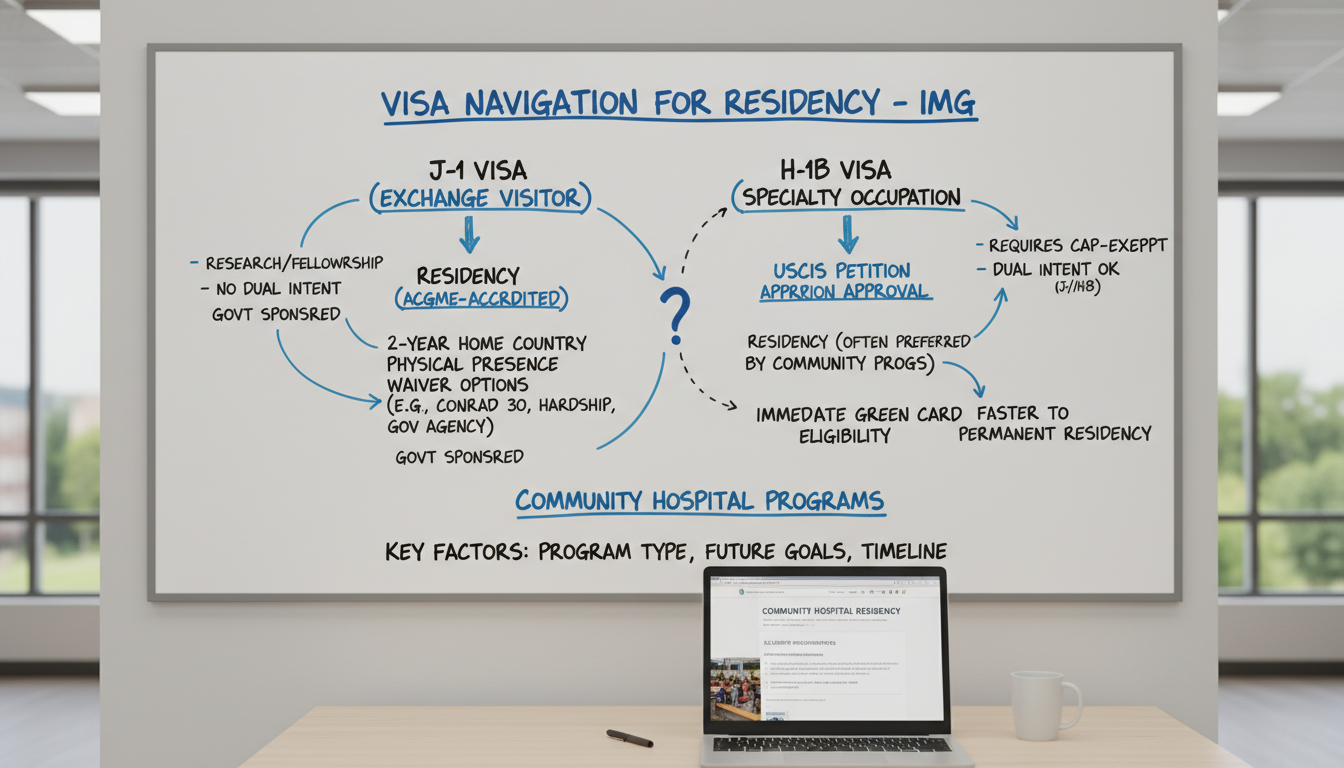
1. The J‑1 Visa for Physicians
The J‑1 visa (sponsored by the Educational Commission for Foreign Medical Graduates – ECFMG) is the most common visa for residency and fellowship.
Key features:
- Purpose: Graduate medical education (residency/fellowship) under ECFMG sponsorship
- Maximum duration: Typically up to 7 years (covers most residency + subspecialty training paths)
- Full-time clinical training required in ACGME-accredited programs
- Two-year home-country physical presence requirement after completion of training (the “J‑1 home return rule”) unless a waiver is obtained
- No dual intent: J‑1 is technically a non-immigrant, non-dual-intent visa; immigration intent can complicate future steps
What this means for IMGs:
- You can do residency and usually one or more fellowships on J‑1.
- When training ends, you are expected to:
- Return to your home country for two cumulative years, or
- Obtain a J‑1 waiver (e.g., via underserved-area service like Conrad 30), then change status to another visa (typically H‑1B).
For many community hospital residency programs, J‑1 is the simplest and most familiar route: the program does not file the visa; ECFMG does. This lower administrative burden is why many community programs are “J‑1 only.”
2. The H‑1B Visa for Residency
The H‑1B is a work visa for “specialty occupations” that require at least a bachelor’s degree, but here it’s used for physicians in graduate training.
Key features:
- Employer-sponsored: The residency program is the petitioner.
- Dual intent allowed: You can pursue immigrant (green card) processes while on H‑1B.
- Duration: Up to 6 years (initial petition usually 3 years, then extension).
- USMLE requirements: Must have passed all USMLE Steps (including Step 3) before the H‑1B petition. Some states and institutions enforce this strictly.
- Prevailing wage rules: Program must pay at least the Department of Labor “prevailing wage” for your position.
- Cap-exempt status: Most hospitals (especially teaching hospitals) are cap-exempt, meaning they can file H‑1B any time of year without the lottery.
Drawbacks:
- More expensive and administratively complex for the program.
- Some community hospitals lack an internal legal team and are reluctant to manage H‑1B petitions.
- H‑1B time used in residency counts toward your 6-year total, which may limit time available for future jobs before green card processing.
In the J‑1 vs H‑1B debate, your priorities, long-term immigration plans, and the policies of community programs you apply to will be critical.
3. Other Pathways (O‑1, Green Card, etc.)
Other options are less common for residency but worth brief mention:
- O‑1 (Extraordinary Ability): Rarely used for residents. Requires substantial evidence of high-level achievements (major awards, significant publications, etc.). Most IMGs entering residency do not qualify.
- Permanent Resident / Green Card Holders: If you already have a green card, you do not need a residency visa. Programs treat you like a U.S. graduate for visa purposes.
- Other visas (E‑2, L‑2, H‑4, etc.): Occasionally, IMGs are already in the U.S. on dependent or other statuses. Transition paths are complex; you’ll need both immigration and program guidance.
Visa Sponsorship in Community Hospital Programs: What Makes Them Different?
Community hospital residency and community-based residency programs differ from large academic centers in how they handle IMGs and visas. Understanding these differences will help you target programs strategically.
1. Fewer Resources, More Caution
Many community programs:
- Do not have in-house immigration attorneys.
- Rely on the hospital’s external legal counsel (which is expensive and slow).
- May have limited staff experienced with IMG visa issues.
As a result, they often adopt simplified policies, such as:
- “We sponsor J‑1 only”
- “We do not sponsor any visas”
- “We sponsor H‑1B only for exceptional candidates or for specific specialties”
This doesn’t mean they are “anti-IMG,” but rather that their capacity to handle complex cases is limited.
2. Policy vs. Practice
Residency program websites often give brief, sometimes outdated statements. For example:
- “We accept J‑1 visas” (but do they actually sponsor every year?)
- “We will consider H‑1B visas” (for how many positions? under what conditions?)
- “We do not sponsor visas” (does this include all non-citizens, including green card applicants, or just those requiring a new visa?)
For community programs, there can be a gap between official written policy and what they might be willing to do for a highly motivated candidate, especially in hard-to-fill specialties or rural locations.
3. Types of Community Programs and Their Attitudes
Not all community hospitals are the same. Broadly:
- Community-based, university-affiliated programs
- Often have more experience with IMG visa options.
- May be more willing to sponsor H‑1B, especially if they share resources with the academic partner.
- Community hospitals with small GME departments
- May limit visa types to J‑1 or exclude visas entirely.
- More likely to have strict, simple rules to protect administrative capacity.
- Rural or underserved-area hospitals
- Often more IMG-friendly in terms of openness to J‑1, because they understand the physician shortage.
- May later become strong sites for J‑1 waiver positions after completion of training.
4. Why Many Community Programs Prefer J‑1
From a program’s perspective, J‑1 is:
- Easier administratively (ECFMG handles much of the paperwork).
- Time-limited (resident leaves after training unless they switch visa), preventing “permanent employment” complexity.
- Well-understood by GME offices.
However, from an IMG’s perspective, J‑1 introduces the home-country return rule and the need for a J‑1 waiver later. Therefore, your personal preferences may differ from the program’s convenience.
J‑1 vs H‑1B in Community Programs: Choosing Your Best Path
The J‑1 vs H‑1B decision is both a legal and strategic choice. You must align:
- Your long-term immigration goals
- Your specialty choice
- The policies and realities of community hospital residency programs
1. When J‑1 May Be the Better Fit
You might prioritize a J‑1 visa if:
- You are flexible about returning to your home country for a couple of years after training, or
- You are open to working in underserved/rural areas to obtain a J‑1 waiver and later transition to H‑1B, or
- Your specialty is highly competitive and most programs you like are J‑1 only, or
- You have not yet passed Step 3 and don’t expect to do so before Match.
Advantages of J‑1 for IMGs in community programs:
- Larger pool of community programs willing to sponsor.
- More predictable process: ECFMG is experienced; many GME offices know the process well.
- Flexibility to change programs/fellowships more easily within the J‑1 structure (subject to approvals).
Important considerations:
- You will have the two-year home-country requirement, which you must satisfy or waive.
- J‑1 waivers typically involve service in underserved areas, which may or may not align with your personal and family plans.
2. When H‑1B May Be the Better Fit
You might prioritize an H‑1B visa if:
- You have a strong desire to pursue long-term U.S. immigration,
- You want to avoid the J‑1 home return rule,
- You have already passed USMLE Step 3,
- You are entering a specialty where H‑1B is more commonly supported (e.g., Internal Medicine, Psychiatry, some Surgery programs with IMG experience), and
- You can find community-based residency programs that explicitly sponsor H‑1B.
Advantages of H‑1B:
- Dual intent enables parallel green card processes later.
- No mandatory home-country return requirement related to the visa.
- Easier to transition directly from residency to a hospital or practice job under H‑1B in the same specialty.
Limitations in community programs:
- Some community hospitals do not sponsor H‑1B at all.
- Those that do may limit the number of H‑1B slots, prioritizing higher-need specialties or longer-term hires.
- Programs may require Step 3 before ranking you, adding pressure to complete exams early.
Practical scenario:
- An IMG targeting Internal Medicine in a mid-sized city:
- If the community hospital program says “J‑1 only,” you must accept J‑1 if you match there.
- If another similar program says “H‑1B considered,” you could prioritize that program, especially if your long-term plan is U.S. permanent residence.
3. Mixed Strategies: J‑1 in Residency, H‑1B After
A realistic long-term strategy for many IMGs is:
- Obtain residency on J‑1 (easier entry into community hospital programs).
- Complete residency and possibly fellowship on J‑1.
- Obtain a J‑1 waiver job (often at a community or rural/underserved hospital or clinic).
- Transition from J‑1 to H‑1B at that waiver job.
- Utilize H‑1B status while applying for a green card (e.g., through employer-sponsored PERM or physician national interest waiver).
This route leverages the relative accessibility of J‑1 in community programs while still leading to long-term U.S. practice.

Step-by-Step: How IMGs Should Approach Visa Strategy in Community Programs
This section converts theory into a practical plan you can follow during your residency application and match process.
Step 1: Clarify Your Immigration and Career Goals
Before looking at programs, define:
- Do you aim for long-term U.S. residence and practice?
- Are you willing to work in rural/underserved areas temporarily to secure immigration benefits?
- Are you open to potentially returning to your home country for two years if needed?
- What specialties interest you, and how competitive are they for IMGs?
Write down your preferences. This will help you decide your stance on J‑1 vs H‑1B.
Step 2: Understand Your Eligibility
Your current status and exam progress shape your IMG visa options:
- Have you passed USMLE Step 1, Step 2 CK, and OET/ECS (or current ECFMG requirements)?
- Have you passed Step 3, or can you realistically do so before ranking deadlines?
- Are you currently in the U.S. on another status (e.g., F‑1, H‑4) that might affect timelines?
If you have not passed Step 3 and are early in the application cycle, you should assume:
- H‑1B for PGY‑1 is unlikely, especially in community hospitals that tend to be conservative about visa compliance.
- Your initial visa pathway will very likely be J‑1.
Step 3: Research Programs’ Visa Policies in Detail
For each program you’re interested in:
- Check the program’s official website under “International Medical Graduates,” “Eligibility,” or “FAQ”:
- Look for specific statements like “We sponsor J‑1 visas,” “We do not support H‑1B,” or “We can support both J‑1 and H‑1B.”
- Review FREIDA or other databases:
- These often indicate which visa types are accepted (J‑1, H‑1B, none).
- Verify with direct communication:
- If the website is unclear, email the program coordinator or office, e.g.:
Dear [Coordinator Name],
I am an international medical graduate interested in applying to your [Specialty] residency. Could you please clarify which types of visas your program sponsors for residents (e.g., J‑1, H‑1B), and whether there are any restrictions or preferences regarding these options?
Thank you for your time,
[Your Name]
Keep a spreadsheet where you record for each program:
- J‑1: Yes/No
- H‑1B: Yes/No/Case-by-case
- Any additional comments (e.g., “H‑1B only after PGY‑2,” “H‑1B for exceptional candidates,” etc.)
Step 4: Categorize Programs and Adjust Your Application Strategy
Based on your research, group programs into:
- J‑1 only
- J‑1 and H‑1B
- No visa sponsorship
For community hospital residency programs:
- Expect more “J‑1 only” categories.
- A smaller subset will allow H‑1B; these are key targets if H‑1B is important to you.
- Many “no visa” programs may be effectively closed to non-green-card IMGs.
If your exam profile and timeline make H‑1B unrealistic (no Step 3 yet), you may:
- Apply broadly to J‑1 friendly community programs, prioritizing those with strong IMG histories.
- Still include some J‑1 + H‑1B programs so you can potentially negotiate later, especially for fellowship or extended training.
Step 5: Communicate Clearly in Interviews
When you obtain interviews:
- Be honest and concise about your visa needs:
- “I will require visa sponsorship for residency. I am eligible for J‑1, and I have/will have completed Step 3 by [date], so H‑1B is also an option depending on your program’s policy.”
- Show that you understand the program’s constraints:
- “I know that many community-based residency programs prefer the J‑1 route. I appreciate that and am happy to work within your policies.”
- Ask clarifying questions respectfully:
- “Does your program ever sponsor H‑1B visas for residents, or is J‑1 your exclusive pathway?”
Avoid sounding demanding (e.g., “I must have H‑1B or I won’t rank you”). Instead, express preferences while showing flexibility.
Step 6: Rank List Strategy in the Match
When forming your rank list:
- If your top priority is matching in the U.S., you might rank J‑1-only community programs highly, even if you would prefer H‑1B in an ideal world.
- If your top priority is long-term immigration on H‑1B, you might:
- Rank H‑1B-sponsoring programs higher, even if they are somewhat less prestigious or in less desirable locations.
- Consider how many such programs you realistically have and your competitiveness.
Remember: not matching at all is generally worse than matching on J‑1 and then seeking a waiver route later.
After the Match: Practical Visa Steps in Community Programs
Matching is a huge milestone, but your residency visa process begins in earnest after Match Day.
For J‑1 Visa Holders
- ECFMG Sponsorship Application
- Your program will issue a contract/offer letter.
- You submit Form DS‑3035 and other required documents to ECFMG for sponsorship.
- DS‑2019 Issuance
- Once ECFMG approves your sponsorship, they issue Form DS‑2019, the J‑1 document you need for a visa interview.
- Visa Interview at U.S. Embassy/Consulate
- You schedule an interview in your home country (unless you are changing status from within the U.S.).
- Be prepared with:
- ECFMG sponsorship documents
- Residency contract
- Financial evidence (usually the program’s salary is sufficient)
- Home-country ties (to satisfy non-immigrant intent)
- Arrival and Onboarding
- Follow SEVIS registration instructions carefully.
- Attend orientation; ensure your I‑94 and DS‑2019 details are correct.
For H‑1B Visa Holders
- Institutional Approval
- The GME office checks whether the hospital will sponsor H‑1B for residents.
- Some community hospitals may require special approvals (e.g., from HR, legal).
- Labor Condition Application (LCA)
- The program (or hospital HR) files an LCA with the Department of Labor.
- This certifies the wage level and working conditions.
- H‑1B Petition (Form I‑129)
- Filed by the employer to USCIS.
- Requires evidence of:
- Your medical degree and ECFMG certification
- USMLE scores (including Step 3)
- Program details, duration, salary
- Processing times can range from weeks (premium processing) to months.
- Visa Stamping and Entry
- If outside the U.S., you attend a consular interview once the petition is approved.
- If within the U.S., you may change status without leaving (case-by-case).
Timing is critical:
Residency starts on July 1; your H‑1B must be approved in time. Community hospitals are often risk-averse and may refuse late or complicated H‑1B cases, pushing you towards J‑1 if possible.
Frequently Asked Questions (FAQ)
1. Are community hospital residency programs less likely to sponsor H‑1B compared to university hospitals?
In general, yes. Community hospitals often have:
- Fewer internal legal resources
- Less historical experience with H‑1B for residents
- Tighter budgets for immigration costs
Therefore, many community programs adopt a J‑1-only policy. University-based centers are more likely to offer H‑1B options, especially in research-heavy departments. However, some large or university-affiliated community programs do provide H‑1B, so researching each program individually is essential.
2. Can I switch from J‑1 to H‑1B during residency at the same program?
It is possible but not common. Constraints include:
- J‑1 home-country requirement: You are still subject to it even if you change to H‑1B, unless you obtain a waiver.
- Program policies: Many community programs prefer not to change your visa type mid-training because it adds complexity and cost.
Most switches from J‑1 to H‑1B occur after completing residency or fellowship, often linked to a J‑1 waiver job.
3. Do I need to have passed USMLE Step 3 to get a J‑1 visa?
No. Step 3 is not required for J‑1 sponsorship by ECFMG. You need to meet standard ECFMG certification requirements (which currently do not include Step 3). Step 3 is primarily a requirement for H‑1B eligibility in most states and institutions.
4. Is a J‑1 visa a bad choice if I want to stay in the U.S. long term?
Not necessarily. Many physicians have successfully followed this path:
- Residency and fellowship on J‑1
- J‑1 waiver job in an underserved or rural community (often a community hospital or clinic)
- Switch to H‑1B and then pursue a green card
This route can be very effective, especially for IMGs who are open to working in high-need areas for several years. The key is to plan early and understand your obligations and timelines.
Navigating residency visa options as an international medical graduate in community hospital residency programs requires strategy, flexibility, and proactive communication. By understanding J‑1 vs H‑1B, researching each program’s policies, and aligning your choices with your long-term goals, you can build a realistic, successful pathway into U.S. training and eventual practice.