
Understanding the Visa Landscape for EM-IM Residency as an IMG
Emergency Medicine–Internal Medicine (EM-IM) combined residency is a uniquely demanding and rewarding path. For an international medical graduate (IMG), it comes with an additional layer of complexity: navigating residency visa options in a way that supports a 5-year combined training program, potential fellowship plans, and long-term career goals in the United States.
This IMG residency guide focuses on visa navigation for EM-IM combined programs, explaining:
- Which visas IMGs commonly use (J-1 vs H-1B)
- How those choices affect EM-IM training and beyond
- Timelines and documentation you must prepare
- Common pitfalls and how to avoid them
- Practical strategies to align your immigration path with your career plans in emergency medicine internal medicine
Throughout, the emphasis is on actionable advice tailored to EM-IM applicants rather than general theory.
Core Visa Options for EM-IM IMGs: J-1 vs H-1B
When people talk about “IMG visa options” for US residency, they are usually referring to two main categories:
- J-1 Exchange Visitor (ECFMG-sponsored)
- H-1B Temporary Worker (institution-sponsored)
Other visa types exist (e.g., O-1, green card holders, dependents), but for most EM-IM applicants, the central decision is J-1 vs H-1B.
1. J-1 Exchange Visitor Visa (ECFMG-Sponsored)
What it is
The J-1 is a training visa specifically structured for graduate medical education and fellowships. For most IMGs, it is administered through ECFMG (Educational Commission for Foreign Medical Graduates).
Key features for EM-IM:
- Duration: Typically granted in 1-year increments, renewable up to 7 years total for residency/fellowship.
- Sufficient for EM-IM: A 5-year combined EM-IM residency fits comfortably within the 7-year limit, even allowing many residents to pursue one additional fellowship afterward.
- 2-year home-country requirement (212(e)):
- After finishing training, most J-1 physicians must return to their home country for 2 years OR
- Obtain a J-1 waiver before they can switch to H-1B or permanent residence (green card) inside the US.
Pros for EM-IM IMGs
- Widely accepted: Most EM-IM programs that sponsor visas will support J-1 sponsorship through ECFMG.
- Predictable structure: The rules, forms, and processes are standardized and well-known to GME offices.
- Straightforward qualifications:
- ECFMG certification
- Valid USMLE scores (no minimum mandated by ECFMG, but required by programs)
- Contract with an ACGME-accredited program
Challenges and limitations
- Home residency requirement: Can limit short-term flexibility after training:
- You cannot easily change to H-1B inside the US without a waiver.
- Direct transition to many non-undeserved urban jobs can be difficult.
- J-1 waiver job constraints:
- To stay in the US, many J-1 physicians must work in designated underserved areas (often rural or inner-city) under Conrad 30 or another waiver program.
- Some EM-IM graduates may find this aligns with their interest in community or rural EM/IM; others may feel constrained.
- Dependents: Your spouse and children usually receive J-2 status; they can study, and in many cases spouses can apply for work authorization (EAD), but processing times vary.
Fit for EM-IM
For most EM-IM applicants, J-1 is the default visa route. If your primary goal is to complete training and then work clinically in the US (especially in underserved areas), J-1 followed by a waiver job can be a workable path.
2. H-1B Temporary Worker Visa (Cap-Exempt for Residency)
What it is
The H-1B is an employment-based visa. For residency, it is typically cap-exempt because teaching hospitals are usually non-profit or academic institutions.
Key features for EM-IM:
- Dual intent: Unlike J-1, H-1B allows the intention to immigrate (pursue a green card) while on the visa, which can be an advantage for long-term planning.
- Duration: Initial grant commonly 3 years, extendable to 6 years total (sometimes beyond with green card processes underway).
Pros for EM-IM IMGs
- No 2-year home-country requirement: After residency, you are free to:
- Move into another H-1B position (clinical or academic)
- Use an employer-sponsored green card path
- Change employers more flexibly (still requiring H-1B transfer petitions)
- Better alignment with long-term US practice: If your aim is to settle in the US and avoid a waiver job, H-1B may provide a cleaner route.
Challenges and limitations
Not all programs sponsor H-1B: Many EM-IM combined residency programs:
- Only offer J-1 sponsorship; or
- Rarely sponsor H-1B because of cost, complexity, and institutional policy.
USMLE Step 3 often required:
- Many hospitals or state licensing boards require passing USMLE Step 3 before they will file H-1B petitions.
- For EM-IM applicants, this means Step 3 should ideally be completed before ranking programs or very early in the interview season if you’re targeting H-1B.
Timing and processing:
- H-1B requires a detailed petition to USCIS, which takes time and legal resources.
- Premium processing (for additional fees) is often used to guarantee faster decisions, but it is not mandatory.
6-year limit vs. 5-year EM-IM:
- A 5-year EM-IM residency fits within the standard 6-year H-1B window.
- If you plan additional fellowship(s) afterward, the 6-year cap becomes more of a concern unless green card steps are underway.
Fit for EM-IM
H-1B is particularly appealing if you:
- Are strongly committed to long-term practice and residence in the US
- Can pass Step 3 early and have strong scores and applications
- Apply to EM-IM programs that explicitly accept and sponsor H-1B
However, availability is more limited than J-1. Many EM-IM applicants start with a J-1 strategy as the realistic default and will choose H-1B only where programs clearly support it.
3. Other Less-Common Visa Situations
Some EM-IM applicants avoid the J-1 vs H-1B dilemma entirely:
Green card holders (permanent residents):
- Treated much like US medical graduates for visa purposes.
- No sponsorship needed; can apply broadly without visa restriction.
US citizens (naturalized or by birth abroad):
- No visa limitation; still need ECFMG certification and USMLE scores.
Dependents of other visas (e.g., H-4, L-2):
- Some may continue on their derivative status.
- Many programs still prefer to transition you to J-1 or H-1B for clarity.
These cases are more individualized; if this applies to you, work closely with your program and/or an immigration attorney.
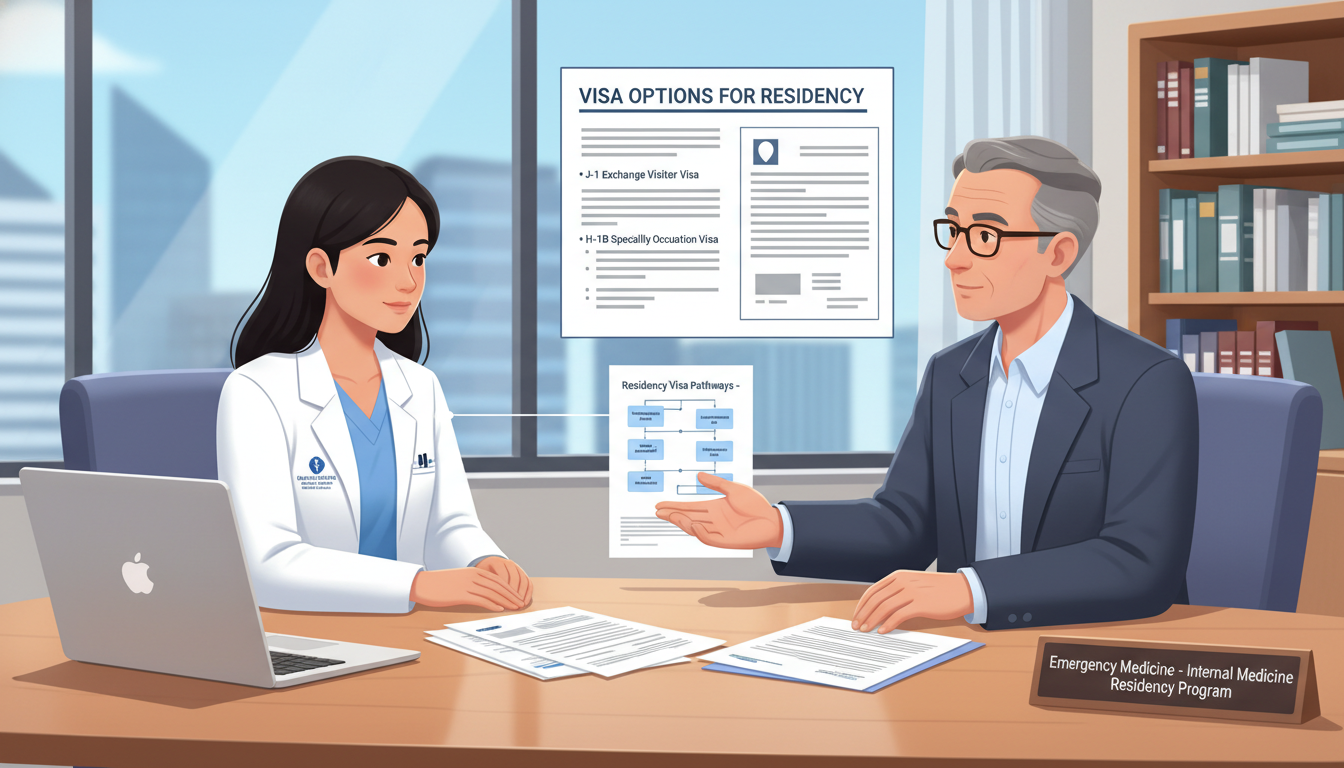
How Visa Choice Interacts with EM-IM Training and Career Path
Because EM-IM is a 5-year combined residency, visa planning should not be separate from your career planning. The type of visa you choose can shape your:
- Fellowship opportunities
- Early job options
- Practice location
- Long-term immigration pathway
Training Length and Visa Durations
EM-IM length: 5 years
On J-1:
- 5-year residency + up to 2 additional years for fellowship is usually allowed within the 7-year cap.
- Example: 5-year EM-IM + 1-year critical care fellowship = 6 total J-1 years → generally acceptable.
On H-1B:
- 5-year residency uses the majority of your initial 6-year cap.
- If you want fellowship afterward, you may:
- Need to ensure green card processing has already advanced (I-140 approved) to extend H-1B beyond 6 years, or
- Switch to J-1 for fellowship (which then comes with its own 2-year home requirement).
Fellowship and Subspecialty Considerations
EM-IM graduates may pursue fellowships in areas like:
- Critical Care Medicine
- Pulmonary and Critical Care
- Infectious Diseases
- Cardiology
- Ultrasound, Simulation, or Education fellowships
- Administration or healthcare leadership roles
Under J-1:
- Many ACGME-accredited fellowships support J-1 sponsorship.
- Total training years (residency + fellowship) must stay within ECFMG’s 7-year limit, unless an extension is granted for specific academic reasons.
- After fellowship, you’ll often need a J-1 waiver job in a shortage area.
Under H-1B:
- You may need to carefully time green card steps:
- If your academic employer files a green card petition early, you might qualify for H-1B extensions beyond 6 years, allowing both residency and fellowship under H-1B.
- If not, you may need to:
- Switch to J-1 for fellowship, or
- Enter practice after residency and delay fellowship.
Post-Training Work and J-1 Waiver Reality
For J-1 physicians, especially EM-IM graduates, understanding J-1 waiver programs is essential.
Common J-1 waiver pathways:
Conrad 30 Program (state-based):
- Each US state can recommend up to 30 J-1 doctors per year for waivers.
- Most waivers require 3 years of full-time work in a designated underserved area.
- Emergency medicine and internal medicine are often in demand, especially in rural and inner-city hospitals.
Federal waiver programs:
- VA (Veterans Affairs)
- Department of Health and Human Services (HHS) for research and some clinical roles
- Other federal agencies in specific circumstances
Implications for EM-IM:
- EM-IM graduates can often be very attractive waiver candidates because:
- They can cover both ED shifts and inpatient/internal medicine roles.
- They may help hospitals meet multiple service-line needs.
- However, practice sites are sometimes geographically limited and may not be in major metropolitan academic centers.
If you are passionate about rural emergency medicine or community internal medicine, this may align well with your goals. If you strongly prefer a major city or academic-only job, think about whether H-1B plus green card might better fit your long-term plan.
Practical Application Strategy: From ERAS to Match to Visa
Your residency visa situation is not something to “figure out later.” It should shape your planning at every stage of the application cycle.
Step 1: Pre-ERAS Planning (12–18 Months Before Match)
Clarify your priorities:
- Do you intend to stay in the US long-term?
- Are you open to working in underserved/rural areas after training?
- Is a specific fellowship (e.g., cardiology, critical care) essential to your plan?
Decide on your preferred visa strategy:
- J-1-first approach: Applicable if you are flexible about post-training location and focused on match success.
- H-1B-priority approach: If you strongly want to avoid the J-1 home residency requirement and are willing to:
- Pass USMLE Step 3 early
- Limit your applications to programs that sponsor H-1B
Research EM-IM program policies early:
- Check program websites and FREIDA profiles for:
- “We sponsor J-1 only”
- “We sponsor J-1 and H-1B”
- “No visa sponsorship”
- If unclear, email programs professionally:
- Ask whether they sponsor J-1, H-1B, or both, and whether Step 3 is mandatory for H-1B.
- Check program websites and FREIDA profiles for:
Plan USMLE timeline strategically:
- For J-1: Step 1, Step 2 CK, and ECFMG certification are sufficient.
- For H-1B: Plan to complete Step 3 before interviews or at least before rank lists are due.
Step 2: ERAS Application and Interview Season
Use your personal statement and CV wisely:
- You do not need to detail your visa plans extensively, but you can:
- Emphasize your commitment to US practice
- Highlight any previous US experience, research, or rotations
- You do not need to detail your visa plans extensively, but you can:
Communicate clearly with programs:
- On ERAS, accurately state your current immigration status and need for sponsorship.
- If you’re targeting H-1B, be transparent about:
- Whether you’ve passed Step 3
- Your flexibility to accept J-1 if H-1B isn’t available (if true)
During interviews:
- Ask programs appropriate questions near the end of the interview or during program coordinator sessions:
- “Does your institution sponsor H-1B for EM-IM residents?”
- “If not, is J-1 sponsorship through ECFMG available for the full 5-year program?”
- Avoid sounding as if visa is your only concern; balance it with interest in curriculum, patient population, and training style.
- Ask programs appropriate questions near the end of the interview or during program coordinator sessions:
Step 3: Rank List and Match
Be realistic with your rank list:
- If you must have H-1B and only a few EM-IM programs offer it, your list may be short. Understand that this could reduce match probability.
- If you’re open to J-1 or H-1B, rank primarily on:
- Training quality
- Supportive environment
- Program fit
J-1 as a backup:
- Some candidates hope for H-1B at top-choice programs but are comfortable with J-1 at others.
- Ensure you genuinely understand and accept the J-1 waiver reality if you choose this path.

Logistics After the Match: Securing Your Residency Visa
Once you match into an EM-IM program, the work of formally obtaining your residency visa begins. Program coordinators and institutional GME/immigration offices will guide you, but it is useful to know the steps.
J-1 Visa Process for EM-IM Residents
ECFMG Certification:
- Must be completed before ECFMG will issue J-1 sponsorship documents.
DS-2019 Application (through ECFMG):
- You will submit:
- Appointment letter/contract from your residency program
- Identification documents (passport, photos)
- Proof of funding (often your resident salary documentation)
- Online application forms and fees
- You will submit:
Visa Interview at US Embassy/Consulate:
- After ECFMG issues your Form DS-2019, use it to schedule a visa interview if you are outside the US.
- Prepare:
- DS-2019
- SEVIS fee receipt
- Program contract/offer letter
- Evidence of your ties to home country, if requested
Arrival and orientation:
- Enter the US on J-1 status.
- Attend hospital and ECFMG-required orientations.
- Keep J-1 compliance in mind:
- No unauthorized moonlighting
- Report changes in address or training site as required
H-1B Visa Process for EM-IM Residents
Step 3 and state licensure requirements:
- Confirm with your program/state whether a full or training license requires Step 3 completion.
- Many institutions only file H-1B after Step 3 is passed.
Labor Condition Application (LCA):
- The sponsoring hospital (employer) files an LCA with the US Department of Labor.
H-1B petition to USCIS:
- Filed by the employer’s immigration team or external attorney.
- Includes:
- Employment offer and contract
- Evidence of your medical degree and ECFMG certification
- USMLE scores (including passed Step 3)
- Details of position and salary
Consular processing or change of status:
- If you are outside the US, you attend an H-1B visa interview at a consulate.
- If you are already inside the US on another status, your status may change without needing to leave, depending on circumstances.
Maintain H-1B compliance:
- Work only for the sponsoring institution and only in the capacity authorized by the petition.
- Report any rotations outside the main site that might affect your H-1B specifics.
Common Pitfalls and How EM-IM IMGs Can Avoid Them
Pitfall 1: Ignoring Visa Policies Until After Interviews
Many IMGs only discover that their dream EM-IM program does not sponsor visas or only supports J-1 late in the process.
How to avoid:
- Check visa policies before applying broadly.
- At minimum, confirm during interview season so your rank list reflects reality.
Pitfall 2: Planning on H-1B Without Step 3
Some applicants aim for H-1B but do not realize that Step 3 is required by the program’s institution or state for H-1B sponsorship.
How to avoid:
- Target an early Step 3 exam date if you want H-1B.
- Clarify with programs whether they’d consider filing H-1B without Step 3 (rare).
Pitfall 3: Underestimating the Impact of J-1 Waiver Requirements
The two-year home-country requirement or the need for J-1 waiver service can significantly shape your first job after residency or fellowship.
How to avoid:
- Learn about J-1 waiver programs (Conrad 30, VA, HHS) before committing to a J-1 strategy.
- Reflect honestly on whether you would be willing to live/work in a potentially rural or underserved area for 3 years.
Pitfall 4: Over-Focusing on Visa at the Expense of Training Quality
Visa status is critical, but training quality and career development matter just as much, especially in a demanding combined specialty.
How to avoid:
- Consider visa type as one factor among others:
- Board pass rates
- EM and IM clinical exposure
- Wellness, mentorship, and research opportunities
- Remember that a strong EM-IM training experience will shape your long-term career security and satisfaction.
Final Thoughts: Building a Strategic Visa Plan as an EM-IM IMG
For an international medical graduate pursuing emergency medicine internal medicine combined training, visa navigation is not just an administrative hurdle; it is a strategic career decision.
In summary:
- J-1 is the most widely available and straightforward route, well-suited to completing a 5-year EM-IM residency and often one additional fellowship, but usually ties you to a J-1 waiver job or a 2-year return home afterward.
- H-1B aligns better with long-term US settlement goals and avoids the home-country requirement, but:
- Is harder to obtain
- Often requires USMLE Step 3 before or early in the match cycle
- Is only offered by a subset of EM-IM programs
- Your visa decision should be integrated with:
- Your willingness to work in underserved/rural areas
- Desired fellowship plans
- Long-term immigration intentions (green card or eventual return home)
A thoughtful, early strategy—paired with clear communication with programs and attention to deadlines—will help you navigate residency visa options confidently and focus on what matters most: becoming an excellent EM-IM physician.
FAQ: Visa Navigation for EM-IM IMGs
1. Can I complete a 5-year EM-IM residency on a J-1 visa without problems?
Yes. The standard ECFMG J-1 sponsorship allows up to 7 years for graduate medical education. A 5-year EM-IM residency comfortably fits within this period, leaving room for many 1–2 year fellowships afterward. You must still maintain good standing, renew annually, and comply with ECFMG and program requirements.
2. Is H-1B realistically possible for EM-IM residency as an IMG?
It is possible but more limited. H-1B depends on:
- The specific EM-IM program and institutional policy
- Your completion of USMLE Step 3 (usually required)
- Timing for filing and approval with USCIS
Many EM-IM programs sponsor only J-1. If H-1B is critical to you, target programs that explicitly support it and plan Step 3 early.
3. If I do EM-IM on a J-1, can I still get a fellowship in the US?
Often yes. As long as your total J-1 time (residency + fellowship) generally does not exceed 7 years, many accredited fellowships will sponsor J-1 through ECFMG. However, after fellowship, you usually face the 2-year home requirement unless you secure a J-1 waiver job, often in a shortage area.
4. Does my visa type affect my competitiveness for EM-IM match?
Indirectly. Programs must ensure they can legally train and employ you. If a program only sponsors J-1 and you require H-1B, they may not rank you. However, among candidates who are all eligible for J-1, visa type itself typically matters less than:
- Scores and clinical performance
- Letters of recommendation (especially US-based)
- Communication skills and fit with the program
Your overall application strength and fit remain the primary drivers of match success, with visa type as an important logistical consideration.