Understanding the Visa Landscape for IMGs in Family Medicine
For an international medical graduate (IMG), securing the right visa is just as important as crafting a strong application for family medicine residency. The “FM match” is competitive and time-sensitive, and your visa strategy can make or break otherwise excellent credentials.
This IMG residency guide will walk you step-by-step through visa navigation for residency, focusing on family medicine and the unique considerations IMGs face. You’ll learn how J‑1 and H‑1B visas differ, how visa choices affect your career and immigration future, and how to plan practically so the visa process supports—rather than disrupts—your residency goals.
We’ll focus on:
- The main visa options for residency (J‑1 vs H‑1B vs others)
- How visa type affects your eligibility, training, and post‑residency pathways
- Strategies to maximize your chance of matching into family medicine as an IMG
- Common pitfalls and how to avoid them
Throughout, keep in mind: you must always verify details with official sources (e.g., ECFMG, USCIS, program websites, and a qualified immigration lawyer). Regulations and program policies change frequently.
Core Visa Options for IMGs Entering Family Medicine Residency
For an IMG seeking family medicine residency in the United States, there are three major categories of visa/status to understand:
- J‑1 (ECFMG‑sponsored) Exchange Visitor (Physician Category)
- H‑1B Temporary Worker (Specialty Occupation)
- Non‑immigrant statuses allowing work authorization (e.g., EAD through pending green card, spouse visas such as H‑4 EAD) – less common at initial entry
Most IMGs who are not already in the US on work‑authorized status will match and train on either J‑1 or H‑1B. Knowing the J‑1 vs H‑1B differences—especially for family medicine—is essential.
1. J‑1 Physician Visa (ECFMG‑Sponsored)
The J‑1 visa for physicians is the most common IMG visa for residency.
Key features:
- Sponsor: ECFMG (Educational Commission for Foreign Medical Graduates)
- Purpose: Graduate medical education (residency/fellowship)
- Duration: Usually the length of residency + any approved fellowship; requires annual renewal
- Work restriction: You can work only at ECFMG‑approved training sites listed on your training program’s payroll/rotation plan
- Two‑year home residency requirement: Usually applies (INA 212(e)); you must, after training, either:
- Return to your home country (or country of last permanent residence) for a total of two years, or
- Obtain a J‑1 waiver before changing status to H‑1B or applying for many immigrant visas/green cards
Advantages for IMGs in family medicine:
- Most family medicine programs sponsor J‑1 routinely.
- Requirements are relatively standardized and familiar to program coordinators.
- ECFMG provides structured support and clear guidelines.
- You can complete residency and many fellowships (e.g., geriatrics, sports medicine, addiction medicine) under the same visa category.
Main drawbacks:
- The two‑year home residency requirement significantly affects long‑term immigration plans.
- To stay in the US and work as an attending after training, you typically need a J‑1 waiver job, most often in a medically underserved / Health Professional Shortage Area (HPSA).
- You’re generally not allowed moonlighting outside the approved training scope. Some programs permit internal moonlighting only.
For IMGs specifically targeting family medicine, J‑1 can still be a very favorable route, because:
- Many waiver programs (Conrad 30, state policies) particularly value primary care physicians, especially in rural or underserved areas.
- Family medicine matches well with jobs that commonly qualify for J‑1 waiver positions.
2. H‑1B Visa for Residency
The H‑1B (specialty occupation) is the primary professional work visa for many fields, but in medicine it has additional nuances.
Key features:
- Sponsor: Your residency program (and later, your employer)
- Purpose: Employment in a specialty occupation (physician role)
- Duration: Up to 6 years total (initial + extensions), though time spent outside the US may “recapture” extra time
- No 2-year home residency requirement tied to H‑1B itself
- Work restriction: You may only work for the petitioning employer, in the described role and location(s) on the petition
Basic requirements for residency:
- ECFMG certification (and, in practice, USMLE Steps 1, 2 CK, and usually Step 3 completed)
- A valid state limited or training license (program will help with this)
- Program’s willingness and institutional capacity to sponsor H‑1B
- Compliance with wage standards (prevailing wage/LCA), making legal fees and salary requirements higher
Advantages for IMGs:
- No two‑year home return requirement like J‑1.
- More flexibility later in transitioning to attending jobs and pursuing a green card.
- For some, it shortens the timeline from residency to permanent residency, because you avoid the J‑1 waiver requirement.
Drawbacks:
- Fewer family medicine programs sponsor H‑1B than J‑1; competition is stronger for those that do.
- USMLE Step 3 is typically required before H‑1B filing, which may significantly constrain your timeline.
- Legal and filing fees, as well as wage requirements, can be a barrier for some programs.
- H‑1B cap issues can arise, but many academic and nonprofit hospital employers qualify as cap‑exempt (a major advantage in residency context).
For an IMG targeting family medicine, H‑1B is a powerful option if:
- You can pass Step 3 early (ideally before applying or before ranking programs).
- You’re able to identify FM programs with a consistent track record of H‑1B sponsorship.
- You have a long‑term plan to remain in the US and want to minimize the restrictions associated with J‑1 waivers.
3. Other Statuses and Lesser‑Used Options
Some IMGs may already be in the US on:
- F‑1 (Student) with OPT, including MD/PhD or related degrees
- Spousal visas (e.g., H‑4 with EAD, L‑2 with EAD)
- Pending green card with EAD
In these cases, you might enter residency using your existing employment authorization rather than J‑1 or H‑1B. Family medicine programs are generally open to this, but it’s more case‑by‑case, and you should work closely with:
- The program’s GME office
- The institution’s international office
- Your own immigration attorney
These situations are more individualized and beyond standard IMG visa options, but they can sometimes offer more flexibility than J‑1 or H‑1B alone.
J‑1 vs H‑1B: How to Choose for Family Medicine
The heart of visa navigation for residency is deciding between J‑1 vs H‑1B. There’s no universal “best” choice; it depends on your background, goals, and flexibility.
Side‑by‑Side Comparison
Training Phase
J‑1:
- Widely accepted in family medicine residencies
- Relatively simpler for the program to implement (routine processes)
- Strong oversight by ECFMG
H‑1B:
- Offered by a smaller subset of programs
- More administrative and financial burden on programs
- Often requires Step 3 and license earlier in the process
Post‑Residency Options
J‑1:
- You must either:
- Return to home country for 2 years, OR
- Secure a J‑1 waiver job (usually in underserved areas) and then switch to H‑1B or pursue a green card
- Very common pathway for family medicine: Conrad 30 / state waiver → underserved primary care job → green card
- You must either:
H‑1B:
- No home return requirement
- You can transition directly from residency to H‑1B attending job and start green card process, if your employer agrees
- Flexibility to choose academic, hospitalist, or outpatient roles, not only HPSA sites (though these are still common in FM)
Immigration Trajectory
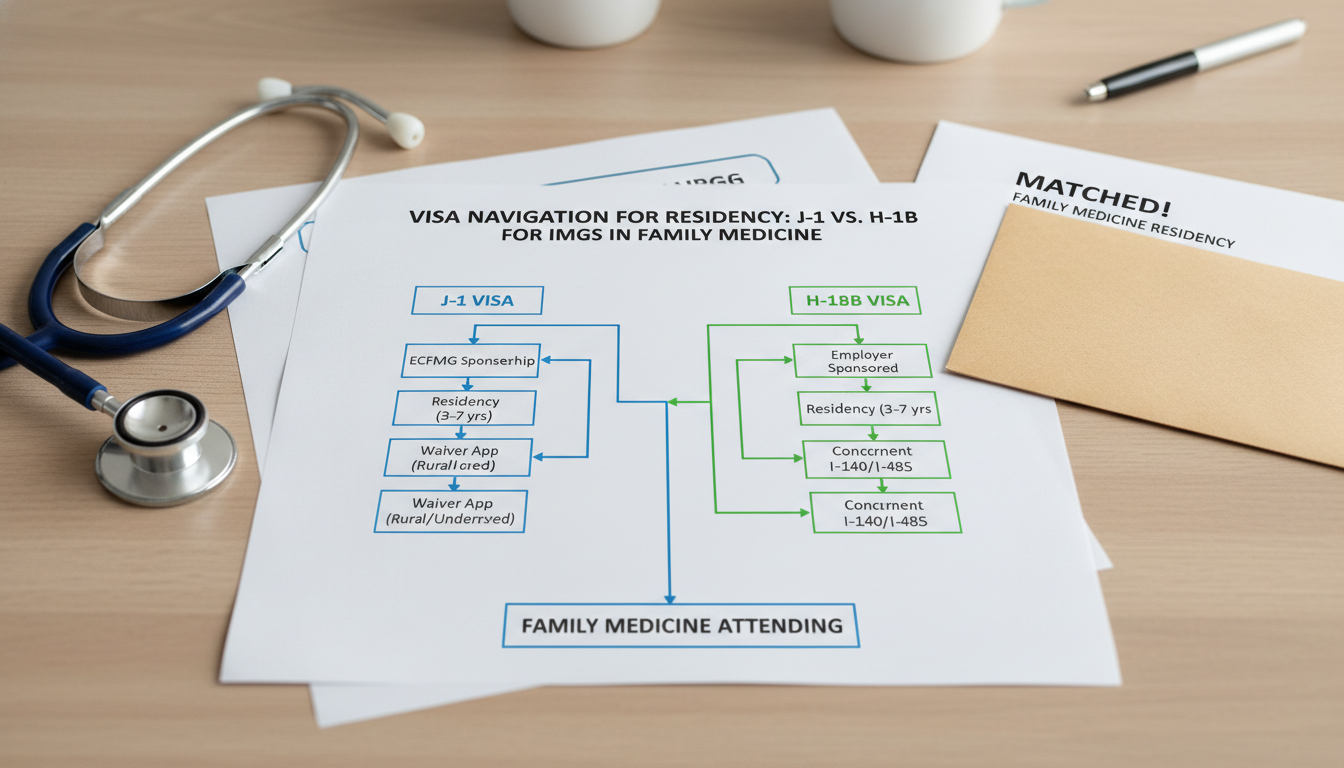
J‑1 route:
FM Residency (J‑1) → J‑1 Waiver Job (H‑1B) in underserved area → Green card (often EB‑2/EB‑3)H‑1B route:
FM Residency (H‑1B) → Attending Job (H‑1B) → Green card (EB‑2/EB‑3, NIW, etc.)
Strategic Questions to Ask Yourself
When deciding your IMG visa options, consider:
How strong is my application, especially for FM?
- If you’re still strengthening your profile, keeping maximum program options open (often J‑1) may be wise.
- If you’re highly competitive and can target specific H‑1B‑friendly programs, an H‑1B strategy may work.
Can I pass USMLE Step 3 before programs need to file visas?
- If yes, H‑1B becomes much more realistic.
- If not, you may have to rely on J‑1 for residency.
Am I willing to work in rural/underserved areas after residency?
- If yes, J‑1 + waiver pathway fits very well with family medicine and can be a smooth route.
- If you desire urban or subspecialty‑heavy work immediately after residency, H‑1B may give more flexibility.
How important is long‑term permanence in the US?
- Both paths can lead to a green card, but J‑1 usually adds the extra step of a waiver job.
- If you are very fixed on staying in the US and minimizing obstacles, an H‑1B strategy—if feasible—can streamline things.
Practical Example
Candidate A:
- IMG targeting family medicine, Step 1 & 2 CK completed with solid scores, but Step 3 not yet taken.
- Flexible about working in underserved Midwest or rural areas post‑residency.
- Wants broad program options.
Better fit: J‑1 visa for residency, with a future plan for a Conrad 30 J‑1 waiver job in family medicine.
Candidate B:
- IMG with high USMLE scores, multiple US clinical experiences, and research.
- Has already passed Step 3 before ERAS submission.
- Aims for an academic family medicine career and wants to maximize urban/academic job options post‑residency.
Better fit: Target FM programs known to sponsor H‑1B, with a plan to stay on H‑1B through attending job and begin green card process early.
Visa Planning Across the Family Medicine Match Timeline
Understanding when to act is crucial. Visa navigation should be integrated into your entire FM match timeline, not left to the end.
1. Pre‑Application Phase (12–18 Months Before Match)
Key tasks:
- Decide your priority visa path (J‑1 vs H‑1B), based on personal and professional goals.
- If aiming for H‑1B:
- Schedule and pass USMLE Step 3 as early as feasible.
- Research state licensing requirements for training licenses.
- Compile a list of family medicine residency programs and note:
- Which explicitly accept/sponsor J‑1
- Which sponsor H‑1B (and what conditions they specify)
- Which have a history of accepting IMGs with similar profiles
Actionable tips:
- Use FREIDA, program websites, and direct emails to verify policies.
- Keep a spreadsheet with columns for “J‑1,” “H‑1B,” “Visa Policy Notes,” and “Recent IMG Residents.”
- Consider geographic areas with high need for primary care—these often host FM programs more open to IMGs, sometimes with future J‑1 waiver opportunities.
2. Application and Interview Season
During ERAS and interviews:
- Tailor your personal statement and conversations to emphasize:
- Commitment to family medicine and primary care
- Flexibility and understanding of underserved medicine, especially if you might pursue J‑1 waiver jobs later
- At interviews, ask appropriate, professional questions about visa sponsorship:
- “Does your program currently sponsor J‑1 and/or H‑1B visas for incoming residents?”
- “Are there any additional requirements for H‑1B sponsorship, such as Step 3 by a specific date?”
- “Do you have IMGs currently in your program on these visas?”
Be polite and concise—programs expect IMGs to ask about visas, but time is limited.
Ranking Strategy:
- Prioritize programs that:
- Clearly support your desired visa type
- Have a track record of successfully onboarding IMGs
- Avoid ranking programs highly if their visa policies are unclear or inconsistent with your needs.
3. Post‑Match: Visa Processing
Once you match:
The program’s Graduate Medical Education (GME) office and international office will coordinate your visa.
For J‑1:
- You’ll work through ECFMG’s OASIS and ERAS systems to submit:
- Form DS‑2019 request
- Required documents (passport, medical diploma, contracts, etc.)
- You’ll attend a US embassy interview in your home country (if you’re outside the US).
- You’ll work through ECFMG’s OASIS and ERAS systems to submit:
For H‑1B:
- The institution’s lawyer will prepare:
- Labor Condition Application (LCA)
- H‑1B petition (Form I‑129 and supporting documents)
- You may need to attend a visa interview abroad if you’re not already in the US in H‑1B‑eligible status.
- The institution’s lawyer will prepare:
Timing is delicate. Family medicine residencies generally start July 1, and any delay in visa issuance can affect your ability to start on time. Respond to all document requests promptly and keep in close communication with your program.

Life After Residency: J‑1 Waivers, H‑1B Jobs, and Green Cards
Visa navigation for residency doesn’t stop at graduation. For FM physicians in particular, post‑residency visa strategy often centers on underserved work and permanent residency options.
J‑1 Waiver Pathway for Family Medicine
If you trained on J‑1, you likely have a two‑year home residence obligation. The primary way to work in the US instead of going home is obtaining a J‑1 waiver.
Common waiver types:
Conrad 30 Waiver Programs (State‑Based)
- Each US state can sponsor up to 30 J‑1 physicians per year for waiver jobs.
- Strong preference for primary care (family medicine, internal medicine, pediatrics, psychiatry, OB/GYN).
- Jobs typically must be in HPSAs, MUAs, or other underserved designations.
- You must agree to a 3‑year full‑time contract in that site on an H‑1B.
Federal Waivers (e.g., VA, DRA, ARC)
- Some federal agencies can sponsor waivers for physicians working in specific kinds of facilities or geographic areas.
- Often still highly compatible with family medicine.
Persecution / Hardship Waivers
- Based on risk of persecution or exceptional hardship to a US spouse/child if you return home.
- Complex, case‑specific, and require legal guidance.
Why this works well for family medicine:
- Rural and underserved areas have chronic shortages of primary care physicians.
- Many J‑1 waiver sites prefer or specifically recruit family medicine practitioners.
- This alignment makes family medicine a particularly strategic specialty for IMGs on J‑1 visas.
H‑1B Pathway After Residency
If you were on H‑1B during residency:
- You can transition directly to:
- Another H‑1B role with a different employer
- Potentially the same institution as an attending
- Your employer can initiate a green card petition (EB‑2 or EB‑3) while you continue working.
For family medicine graduates, options include:
- Academic positions (teaching + clinical)
- Hospital‑employed outpatient practices
- FQHCs and community health centers
- Private group practices with H‑1B experience
No J‑1 waiver is required, which can open more urban or subspecialized primary care roles.
National Interest Waiver (NIW) and FM
Regardless of J‑1 or H‑1B background, many family medicine physicians qualify for EB‑2 National Interest Waiver (NIW) if they work in underserved areas and demonstrate that their work benefits the US on a national scale.
- Strong fit for physicians serving in HPSAs or MUAs, particularly if:
- You provide continuity primary care
- You help close access gaps for vulnerable populations
An NIW can be pursued:
- After completing a J‑1 waiver job (for former J‑1 physicians)
- Directly while in H‑1B status as an attending
Because NIWs are highly individualized, detailed legal planning is recommended.
Practical Tips and Common Pitfalls for IMGs in Family Medicine
Actionable Tips
Start visa planning early.
- Consider visa strategy at least a year before applying for FM residency.
- Don’t wait until after the Match to think about J‑1 vs H‑1B.
Organize your documentation.
- Keep all passports, ECFMG certificates, diplomas, translations, and prior visas/forms in one scanned and backup‑stored folder.
- Make a checklist tailored to J‑1 or H‑1B expectations.
Tailor your program list to your visa needs.
- If H‑1B is essential to you, build your list around programs known for H‑1B sponsorship, even if it narrows your options.
- If you’re open to J‑1, cast a wider net.
Be transparent, but strategic, in communication.
- Don’t demand commitments from programs too early, but it’s appropriate to ask about general visa policies.
- Keep a record of what programs say about sponsorship.
Stay updated on policy changes.
- Follow ECFMG, NRMP, and major immigration news channels.
- Policy shifts (for example, around J‑1 or residency visa processing) can alter timelines or requirements.
Common Pitfalls to Avoid
Assuming all programs sponsor all visas.
Visa policies are highly institution‑specific. Never assume—always verify.Delaying USMLE Step 3 if you want H‑1B.
Late Step 3 can close H‑1B doors quickly, even if your profile is strong.Ignoring the two‑year home requirement.
If you choose J‑1, you must plan realistically for waiver options or return home; pretending it doesn’t exist leads to panic later.Underestimating rural/underserved practice.
Many IMGs initially resist the idea of working in rural or underserved settings, but these jobs frequently:- Provide strong early‑career experience
- Enable J‑1 waivers or NIWs
- Offer good compensation and loan repayment programs
Relying solely on informal advice.
Online forums and peers can be helpful but are not authoritative. Always cross‑check with official sources and, when needed, an immigration attorney.
FAQs: Visa Navigation for IMGs Entering Family Medicine
1. Is it harder to match into family medicine as an IMG if I need a visa?
Needing a visa does introduce complexity, but family medicine is among the most IMG‑friendly specialties, and many FM programs are accustomed to sponsoring J‑1 (and some H‑1B) visas. Your chances depend more on your USMLE scores, clinical experience, communication skills, and overall fit with FM than on visa needs alone—provided you apply smartly to programs that match your visa profile.
2. Should I delay applying to the Match until I pass Step 3 to improve my H‑1B chances?
It depends on your overall competitiveness and timing. Passing Step 3 before applying certainly improves H‑1B eligibility, but delaying too long might push your application to a less favorable cycle. If you are early in your timeline and can reasonably pass Step 3 before applications open, it can be beneficial. If not, it may be wiser to pursue the Match with a J‑1 focus and plan a strong post‑residency waiver and immigration strategy.
3. Can I switch from J‑1 to H‑1B during residency?
Switching directly from J‑1 physician status to H‑1B is generally not allowed without first dealing with the two‑year home residence requirement. You would typically need to obtain a J‑1 waiver or fulfill the 2‑year requirement before changing status to H‑1B. For most IMGs in family medicine, the practical pathway is: complete residency on J‑1 → obtain a J‑1 waiver job → move to H‑1B for that job.
4. Does my choice of residency visa affect which fellowships I can do after family medicine?
In most cases, no—both J‑1 and H‑1B can support common FM fellowships (e.g., geriatrics, sports medicine, palliative care, addiction medicine), assuming the fellowship program sponsors that visa type. However, if you are on J‑1, prolonging training with fellowships delays when you must obtain a J‑1 waiver job or return home; on H‑1B, prolonged training uses more of your 6‑year H‑1B limit, which may affect later attending H‑1B time. Plan fellowships in conjunction with an immigration timeline.
Navigating residency visa options as an international medical graduate in family medicine is complex, but manageable with clear information and early planning. Understanding J‑1 vs H‑1B, aligning your FM match strategy with realistic visa possibilities, and planning ahead for post‑residency waivers or green card pathways will place you in the strongest position to build the family medicine career you envision in the United States.