
Understanding the Visa Landscape for IMGs in Internal Medicine
Visa navigation is one of the most critical—and often most confusing—parts of the journey for an international medical graduate (IMG) pursuing internal medicine residency in the United States. Your visa type will influence where you can train, whether you can moonlight, your spouse’s ability to work, your long‑term plans for staying in the U.S., and your pathway to fellowship and beyond.
This IMG residency guide focuses specifically on internal medicine and explains residency visa options in clear, practical terms. It will help you understand:
- Which visas are commonly used for internal medicine residency
- Key differences between J-1 vs H-1B
- How visa status affects your competitiveness in the IM match
- What questions to ask programs during interviews
- How to align visa choices with long‑term career goals
While this article is detailed and practical, it is not legal advice. Visa regulations change, and individual circumstances differ significantly. Always confirm specifics with an immigration attorney and the program’s GME/HR office.
Major Visa Types for IMGs in Internal Medicine Residency
For graduate medical education (GME) in the U.S., IMGs most commonly train under:
- J-1 Exchange Visitor (ECFMG-sponsored)
- H-1B Temporary Worker (employer-sponsored)
- Less commonly: F-1 with OPT for pre-residency clinical roles or research (not residency itself), and a few special categories
1. J-1 Exchange Visitor (ECFMG-Sponsored)
The J-1 visa is the most common pathway for IMGs in internal medicine residency training.
Key features:
- Sponsor: Educational Commission for Foreign Medical Graduates (ECFMG)
- Purpose: Graduate medical education (residency and fellowship)
- Duration: Up to 7 years total for clinical training (internal medicine + fellowship)
- Home residence requirement: Usually a 2-year home-country physical presence requirement after completion, unless waived
- Dependents: J-2 dependents (spouse and children) can accompany; spouses on J‑2 may apply for work authorization (EAD)
Requirements:
- Valid ECFMG certification
- Residency contract from an ECFMG-approved host institution
- Passing USMLE exams as required for ECFMG certification
- Proof of adequate financial support
- Proof of home-country ties and intent to return (at least on paper, unless later waived)
Advantages of J-1:
- Widely accepted: Many internal medicine programs sponsor only J-1 visas, not H-1B.
- Predictable process: Managed through ECFMG, which has clearly defined steps.
- Easier for first residency: Programs are familiar with the process and timelines.
- J-2 spouse work eligibility (if EAD approved), which can support dual-career families.
Disadvantages of J-1:
- 2-year home residence requirement: After training, you must:
- Return to your home country for at least two years, or
- Obtain a J-1 waiver (e.g., through the Conrad 30 program, federal agencies, or hardship/persecution claims)
- Moonlighting limitations: Often more restricted than H‑1B; policies vary by institution.
- Fellowship planning: Your 7-year cap must cover internal medicine residency (usually 3 years) plus any fellowship years.
Who might prefer J-1?
- IMGs applying broadly, especially to community or smaller academic programs that do not sponsor H-1B.
- Those who are open to serving in underserved areas after residency for a J-1 waiver (e.g., outpatient internal medicine, hospitalist in rural/medically underserved settings).
- Applicants who prioritize maximizing the number of programs they can apply to.
2. H-1B Temporary Worker (Specialty Occupation)
H-1B is an employment-based visa; the residency program sponsors you directly. It is less common than J-1 in internal medicine but remains an important IMG visa option.
Key features:
- Sponsor: The residency program (employer)
- Purpose: Employment in a specialty occupation—here, resident physician
- Duration: Up to 6 years total (time in prior H-1B status counts; some exceptions exist)
- Home residence requirement: No 2-year home-country requirement
- Dependents: H-4 dependents; spouses can work only if they qualify under specific conditions (e.g., if you’ve reached certain stages in a green card process—rare during residency)
Typical requirements for H-1B in residency:
- USMLE Step 3 passed before filing the H-1B petition (many programs require Step 3 at time of rank or offer)
- ECFMG certification
- State medical license or eligibility for training license (varies by state)
- Employer (program) willing to handle legal and filing fees and comply with wage rules
Advantages of H-1B:
- No 2-year home residency requirement: You can transition directly:
- From residency to fellowship (also often on H‑1B), or
- To attending jobs and a green card pathway
- Often more flexibility with moonlighting, if program and state rules allow and if the H‑1B is structured to permit it.
- Seen as a “dual intent” visa: You can legally pursue permanent residency (green card) while on H‑1B.
Disadvantages of H-1B:
- Fewer IM programs sponsor it: Many internal medicine programs are J‑1 only.
- Higher administrative and legal cost for the employer.
- Step 3 timing pressure: You must pass USMLE Step 3 early (ideally before applying or at least before ranking).
- Time cap: The 6-year maximum includes any prior H‑1B time (e.g., previous research jobs).
Who might prefer H-1B?
- IMGs with strong exam scores and CV who are competitive for programs that sponsor H‑1B.
- Those planning a long-term career in the U.S. without a mandatory service requirement abroad.
- Internal medicine applicants aiming for subspecialty fellowships in the U.S. and eventual green card sponsorship.
3. Other Less Common Visa/Status Situations
While J-1 vs H-1B covers most IMGs in internal medicine residency, you may encounter other categories:
F-1 with OPT (Optional Practical Training)
- Sometimes used for pre-residency research or clinical research fellowships.
- F-1/OPT status does not typically allow you to start an ACGME-accredited residency; you would still need a J‑1 or H‑1B for residency.
- Can be a bridge to build a research profile and U.S. experience while preparing for the IM match.
Green card holders / U.S. permanent residents
- If you are already a permanent resident, you do not need a residency visa.
- You are often considered similarly to U.S. graduates in terms of visa issues, which may improve your competitiveness.
Other categories (O-1, TN, etc.)
- O-1 (extraordinary ability) is rarely used for residency and is more common for senior researchers or faculty.
- TN is for Canadian/Mexican citizens in certain professions; physician roles have restrictions and generally require non-clinical or teaching positions.
For residency, practically, you will almost always be choosing between J-1 and H-1B.
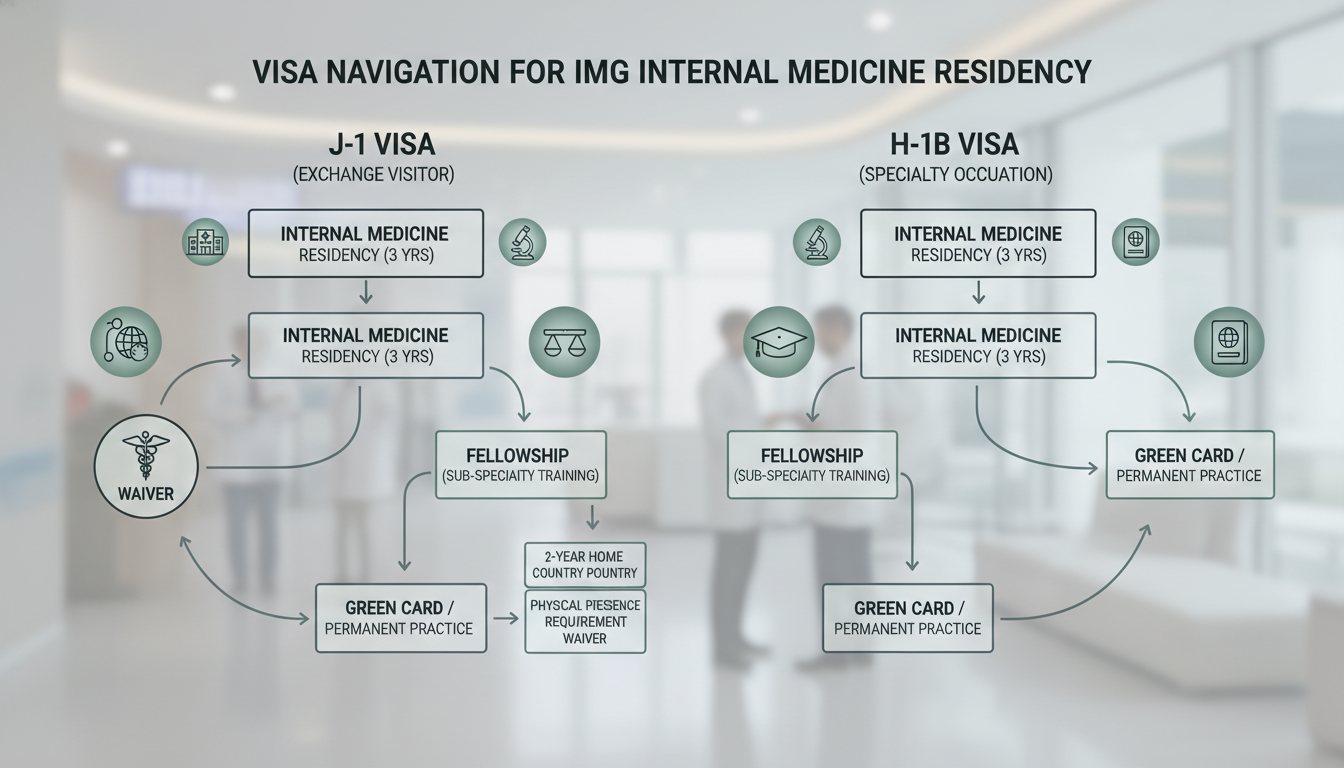
Comparing J-1 vs H-1B for Internal Medicine: Practical Considerations
When deciding on your preferred visa type for internal medicine residency, think beyond the first three years of training. Your long-term goals, country of citizenship, and personal situation all matter.
Below are the main dimensions you should evaluate.
1. Match Competitiveness and Program Availability
Program sponsorship patterns:
- Many community and smaller academic internal medicine programs:
- Sponsor J‑1 only
- Do not handle H‑1B due to cost, complexity, or institutional policy
- Some larger academic centers:
- Sponsor both J‑1 and H‑1B, often with clear policies
- May have preference for H‑1B for candidates already in the U.S. with Step 3 done
Impact on your match strategy:
- If you insist on H‑1B only, your program list shrinks significantly.
- If you are flexible (J‑1 or H‑1B), you can apply more broadly.
- For many IMGs, the pragmatic strategy is:
- Indicate openness to both J-1 and H-1B
- Prioritize matching in a solid internal medicine residency first
- Decide later whether to pursue a J-1 waiver or H‑1B transition
Practical advice:
- Use FREIDA, program websites, and email communication to identify each program’s visa policy.
- Keep a spreadsheet: program name, visa types accepted (J-1, H-1B, both, none), Step 3 requirement, notes.
- During interviews, ask politely for clarification on their current visa sponsorship practices (policies can change).
2. Training, Moonlighting, and Income Considerations
Moonlighting can be a significant income source in PGY‑2/PGY‑3 internal medicine, especially in community hospitals or rural areas.
J-1:
- ECFMG expects J-1 physicians to engage primarily in approved training activities.
- Extra clinical work (moonlighting) may be restricted or require explicit permission.
- Many institutions prohibit external moonlighting for J‑1 residents.
- Internal moonlighting (shifts within the same institution) may be permitted but is often limited.
H-1B:
- You are sponsored as an employee; however, the visa is tied to specific employer(s) and worksites.
- Moonlighting at another institution usually requires:
- Amended or concurrent H‑1B petition, which is complex and costly.
- Internal moonlighting (extra shifts at the same institution) is sometimes easier to configure within the existing H-1B framework, depending on how the petition is structured.
Financial impact:
- Internal medicine residency salaries are relatively standard, but moonlighting can significantly supplement income, particularly in later years and for hospitalist-type shifts.
- If you anticipate relying on moonlighting for financial reasons, discuss the institution’s policy for your visa type.
3. Post-Residency Pathways: Fellowship, Practice, and Green Card
Internal medicine is often a stepping stone to subspecialty fellowship (e.g., cardiology, GI, pulmonary/critical care, nephrology) or to hospitalist/primary care roles. Your visa type affects these transitions.
J-1 Post-Residency Pathways
After 3 years of internal medicine residency:
- If you pursue fellowship on J‑1:
- Each fellowship year uses part of your 7-year J-1 cap.
- Example: 3 years IM + 3 years cardiology = 6 years used; 1 year remaining for potential additional training.
- After all training, you must address the 2-year home residence requirement:
- Option A: Return home for 2 years, then potentially reapply for another U.S. visa later.
- Option B: J-1 waiver, most commonly:
- Conrad 30 Waiver Program (state-based):
- Requires 3 years full-time service in a designated underserved area.
- Many internal medicine hospitalist or primary care roles qualify.
- Process is state-specific and competitive in some states.
- Federal agency waivers (e.g., VA, HHS, ARC), also tied to service in specific settings.
- Hardship/persecution waivers (case-by-case, legally complex).
- Conrad 30 Waiver Program (state-based):
After completing J‑1 waiver service (typically in H‑1B status), employers may sponsor you for permanent residency.
H-1B Post-Residency Pathways
After 3 years of internal medicine residency on H‑1B:
- You may have used 3 of your 6 H‑1B years.
- For fellowship, you can:
- Move to another H‑1B-sponsoring institution (cap-exempt if in academic/non-profit setting).
- Continue accumulating H‑1B time; total cannot exceed 6 years (without green card-related extensions).
- After training, you can work as an attending on:
- Employer-sponsored H-1B
- Transition to a green card pathway (EB-2, NIW, etc.), especially amenable for internists and subspecialists willing to work in underserved areas.
No obligation to return home or seek a waiver, but you must maintain valid immigration status and eventually obtain permanent residency or another long-term visa if you plan to stay.
4. Family and Lifestyle Considerations
Many IMGs start internal medicine residency with spouses and children. Different visas carry different implications.
J-1/J-2:
- J‑2 spouse can apply for work authorization (EAD); once approved, they can work in almost any job.
- Children can attend school without separate study visas.
- If you fail to secure a waiver, the 2-year return requirement applies to dependents as well.
H-1B/H-4:
- H‑4 spouse generally cannot work unless you reach certain green card process milestones (rare during residency).
- This may affect financial planning and spouse’s career progression.
- Children can study in school on H‑4.
Emotional and logistical factors:
- Will your spouse need or want to work during your residency?
- Are you willing to consider practicing in an underserved or rural area to fulfill a J‑1 waiver obligation?
- How important is geographic flexibility after training?

Step-by-Step Visa Navigation Timeline for the IM Match
Visa planning should start early—ideally before you submit ERAS. Below is a structured timeline for an international medical graduate targeting internal medicine residency.
Phase 1: Before Applying to ERAS
Clarify your long-term goals
- Do you want to settle permanently in the U.S.?
- Are you interested in competitive fellowships?
- Would you consider working in underserved areas after residency?
Research visa policies of IM programs
- Use FREIDA and program websites to classify:
- J-1 only
- J-1 + H-1B
- No visa sponsorship
- Note specific mentions like:
- “We require Step 3 for H‑1B.”
- “We sponsor only J‑1 through ECFMG.”
- If unclear, a polite email to the program coordinator can help.
- Use FREIDA and program websites to classify:
Plan your Step 3 strategy (if eyeing H‑1B)
- Aim to pass Step 3 before or early in the application season.
- This makes you immediately eligible for H‑1B at programs that sponsor it and can give you a competitive edge.
Document organization
- Ensure passports, ECFMG certificates, USMLE transcripts, and diplomas are up to date and easily accessible.
- Keep digital copies ready for quick sharing with programs and ECFMG.
Phase 2: During Application and Interview Season
In ERAS, answer visa-related questions carefully
- If you are open to both J‑1 and H‑1B, indicate flexibility.
- If you truly require H‑1B (e.g., due to J‑1 ineligibility or policy from your home country), signal that—but recognize it could narrow options.
Discuss visa policies during interviews (tactfully)
- Appropriate questions:
- “What types of visas does your program currently sponsor for IMGs?”
- “For applicants requiring H‑1B, do you require Step 3 at the time of ranking?”
- “How does your institution manage J‑1 waiver or H‑1B transitions for graduates who stay with your health system?”
- Avoid sounding like your primary interest is immigration benefits rather than training, but be honest and clear.
- Appropriate questions:
Assess institutional support
- Strong indicators of a supportive environment:
- Established GME office with international office support
- Clear written visa policies on the website
- Presence of current IMG residents on J‑1 or H‑1B who can informally share their experiences
- Strong indicators of a supportive environment:
Phase 3: Ranking and Pre-Match Planning
Incorporate visa realities into your Rank Order List
- If you have both J‑1 and H‑1B offers, weigh:
- Long-term plans
- Geographic location and family factors
- Program quality and fit
- Don’t rank a program highly if you know they cannot sponsor your required visa.
- If you have both J‑1 and H‑1B offers, weigh:
Understand contingencies
- Some programs might “prefer” J‑1 even if they theoretically can do H‑1B.
- Clarify with the program:
- “If I match here, would you be willing to sponsor me on an H‑1B, assuming I have Step 3 and meet all requirements?”
Phase 4: After Match Day
Once you match into an internal medicine residency:
Confirm the visa type with the GME office immediately
- You will usually receive formal confirmation and instructions within weeks.
If J-1: Start the ECFMG sponsorship process early
- Complete Form DS-2019 application via OASIS/EVNet as directed.
- Upload required documents (contract, passport, ECFMG certificate, etc.).
- Plan for a visa interview at the U.S. embassy/consulate if you are outside the U.S.
If H-1B: Coordinate with program and attorney
- Provide necessary documentation (Step 3, license eligibility, CV, diploma).
- Track petition filing, approval, and stamping timelines.
- If changing status from another U.S. visa, confirm whether you need consular processing.
Prepare for entry or status change
- Respect entry windows (e.g., up to 30 days before program start on J-1).
- Keep copies of all I-797 approvals, DS-2019, and other critical documents.
- Attend any institutional orientation sessions for international trainees.
Strategic Advice for IMGs: Choosing the Best Visa Path for You
No single visa is “best” for all international medical graduates. Your choice should integrate:
- Academic ambitions
- Geographic preferences
- Family needs
- Willingness to work in underserved areas
- Risk tolerance
Scenario-Based Examples
Scenario 1: Strong academic IMG aiming for cardiology fellowship and long-term U.S. academic career
- Competitive application, strong research, high Step scores.
- Willing to take Step 3 early.
- Ideally:
- Target programs that sponsor H‑1B.
- Take Step 3 before interview or ranking season.
- Use H‑1B for residency and fellowship.
- Plan early for green card through academic employer.
Scenario 2: Solid IMG with moderate scores, first priority is to match anywhere in IM
- Less competitive on paper, limited U.S. experience.
- Strategy:
- Be open to J‑1 and H‑1B, but recognize many offers may be J‑1.
- Focus on maximizing the number of programs you can apply to.
- Once on J‑1, plan ahead for possible J‑1 waiver positions (hospitalist or primary care in underserved areas).
Scenario 3: IMG with family whose spouse’s career is crucial
- Spouse would like/need to work in the U.S.
- Consider:
- J‑1/J‑2 may be more attractive short-term because J‑2 spouse can apply for EAD and work.
- In long term, you must address the 2-year requirement or waiver.
- If spouse’s career flexibility is limited, choose programs and states with strong J‑1 waiver opportunities after training.
Frequently Asked Questions (FAQ)
1. Is a J-1 visa worse than an H-1B for an IMG in internal medicine?
Not necessarily. J‑1 is more common and can be perfectly compatible with a successful internal medicine and fellowship career. The key trade-off is the 2-year home residence requirement (or need for a waiver) versus H‑1B’s more direct pathway to remaining in the U.S. Neither is universally “better”; it depends on your long-term goals, family situation, and comfort with serving in underserved areas after training.
2. Do I need to pass USMLE Step 3 to get an internal medicine residency visa?
For J-1, Step 3 is not required for visa issuance; you only need ECFMG certification and the residency contract.
For H-1B, most programs and state licensing boards require Step 3 before they can file the H‑1B petition. If you are aiming for an H‑1B IM residency spot, plan to take and pass Step 3 early—ideally before or during interview season.
3. Can I switch from J-1 to H-1B during or after residency?
Switching from J‑1 to H‑1B is possible but constrained by the 2-year home residence requirement. In most cases, you cannot change to H‑1B or obtain an H‑1B visa abroad until you have either:
- Completed the 2-year home-country physical presence requirement, or
- Obtained a J‑1 waiver.
Once you secure a waiver (e.g., through a Conrad 30 job), you can be sponsored for H-1B by that employer. This is a common pathway for internal medicine hospitalists in underserved areas.
4. Will my visa type affect my chances of getting an internal medicine fellowship?
Indirectly, yes. Fellowship programs often sponsor both J‑1 and H‑1B, but some prefer one over the other. If you’re on:
- J-1: You must ensure your total training (residency + fellowship) fits within the 7-year cap. Many internal medicine + fellowship combinations are compatible with this.
- H-1B: You must ensure you still have enough H‑1B time (out of 6 years) left for fellowship unless an employer is starting a green card process that could extend H‑1B time.
However, the most decisive factors for fellowship remain your clinical performance, research, evaluations, and letters, not just your visa.
Navigating residency visa options as an international medical graduate in internal medicine is complex but manageable with early planning and clear priorities. By understanding the nuances of J-1 vs H-1B, aligning your visa strategy with your long-term goals, and engaging transparently with programs, you can position yourself strongly for both a successful IM match and a sustainable career in the U.S.