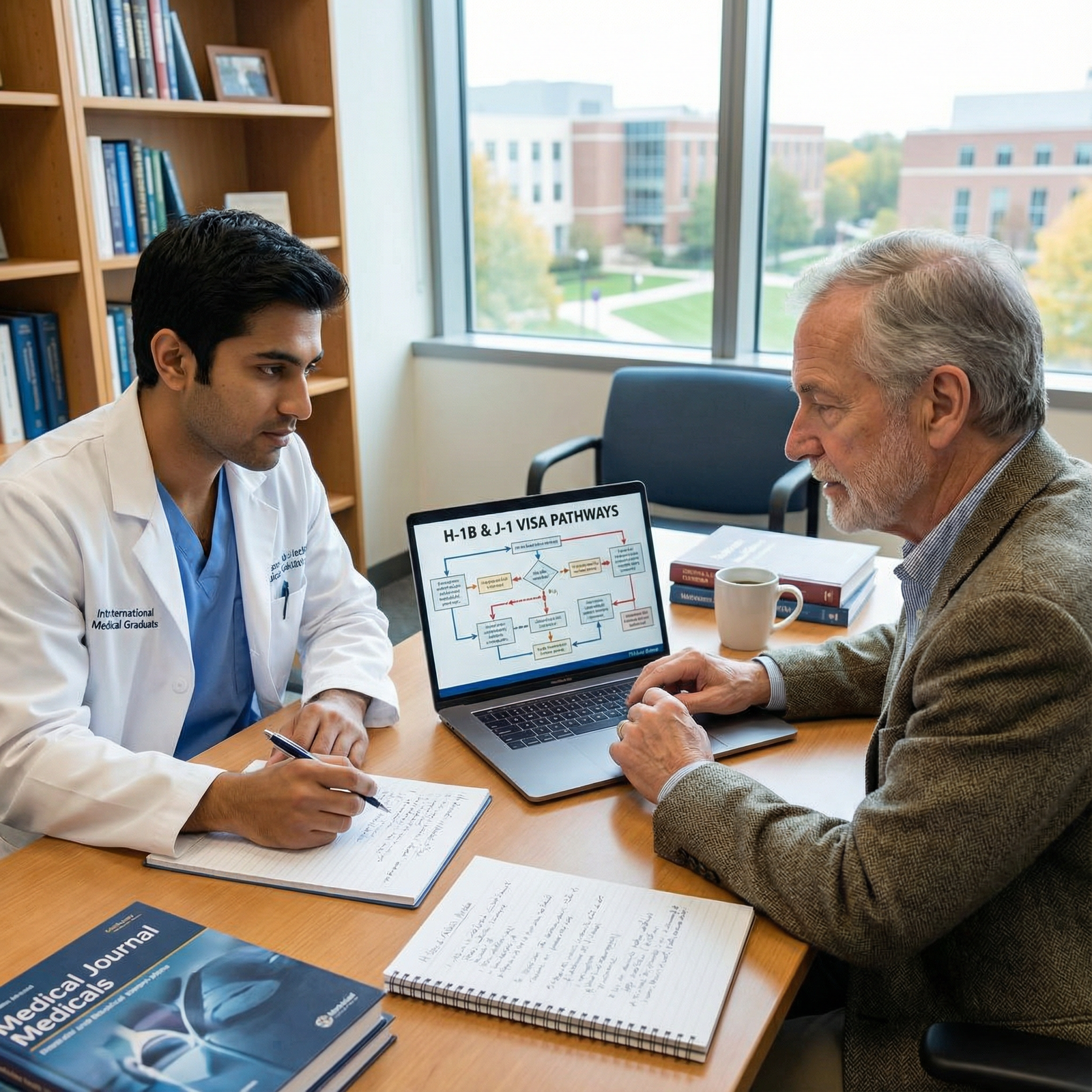
Understanding the Visa Landscape for IMGs in Interventional Radiology
For an international medical graduate, navigating visas can feel more intimidating than studying for the Boards—especially in a niche, highly competitive field like interventional radiology (IR). This IMG residency guide focuses specifically on visa navigation for residency in Interventional Radiology and breaks down how immigration issues intersect with the IR match, training structure, and long-term career planning.
Interventional radiology is unique because:
- It has integrated (IR/DR) residencies, independent IR residencies, and transitional pathways through diagnostic radiology (DR).
- Training is typically longer and more structured than many other specialties.
- Many IRs ultimately seek academic appointments or hospital employment, which can influence which visa type (J-1 vs H-1B) is more advantageous.
Before diving into complex scenarios, anchor yourself in three core principles:
- Program first, visa second. You must secure a training position before a visa can be issued.
- Visa type shapes your future. Your choice between J-1 vs H-1B for residency can determine how and where you practice after training, especially if you aim to stay in the U.S.
- IR pathway = multiple stages. For IR, you must think beyond “residency” and consider how visas will work from:
- Internship → DR residency → IR years (for integrated programs), or
- DR residency → independent IR residency.
In other words, you’re not just planning for the match—you’re planning for the entire training continuum and your early career.
The Main Visa Types for IMGs Entering IR Training
There are three visa categories most relevant to an international medical graduate entering an interventional radiology track: J-1, H-1B, and permanent residency (green card). Most IMGs start training on J-1 or H-1B, then later transition to other statuses.
1. The J-1 Exchange Visitor Visa (ECFMG-Sponsored)
The J-1 is the most common residency visa for IMGs training in the U.S.
Key features:
- Sponsor: ECFMG (Educational Commission for Foreign Medical Graduates)
- Purpose: Clinical training and graduate medical education
- Annual renewal: Must be renewed yearly with ECFMG, based on continued participation in an accredited training program
- Home residency requirement: Usually subject to 2-year home country physical presence requirement after completion of training, unless a waiver is obtained
For IR specifically:
- J-1 can cover all your GME years, including:
- Transitional/preliminary year
- Diagnostic Radiology (DR)
- Integrated IR years (PGY-5 and PGY-6)
- Or independent IR residency after DR
- Total clinical training time is limited to 7 years under standard J-1 rules. Extensions are possible in limited, well-justified circumstances (e.g., some research years, certain subspecialties), but should not be assumed.
Advantages of J-1:
- Widely accepted by teaching hospitals, including top academic IR programs.
- Application process is standardized through ECFMG.
- Often easier to secure for residency than H-1B, especially in programs that do not want the added complexity of employer-sponsored work visas.
Challenges of J-1 for IR:
- Two-year home residency requirement after completing training:
- You must return to your home country for two years or obtain a J-1 waiver to remain in the U.S. long term.
- This can complicate transitions into IR fellowships (if applicable), jobs, or further training.
- Some IR applicants aiming to remain in the U.S. long term prefer H-1B to avoid the home return requirement.
However, J-1 waivers (e.g., Conrad 30 or federal programs) can be powerful pathways to stay and work, especially if you can accept underserved or rural positions that may not have an IR-heavy practice but sometimes include IR components.
2. The H-1B Temporary Worker Visa for Residency
The H-1B is a temporary professional worker visa that some hospitals sponsor for GME positions.
Key features:
- Sponsor: The employing institution (hospital or academic center)
- Purpose: Employment in a specialty occupation (in this case, physician)
- Duration: Usually granted in increments up to a maximum of 6 years, including any time in H-1B status before residency.
- Prevailing wage: The employer must pay at least a prevailing wage set by labor regulations.
For interventional radiology residency and DR/IR training:
- H-1B can cover:
- Preliminary year (if hospital sponsors it)
- DR residency
- Integrated IR years or independent IR residency
- You must carefully calculate your total training duration so it fits within H-1B limits (or plan for specific exceptions, such as time recaptured from outside the U.S.).
Advantages of H-1B for IR IMGs:
- No automatic 2-year home residency requirement like J-1.
- Easier transition from training to employment-based green card sponsorship.
- Attractive if your goal is to remain in the U.S. and practice IR after training, especially in competitive metropolitan markets.
Disadvantages and challenges:
- Not all IR or DR programs sponsor H-1B. Many state explicitly: “J-1 only.”
- Higher administrative and legal cost for institutions; may deter some programs.
- Requires:
- USMLE Step 3 completed before H-1B filing (common requirement)
- More lead time and paperwork compared to J-1.
In reality, you’ll see three types of programs:
- J-1 only (majority of university IR/DR residencies).
- J-1 or H-1B (flexible and IMG-friendly, often strong academic centers).
- No visa sponsorship (rare for major academic centers, but some community-linked IR programs may be this way).
If you strongly prefer H-1B, your IR match strategy must filter and prioritize H-1B-friendly programs from the beginning.
3. Permanent Residency and Other Less Common Paths
Entering IR residency already as a U.S. permanent resident (green card holder) or U.S. citizen sidesteps the entire residency visa issue.
Common routes include:
- Family-based immigration (e.g., U.S. citizen spouse).
- Diversity visa lottery, where applicable.
- Transitioning from F-1 (student) status with Optional Practical Training (OPT) into employment-based green card, then applying to residency.
- Country-specific visas (e.g., E-3 for Australian nationals) or other niche categories, which are less common for medical residency.
For most international medical graduates targeting interventional radiology, however, the meaningful choices are between J-1 vs H-1B.
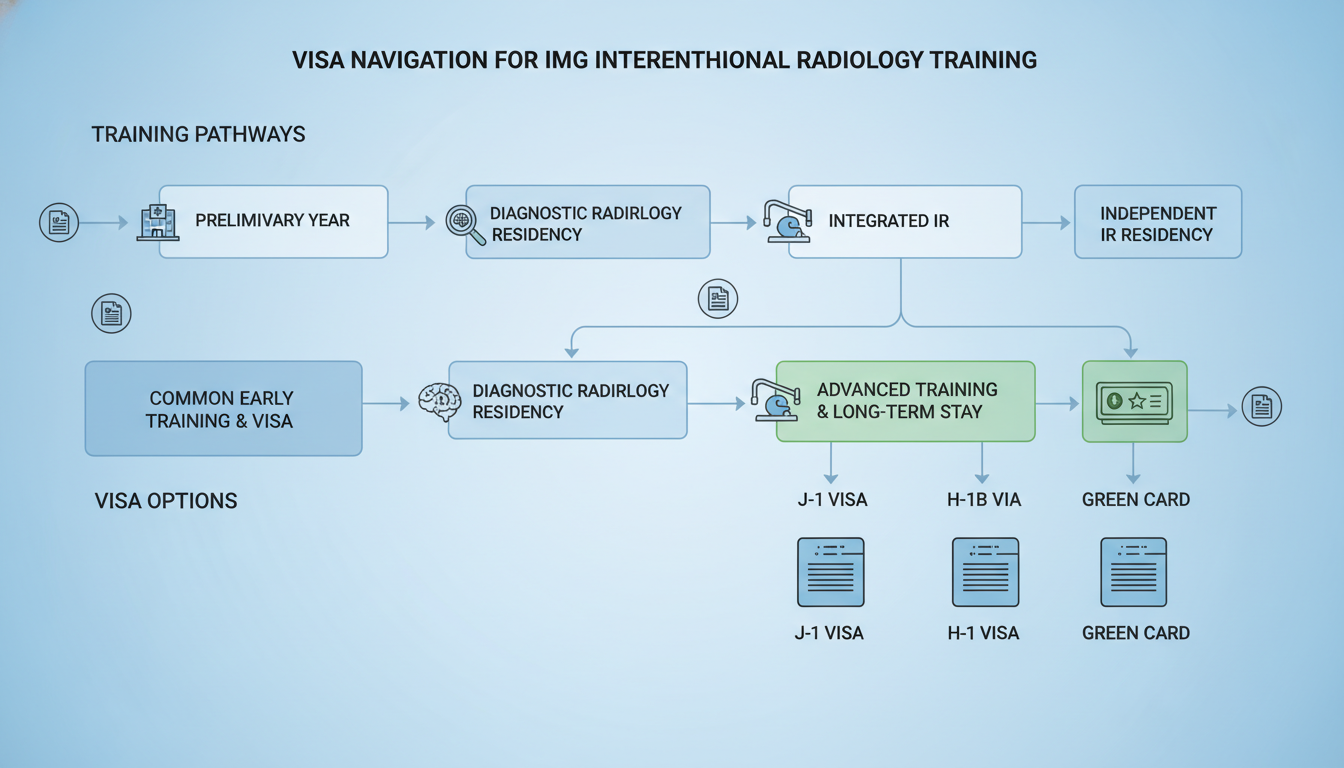
How Visa Status Interacts with IR Training Pathways
Interventional radiology is not a simple three-year residency. As an IMG, you must align your IMG visa options with the full training sequence and the IR match structure.
Overview of IR Training Structures
Integrated IR/DR residency (most popular path now):
- Length: 6 years (PGY-1 to PGY-6)
- Includes:
- Clinical internship (surgical, transitional, or preliminary medicine year)
- DR core training
- Dedicated IR years
Independent IR residency (traditional post-DR path):
- After 4-year DR residency
- Typically 2-year independent IR residency (PGY-6–7)
Early specialization in IR (ESIR):
- A DR resident completes extra IR-focused training during DR years
- May shorten independent IR residency (e.g., to 1 year)
From a visa standpoint, you must ask:
“How many years of GME will I need from start to board-eligible IR, and can my visa realistically cover that?”
J-1 for Integrated IR/DR
An integrated IR/DR residency is usually 6 years total:
- Under J-1, the 7-year cap is typically sufficient:
- Year 1: Internship
- Years 2–4: DR
- Years 5–6: IR
- This leaves a 1-year buffer that might allow:
- An additional fellowship (e.g., neuroIR) if total remains under 7 years
- Rare extensions for research or exceptional circumstances (case-by-case)
For most IR IMGs, an integrated program on J-1 is structurally feasible. The challenge is not the length, but the post-training 2-year home residency requirement.
H-1B for Integrated IR/DR
Under H-1B:
- Maximum: 6 years total in H-1B status.
- If your entire IR/DR training is done under H-1B, you use essentially all available H-1B time (6 years).
- If you have previous H-1B employment (e.g., in another U.S. role, or research), that reduces the remaining time.
This setup is workable if:
- The program sponsors H-1B continuously.
- You have no significant prior H-1B usage.
- You plan your long-term path toward green card sponsorship during or soon after residency.
Some institutions prefer to place interns (PGY-1) on J-1 or a different visa and then transition to H-1B for DR/IR years; this is complex and not universally available. You must confirm with the GME office how they handle multi-year H-1B sponsorship.
J-1 vs H-1B for DR + Independent IR
If you pursue IR via DR residency + independent IR residency:
- DR residency: 4 years (PGY-2–5)
- Independent IR: 1–2 years (PGY-6–7)
- Total: 5–6 years after internship, 6–7 including PGY-1.
On J-1:
- Still typically within the 7-year cap.
- You can:
- Do DR on J-1, then independent IR on J-1.
- Or DR on J-1 and seek a J-1 waiver job after training instead of independent IR (less ideal if IR is your core goal).
On H-1B:
- The 6-year limit becomes tighter:
- If DR is on H-1B for 4 years, you only have ~2 years left for IR.
- Independent IR can still fit if it’s 1–2 years.
- If you want a fellowship after IR (e.g., neurointerventions), you may hit the 6-year ceiling unless:
- You’ve applied for a green card with an approved I-140 and qualify for H-1B extensions beyond 6 years; or
- You spent time outside the U.S. that can be “recaptured.”
Practical tip: During interviews, explicitly ask IR and DR program directors:
- “Do you sponsor H-1B for all years of training, including IR years?”
- “Have you previously sponsored H-1B for IMGs in IR or DR?”
- “How many years of training can you support under H-1B status?”
Strategizing Your IR Match with Visa in Mind
Your IR match success depends not only on your scores, research, and letters, but also on aligning with programs compatible with your visa needs. Here’s a structured approach.
1. Researching Programs’ Visa Policies Early
Treat visa policy as a filter, not an afterthought.
Use these sources:
- Program websites: Most list “We sponsor J-1 only” or “J-1 and H-1B.”
- FREIDA / ACGME / ERAS listings: Check the “Visa Sponsorship” section.
- Direct email to program coordinators: Ask politely when not clearly stated.
Questions to ask (email or interview):
- “Do you sponsor J-1, H-1B, or both for interventional radiology (and diagnostic radiology, if integrated)?”
- “Is H-1B sponsorship guaranteed for all matched candidates if requested, or subject to case-by-case approval?”
- “Do you have experience training IMGs under H-1B in IR or DR?”
Keep a spreadsheet with:
- Program name
- IR pathway (integrated / independent)
- Visa types accepted
- Notes from coordinator replies
This allows you to build a realistic rank list that matches your visa strategy.
2. Deciding Between J-1 and H-1B as an IR-Bound IMG
This is often the central question: J-1 vs H-1B?
Choose J-1 if:
- You want to maximize your choice of programs and prioritize matching into a strong IR training environment above all else.
- You are open to:
- Returning to your home country after training, or
- Using a J-1 waiver to work in underserved/rural areas (likely heavy on general radiology, sometimes with IR).
Choose H-1B if:
- Your priority is to remain in the U.S. long term without a mandatory 2-year home return.
- You’re comfortable limiting your applications to H-1B-friendly IR/DR programs.
- You already completed or plan to complete USMLE Step 3 early enough for H-1B processing.
Hybrid strategies:
- Some IMGs apply broadly without a firm stance, then:
- Accept J-1 offers if they come from top-tier IR programs.
- Prefer H-1B if they have equivalent program options.
- Others commit fully to H-1B and won’t rank J-1 only programs high, accepting that this may lower match probability.
There is no universally “right” answer. The decision hinges on your risk tolerance, career geography goals, and how much you value immediate IR training prestige vs long-term U.S. immigration flexibility.
After Residency: Waivers, Green Cards, and Long-Term IR Careers
Your visa planning does not end once you match. As an ambitious interventional radiologist, you must envision what happens after training, when you transition into attending roles.
If You Trained on J-1
Unless you obtained an exception, you’ll face the 2-year home country requirement. Main ways around it:
1. Return Home for 2 Years
You:
- Return to your country of nationality or last permanent residence.
- Practice there for 24 continuous months (or cumulative, depending on the interpretation and your documentation).
- After fulfilling this, you may apply for:
- H-1B employment in the U.S.
- Certain immigrant (green card) visas.
For some IRs, this is an opportunity to build international IR programs or high-impact IR services in resource-limited settings. For others, it feels like an unwanted delay.
2. J-1 Waiver Jobs (Most Popular for IMGs)
You obtain a waiver of the home requirement by agreeing to work in an underserved area under specific conditions, typically:
- Conrad 30 program (state-based):
- Each state can sponsor up to 30 J-1 waiver physicians yearly.
- Historically focused on primary care, but some states accept specialists, including radiologists and occasionally IR.
- Federal waiver programs (e.g., VA, HHS):
- May offer more flexibility for specialists, but positions can be geographically limited.
For IR:
- Many J-1 waiver jobs will be general radiology posts in underserved communities, sometimes with part-time IR components.
- Pure, high-end academic IR positions are less likely to be J-1 waiver eligible, though not impossible (especially at VA hospitals or certain federal institutions).
The waiver job typically requires:
- 3 years of full-time work in the designated setting, under H-1B status.
- After that, you’re usually free to move to other roles and pursue permanent residency.
If You Trained on H-1B
You avoid the J-1 home requirement, but must manage the 6-year limit and plan for green card sponsorship if you intend to stay in the U.S. beyond that.
Common steps:
- During residency or IR fellowship:
- Negotiate with a future employer to sponsor your green card.
- Start the PERM labor certification and I-140 process as early as practical.
- Use:
- AC21 provisions for H-1B extensions beyond 6 years if your green card process reaches specific milestones.
- Eventually adjust status from H-1B to permanent resident.
For IR specialists:
- Academically inclined IRs often find university hospitals willing to sponsor green cards.
- Private practice IR/DR groups may also sponsor, especially in areas with physician shortages.
Key point: With H-1B, your main challenge is not a home residency requirement but building a stable employer relationship willing to invest in your immigration.
Special Considerations for IR-Focused IMGs
Because IR is both a procedural and technologically advanced field, IMGs face a few additional nuances.
1. Balancing Research, Observerships, and Visa Status
To strengthen your IR application:
- Many IMGs pursue research positions in IR or DR.
- Common visas for research: J-1 research scholar, F-1 OPT, or H-1B research.
However:
- Time spent in the U.S. on certain J-1 categories may still trigger home residency requirements.
- H-1B research time may count toward the 6-year H-1B cap, reducing future training eligibility.
Always confirm with an immigration attorney:
- “If I take this research position under J-1 or H-1B, how will it affect my ability to do residency later?”
- “Will this time count toward my J-1 or H-1B cap for clinical GME?”
2. USMLE Step 3 Timing for H-1B
For H-1B residency sponsorship:
- Many GME offices require USMLE Step 3 passed before filing the H-1B petition.
- Because IR/DR interviews happen early, aim to:
- Complete Step 3 before or during the application season, if you want to be a competitive H-1B candidate.
- Mention on your application that Step 3 is scheduled (with expected date) if not yet completed.
This may influence whether programs consider you viable for H-1B sponsorship for the upcoming July start.
3. Long Training and Life Planning
Interventional radiology training is intense and long:
- 6–7 years from PGY-1 to board eligibility.
- Additional fellowships or advanced subspecialization possible.
During this time:
- Your visa status affects your spouse and children (e.g., J-2 vs H-4).
- Spousal work authorization differs:
- J-2 spouses can often apply for work authorization (EAD).
- H-4 spouses typically cannot work unless certain green card milestones are met.
When evaluating offers, consider not only the quality of IR training, but also family implications of your chosen visa type and location.

Practical Action Plan for IR-Bound IMGs
To make this IMG residency guide operational, here is a step-by-step action plan for visa navigation:
Clarify your long-term goal.
- Do you want to:
- Train in IR and return home?
- Train and remain in the U.S. indefinitely?
- Your answer heavily influences J-1 vs H-1B preference.
- Do you want to:
Get your exams in order.
- Complete USMLE Step 1, Step 2 CK, and ideally Step 3 before ERAS if you want to keep H-1B realistic.
Map your IR pathway.
- Decide whether you are targeting:
- Integrated IR/DR directly through NRMP.
- DR with the long-term aim of independent IR (plus possible ESIR).
- Analyze how many total GME years you will need.
- Decide whether you are targeting:
Create a visa-aware program list.
- Build a spreadsheet of IR/DR and DR programs:
- Visa types sponsored (J-1 only vs J-1/H-1B)
- IR tracks available (integrated, ESIR, independent)
- Balance:
- Academic prestige
- IR case volume
- Visa compatibility
- Build a spreadsheet of IR/DR and DR programs:
Contact coordinators early.
- Clarify ambiguous visa statements.
- Ask specifically about previous IMGs and H-1B sponsorship track record.
Consult an immigration attorney.
- Especially if:
- You’ve had previous J-1 or H-1B stay.
- You are transitioning from another visa (F-1, B-1/B-2, J-1 research).
- You aim for a green card as soon as possible.
- Especially if:
Prepare for interviews.
- Be ready to discuss:
- Your visa needs clearly and professionally.
- Flexibility (e.g., “I’m open to J-1 if that aligns best with your GME policies.”).
- Avoid vagueness; program directors appreciate candidates who understand their own situation.
- Be ready to discuss:
Plan for post-training early.
- During later years of IR/DR training:
- Explore J-1 waiver options if on J-1.
- Seek employers willing to sponsor green cards early if on H-1B.
- Talk to senior IMGs in IR who have navigated the same path—you’ll learn practical employer and state-specific nuances not easily found online.
- During later years of IR/DR training:
FAQ: Visa Navigation for IMGs in Interventional Radiology
1. Is it harder to match into interventional radiology as an IMG because of visa issues?
Visa needs add complexity, but many IR and DR programs are experienced with IMGs. The main effect is that your list of realistic programs is smaller if you need H-1B only, and you must be especially strategic. Strong scores, robust IR-related research, U.S. clinical exposure, and clear communication about visa status can offset some of this disadvantage.
2. Can I switch from J-1 in DR to H-1B for independent IR?
It is theoretically possible to change status from J-1 to H-1B, but not without addressing the J-1 home residency requirement. Unless you obtain a J-1 waiver, you generally cannot change to H-1B or permanent resident status within the U.S. Simply starting independent IR on H-1B after DR on J-1 is usually not possible without a waiver or fulfilling the 2-year home requirement. You should plan the entire DR + IR sequence under a consistent, realistic visa strategy.
3. Do all IR-integrated programs sponsor H-1B visas?
No. Many integrated IR/DR programs sponsor J-1 only. A subset, often at large academic centers, sponsor both J-1 and H-1B. You must check each program individually—there is no universal rule. Some institutions that sponsor H-1B for other specialties might still choose J-1 only for radiology or IR.
4. If I plan to return to my home country after IR, should I still consider H-1B?
If your long-term plan is to return home, J-1 often makes more sense:
- It is more widely accepted and may open more program options.
- The 2-year home residency requirement aligns with your plan anyway. H-1B is more useful if you want to stay in the U.S. long term. That said, if you have easy access to H-1B (e.g., prior U.S. status, strong program support), it can still be beneficial for future flexibility, but it is not essential if your end goal is to leave the U.S. after training.
Navigating visas as an international medical graduate in interventional radiology requires the same mindset that IR demands in the angiography suite: careful planning, familiarity with all your tools, and readiness to adapt your approach. By understanding J-1 vs H-1B trade-offs, aligning them with IR training structures, and planning early for post-residency options, you can build not only a competitive IR application—but a sustainable, long-term career in the U.S. or abroad.