
Understanding the Visa Landscape for Medicine-Psychiatry IMGs
For an international medical graduate planning to train in a medicine-psychiatry combined program in the United States, understanding visa pathways is as critical as polishing your CV or perfecting your personal statement. A strong IMG residency guide must address not only how to match, but also how to stay in status legally and plan for future career options.
Visa rules are federal immigration law, but how they are applied can differ significantly between hospitals and residency programs. Med psych residency programs are relatively few in number and training is longer (5 years instead of 3), so your residency visa strategy must be even more deliberate than in categorical internal medicine or psychiatry alone.
In this article, you’ll find:
- A structured overview of IMG visa options (with a focus on J-1 vs H-1B)
- How visa choice specifically impacts medicine-psychiatry combined training
- Practical steps to research and prioritize programs based on visa sponsorship
- Long-term planning: fellowship, waiver jobs, and permanent residency
- Common pitfalls and FAQs tailored to IMGs in med-psych programs
Throughout, assume that rules can change—always verify details with official sources (ECFMG, program coordinators, and institutional graduate medical education [GME] offices) before making final decisions.
Core Visa Options for IMGs: J-1 vs H-1B (and Others)
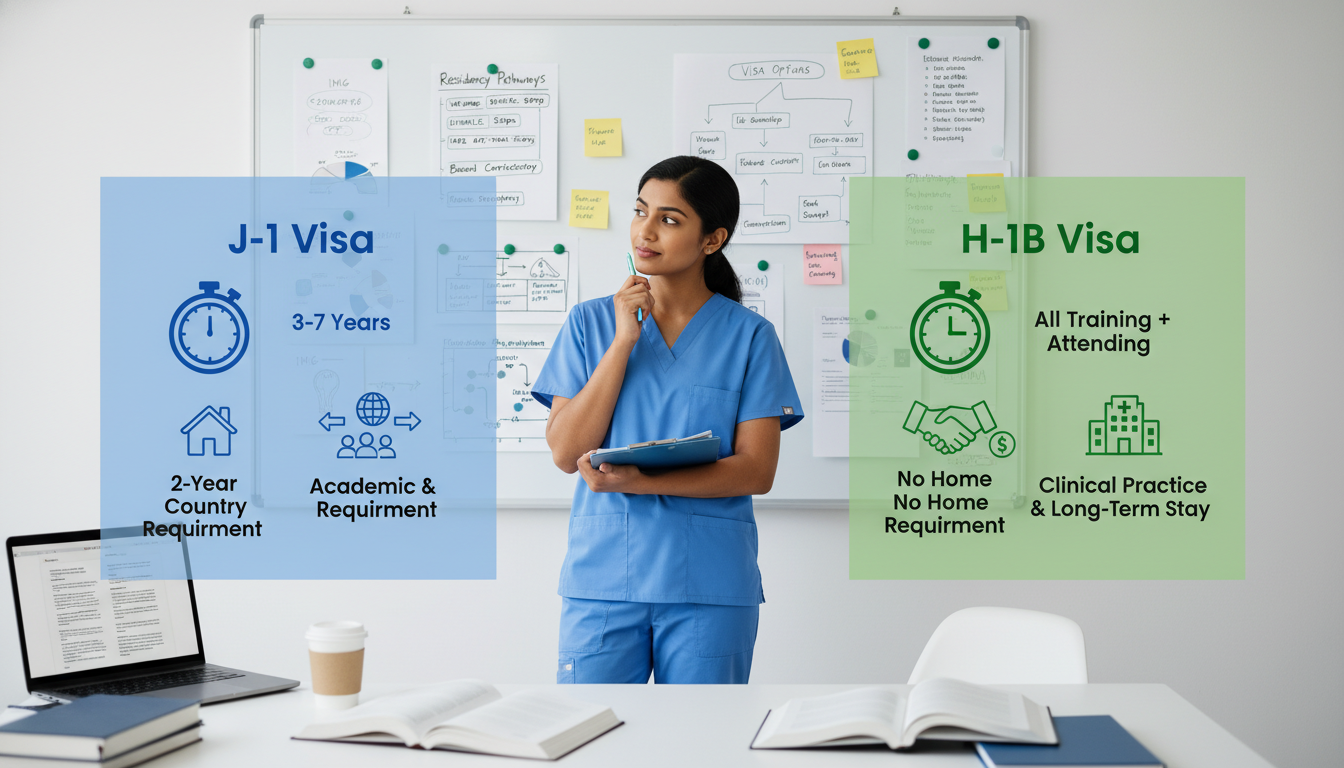
Most IMGs training in U.S. graduate medical education fall into two main residency visa categories: the J-1 physician visa and the H-1B temporary worker visa. Understanding these is foundational before you even formulate your program list.
J-1 Physician Visa: The Most Common Path
For residency, the J-1 physician visa is sponsored not by individual hospitals, but by the Educational Commission for Foreign Medical Graduates (ECFMG). It is the primary route for IMGs entering GME.
Basic features
- Sponsor: ECFMG (not the hospital directly)
- Purpose: Graduate medical education/training only
- Duration: Typically valid for the length of the training program, with annual renewals; cumulative maximum usually 7 years for clinical training
- Home-country requirement: 2-year home residence requirement after completion of training, unless waived
- Work restriction: You can only work for the training program(s) listed on your DS-2019; moonlighting is heavily restricted
Advantages for a medicine-psychiatry IMG
- Availability: Almost all med psych residency programs that accept IMGs sponsor J-1 visas. If you are flexible on visa type, you will have a broader program list.
- Predictability: ECFMG has an established process for physician J-1 sponsorship. Programs are usually very familiar with the documentation and timelines.
- Multiple training phases: If you later pursue fellowship (e.g., child and adolescent psychiatry, addiction, consultation-liaison), you can typically continue on J-1 within the overall time limit.
Disadvantages and challenges
- 2-year home-country requirement: After finishing training (residency + any fellowship), you must:
- Return to your home country for at least 2 years cumulatively, or
- Obtain a J-1 waiver (e.g., Conrad 30, federal agency waiver) before changing to H-1B or permanent residence (green card) inside the U.S.
- Limited moonlighting: Many institutions prohibit J-1 moonlighting completely. This can impact income, though it also gives more time for rest and board preparation.
- Dependents (J-2): Can usually get employment authorization, but must apply for it; processing times vary.
For a 5-year medicine-psychiatry combined residency, the 7-year typical J-1 training limit usually permits either:
- 5 years of residency + up to 2 years of fellowship, or
- 5 years residency + 1 year fellowship and 1 additional clinical year
You must plan early if you are interested in lengthy subspecialty training.
H-1B Visa: A More Flexible but Less Common Option in GME
The H-1B is a temporary worker visa used across many industries. In medicine, some hospitals sponsor residents and fellows on H-1B.
Basic features (for residency)
- Sponsor: The specific hospital/institution (not ECFMG)
- Purpose: Specialty occupation, which can include residency/fellowship
- Requirements:
- Must have passed USMLE Step 3 before H-1B filing (timing-sensitive)
- Must have a valid state training license or full license requirements as applicable
- Duration:
- Usually up to 6 years total (with possible extensions in some green card processes)
- No 2-year home return requirement like J-1
Advantages for a medicine-psychiatry IMG
- Flexibility for long-term U.S. career:
- No mandatory 2-year home-country stay
- Allows smoother transition into post-residency employment and green card processes
- Employment mobility: Easier to continue working in the U.S. immediately after residency (as long as you have an employer willing to sponsor and transfer H-1B)
- Moonlighting: Often institution-dependent rather than visa-prohibited; some residents can moonlight if program and state rules allow.
Disadvantages and challenges
- Fewer programs sponsor it: Especially for a 5-year medicine-psychiatry program, some institutions avoid H-1B because of cost, complexity, and duration limitations.
- Step 3 requirement: You must have USMLE Step 3 passed well before your H-1B petition is filed (usually by spring before residency starts). For IMGs, scheduling and passing Step 3 in time can be challenging.
- Cap issues (sometimes):
- Many teaching hospitals are cap-exempt (because they are universities or affiliated nonprofits), but not all.
- Cap-exempt status is a major advantage, but you must confirm with each program.
- Spouse/dependents (H-4): Generally cannot work unless they have their own status (e.g., H-1B) or qualify under limited EAD rules tied to your green card stage.
Special concern for med-psych training duration
For a 5-year medicine-psychiatry combined residency, the 6-year H-1B limit leaves less room for additional fellowships unless:
- You have prior H-1B time in a cap-exempt environment and plan to continue in cap-exempt positions, or
- You initiate a green card process early with an employer who can help extend beyond 6 years under certain immigration rules.
This makes early planning even more crucial for med-psych residents.
Other Visa Categories: Rare, but Sometimes Relevant
While the vast majority of IMGs in residency are on J-1 or H-1B, you may encounter other residency visa options:
O-1 (Extraordinary Ability):
- For individuals with significant, documented achievements (major publications, international recognition).
- Rarely used for residency, more common among established physician-scientists.
U.S. Permanent Resident (Green Card):
- Not a visa, but if you already hold a green card, you do not need a separate residency visa.
- Strong advantage in matching and in career flexibility, but most IMGs do not start here.
Other dependent statuses (e.g., F-2, L-2):
- If you enter the U.S. as a dependent, you may still need to change your status to J-1 or H-1B to undertake clinical training, depending on your category.
For practical purposes, if you are reading an IMG residency guide for medicine-psychiatry, assume you are choosing primarily between J-1 vs H-1B.
How Visa Type Interacts with Medicine-Psychiatry Combined Training
Medicine-psychiatry combined residency is a unique, demanding pathway that intertwines internal medicine and psychiatry over five years, leading to board eligibility in both specialties. The structure of this training amplifies the implications of your visa choice.
Training Length and Visa Limits
J-1:
- Typical ECFMG limit: about 7 years for clinical training.
- A standard med-psych residency is 5 years.
- This usually leaves 2 additional years for:
- Psychiatry fellowship (e.g., consultation-liaison, addiction, forensic, child/adolescent),
- Or internal medicine fellowship (e.g., geriatrics, addiction medicine),
- Or an additional academic/clinical year.
However, exceptions or policy updates can apply; always verify current ECFMG rules before committing to multi-step training plans.
H-1B:
- Standard maximum: 6 years total.
- If you spend all 5 years of your H-1B in a med-psych residency, you may only have 1 year remaining for fellowship or attending-level work before needing an extension.
- Extensions beyond 6 years are often tied to:
- Timely filing of a green card through an employer, and
- Specific milestones in the permanent residency process (e.g., I-140 approval).
For medicine-psychiatry IMGs with strong interest in multiple fellowships, a J-1 route followed by a waiver job may be more realistic than trying to fit everything into an H-1B timeline—unless you have an exceptionally proactive employer and immigration attorney.
Board Eligibility and Program Requirements
Visa type does not affect your eligibility for:
- American Board of Internal Medicine (ABIM),
- American Board of Psychiatry and Neurology (ABPN),
as long as:
- Your medicine-psychiatry program is ACGME-accredited, and
- You complete all required rotations and milestones.
However, your visa can affect:
- Availability of certain off-site rotations (e.g., affiliated VA hospitals or community clinics), particularly if your DS-2019/H-1B petition must list specific work sites.
- Your ability to engage in research positions or extended electives outside your program’s primary hospitals.
Always discuss with your program director before accepting research or moonlighting roles, to ensure they are consistent with your residency visa terms.
Med-Psych Career Paths and How Visa Choice Shapes Them
Combined training opens multiple career directions:
- Academic med-psych faculty: Working across medicine and psychiatry departments; often hospital-employed.
- Consultation-liaison psychiatry with strong medical focus: Especially in transplant, HIV, oncology, ICU.
- Integrated primary care-mental health models: Particularly in safety-net systems, VA, or large health systems.
- Addiction medicine or geriatrics with both medical and psychiatric complexity.
J-1 implications:
- You will likely need a Conrad 30 waiver job or another federal waiver in an underserved area after training.
- Many such positions are more primary-care or psychiatry focused, but some states and institutions appreciate med-psych dual training for:
- Rural hospitals with no in-house psychiatry,
- Integrated behavioral health clinics,
- Safety-net systems with high comorbidity.
H-1B implications:
- You may transition directly into:
- Academic med-psych roles,
- Hospitalist + psychiatry combinations,
- Subspecialty fellowships, if you still have H-1B time left or can obtain an extension.
Your long-term goal should strongly influence how you rank J-1 vs H-1B friendly programs.
Strategic Program Selection: Matching Visa Policy to Your Priorities
Your residency visa options are not abstract—they must be aligned with actual program policies. For a medicine-psychiatry candidate, the number of programs is relatively small, so detailed research is both feasible and important.
Step 1: Clarify Your Own Priorities
Before you look at programs, define what matters to you:
Visa flexibility vs. number of programs
- Are you open to J-1 to maximize options?
- Or is H-1B essential for your long-term plan (e.g., you cannot accept a 2-year home return)?
Timeline for USMLE Step 3
- Can you realistically pass Step 3 by early spring of the Match year?
- If not, H-1B may be unrealistic for starting residency that July.
Long-term career intention
- Academic career, multiple fellowships → J-1 + waiver may be acceptable.
- Immediate green card path, avoidance of J-1 home-return rule → H-1B may be worth narrowing your list.
Step 2: Research Program Visa Policies
Use multiple sources to confirm:
Program websites:
- Look for “International Medical Graduates” or “Visas” sections.
- Note if they state “J-1 only,” “J-1 and H-1B,” or “No visa sponsorship.”
FREIDA and program directories:
- Some list whether they sponsor J-1 or H-1B.
Email the program coordinator (politely and concisely):
- Ask specifically:
- “Do you sponsor J-1 visas for residents?”
- “Do you ever sponsor H-1B visas for residents?”
- “If so, are there additional conditions (e.g., Step 3 by interview, only after PGY-2, etc.)?”
- Ask specifically:
Keep a spreadsheet tracking:
- Program name, location
- Visa policy (J-1, H-1B, both)
- Step 3 requirement for H-1B
- Any notes from email replies or open houses
This turns abstract “IMG visa options” into concrete, strategic data.
Step 3: Use Visa Policy to Shape Your Application List
For a strong med psych applicant:
If you are open to J-1:
- Apply broadly to all J-1-sponsoring programs aligned with your other criteria.
- Include a subset of programs that also offer H-1B if available, to keep options open in case your Step 3 timeline works out.
If you must have H-1B:
- Focus on programs explicitly stating H-1B sponsorship and match their demands:
- Step 3 passed early,
- Possibly higher USMLE scores or research for competitiveness.
- Be realistic: this may significantly reduce the number of med-psych programs you can apply to.
- Focus on programs explicitly stating H-1B sponsorship and match their demands:
If you already hold a green card or other independent work authorization:
- Highlight this subtly in your application (personal statement or ERAS) since it simplifies program logistics.

Practical Tips for Managing the Residency Visa Process
Beyond understanding J-1 vs H-1B, you must manage deadlines and documents carefully. Visa issues can derail even an excellent match.
Document Preparation and Timing
Start early with Step 3 (if considering H-1B):
- Aim to:
- Take Step 3 by late fall or early winter of the application cycle.
- Have your score available by January–February.
- Delays can prevent H-1B filing in time, forcing you toward J-1 even if the program sponsors both.
- Aim to:
Keep your passport valid:
- Ensure your passport will be valid for at least 6–12 months beyond anticipated visa dates.
Maintain clear records:
- Medical school diploma and transcript
- ECFMG certification
- USMLE score reports
- Prior immigration documents (if you have been in the U.S. on another status)
Respond quickly to program and ECFMG requests:
- Delays in providing documents can compress visa processing time dangerously close to residency start dates.
After the Match: From Offer to Arrival
For J-1:
- Your residency program will confirm your match and initiate ECFMG’s J-1 sponsorship process.
- You will apply for a DS-2019 through ECFMG, providing:
- Proof of health insurance,
- Financial support documentation (usually your training contract),
- Required forms and fees.
- Once the DS-2019 is issued:
- Book a visa interview at a U.S. embassy or consulate.
- Prepare to explain your training plan and your intention to comply with J-1 rules.
For H-1B:
- The program’s legal office will file an H-1B petition with USCIS.
- You may need:
- Early state training license or permit,
- Step 3 proof,
- Credential evaluation documents.
- Processing times can be longer than J-1; some institutions may pay for premium processing to ensure timely approval.
Maintaining Status During Residency
Regardless of status:
- Do not:
- Work at unapproved locations.
- Take extended leaves or outside jobs without program and immigration approval.
- Do:
- Keep your address updated with your program and immigration authorities.
- Renew documents (DS-2019, I-94 records, H-1B approval notices) before they expire.
A medicine-psychiatry schedule is intense, with frequent service changes between medicine and psychiatry blocks. Always confirm that each training site is explicitly covered in your visa documentation.
Long-Term Planning: After Medicine-Psychiatry Residency
Your residency visa choices will profoundly influence what happens when you finish med-psych training.
If You Train on a J-1 Visa
You must address the 2-year home-country physical presence requirement. Options include:
Return home for 2 years:
- Some physicians accept positions in their home country’s academic or health system and may later apply again for U.S. opportunities.
- For many, this is difficult after integrating their careers into U.S. systems.
Apply for a J-1 waiver:
- Conrad 30 State Waiver:
- Each U.S. state can sponsor up to 30 J-1 physicians per year to work in underserved areas.
- These are often primary care or psychiatry-heavy roles; med-psych skills can be very attractive in rural or safety-net settings.
- Typically requires a 3-year full-time commitment on an H-1B visa post-training.
- Federal agency waivers:
- Agencies such as the VA, HHS, or the Department of Health may sponsor waivers for positions that meet national interest needs.
- For combined med-psych physicians, roles in complex systems (e.g., VA integrated care) can be strong fits.
- Conrad 30 State Waiver:
Spousal or family-based immigration:
- If you marry a U.S. citizen or permanent resident, other immigration paths might open, but these are personal and unpredictable.
If You Train on an H-1B Visa
Post-residency options can be more direct:
Move to an attending job:
- If your new employer is cap-exempt, they can often transfer your H-1B without limit issues.
- If cap-subject, you may need to enter the H-1B lottery unless you already have cap-exempt protections.
Apply for a green card through employment:
- Many employers (especially academic medical centers or health systems) sponsor PERM-based green cards.
- Starting this process early in your attending job is key to obtaining H-1B extensions beyond 6 years if needed.
Pursue fellowship:
- If you still have H-1B time left or are in a position where your fellowship institution can combine cap-exempt status with your previous H-1B use.
For medicine-psychiatry graduates, institutions highly value your dual board eligibility. This can strengthen your bargaining position when discussing visa sponsorship, especially in roles that need your integrated expertise.
FAQs: Visa Navigation for Medicine-Psychiatry IMGs
1. Is J-1 or H-1B better for a medicine-psychiatry residency?
“Better” depends on your priorities.
- J-1:
- More widely available across programs.
- Easier to obtain for GME.
- But requires a 2-year home-country stay or a waiver after training.
- H-1B:
- No home-country requirement.
- Better for a seamless long-term U.S. career and green card processes.
- But fewer med-psych programs sponsor it, and you must pass Step 3 early.
If your main goal is simply to enter a med psych residency and you are flexible about post-training geography, J-1 is usually more realistic. If avoiding the 2-year rule is critical and your application is strong with an early Step 3, targeting H-1B-sponsoring programs can be worthwhile.
2. Can I switch from J-1 to H-1B during or after my medicine-psychiatry residency?
Yes, but with conditions:
- During residency:
- Switching from J-1 to H-1B is uncommon and complex; it generally requires:
- Program support,
- Meeting H-1B requirements (Step 3, license),
- Often involves leaving and re-entering the U.S. or a change of status.
- Switching from J-1 to H-1B is uncommon and complex; it generally requires:
- After residency:
- You cannot simply change to H-1B unless:
- You fulfill the 2-year home-country requirement, or
- You obtain a J-1 waiver (e.g., Conrad 30) and then move into an H-1B waiver job.
- You cannot simply change to H-1B unless:
Plan with your program and an immigration attorney if you intend to transition from J-1 to H-1B.
3. Do I need to pass USMLE Step 3 to start residency on a J-1 visa?
No. For a J-1 residency visa, USMLE Step 3 is not required. You must:
- Have passed Step 1 and Step 2 CK,
- Have ECFMG certification,
- Meet all ECFMG and program requirements.
Step 3 becomes critical only if you or your program want you to start residency on an H-1B visa. Many IMGs complete Step 3 during PGY-1 or PGY-2 if they are on J-1.
4. Are medicine-psychiatry graduates competitive for J-1 waiver (Conrad 30) jobs?
Yes, often more than you might think. Many underserved and rural areas urgently need:
- Internal medicine physicians who are comfortable with serious mental illness, or
- Psychiatrists who understand complex medical comorbidities.
Your dual training can be highly attractive to:
- Community hospitals,
- Federally Qualified Health Centers (FQHCs),
- State mental health systems,
- VA or safety-net systems (when aligned with federal waiver programs).
However, availability of dual-role positions varies by state and institution. Start networking and exploring potential waiver employers by PGY-3 or PGY-4, so you can leverage your med-psych skill set fully.
By understanding the core IMG visa options, focusing your program search strategically, and planning early for the realities of a 5-year medicine-psychiatry combined residency, you can turn a complex visa landscape into a structured, manageable pathway toward your long-term career in U.S. healthcare.