Understanding the Visa Landscape for IMGs in Miami
For an international medical graduate (IMG), matching into Miami residency programs involves more than just strong scores and stellar letters of recommendation—it also requires a clear strategy for visa navigation. Programs in Miami and South Florida are accustomed to working with IMGs, but they vary significantly in their willingness and ability to sponsor different types of visas.
This IMG residency guide will walk you through:
- The main residency visa categories (with a focus on J‑1 vs H‑1B)
- How Miami and South Florida residency programs typically handle visa sponsorship
- Timeline and documents you need to plan for
- How to talk about visa issues with programs and on applications
- Common pitfalls and practical strategies to improve your chances
Throughout, the focus is on Miami and the broader South Florida residency environment, where the IMG community is large and diverse, and visa policies have important local nuances.
Core Visa Types for IMGs: J‑1 vs H‑1B (and Others)
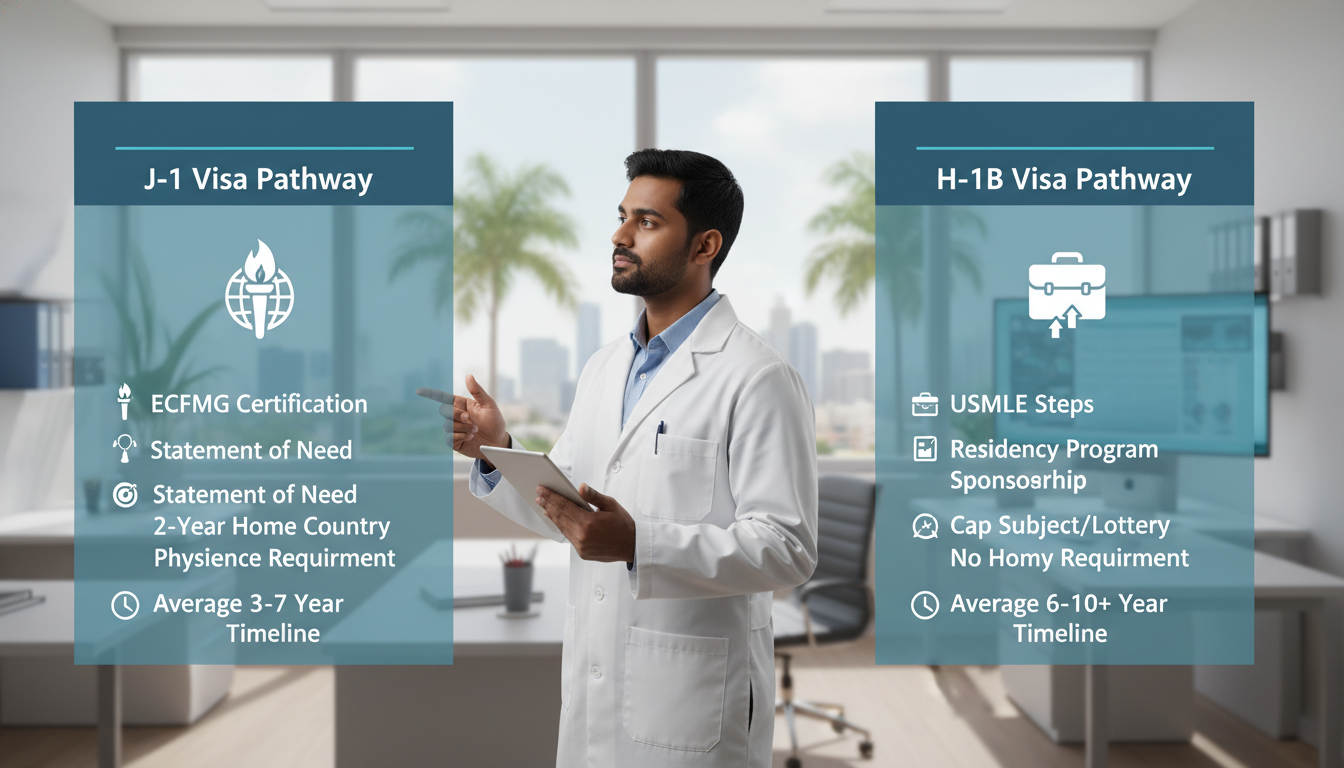
For graduate medical education (GME) in the United States, there are a few visa routes available, but two dominate: J‑1 (ECFMG-sponsored) and H‑1B (employer-sponsored). Understanding the tradeoffs of J‑1 vs H‑1B is essential before you start ranking Miami residency programs.
J‑1 Exchange Visitor Visa (ECFMG-Sponsored)
The majority of IMGs in U.S. residency programs use the J‑1 Exchange Visitor visa. For Miami and South Florida residency programs, J‑1 is often the default and, in many cases, the only visa option.
Key features of the J‑1 for residency:
- Sponsor: ECFMG (Educational Commission for Foreign Medical Graduates), not the individual hospital
- Purpose: Graduate medical education and training
- Program requirement: You must hold valid ECFMG certification and have a contract/offer from an accredited residency or fellowship program
- Duration: Typically valid for the length of your training program, renewed annually (up to a maximum, usually 7 years for clinical training)
- Funding: Must demonstrate financial support sufficient for living expenses (salary via residency contract usually satisfies this)
Critical issue: The two-year home residence requirement (212(e))
Most J‑1 clinical trainees are subject to a two‑year home-country physical presence requirement. This means:
- After finishing residency/fellowship, you must:
- Return to your home country for a cumulative 2 years, OR
- Obtain a waiver of this requirement before you can:
- Get H‑1B or L‑1 visa status, or
- Apply for permanent residence (green card)
If you plan to stay in the U.S. after training—particularly in Florida—your long‑term plan must include a J‑1 waiver strategy, such as:
- Conrad 30 Waiver (State 30 Program)
- VA or federal government agency waivers
- Hardship or persecution waivers (rarer, more complex)
We’ll discuss these in the context of Miami and South Florida later, but you must factor this requirement into your initial decision.
Advantages of J‑1:
- Widely accepted: Many Miami residency programs are “J‑1 only”
- Administrative experience: GME offices are familiar with ECFMG processes
- Predictable: Structured annual process; ECFMG provides clear guidelines
- Easier to obtain for new graduates compared to H‑1B in many specialties
Disadvantages of J‑1:
- Two-year home-country residence requirement
- More limited moonlighting opportunities in some programs (depends on policy)
- Less flexibility if you want to transition quickly to H‑1B or a green card pathway after residency
H‑1B Temporary Worker Visa
The H‑1B is the second major option—and often the preferred one for IMGs who intend to pursue long‑term practice and immigration in the U.S.
Key features of the H‑1B for residency:
- Sponsor: The residency program/hospital (as the U.S. employer)
- Purpose: Specialty occupation employment (physician is a qualifying specialty)
- Requirements:
- USMLE Step 3 usually required at time of petition (some state and institutional variations, but virtually all residency programs require Step 3 for H‑1B sponsorship)
- Valid ECFMG certification (unless you are a U.S. MD/DO grad)
- Duration:
- Typically 3-year initial period, up to a total of 6 years (with some extensions if you begin green card process)
Advantages of H‑1B:
- No automatic two‑year home‑country requirement
- Cleaner transition to:
- Employment after residency
- Green card processes (e.g., EB‑2, NIW, employer-sponsored PERM)
- Attractive to some employer-based immigration strategies in Florida after training
Disadvantages of H‑1B:
- Not all Miami or South Florida residency programs sponsor H‑1B; many restrict to J‑1
- Requires Step 3 early (before residency start), which can be challenging for IMGs still overseas
- Higher administrative cost and complexity for the program
- Cap issues are less relevant for most university or hospital systems (often cap‑exempt), but still some bureaucracy
Other Visa Types (Less Common for Residency)
A few additional visa and status categories occasionally arise, but they are less central in this IMG residency guide:
- O‑1 (Extraordinary Ability):
- Rare at the residency level, more often for established researchers or attending‑level positions.
- TN (for Canadian and Mexican citizens):
- Typically not used for residency GME positions; more common for physician employment after training.
- F‑1 with OPT/ STEM OPT:
- Some IMGs are already in the U.S. on F‑1 (e.g., MPH, PhD). You may use OPT for research or preliminary work but will still need J‑1 or H‑1B for clinical training.
- Green card or U.S. permanent resident:
- If you already hold a green card, you do not need a residency visa; you apply like a U.S. graduate for most visa-related purposes.
How Miami and South Florida Residency Programs Approach Visa Sponsorship
Miami and the broader South Florida region is one of the most IMG‑friendly areas in the U.S., but visa policies still vary widely between programs. Before you apply, research and categorize programs based on their residency visa policies.
Typical Visa Patterns in Miami & South Florida
In Miami, you’ll find a mix of:
- Large academic centers (e.g., university‑affiliated hospitals)
- Community-based programs with strong IMG representation
- Safety‑net hospitals serving diverse immigrant communities
- VA and county hospitals integrated into larger systems
Across these, common patterns are:
J‑1 Only Programs
- Many internal medicine, pediatrics, and family medicine programs
- Some surgery and subspecialty programs
- Often clearly state on their websites: “Accept J‑1 visas only”
- Advantage: They are very familiar with ECFMG and J‑1 processes
- Consideration: If you want H‑1B, these programs are not an option
J‑1 and H‑1B (Selective)
- Some Miami residency programs sponsor H‑1B only for particular specialties or only for highly competitive candidates.
- Conditions may include:
- USMLE Step 3 passed before rank list submission
- Strong academic profile or prior U.S. clinical experience
- Policies may change year to year depending on GME leadership and institutional legal teams.
Case‑by‑Case H‑1B Sponsorship
- Some South Florida residency programs do not commit publicly but have occasionally sponsored H‑1B in the past.
- What matters is:
- The stance of the program director (PD)
- The support of GME and legal/HR
- You may only learn about this during interviews or through alumni/upper‑year residents.
No Visa Sponsorship
- Rare in IMG-heavy Miami programs, but some institutions only consider:
- U.S. citizens
- Permanent residents
- Canadians with specific authorizations
- Typically more common in highly competitive or smaller subspecialty programs.
- Rare in IMG-heavy Miami programs, but some institutions only consider:
How to Research Visa Policies for Miami Programs
Use a structured approach:
Program Websites and FREIDA
- Check the “International Medical Graduates” or “Eligibility” sections.
- Look specifically for:
- “We sponsor J‑1 visas through ECFMG”
- “We sponsor both J‑1 and H‑1B visas”
- “We do not sponsor visas”
- On FREIDA, filter and verify visa options, but confirm directly with program websites (FREIDA data can be outdated).
Program Coordinator Emails
- If the website is unclear, send a concise email:
- Introduce yourself briefly
- Ask targeted visa questions:
- Do you sponsor J‑1 visas?
- Do you sponsor H‑1B visas for residents?
- Any additional requirements (e.g., Step 3 by a specific date)?
- If the website is unclear, send a concise email:
Residents and Alumni Networks
- Look up current residents on program websites or LinkedIn.
- If you see many IMGs from your region, politely ask:
- Which visa types are residents currently on?
- Any unofficial norms or expectations around H‑1B?
ECFMG and Institutional GME Offices
- ECFMG can confirm if a program is approved for J‑1 sponsorship.
- Some Miami institutions publish GME‑wide policies indicating whether they support H‑1B for residents/fellows.
Strategic Ranking Based on Visa Preferences
When creating your rank list for Miami and South Florida residency programs:
- If you are comfortable with J‑1 and plan a J‑1 waiver path later:
- Cast a wide net among J‑1 friendly programs.
- Focus more on fit, training quality, and location.
- If your priority is H‑1B and long‑term U.S. immigration:
- Prioritize programs that clearly sponsor H‑1B.
- Ensure you have Step 3 results ready by application or interview time.
- Keep in mind: restricting yourself to only H‑1B‑sponsoring programs may significantly reduce the number of programs you can apply to in Miami.
Step-by-Step Visa Preparation Timeline for IMGs Targeting Miami
Visa navigation should start long before you receive an offer. A clear timeline helps avoid last‑minute issues that can cost you a residency spot.
12–18 Months Before Match: Foundation and Planning
- Secure ECFMG Certification
- USMLE Steps 1 and 2 CK passed
- Primary source verification completed
- Evaluate Your Long‑Term Plan
- Are you open to J‑1 and a future J‑1 waiver in Florida or elsewhere?
- Or is H‑1B a priority for you and your family’s immigration plans?
- Research Miami and South Florida Residency Programs
- Create a spreadsheet with:
- Program name, specialty
- IMG friendliness (based on current residents)
- Visa policy (J‑1 only / J‑1 + H‑1B / no sponsorship)
- Step 3 requirement for H‑1B
- Create a spreadsheet with:
9–12 Months Before Match: Application Cycle
Finalize Program List
- Diversify:
- A mix of academic and community programs
- Different levels of competitiveness
- For H‑1B‑seeking IMGs:
- Identify programs that historically sponsor H‑1B in Miami
- Diversify:
Plan Step 3 (if aiming for H‑1B)
- Target completion before interview season or at least before ranking.
- Note: Some Miami programs won’t promise H‑1B without a Step 3 pass in hand.
ERAS Application
- In your personal statement or experiences:
- Highlight realistic visa expectations (J‑1 vs H‑1B) only if you are directly asked or if relevant.
- Do not overcomplicate your application with visa details—programs will ask if needed.
- In your personal statement or experiences:
Interview Season (September–January): Clarifying Visa Options
During interviews with Miami and South Florida residency programs:
Appropriate Way to Ask About Visas
- You can ask the program coordinator or PD, for example:
- “Could you share how your program typically handles visas for IMGs?”
- “Do you currently sponsor J‑1 and/or H‑1B visas for residents?”
- Avoid sounding demanding or inflexible:
- Phrase questions as seeking information, not issuing conditions.
- You can ask the program coordinator or PD, for example:
Observe Existing Residents
- Ask: “What visa types are your current IMG residents on?”
- If there are multiple H‑1B residents, your odds of sponsorship are higher.
Post-Match (March–July): Visa Processing Phase
Once you match into a Miami residency program:
Confirm Visa Type with GME
- The GME office will usually contact you with instructions.
- Confirm:
- Will they proceed with ECFMG J‑1 sponsorship?
- Are they filing H‑1B for you? What is the timeline?
For J‑1 Visa (ECFMG Process)
- Submit:
- Form DS‑2019 application materials via OASIS or other ECFMG systems
- Financial documents (your contract often suffices)
- Proof of J‑1‑compliant health insurance
- After DS‑2019 issuance:
- Schedule visa interview at U.S. consulate in your country
- Prepare:
- Appointment letter
- ECFMG and residency program documents
- Proof of ties to your home country (if requested)
- Submit:
For H‑1B Visa
- Program will file H‑1B petition (Form I‑129) with USCIS.
- Your tasks:
- Provide documents: passport, diplomas, ECFMG cert, USMLEs (including Step 3)
- Attend visa stamping at U.S. consulate (if outside U.S.)
- Many academic medical centers in Miami are cap‑exempt, simplifying timing.
Arrival in Miami
- Carry:
- Visa and DS‑2019 (for J‑1) or H‑1B notice (I‑797)
- Original ECFMG certificate
- Contract and program letters
- Attend onboarding, occupational health clearance, and orientation.
- Carry:
Planning Beyond Residency: J‑1 Waivers and Long-Term Options in Florida
Visa navigation for residency should align with your long‑term career and immigration goals. This is especially true if you train in Miami but hope to stay in Florida afterward.
J‑1 Waiver Options After Residency
If you’re on a J‑1 visa, you’ll need a waiver to remain and work clinically in the U.S. without fulfilling the 2‑year home-country requirement.
Common waiver routes include:
Conrad 30 State Program (Florida)
- Each U.S. state can sponsor up to 30 J‑1 waivers per year.
- Requirements usually include:
- Employment in a federally designated health professional shortage area (HPSA) or medically underserved area/population (MUA/P)
- Full-time clinical practice (often 3 years commitment)
- In Florida:
- Many waivers are used in primary care and psychiatry, especially in underserved or rural counties.
- South Florida has some eligible locations, but many opportunities are outside major metro Miami.
- Strategy:
- Start exploring job options during your final years of residency/fellowship.
- Work with immigration counsel and potential employers early.
Federal Agency Waivers
- Offered by agencies such as:
- VA (Department of Veterans Affairs)
- HHS (Health and Human Services)
- Other federal entities serving underserved populations
- Usually involve employment at VA hospitals or specific federal clinics.
- Offered by agencies such as:
Hardship or Persecution Waivers
- Based on extreme hardship to a U.S. citizen/permanent resident spouse or child, or fear of persecution in your home country.
- Complex, legal-intensive, and not a primary strategy unless you truly qualify.
Transitioning from H‑1B to Permanent Residency
If you are in Miami on an H‑1B for residency or fellowship:
- After training, employers can:
- Continue H‑1B sponsorship for attending positions.
- Start a green card process (EB‑2 via PERM, or EB‑2 NIW if eligible).
- Many hospital systems in South Florida have in‑house or retained immigration attorneys and are accustomed to sponsor physicians.
Key tip: Maintaining clean immigration history and timely status is crucial. Keep all forms and approvals organized (I‑797s, I‑94 records, visa stamps).
Practical Strategies and Common Pitfalls for IMGs in Miami
Practical Strategies
Be Flexible Where Possible
- If your main goal is to train in Miami, consider accepting a J‑1 even if H‑1B would be ideal.
- You can still build a long‑term path via J‑1 waiver jobs in Florida or elsewhere.
Use Objective Information
- Don’t rely solely on hearsay from forums.
- Verify current visa practices with:
- Official program websites
- Direct emails to coordinators
- Current residents in that program
Prepare Early for Step 3
- If you may want H‑1B, aim to:
- Take Step 3 as soon as eligible.
- Have your result in time for applications or at least rank list deadlines.
- If you may want H‑1B, aim to:
Work with Legal Professionals When Needed
- For complex cases (previous U.S. visa refusals, changes of status, J‑1 waiver planning), consult an immigration attorney experienced with physicians.
- Many Miami hospitals have recommended legal partners; ask GME for referrals.
Common Pitfalls to Avoid
Assuming All Programs Sponsor H‑1B
- Many Miami residency programs sponsor J‑1 only.
- Don’t plan on “convincing” a J‑1‑only program to change policy just for you.
Ignoring the Two-Year Rule
- J‑1’s home-country requirement is not a small detail; it shapes your post‑residency options.
- Understand your future waiver possibilities before committing, especially if you have a spouse or children.
Waiting Too Long to Address Visa Issues
- Late Step 3 attempts, delayed document gathering, or failure to schedule consular appointments early can threaten your ability to start on time.
Overcomplicating Visa Discussion in Interviews
- Be honest and clear, but avoid making visa type the first or only topic you discuss.
- Programs want to see your commitment to patient care, training, and their mission—not only your visa priorities.
FAQs: Visa Navigation for IMGs in Miami Residency Programs
1. Do most Miami residency programs sponsor J‑1 or H‑1B visas for IMGs?
Most IMG‑friendly Miami residency programs sponsor J‑1 visas through ECFMG. A smaller but significant subset also sponsors H‑1B for qualified candidates (often with Step 3 completed). Always confirm at the program level; policies vary by institution and specialty.
2. If a program states “J‑1 only,” can I still ask them for an H‑1B?
You can ask for clarification, but you should not expect them to change policy. “J‑1 only” usually reflects institutional GME and legal decisions, not something a program director can easily alter for one applicant. Plan as if they truly mean J‑1 only.
3. Is it risky to train on a J‑1 if I want to stay in Florida after residency?
It depends on your flexibility. Many physicians successfully obtain J‑1 waivers through Florida’s Conrad 30 program or federal agencies and then continue in H‑1B and later pursue a green card. However, you must be willing to work in a designated underserved area (which may or may not be in Miami proper) for several years.
4. I’m already in the U.S. on F‑1 (for an MPH/PhD). Can I do residency on F‑1 OPT instead of J‑1 or H‑1B?
No. Clinical residency training requires appropriate clinical visa status—either J‑1 (ECFMG‑sponsored) or H‑1B (employer‑sponsored). Your F‑1 and any OPT time may help you gain research experience in Miami, but you will still need to transition to a residency‑appropriate visa before starting GME.
Navigating residency visa options as an international medical graduate is complex, but with early planning and clear information, you can make informed decisions. For IMGs targeting Miami and South Florida residency programs, understanding J‑1 vs H‑1B, researching each program’s policies, and aligning your visa path with your long‑term goals will put you in the strongest position to build both your medical career and your future in the U.S.