
Navigating visa options is one of the most stressful and confusing parts of the U.S. residency journey for any international medical graduate (IMG). For those pursuing psychiatry residency, understanding how immigration status intersects with training requirements, fellowship plans, and long‑term career goals is essential.
This IMG residency guide will walk you through key visa concepts, highlight psychiatry‑specific considerations, and give you practical strategies to optimize your psych match prospects while protecting your immigration future.
Understanding the Big Picture: How Visas Fit Into the Psychiatry Match
For an international medical graduate, your visa status is not separate from your training plan—it is a core part of your overall strategy. Program directors and GME offices think about three things simultaneously:
- Your qualifications – USMLE scores, clinical experience, letters of recommendation, personal statement, and interviews.
- Your fit for psychiatry – commitment to the specialty, understanding of the U.S. mental health system, communication skills, and professionalism.
- Your visa needs – whether you require sponsorship, what type of visa, and how that aligns with institutional policy.
Key realities for IMGs applying to psychiatry:
- Psychiatry is IMG‑friendly overall, but visa policies vary widely by program and institution.
- Many academic psychiatry departments are comfortable with J‑1 sponsorship; fewer are willing or able to sponsor H‑1B.
- Visa type can influence:
- Where you can train
- Your flexibility for research or moonlighting
- Your options for fellowship and post‑residency employment
- How and where you can eventually practice (especially under waiver programs)
Bottom line: You must plan your visa strategy at the same time as your application strategy—not after Match Day.
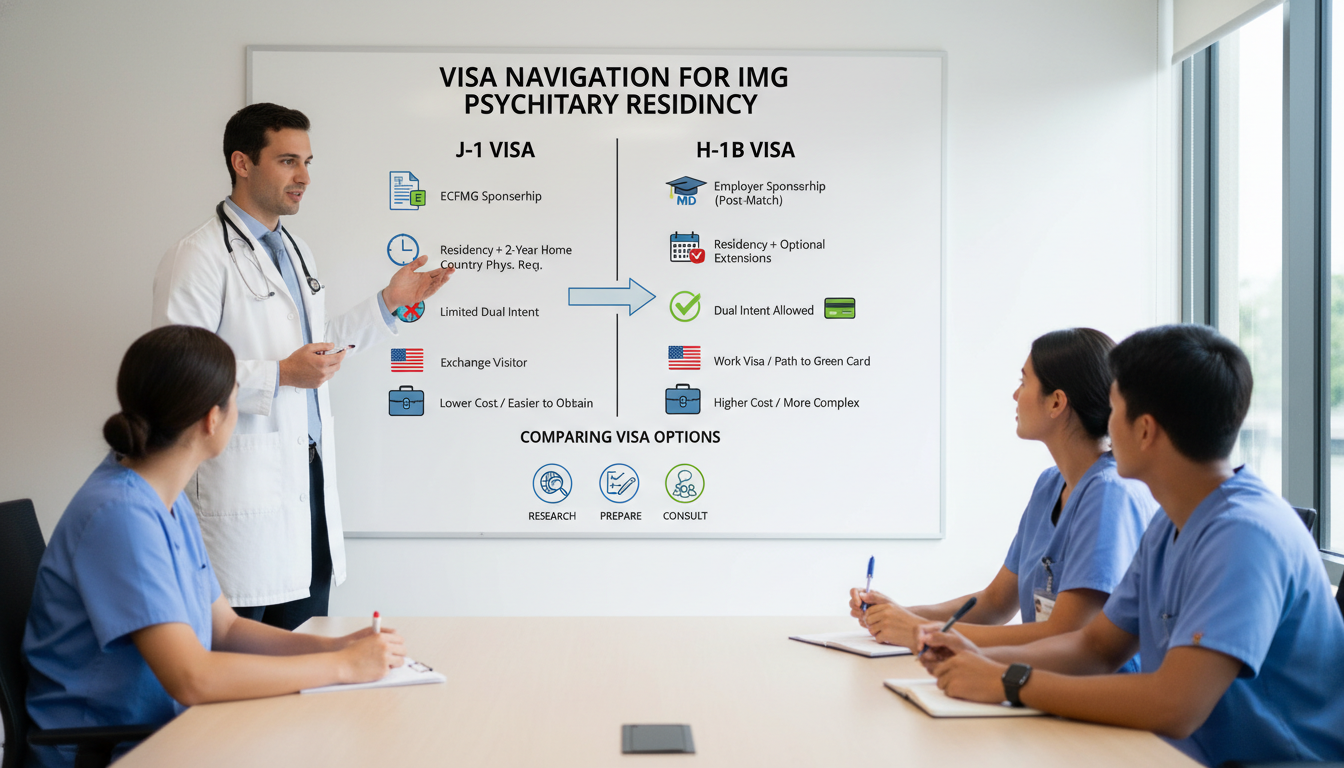
The Core Visa Options for Psychiatry Residency: J‑1 vs H‑1B
The two major residency visa categories for IMGs are:
- J‑1 Exchange Visitor (ECFMG‑sponsored)
- H‑1B Temporary Worker (employer‑sponsored)
Each has clear advantages and drawbacks, especially for someone considering a career in psychiatry.
J‑1 Visa for Psychiatry Residency
The J‑1 visa for physicians is a training visa sponsored by ECFMG, not directly by your residency program. It is by far the most common visa for IMGs in all specialties, including psychiatry.
Core features
- Purpose: Graduate medical education or training only (residency and fellowship)
- Sponsor: ECFMG (Educational Commission for Foreign Medical Graduates)
- Duration: Up to 7 years total of clinical training (residency + fellowship)
- Requirement: At the end of training, most J‑1 physicians are subject to the two‑year home residency requirement (often called “212(e)” or the “two‑year rule”)
Pros for psychiatry IMGs
Widely accepted
- Most psychiatry programs that sponsor any visas will at least sponsor J‑1.
- Many university hospitals and community programs are very familiar with ECFMG J‑1 procedures.
Relatively streamlined process
- Program does not need to handle complex USCIS paperwork.
- ECFMG guides both you and the program through DS‑2019 issuance.
Flexible for multiple psychiatry fellowships (within limits)
- Total training time of up to 7 years allows common psychiatry pathways:
- 4‑year general psychiatry residency + 1‑2 year fellowship (e.g., child & adolescent, addiction, consult‑liaison, geriatric)
- Some may even fit more specialized training within this window if carefully planned.
- Total training time of up to 7 years allows common psychiatry pathways:
Part‑time or additional scholarly roles are sometimes allowed
- With proper ECFMG approval, limited moonlighting or research can be possible, but this is strictly regulated and not guaranteed.
Cons for psychiatry IMGs
Two‑year home residence requirement (HRR)
- After you finish training, you must:
- Return to your home country for an aggregate of 2 years, or
- Obtain a waiver of this requirement.
- You cannot easily convert from J‑1 to other long‑term U.S. statuses (e.g., H‑1B or permanent residence) without addressing the HRR.
- After you finish training, you must:
Limited long‑term flexibility without a waiver
- If you want to stay and practice in the U.S. immediately after residency/fellowship, you will need a J‑1 waiver job, usually in an underserved area.
Dependent limitations
- J‑2 dependents can usually:
- Apply for work authorization (EAD)
- Study in the U.S.
- However, their stay is tied to your training timeline.
- J‑2 dependents can usually:
Less control over timing
- Extensions, transfers, and fellowship additions must fit into ECFMG rules and the 7‑year limit.
H‑1B Visa for Psychiatry Residency
The H‑1B visa is a work visa sponsored by the employer (residency program). It is less common than J‑1 in GME, but highly sought after by many IMGs because it does not carry the 2‑year home residency requirement.
Core features
- Purpose: Specialty occupation (in this context, “physician in training”)
- Sponsor: The hospital/health system (your residency program)
- Duration: Typically up to 6 years total in H‑1B status (with some exceptions/extensions)
Pros for psychiatry IMGs
No 2‑year home residency requirement
- You can freely:
- Transition between H‑1B employers
- Apply for permanent residency (green card) once you find a sponsoring employer
- Much simpler if your long‑term goal is to settle and work in the U.S.
- You can freely:
Stronger continuity for career planning
- Ideal for those aiming at:
- Academic psychiatry careers
- Highly specialized fellowships
- Long‑term U.S. practice
- Ideal for those aiming at:
Flexible for post‑residency employment
- After residency or fellowship, you can:
- Transfer to a new H‑1B sponsor (e.g., hospital, community mental health center)
- Potentially avoid J‑1 waiver obligations tied to underserved areas (though many H‑1B jobs are also in shortage areas)
- After residency or fellowship, you can:
Cons for psychiatry IMGs
Not all programs sponsor H‑1B
- Many psychiatry residencies:
- Only sponsor J‑1
- Or do not sponsor visas at all
- This significantly reduces your list of eligible programs if you require H‑1B.
- Many psychiatry residencies:
More complex and expensive for institutions
- Programs must:
- File petitions with USCIS
- Cover legal and filing fees (in many cases)
- Meet wage and specialty occupation requirements
- Smaller or less resourced programs may avoid H‑1B entirely.
- Programs must:
USMLE Step 3 often required
- Many states and hospitals insist that H‑1B applicants have passed Step 3 before the visa petition can be filed.
- This means:
- You may need to complete Step 3 during your final year of medical school or before Match.
- If Step 3 is delayed, visa processing can be jeopardized.
Time limitations
- Total H‑1B time is usually 6 years; long training paths (residency + multiple fellowships) can be challenging.
- Time spent in H‑1B training counts against your long‑term H‑1B cap as an attending.
Psychiatry‑specific takeaway on J‑1 vs H‑1B
- If your priority is maximizing the number of program options and ensuring you can match into psychiatry somewhere, J‑1 is usually more realistic.
- If your priority is staying long‑term in the U.S. with more flexibility after training, and you can secure interviews at programs that sponsor H‑1B, then H‑1B can be a strategic choice.
J‑1 Waivers and Post‑Residency Options for Psychiatry
If you choose or receive a J‑1 visa, understanding waiver options is crucial to your long‑term career planning as a psychiatrist.
What Is a J‑1 Waiver?
The J‑1 waiver is a legal mechanism to avoid or satisfy the 2‑year home residency requirement by working in specific settings or under specific programs in the United States.
For psychiatry, the most relevant waivers are:
- Conrad 30 Waiver Program
- Waivers from federal agencies focused on underserved populations
- Less common categories (e.g., hardship or persecution)
Conrad 30 Waiver for Psychiatry
The Conrad 30 program is often the primary path for J‑1 psychiatrists to remain in the U.S. after training.
Key features
- Each U.S. state can sponsor up to 30 J‑1 physicians per year to work in designated underserved areas.
- Psychiatrists are in especially high demand in many states, which can help your chances.
- Requirements typically include:
- A full‑time job offer (usually 3 years)
- Working in a Health Professional Shortage Area (HPSA), Medically Underserved Area (MUA), or serving an underserved population
- Commitment to serve in that position for at least three years in H‑1B status
Psychiatry‑specific advantages
- Psychiatry is one of the most needed specialties in underserved areas nationwide.
- Many states prioritize or reserve slots for psychiatrists.
- Jobs may include:
- Community mental health centers
- State hospitals
- Rural or inner‑city clinics
- Federally Qualified Health Centers with psychiatric services
Challenges
- Job search is time‑sensitive and competitive:
- Applications open at different times depending on the state.
- Not all states accept new grads every cycle; requirements vary.
- You must coordinate:
- End of training
- State waiver timelines
- H‑1B filing and start dates
Practical planning tips
- Start exploring potential waiver states and employers during your PGY‑2 or early PGY‑3 year.
- Ask faculty and older residents how prior J‑1 graduates navigated the waiver process.
- Maintain a strong profile:
- Good evaluations
- No professionalism concerns
- Interest or experience in community psychiatry or underserved populations
Other J‑1 Waiver Options for Psychiatrists
Federal Agency Waivers
- Agencies like the VA, HHS, or certain mental health/telepsychiatry initiatives sometimes sponsor waiver positions.
- These are less predictable and often require specific experience or job types.
Hardship or Persecution Waivers
- Based on risk to you or your U.S. citizen/LPR spouse/children if you return home.
- Involve complex legal arguments; require an experienced immigration attorney.
- Not common but can be crucial for some IMGs.
Strategic note: Even if you think you might return home eventually, planning as if you may need a waiver gives you maximum flexibility.
Choosing a Visa Strategy: Aligning With Your Psychiatry Career Goals
Your long‑term goals in psychiatry should shape your IMG visa options and preferences.
Step 1: Clarify Your Career Vision
Ask yourself:
- Do I want to live and practice long‑term in the U.S., or might I return home or work internationally?
- Am I strongly interested in:
- Community psychiatry
- Rural mental health
- Child & adolescent psychiatry
- Addiction, geriatric, forensic, or consult‑liaison psychiatry
- Do I see myself in:
- Academic psychiatry (research, teaching)
- Private practice
- Public sector (state hospitals, VA, community clinics)
Step 2: Map That Vision to Visa Choices
Here’s how career paths might influence your J‑1 vs H‑1B thinking:
If you plan to stay in the U.S. long‑term and want maximum flexibility
- H‑1B is often more attractive because:
- No 2‑year home residency requirement
- Cleaner transition to green card
- However, you must accept:
- A smaller pool of possible programs
- The need for Step 3 (often before applying or before rank lists)
If you are open to underserved work and community psychiatry
- J‑1 + Conrad 30 waiver may match your goals very well.
- Many J‑1 waiver jobs:
- Offer broad, meaningful clinical work
- Can still allow academic or leadership paths later
If you want an academic psychiatry career with significant research
- Both paths can work:
- J‑1 + fellowship + waiver job + later academic position
- H‑1B + academic residency + academic attending job
- H‑1B is often preferred by those on a research‑intensive track who want to avoid waiver constraints, but this depends heavily on institutional support.
Step 3: Be Realistic About Competitiveness
- Psychiatry has become more competitive in recent years, though it remains accessible for strong IMGs.
- If your application is:
- Very strong (high scores, strong U.S. clinical experience, research, excellent English), you can afford to target more H‑1B‑friendly academic programs.
- Moderate or borderline, heavily restricting yourself to H‑1B‑only programs can be risky. You may need to prioritize matching—even if it means accepting J‑1.

Practical Application Strategy: Integrating Visa Planning Into Your Psych Match
A strong psych match strategy for an international medical graduate must explicitly account for visa realities.
Researching Program Visa Policies
Before applying, build a spreadsheet including:
- Program name and location
- University vs community vs hybrid
- Visa sponsorship:
- J‑1 only
- H‑1B and J‑1
- No visas
- “Case‑by‑case” (requires follow‑up)
- Whether USMLE Step 3 is required for H‑1B at that program
- Presence of psychiatry fellowships you may be interested in
- Past history of matching IMGs and sponsoring visas
Sources to use:
- Program websites (check “international applicants” and “visa” pages)
- FREIDA and other databases
- Emails to program coordinators (polite, concise questions)
- Current residents or recent graduates (especially IMGs)
Tip: Policies can change yearly. Always confirm for the current application cycle.
Deciding Your Application Mix
Consider these sample strategies:
1. IMG comfortable with J‑1 and mainly wants to match
- Apply broadly to:
- All IMG‑friendly psychiatry programs sponsoring J‑1
- A subset that offer H‑1B as a bonus but not a requirement
- Focus on:
- Strong psych‑specific personal statement
- U.S. psychiatry letters
- Demonstrated interest in mental health and communication skills
2. IMG strongly prefers H‑1B (e.g., due to home‑country constraints, political risk, or specific family plans)
- Apply to:
- All psychiatry programs that explicitly sponsor H‑1B
- Some J‑1 programs as a backup, if you are open to later waiver strategies
- Make a clear plan to:
- Take and pass Step 3 early (ideally before rank order list submission)
- Signal seriousness and preparation to H‑1B‑friendly programs
3. Very high‑achieving IMG targeting academics
- Prioritize:
- University hospitals with strong psychiatry departments
- Programs with multiple fellowships
- Programs that either:
- Routinely sponsor H‑1B, or
- Have a well‑structured J‑1 pathway with strong fellowship support
- Use interviews to ask detailed but professional questions about:
- Past visa sponsorship
- Support for waiver job placement (if J‑1)
- Long‑term faculty visa experiences
Discussing Visa Issues During the Application Season
Handled poorly, visa discussion can appear as “extra work” for programs. Done well, it shows you are organized and realistic.
Best practices:
- In your application:
- Indicate your visa needs honestly.
- You do not need a long visa explanation in your personal statement unless it is highly relevant (e.g., asylum, refugee background).
- In emails:
- Be brief and courteous.
- Example:
“I am an IMG currently on an F‑1 visa and will require sponsorship for residency. I wanted to confirm whether your psychiatry program is able to sponsor J‑1 and/or H‑1B visas for incoming residents.”
- On interview day:
- Research the program’s stated policy beforehand.
- Ask visa questions to the program coordinator or GME office, not only to faculty.
- Avoid pressing faculty interviewers hard on immigration details they may not control.
Common Pitfalls and How to Avoid Them
Many IMGs damage their psych match prospects or immigration future with avoidable mistakes. Awareness is your best protection.
Pitfall 1: Ignoring Visa Reality Until After Match
Some applicants focus entirely on scores and interviews, assuming immigration will “work out.” This can lead to:
- Matching at programs unable to sponsor your needed visa
- Delays in start date or even loss of position
Solution: Treat visa compatibility as a non‑negotiable search filter from the beginning.
Pitfall 2: Over‑restricting to H‑1B Without the Profile to Support It
An IMG applying only to H‑1B‑sponsoring psychiatry programs, especially with modest scores or limited U.S. experience, may end up with too few interviews.
Solution:
- Be honest about your competitiveness.
- If H‑1B is very important, still consider a tiered plan, with J‑1 programs as a secondary option.
Pitfall 3: Not Taking Step 3 Early Enough (When Aiming for H‑1B)
Programs often cannot file an H‑1B petition until you have passed Step 3.
Solution:
- Schedule Step 3 early if:
- You are on an F‑1/OPT timeline
- You are committed to an H‑1B route
- Confirm state requirements (some licensing bodies or hospitals have additional conditions).
Pitfall 4: Underestimating J‑1 Waiver Complexity
Some residents on J‑1 assume “I’ll just get a waiver job,” without understanding state differences, timelines, and contract obligations.
Solution:
- Learn about Conrad 30 and other waivers by PGY‑2.
- Attend any GME workshops about immigration.
- Network with older residents who have already gone through the waiver process.
Pitfall 5: Poor Communication or Incomplete Documents
Small administrative errors can have big consequences:
- Wrong dates on DS‑2019 or I‑20
- Missing signatures or incomplete forms
- Late submission of required documents
Solution:
- Use checklists for all immigration paperwork.
- Respond promptly to coordinator and ECFMG requests.
- Keep copies of all documents (I‑94, visas, DS‑2019, I‑797 approvals, etc.) well organized.
FAQs: Visa Navigation for Psychiatry Residency IMGs
1. Is psychiatry residency friendly to IMGs who need visas?
Yes. Psychiatry has historically been IMG‑friendly, and many programs sponsor J‑1 visas. H‑1B sponsorship is more limited but still available at some academic and community programs. Your challenge is identifying which programs match both your academic profile and your visa needs.
2. Which is better for a psychiatry IMG: J‑1 or H‑1B?
Neither visa is “better” in all situations.
- J‑1: More widely available; easier to match with; structured by ECFMG; but comes with a 2‑year home residency requirement, usually requiring a waiver job in an underserved area afterward.
- H‑1B: No home residency requirement and better continuity for a long‑term U.S. career; but fewer programs sponsor it, it often requires Step 3 earlier, and the application process is more complex.
Your choice should reflect your career goals, risk tolerance, and the competitiveness of your application.
3. Can I change from J‑1 to H‑1B during or after psychiatry residency?
You generally cannot change from J‑1 to H‑1B without addressing the two‑year home residency requirement. To move into H‑1B status, you must either:
- Complete the 2 years of home residence, or
- Obtain a waiver (e.g., through Conrad 30, federal agency, hardship, or persecution)
Once you have a waiver granted, you can move into H‑1B with a sponsoring employer, often in an underserved location for at least three years.
4. How early should I start planning my visa strategy for psychiatry residency?
Ideally:
- Before ERAS opens:
- Decide whether you are open to J‑1, prefer H‑1B, or will consider both.
- Research program visa policies and build your application list.
- During final year of medical school or early PGY‑1:
- If aiming for H‑1B, plan and schedule USMLE Step 3.
- During PGY‑2/PGY‑3 (if J‑1):
- Learn in detail about J‑1 waiver pathways and start planning post‑residency options.
Early, informed planning gives you more flexibility and reduces last‑minute stress.
Visa navigation for residency is not just about paperwork; it is a strategic layer of your entire psychiatry career plan as an international medical graduate. By understanding J‑1 vs H‑1B, exploring realistic IMG visa options, and aligning these decisions with your goals in mental health care, you can move through the psych match with clarity and confidence—and position yourself for a sustainable, meaningful future in psychiatry.