
Understanding the Visa Landscape for IMGs in Radiation Oncology
Radiation oncology is one of the most competitive and niche specialties in the United States. For an international medical graduate, securing a radiation oncology residency is challenging not only because of academic and research expectations, but also because of complex residency visa questions. Visa navigation is often the deciding factor in whether an IMG can realistically pursue the rad onc match.
This IMG residency guide focuses specifically on visa navigation for radiation oncology residency: what you need to know about J-1 vs H-1B, how visa type affects your competitiveness, practical strategies for discussing visas with programs, and how to plan for long-term career goals in the United States.
Radiation oncology is small—only a limited number of programs and positions exist each year—so each program’s visa policy matters more than in larger specialties. Understanding IMG visa options early and aligning your strategy will save you time, money, and avoid dead ends.
Core Visa Options for Radiation Oncology Residency
When talking about residency visa options for an international medical graduate, two categories matter most:
- J-1 (ECFMG-sponsored) clinical training visa
- H-1B (employer-sponsored) work visa for residents/fellows
Other pathways (green card, O-1, TN, etc.) usually come later or in special circumstances, and rarely function as the primary path to start radiation oncology residency.
1. J-1 Visa via ECFMG Sponsorship
The J-1 is the most common residency visa for IMGs entering clinical training in the US.
Key features:
- Sponsor: ECFMG (Educational Commission for Foreign Medical Graduates)
- Purpose: Graduate medical education (residency and fellowship)
- Duration: Typically up to 7 years for clinical training (sufficient for radiation oncology residency plus many fellowships)
- Return-home requirement: Most J‑1 physicians are subject to a two-year home-country physical presence requirement (INA 212(e)) after training
Pros for radiation oncology IMGs:
- Widely accepted: Many rad onc programs that sponsor IMGs use only J-1 visas.
- Streamlined process: ECFMG and GME offices are very familiar with the process; timelines are predictable.
- Good fit for training duration: Radiation oncology residency is typically four years after a one-year preliminary or transitional year; seven years is usually enough even with fellowship.
Cons and challenges:
Two-year home return requirement:
- You must return to your home country (or country of last legal permanent residence) for a cumulative two years before most US visas (e.g., H-1B, L-1, permanent residency) become available, unless you get a waiver.
- This is the single biggest concern for many IMGs with long-term US career plans.
Employment restrictions:
- You can only engage in clinical work as part of your approved training program (and certain approved moonlighting, if allowed).
- Significant limitations on outside clinical or industry work during training.
Visa tied to training:
- You cannot “switch employers” easily like other H-1B workers; the visa is strictly for GME.
Despite the drawbacks, J‑1 is still the default route for most IMG radiation oncology residents.
2. H-1B Visa for Residency
The H‑1B is a non-immigrant, employment-based visa. In residency, your employer is the teaching hospital or university.
Key features:
- Employer-sponsored: Program must be willing and able to file H‑1B petitions
- Professional specialty: Requires a specialty occupation (physician) with a USMLE Step 3 pass and state license eligibility
- Duration: Up to 6 years total (can be extended in specific green card processes)
- No automatic home-country requirement: Unlike J‑1, there is no mandatory 2-year return clause
Pros for radiation oncology IMGs:
- No 2-year return requirement: Major advantage if your long-term plan is to stay in the US.
- Smoother transition to attending jobs: You can often move directly to another H‑1B employer or adjust status to permanent residency.
- Potentially better for dual-career or family immigration plans: Fewer constraints if your partner is also a professional seeking US work options (though note H-4 work restrictions may apply depending on policies).
Cons and limitations:
Fewer radiation oncology programs offer H‑1B:
- Many GME offices have a strict “J‑1 only” policy, especially in smaller, resource-limited programs.
- In a small specialty like radiation oncology, this drastically shrinks your options.
USMLE Step 3 requirement:
- Must usually be passed before H‑1B filing (and often before ranking or contract)
- This is difficult for many IMGs trying to apply simultaneously for the rad onc match.
Cost and administrative burden:
- Filing fees and attorney costs are significant for the institution.
- Some programs proactively avoid H‑1B because of cost and complexity.
Time limits:
- Radiation oncology requires a preliminary year in internal medicine, transitional, or similar, plus 4 years of rad onc.
- That’s 5 years total; if you later need a fellowship or if timelines are extended, you approach the 6-year cap quickly unless you are already in a green card process.
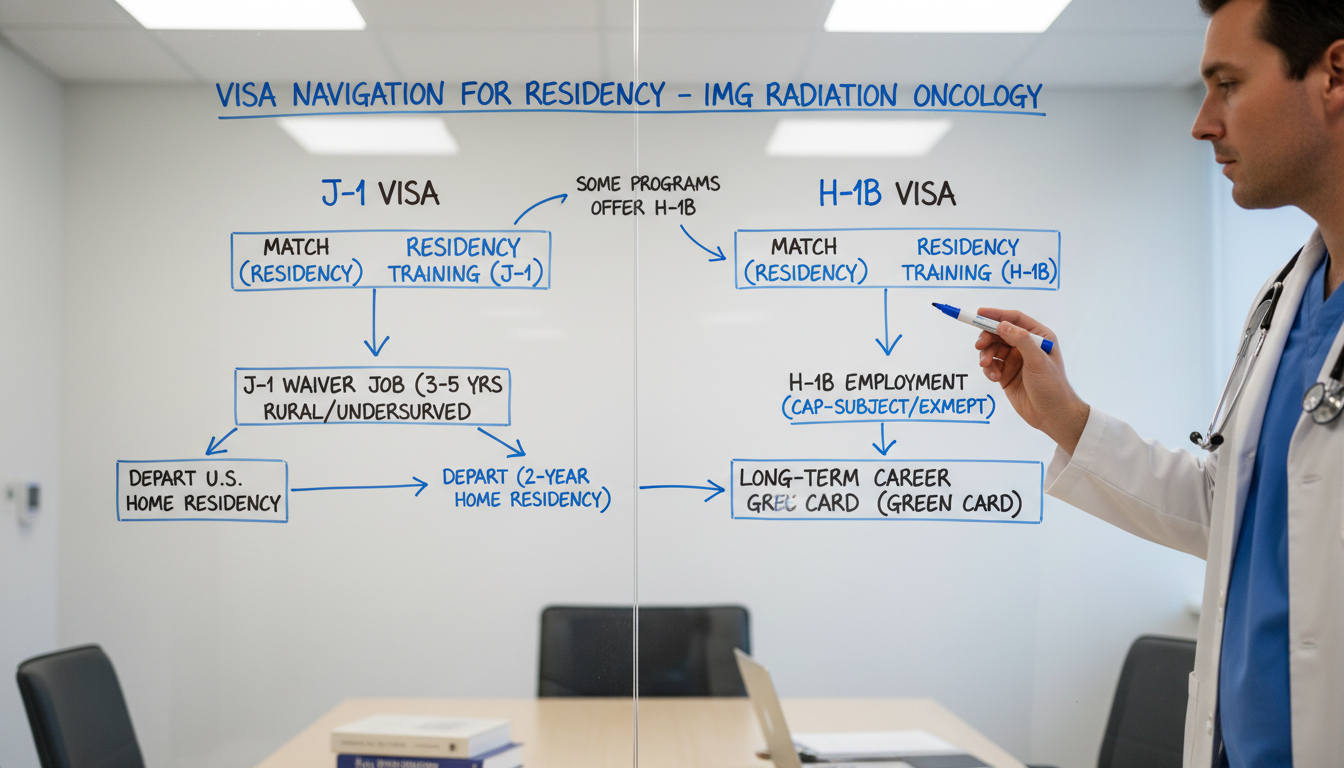
3. Comparing J‑1 vs H‑1B for Radiation Oncology
From a rad onc residency perspective:
Access to programs
- J‑1: Access to the majority of IMG-friendly rad onc programs that sponsor visas
- H‑1B: Limited subset of programs; may exclude many mid-size centers
Long-term career in US
- J‑1: Requires waiver (often through service in an underserved/academic setting) or 2-year home return
- H‑1B: More direct route to staying and eventually obtaining permanent residency
Competitiveness impact
- Many programs prefer not to deal with H‑1B logistics.
- As a highly competitive specialty, some rad onc programs use visa requirements as a screening step.
Practical takeaway:
If your primary goal is to maximize chances of matching in radiation oncology, you should be open to J‑1 and then plan your long-term strategy (waiver jobs, fellowships, and eventual green card) around that. Pursuing H‑1B only will significantly limit opportunities and is usually viable only if you are extremely competitive and/or targeting specific institutions known to sponsor H‑1B.
How Visa Type Affects Your Radiation Oncology Match Strategy
Because rad onc is small and selective, residency visa considerations must be built into every part of your application strategy.
1. Researching Program Visa Policies Early
In an IMG residency guide for a larger specialty, you might wait until later to refine by visa type. For radiation oncology, that’s risky.
Steps to research visa policies:
Use official databases:
- Check program websites for explicit statements: “We sponsor J‑1 only”, “We do not sponsor visas”, or “We consider H‑1B in select cases.”
- Verify with FREIDA and individual program GME pages.
Email or call if unclear:
- Ask the GME office or program coordinator a very specific question:
- “Do you sponsor J‑1 visas for categorical radiation oncology residents?”
- “Do you consider H‑1B for radiation oncology residents if USMLE Step 3 is passed?”
- Ask the GME office or program coordinator a very specific question:
Distinguish between preliminary year and categorical rad onc:
- Your intern year program and your rad onc program might have different visa policies.
- You need both years covered (or a pathway to transition) to avoid being stranded after PGY-1.
Sample email template:
Dear [Program Coordinator/Director],
I am an international medical graduate planning to apply for the upcoming radiation oncology match. I am writing to clarify your residency visa policies. Does your program sponsor J‑1 visas through ECFMG for categorical radiation oncology residents? Do you also consider H‑1B sponsorship for highly qualified applicants who have passed USMLE Step 3?
Thank you very much for your time and guidance.
Sincerely,
[Name], [Current status]
Doing this before you finalize your application list allows you to avoid applying to programs that cannot legally accept you.
2. Matching the Visa Strategy to Your Profile
Your individual strengths and constraints affect which residency visa makes the most sense.
Scenario A: Highly competitive IMG with strong US research and Step scores
- Could strategically target a shortlist of H‑1B-friendly programs while remaining open to J‑1 at others.
- Might aim for academic centers known for immigration support and research-heavy rad onc departments.
- Consider taking USMLE Step 3 early to keep H‑1B options open.
Scenario B: Strong IMG but limited time and financial resources
- Focus primarily on J‑1 because:
- More programs are available.
- No added burden of Step 3 before match.
- Concentrate on boosting US clinical exposure, research, and networking rather than chasing rare H‑1B positions.
Scenario C: Already in the US on another status (F‑1, J‑2, H‑4, etc.)
- Your current status can shape the best pathway:
- F‑1 with OPT: Maybe transition into J‑1 or H‑1B depending on program policy.
- J‑2 or H‑4: Transitioning to J‑1 or H‑1B may have pros and cons for the family unit.
- Discuss with an immigration attorney familiar with physicians to avoid unintended consequences (loss of work authorization for spouse, home requirement triggering, etc.).
3. How Programs Weigh Different Visa Types
Radiation oncology departments often work within broader institutional GME policies. From the program’s perspective:
J‑1 is:
- Predictable, standardized, and low-risk.
- Handled mainly by ECFMG and GME office.
H‑1B is:
- More paperwork, cost, and legal oversight.
- May require early Step 3 and state license eligibility, limiting applicant pool.
Some program directors informally report:
- They will not rank applicants who require H‑1B, even if technically allowed, because the risk of delays or denials feels too high.
- They may make rare exceptions for truly extraordinary candidates (e.g., multiple first-author publications, prestigious PhD, or strong institutional advocates).
As an IMG, you cannot fully control this, but you can control clarity:
- Be explicit in your ERAS application and communications about your visa needs.
- If you are willing to take J‑1, do not let a program assume you are H‑1B only.
Residency Visa Timelines, Requirements, and Common Pitfalls
Once you understand the big picture of J‑1 vs H‑1B, the next step in visa navigation for residency is handling timing, documentation, and avoiding common mistakes that jeopardize your rad onc match.
1. J‑1 Visa Requirements for IMGs
For an international medical graduate, ECFMG sets the main criteria for J‑1 sponsorship.
Typical requirements include:
- Valid ECFMG certification (USMLE Steps 1 and 2 CK passed, and pathway/OSCE requirements fulfilled as applicable)
- A signed appointment contract or offer letter from an ACGME-accredited program
- Proof of medical school graduation and credentials verification
- Sufficient English language proficiency (usually implied through ECFMG certification and medical training)
- Adequate funding/salary as per institutional contract
- Proof of suitable health and repatriation insurance
Timing issues:
- ECFMG sponsorship applications are usually processed after the match, in spring.
- Delays can occur if your medical school documents or identity verifications are incomplete or if your country has additional checks.
Pitfalls:
- Late graduation or delayed diploma can postpone visa processing.
- Inadequate communication with your medical school about document requests from ECFMG.
- Mistakenly assuming that previous US visas (e.g., B‑1/B‑2, F‑1) automatically make J‑1 easier—each category is separate.
2. H‑1B Visa Requirements for Residents
For residency-level H‑1B in radiation oncology, requirements are stricter:
- USMLE Step 3 passed
- Must meet state licensing board criteria (often requires ECFMG certification and certain postgraduate training or supervision conditions)
- Employer (the hospital/university) must:
- File a Labor Condition Application (LCA)
- Petition for H‑1B with USCIS
- Pay required fees (largely not transferable to the resident)
Timing challenges:
- To start residency on July 1, H‑1B petitions often need to be filed in early spring, sometimes before the program has all official documents in place.
- Step 3 scheduling, score release, and any delays can jeopardize H‑1B filing.
- Some programs simply will not risk this for new residents and instead default to J‑1.
Pitfalls:
- Taking Step 3 too late (post-Match) and missing H‑1B deadlines.
- Overestimating the willingness of rad onc programs to handle H‑1B complexity.
- Not understanding that Cap-exempt vs. Cap-subject H‑1B distinctions still matter:
- Universities and many teaching hospitals are cap-exempt, which helps, but proper classification and paperwork are still needed.
Long-Term Planning: From Residency Visa to Career in Rad Onc
Visa navigation for residency should align with your long-term goals in radiation oncology. The choice between J‑1 and H‑1B, and how you handle each, will shape your post-residency career options.
1. J‑1 Waiver Options After Radiation Oncology Residency
If you complete rad onc training on a J‑1 visa and are subject to the 2-year home requirement, you have three main pathways:
Return home for two years
- Work in your home country or country of last residence.
- After fulfilling the requirement, you can apply for H‑1B, O‑1, or immigrant visas again.
Obtain a J‑1 waiver based on service needs (most common):
- Federal or state programs can sponsor waivers in exchange for service in underserved areas or certain institutions.
- For radiation oncology, opportunities may be more limited than in primary care, but they do exist, especially in:
- Rural or regional cancer centers
- Safety-net hospitals or academic centers with documented need
Other waiver bases (hardship or persecution):
- Extremely case-specific and require careful legal assistance.
Radiation oncology is not covered by some traditional J‑1 waiver programs (like state Conrad 30 for primary care), but:
- Certain states or federal agencies can still sponsor waivers case-by-case for subspecialists, particularly in oncology.
- Academic centers may justify needs for underserved oncology populations.
Practical steps during residency:
- Use your rad onc training years to network with departments that serve underserved areas or have historically sponsored waiver positions.
- Maintain strong research output and clinical performance; being a highly desirable candidate increases your chances of securing a waiver-sponsored job.
2. Transitioning from H‑1B Resident to Attending
If you complete residency on H‑1B:
- You may move directly into an attending position on another H‑1B (transfer), especially if your employer is also cap-exempt (e.g., another university hospital or cancer center).
- Many academic cancer centers actively sponsor green cards (EB‑2 NIW, EB‑1, etc.) for strong faculty.
Key considerations:
- Monitor your H‑1B year count carefully; residency years count toward the 6-year limit.
- Plan green card processes early if you anticipate needing more than 6 years in H‑1B status (e.g., if you pursue a fellowship plus residency plus junior faculty time).
- Research specialty-specific immigration strategies, such as EB‑1 for outstanding researchers, especially if you have strong publications or major grants.
3. Family, Spouse, and Children: Planning as a Unit
Your residency visa choice affects your family:
J‑1 dependents (J‑2):
- Some J‑2 spouses may have work authorization (EAD), but rules can change; always verify current policies.
- Children on J‑2 can attend school but generally cannot work until eligible age and authorization.
H‑1B dependents (H‑4):
- Spousal work authorization is more limited and tied to H‑1B principal’s green card process progress; your spouse may not be able to work initially.
- Children on H‑4 can study but age-out issues may arise over many years.
Long-term, consider:
- Where your children might attend high school/college.
- Whether your spouse wants to work in the US and how quickly.
- Which visa path offers the best balance between your rad onc career and your family’s needs.
Practical Tips and Actionable Advice for IMG Visa Navigation in Radiation Oncology
To tie this IMG residency guide together, here is a concise, practical roadmap.
1. Start Visa Planning Early (2–3 Years Before the Match)
- Understand J‑1 vs H‑1B fundamentals.
- Decide if you are willing to accept J‑1 or insisting on H‑1B only (with full awareness of trade-offs).
- Plan your exam timeline:
- Steps 1 and 2 CK for ECFMG certification and J‑1 eligibility
- Step 3 if you are seriously targeting H‑1B
2. Build a Program List with Visa Filters
- Use a spreadsheet to categorize rad onc programs as:
- J‑1 only
- J‑1 and H‑1B possible
- No visa sponsorship / US citizen/green card only
- Don’t overlook preliminary year programs’ visa policies.
3. Communicate Clearly and Professionally
- In interviews, be honest about your visa needs but frame them as informed and flexible:
- “I am ECFMG-certified and fully eligible for J‑1 sponsorship; I’m open to J‑1 and would value your guidance on institutional policies.”
- If you’re especially strong and have Step 3: “I have passed USMLE Step 3 and understand your institution may occasionally consider H‑1B, but I am also open to J‑1 if that is your standard pathway.”
4. Consult an Immigration Attorney When Needed
- For complex cases (prior J‑1, family on different status, previous visa denials), do not rely solely on informal advice or online forums.
- Choose an attorney experienced with physician immigration and GME.
5. Plan for Contingencies
- If you do not match into radiation oncology on your first try:
- Consider research or prelim/transitional year positions while improving your profile.
- Re-evaluate visa strategy in light of changing personal circumstances or policies.
- Stay updated: immigration rules (especially around H‑1B, J‑1 waivers, and dependents) can change.
FAQs: Visa Navigation for IMGs in Radiation Oncology
1. As an IMG applying to radiation oncology, should I insist on H‑1B or accept J‑1?
If your top priority is maximizing your chances of matching into radiation oncology, you should usually be open to J‑1, because many rad onc programs that accept IMGs sponsor only J‑1. Insisting on H‑1B only will limit your options to a small subset of programs. You can later address the J‑1 two-year home requirement through waiver jobs or other strategies.
2. Do I need USMLE Step 3 for radiation oncology residency as an IMG?
For J‑1, Step 3 is not required to start residency (ECFMG certification with Steps 1 and 2 CK is sufficient). For H‑1B, most institutions require Step 3 before filing the petition. If you aim for H‑1B, taking Step 3 early (ideally before ERAS submission) is wise, but this is not mandatory for J‑1 routes.
3. How does the J‑1 two-year home-country requirement affect my rad onc career?
After finishing your J‑1-sponsored rad onc training, you will either need to return to your home country for 2 years or secure a J‑1 waiver (usually by working in an underserved or high-need setting). This requirement delays certain US visas (like H‑1B or green card) unless waived, but many J‑1 physicians in oncology successfully obtain waivers by carefully planning post-residency employment.
4. Are there enough J‑1 waiver jobs for radiation oncologists?
Waiver opportunities for radiation oncology are more limited than for primary care, but they do exist—particularly in rural or regional cancer centers, safety-net hospitals, and some academic institutions serving underserved populations. Networking during residency, maintaining a strong academic and clinical profile, and working with departments that historically use waiver positions can significantly improve your chances of finding a suitable role.
By understanding your residency visa options, realistically assessing J‑1 vs H‑1B, and aligning your immigration strategy with your academic and career goals, you can navigate the rad onc match as an international medical graduate with clarity and purpose.