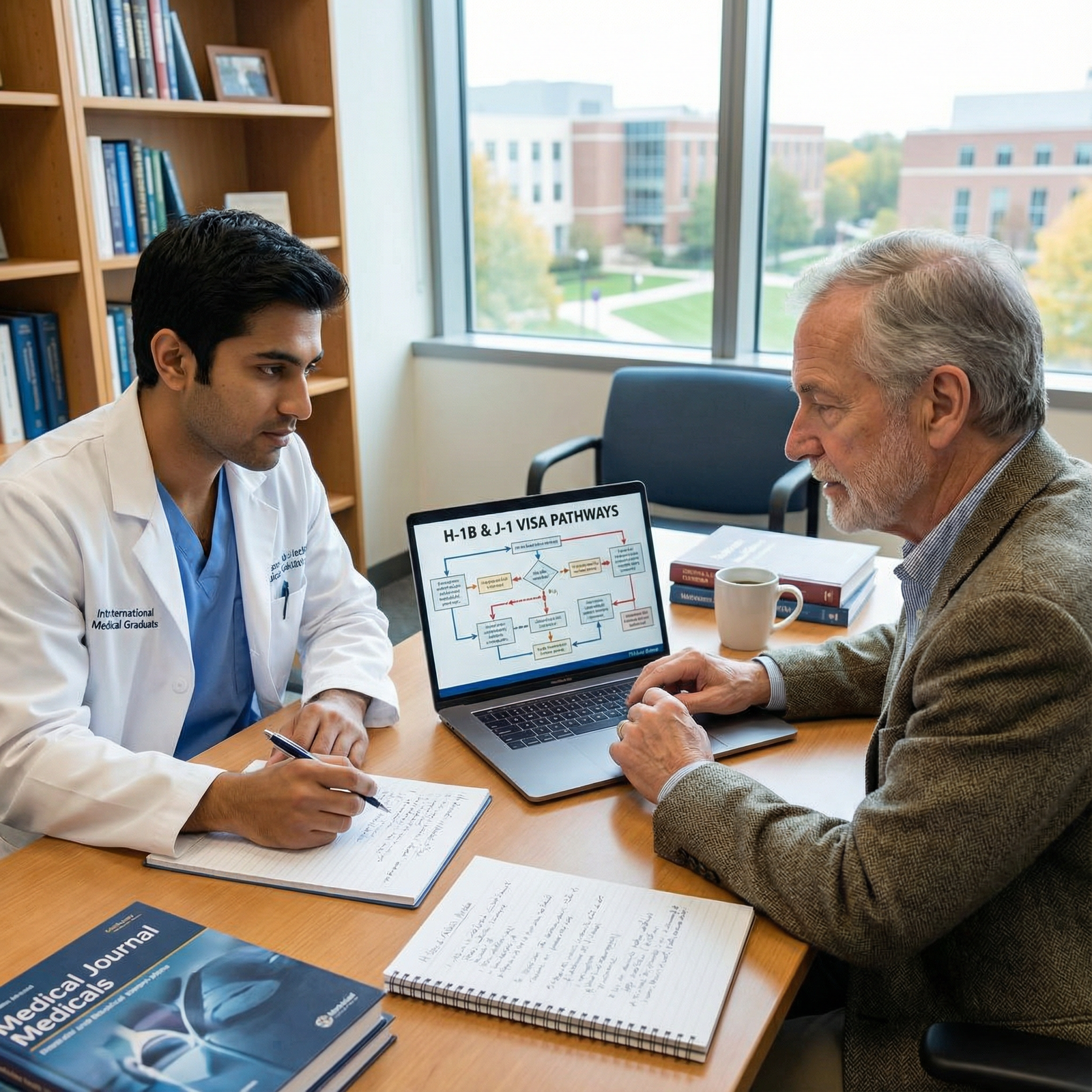
Understanding the Visa Landscape for IMGs in State University Residency Programs
For any international medical graduate, securing the right residency visa is as critical as securing a residency position itself. State university residency and public medical school residency programs are often IMG‑friendly, but they operate within strict visa and institutional policies. Knowing how to navigate J‑1 vs H‑1B, deadlines, documentation, and strategic choices can determine whether you can actually start the residency you match into.
This IMG residency guide focuses on visa navigation specifically for state university programs in the United States—typically large public medical schools with affiliated teaching hospitals funded or chartered by state governments. These institutions tend to have structured policies and timelines, which can work in your favor if you plan early and communicate clearly.
Section 1: Core Visa Options for IMGs Entering Residency
Most IMGs starting residency in state university programs will use one of two primary visa categories:
- J‑1 Exchange Visitor (Alien Physician) visa
- H‑1B Temporary Worker (Specialty Occupation) visa
A smaller group will already have U.S. permanent residency (green card) or another status (e.g., EAD via asylum, TPS, marriage-based, etc.), but this article focuses on IMG visa options specific to graduate medical education.
1.1 J‑1 vs H‑1B: Big Picture Overview
Both visas allow you to do residency legally in the U.S., but they differ substantially in terms of:
- Who sponsors you
- Duration and flexibility
- Requirements during and after training
- Impact on long‑term immigration plans
J‑1 (ECFMG‑sponsored):
- Sponsor: ECFMG (Educational Commission for Foreign Medical Graduates), not the hospital or state university directly.
- Primary purpose: Graduate medical education and training.
- Duration: Typically year‑to‑year, up to 7 years for clinical training (with possible extensions for specific fellowships).
- Key feature: Two‑year home country physical presence requirement for most IMGs after training (the “J‑1 home residency requirement”).
H‑1B (Employer‑sponsored):
- Sponsor: The residency program/hospital (employer), often via the university’s GME and international office.
- Primary purpose: Employment in a specialty occupation (physician).
- Duration: Up to 6 years total (usually approved in 3‑year increments, but residencies often seek 1–3 years at a time).
- Key feature: Dual intent (easier path to later permanent residency, no J‑1 home return requirement).
For state university residency programs, institutional policy often leans strongly toward J‑1 for incoming IMGs, though many will sponsor H‑1B for senior residents, fellows, or specific candidates who meet strict criteria.
Section 2: The J‑1 Residency Visa – Practical Guide for IMGs
For most IMGs entering state university programs, the J‑1 will be the default and most attainable option. Understanding how it works is central to effective visa navigation for residency.
2.1 Eligibility and Core Requirements
To qualify for an ECFMG‑sponsored J‑1 for residency:
- Exams: You must have passed USMLE Step 1 and Step 2 CK (or COMLEX equivalents if applicable for DO‑track; most IMGs use USMLE).
- ECFMG Certification: Required before ECFMG issues the Form DS‑2019.
- Contract: You need a signed residency contract or official offer from a ACGME‑accredited program.
- Financial support: Salary from the program must meet basic thresholds; ECFMG will check this based on your contract.
- English proficiency: Implied by exams and program acceptance; no separate test for ECFMG vs some other J‑1 categories.
State university programs usually know the ECFMG process well and will coordinate closely with ECFMG once you match.
2.2 Step‑by‑Step J‑1 Process for a Matched IMG
Here’s how J‑1 visa navigation typically unfolds after you match into a state university residency:
Match and Contract Issuance
- NRMP Match Day in March (or SOAP/other matches).
- Program sends you a contract and/or GME onboarding packet.
Program Notifies ECFMG
- The GME or international office confirms your appointment in the ECFMG OASIS/EVNet system.
- You receive instructions to start your J‑1 application.
You Submit J‑1 Application to ECFMG
- Upload required documents (passport, proof of ECFMG certification, contract, prior visa history).
- Pay ECFMG administrative fee.
- Confirm start/end dates and sponsoring institution (the state university hospital).
ECFMG Issues DS‑2019
- Once approved, ECFMG prepares and ships Form DS‑2019, which is the official document for a J‑1 visa.
- Carefully check your personal information, program, and dates.
Schedule Visa Interview at U.S. Embassy/Consulate
- Complete DS‑160 (online nonimmigrant visa application).
- Pay the SEVIS I‑901 fee (for maintaining your record in the SEVIS system).
- Schedule visa interview, often in late spring or early summer.
- Attend interview with DS‑2019, passport, DS‑160 confirmation, photos, contract, and supporting documents.
Travel and Program Start
- J‑1 entry is typically allowed up to 30 days before your DS‑2019 start date.
- Report to your program and complete I‑94 admission process on entry.
2.3 Advantages of J‑1 for IMGs in State University Programs
- Consistency and familiarity: Almost all large public medical school residency programs are accustomed to J‑1 processing.
- No H‑1B cap: You are not subject to the general H‑1B lottery or deadlines; ECFMG handles your sponsorship.
- Relatively quick processing: After you submit a complete application, ECFMG can often issue DS‑2019s in weeks if documents are in order.
- Program flexibility: Less bureaucratic hassle for state university programs compared to H‑1B, making them more willing to support J‑1 IMGs.
2.4 Key Drawbacks: The Two‑Year Home Country Requirement
The most significant limitation of the J‑1 route is that most J‑1 physicians are subject to the two‑year home country physical presence requirement under Section 212(e) of the Immigration and Nationality Act. That usually means:
- After finishing residency (and any fellowship) you must return to your home country for an aggregate of two years before you can:
- Apply for an H‑1B or L‑1 visa, or
- Adjust status to U.S. permanent resident (green card),
- Unless you obtain a waiver.
For many IMGs who want to stay and practice in the U.S., the practical path is:
- J‑1 for residency and possibly fellowship; then
- J‑1 waiver job, usually through a Conrad 30 or other waiver program in an underserved area; then
- H‑1B employment while working off the 2‑year requirement; then
- Pursuit of permanent residency.
State university programs sometimes also have affiliated or state‑run systems that qualify for Conrad 30 waiver positions later—important to consider for long‑term planning.
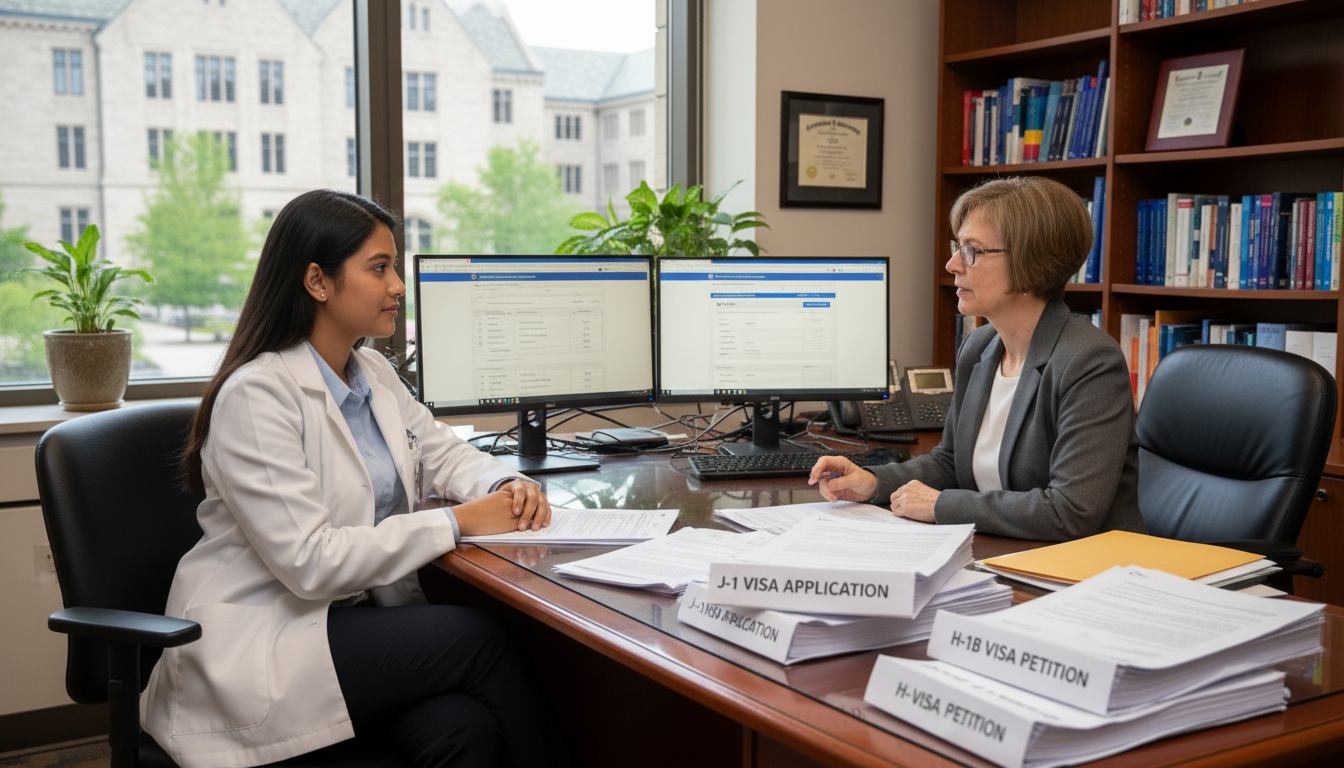
Section 3: The H‑1B Residency Visa – When and How It Works
Some IMGs successfully pursue H‑1B visas for residency, but this is more complex and less universally supported—especially at public medical schools with strict funding and HR policies.
3.1 Baseline H‑1B Requirements for IMG Residents
To qualify for an H‑1B for residency:
- USMLE exams:
- You must have passed USMLE Step 3 before the H‑1B petition is filed (in almost all cases).
- Valid medical license eligibility:
- At minimum, an unrestricted training license for the state where your state university residency is located (requirements vary by state).
- Employer sponsorship:
- Your residency program/hospital must be willing to sponsor and pay filing (and often attorney) fees.
- Prevailing wage & fee compliance:
- The institution must pay at or above the prevailing wage for your role and comply with Department of Labor rules.
For many first‑year residency applicants, the timing of Step 3 and institutional policies make H‑1B difficult.
3.2 State University Policies on H‑1B Sponsorship
Public medical school residency programs fall broadly into three policy types:
- J‑1 only:
- Will not sponsor H‑1B for residency at all (common in some state universities to simplify compliance and cost).
- J‑1 preferred, H‑1B rare exceptions:
- H‑1B only if you already passed Step 3, or if there’s a compelling institutional reason (e.g., program needs your specific skill set, or you are already in H‑1B status).
- Flexible J‑1 or H‑1B:
- Fewer public institutions fall into this category, but some large academic centers with robust legal teams do.
When reviewing programs, always check their website and ask directly:
- “Do you sponsor J‑1, H‑1B, or both for IMG residents?”
- “Are there special conditions for H‑1B sponsorship (e.g., Step 3 requirement timing, funding restrictions)?”
3.3 Timeline Considerations for H‑1B
For an IMG aiming for H‑1B as a first‑year resident:
- You should plan to complete Step 3 before Match Day or as soon as possible afterward.
- Some programs require your Step 3 result before they can file the H‑1B petition, which must be approved (or at least receipted with premium processing) before your start date (often July 1).
- Programs that are cap‑exempt (most teaching hospitals associated with universities) can file H‑1B any time of year, not just during the April lottery. This is a key benefit of state university residency programs.
3.4 Pros and Cons of H‑1B for Residency
Advantages:
- No two‑year home country requirement.
- Dual intent: More straightforward pathway to U.S. permanent residency later.
- Often more favorable for long‑term planners who know they want to remain in the U.S.
Disadvantages:
- More work and cost for the residency sponsor.
- Step 3 requirement is a significant barrier for many IMGs applying straight from medical school abroad.
- Some states have complex licensing rules that slow down the process.
- Institutional policies at public medical school residency programs frequently discourage H‑1B for PGY‑1s.
Because of these constraints, many IMGs accept a J‑1 for residency and then aim for an H‑1B after obtaining a waiver job.
Section 4: Matching Strategy – Aligning Visa Goals with State University Programs
Your visa navigation strategy should begin well before you submit your ERAS application. Understanding each program’s stance on IMG visa options can save you time, money, and disappointment.
4.1 Researching Programs’ Visa Policies
For each state university residency or public medical school residency you’re interested in:
Check the program website:
- Look for sections titled “Eligibility & Visa Information,” “International Medical Graduates,” or “Requirements for Non‑U.S. Citizens.”
- Identify whether they clearly state:
- J‑1 only
- J‑1 and H‑1B
- H‑1B considered only in special cases
Contact the program coordinator or GME office: When information is unclear, send a concise email:
- Mention your status as an international medical graduate.
- Ask directly:
- “Do you sponsor J‑1, H‑1B, or both for residency?”
- “Do you require USMLE Step 3 for H‑1B sponsorship?”
- “Have you sponsored H‑1B residents in the past 2–3 years?”
Use alumni and resident networks:
- Connect via LinkedIn or social media with current IMG residents at that program.
- Ask about their visa category and whether the program’s stated policy matches actual practice.
4.2 Strategic Application Examples
Example 1: Recent Graduate Without Step 3
You are an IMG in your final year of medical school abroad, have ECFMG certification with Step 1 and Step 2 CK, but no Step 3 yet.
- Realistic plan: Target programs that explicitly sponsor J‑1. Don’t rely on H‑1B sponsorship.
- Action:
- Rank state university programs that are historically IMG‑friendly and J‑1 friendly.
- Plan to complete Step 3 during residency (often in PGY‑1 or PGY‑2).
Example 2: IMG with Step 3 and Strong U.S. Experience
You already passed Step 3 and have extensive U.S. clinical experience.
Realistic plan:
- Apply to programs that sponsor both J‑1 and H‑1B, especially large academic centers.
- Be explicit in your personal statement or supplemental information that you are “eligible and interested in H‑1B sponsorship.”
Action:
- Reach out early after interview invitations to reiterate your H‑1B eligibility.
- Be prepared to explain your long‑term plan (e.g., future interest in academic medicine, research, etc.) to appeal to academic programs.
Example 3: IMG with Existing H‑1B Status
You are already in the U.S. on H‑1B in a research or non‑clinical role.
Realistic plan:
- Seek state university residency programs with experience transferring or extending H‑1B visas.
- Confirm with the program’s international office that transferring your H‑1B to a resident position is permissible.
Action:
- Provide documentation of your current H‑1B status during interviews.
- Ask programs to coordinate early with their immigration counsel if they are unfamiliar with such transfers.

Section 5: Practical Visa Navigation Tips for IMGs in State University Programs
Visa navigation for residency is not just about choosing J‑1 vs H‑1B; it’s also about timing, documentation, and communication.
5.1 Timeline Management
A structured timeline can prevent last‑minute visa crises:
12–18 months before Match:
- Complete Step 1 and Step 2 CK.
- Obtain ECFMG certification or be close to it.
- Start researching which state university residency programs sponsor which visas.
9–12 months before Match:
- Finalize your ERAS list with attention to visa policies.
- If aiming for H‑1B, schedule Step 3 as early as feasible.
4–6 months before residency start (after Match):
- Promptly sign and return your contract.
- Respond immediately to any GME or ECFMG emails about your J‑1 or H‑1B application.
- Schedule consular visa interviews strategically to allow for unforeseen delays.
5.2 Documentation Best Practices
Regardless of whether you choose J‑1 or H‑1B, you’ll need:
- Valid passport (with sufficient validity for the duration of your training).
- ECFMG certificate.
- USMLE score reports.
- Official residency contract or appointment letter.
- Prior U.S. visa records (if any), including copies of prior DS‑2019s, I‑20s, or I‑797 approvals.
- CV and medical school diploma (and translations if applicable).
Keep scanned and organized digital copies of everything. Use consistent naming (e.g., “Passport_YourName_Exp2029.pdf”) to avoid confusion, especially when multiple offices (ECFMG, GME, immigration attorney, embassy) request documents.
5.3 Working with GME and International Offices
State university residency and public medical school residency programs typically centralize visa processing through a Graduate Medical Education office and a central international or immigration office.
To work effectively with them:
- Respond quickly to all requests (ideally within 24–48 hours).
- Notify them immediately of:
- Any change in your personal details (address, marital status, passport renewal).
- Any prior U.S. immigration issues (overstays, visa denials), so they can plan accordingly.
Treat emails from:
- GME Office
- ECFMG
- International Students & Scholars Office as high‑priority items during the pre‑residency period.
5.4 Planning Beyond Residency: J‑1 Waivers and Career Paths
Even if you are years away from graduation, it’s wise to think about how your residency visa interacts with your eventual career path.
If on J‑1:
- Start learning about Conrad 30 and other J‑1 waiver programs early (PGY‑2 or PGY‑3).
- Consider fellowships strategically: Some states and employers sponsor J‑1 waivers for subspecialists, others prioritize primary care.
If on H‑1B:
- Track your total H‑1B time used (remember the 6‑year maximum).
- Explore institutions that sponsor green cards, especially academic or large health systems.
Many state university systems include rural or underserved hospitals that partner with state health departments—these frequently host J‑1 waiver positions, which can be a natural next step after graduation.
Section 6: Common Pitfalls and How to Avoid Them
Even well‑prepared IMGs can run into avoidable problems. Below are frequent issues and solutions.
6.1 Late DS‑2019 or I‑797 Approvals
- Cause: Slow contract return, incomplete application, or administrative delays.
- Impact: Risk of missing your start date or needing emergency travel rescheduling.
- Prevention:
- Return signed contract promptly.
- Submit your J‑1 or H‑1B documents as soon as requested.
- Follow up courteously if you haven’t heard back within the expected timeframe (often 2–3 weeks).
6.2 Incompatible Visa Expectations
Sometimes applicants assume they’ll get H‑1B, while the program only offers J‑1, or vice versa.
- Solution:
- Clarify visa policy before ranking programs in the Match.
- Decide whether you are comfortable training on J‑1 if H‑1B is not offered.
6.3 Misunderstanding the J‑1 Home Country Requirement
Some IMGs mistakenly believe:
- They can easily “switch” from J‑1 to H‑1B after residency without a waiver.
- They can “just overstay” and apply for a green card another way.
This is inaccurate and can seriously damage long‑term immigration prospects.
- Reality:
- Without a waiver, the 2‑year home requirement must be met before H‑1B or permanent residency is possible.
- Intentional overstay or violation of status jeopardizes both your career and legal future in the U.S.
6.4 Ignoring Spouse/Family Visa Issues
If you have a spouse or children:
- J‑1 dependents: J‑2 visas; spouses can sometimes obtain work authorization (EAD).
- H‑1B dependents: H‑4 visas; work authorization is more limited (usually requires specific conditions like spouse having an approved I‑140 in many scenarios).
Discuss family plans with your program and, if necessary, an immigration attorney to ensure dependents can accompany you and maintain legal status.
FAQ: Visa Navigation for IMGs in State University Residency Programs
1. Is J‑1 or H‑1B better for an international medical graduate starting residency?
There is no universal “better” option—only what is more realistic and aligned with your goals.
- J‑1 is more commonly supported by state university residency and public medical school residency programs, especially for PGY‑1, and has a smoother application process through ECFMG.
- H‑1B can be better for long‑term U.S. immigration goals (no 2‑year home requirement, dual intent), but it requires Step 3 and institutional willingness to sponsor. Most IMGs in state university programs begin on J‑1.
2. Can I change from J‑1 to H‑1B during or after residency?
You generally cannot change directly from J‑1 physician status to H‑1B without either:
- Completing the 2‑year home country requirement, or
- Obtaining a J‑1 waiver (for example, via the Conrad 30 program or another qualifying waiver route).
Once the waiver is obtained or the home requirement is fulfilled, an employer—often in an underserved area—can file an H‑1B petition for you.
3. Do all state university residency programs sponsor visas for IMGs?
No. Visa policies vary widely. Some state university programs:
- Fully support J‑1 but not H‑1B.
- Accept only U.S. citizens/green card holders.
- Sponsor both J‑1 and H‑1B under set conditions.
You must verify each program’s policy from their website or via direct communication before applying and especially before ranking them in the Match.
4. Should I delay applying for residency until I pass Step 3 to aim for H‑1B?
Delaying solely for Step 3 is not always wise. Many IMGs successfully match and train on J‑1 without Step 3 at entry. Consider:
- Pros of waiting: Stronger H‑1B eligibility at application time.
- Cons of waiting: One or more lost application cycles, risk of “time since graduation” becoming a negative, and no guarantee that programs will still sponsor H‑1B.
For most IMGs, especially new graduates abroad, applying as soon as you are competitive for residency (with Steps 1 and 2 and ECFMG certification) and accepting J‑1 if offered is a practical route, while planning a J‑1 waiver strategy for later.
By understanding J‑1 vs H‑1B, program expectations, and the long‑term implications of each residency visa, you can approach the IMG residency guide process with clarity and confidence. State university residency and public medical school residency programs can be excellent training environments for international medical graduates; with informed planning and proactive communication, your visa will support—rather than obstruct—your path to becoming a practicing physician in the United States.