
The US-Mexico border region offers unique opportunities—and unique challenges—for international medical graduates (IMGs) seeking residency training in the United States. One of the most complex parts of the journey is understanding and navigating visa options. This IMG residency guide focuses on visa navigation for residency specifically in the Texas border residency programs and other border region institutions in states like Arizona, New Mexico, and California.
Below is a detailed, practical roadmap to help you understand residency visa pathways, compare J-1 vs H-1B, and strategically plan your career if you aim to train and possibly remain in the US-Mexico border region.
Understanding the US-Mexico Border Region Context for IMGs
The US-Mexico border region is not just a geographic term—it’s a distinct medical and policy environment. Many hospitals and residency programs here serve communities with:
- High proportions of Spanish-speaking patients
- Large numbers of uninsured or underinsured individuals
- High burden of chronic diseases (e.g., diabetes, obesity, cardiovascular disease)
- Rural and medically underserved populations
These features shape both residency training and post-residency immigration opportunities.
Why the Border Region Matters for Visa Strategy
High Need Areas = More Waiver Opportunities
Many border counties are designated as:- Health Professional Shortage Areas (HPSAs)
- Medically Underserved Areas (MUAs)
These designations are important for J-1 waiver jobs (e.g., Conrad 30 programs), which can allow you to stay in the U.S. after residency.
Public Service Missions
Border region programs often emphasize:- Service to marginalized and binational communities
- Bilingual care (English/Spanish)
- Community-based and primary care training
This can align well with the requirements of J-1 home residency requirement waivers based on working in underserved areas.
Binational Collaboration and Cross-border Care
Some institutions collaborate with Mexican hospitals or community organizations. While this doesn’t change core visa law, it can influence:- Types of positions created post-residency
- Institutional familiarity with IMGs and visa processes
In short, training in the US-Mexico border region may create stronger pathways to J-1 waivers and long-term employment for IMGs compared to some other regions.
Core Visa Options for Residency: J-1 vs H-1B
Most non–U.S. citizen/non–green card IMGs pursue residency on either a J-1 or H-1B visa. Understanding the differences between J-1 vs H-1B is essential to long-term planning, especially if you intend to remain in or return to the border region after training.
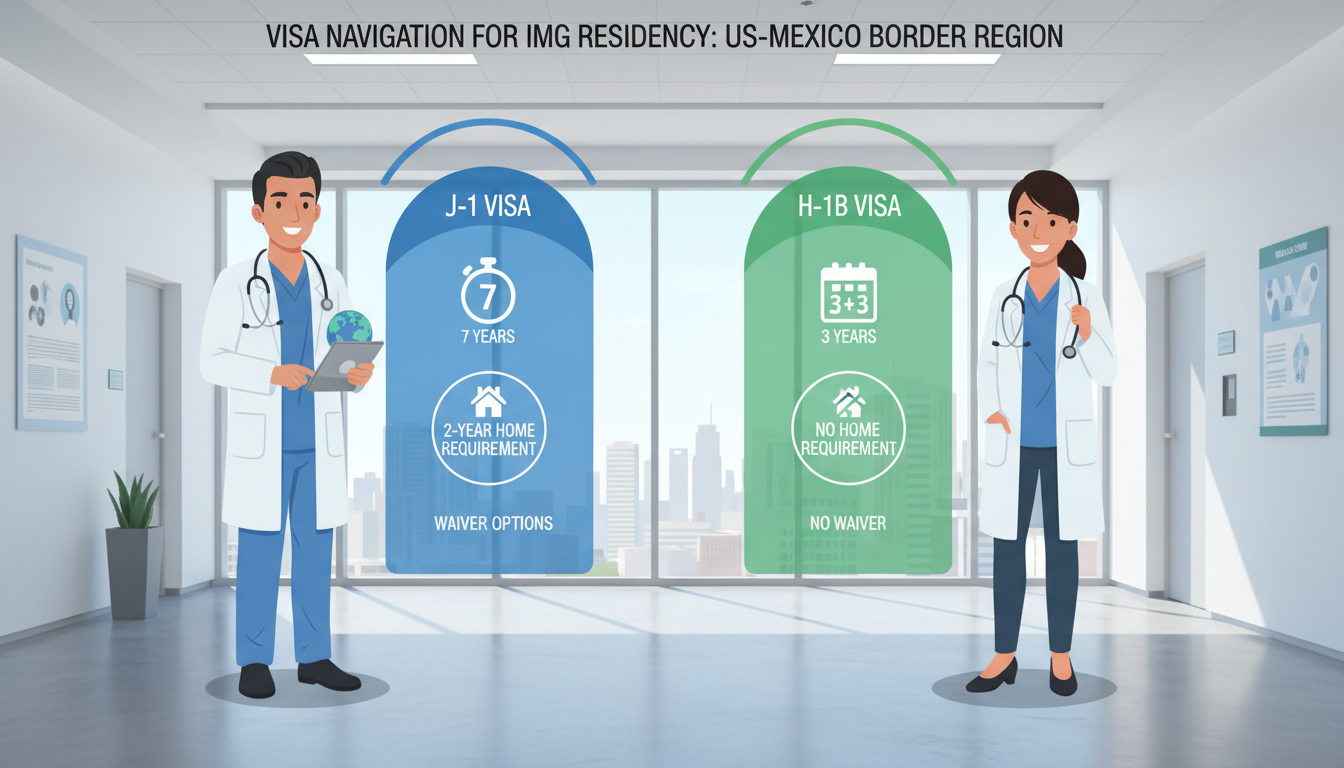
J-1 Visa for Residency (ECFMG-Sponsored)
Key Features:
- Sponsor: ECFMG (Educational Commission for Foreign Medical Graduates)
- Purpose: Graduate medical education (GME) in ACGME-accredited programs
- Duration: Usually up to 7 years (in total GME time), with annual renewals
- Home Residency Requirement:
- A 2-year home-country physical presence requirement after training
- You must return to your country of last legal permanent residence for at least 2 years
- Or obtain a waiver of this requirement
Pros for IMGs:
- Widely accepted: Many programs—especially community, smaller, or certain academic programs—sponsor J-1 only, not H-1B.
- Straightforward process: ECFMG has a standardized, well-established system for sponsorship.
- Lower institutional burden: Hospitals sometimes prefer J-1 because ECFMG handles much of the sponsorship process.
Cons for IMGs:
- The 2-year home-country requirement is a major limitation.
- You are tied closely to your training program and ECFMG; changes in specialty or program require formal approval.
- You cannot directly change to some other statuses (e.g., H-1B, permanent resident) without addressing the 2-year requirement.
H-1B Visa for Residency
Key Features:
- Sponsor: The residency program (employer) directly
- Purpose: Employment as a “specialty occupation” (physician)
- Duration: Typically up to 6 years total (initial period plus extensions)
- No automatic home residency requirement
Pros for IMGs:
- No 2-year home-country requirement.
- Often seen as more flexible for future immigration transitions (e.g., to green card).
- Easier to move from residency into fellowship or attending roles without a J-1 waiver barrier.
Cons for IMGs:
- Fewer programs offer H-1B sponsorship, especially for categorical residency.
- Requires passing USMLE Step 3 before visa petition (in most cases).
- More complicated and expensive for the hospital (legal and filing fees, documentation).
- Subject to specific prevailing wage requirements that may affect whether the program can sponsor you.
How Border Region Programs Typically Handle J-1 vs H-1B
- Many Texas border residency and US-Mexico border programs are historically J-1 friendly, sometimes J-1 only.
- Academic centers in border-adjacent cities (e.g., San Antonio, El Paso, Tucson) may sponsor both J-1 and H-1B, particularly in highly competitive specialties.
- Due to physician shortages in border counties, some institutions value IMGs who plan to stay long-term, which can make them somewhat more open to H-1B—but this varies dramatically by program.
Actionable Step:
When researching programs in the border region, always check:
- “We sponsor J-1 only” vs “J-1 and H-1B” vs “No visa sponsorship”
- Any program-specific policies on H-1B (e.g., Step 3 deadline, specialty restrictions)
Key IMG Visa Options and Pathways Before, During, and After Residency
Visa navigation is not one decision—it’s a sequence of decisions across different phases of your journey.
Pre-Residency Phase: Getting to Interviews
Common statuses at this stage:
B-1/B-2 (Visitor Visa):
- Some IMGs use a B-1/B-2 to attend observerships or residency interviews.
- It does not authorize you to work or train.
- Using a visitor visa for anything beyond allowed activities (e.g., paid clinical work) can be problematic.
F-1 (Student Visa):
- Some IMGs may be in the U.S. completing MPH, MS, or PhD degrees.
- Optional Practical Training (OPT) under F-1 may sometimes be relevant (e.g., research), but not for ACGME residency itself.
Key point: Residency itself almost always requires J-1 or H-1B. Plan early so that your existing status, if any, can transition smoothly.
Residency Phase: Choosing and Maintaining Status
Most IMGs training in the US-Mexico border region will be on:
- J-1 (ECFMG-Sponsored)
- H-1B (Employer-Sponsored)
If You Choose J-1
- Ensure you track total years of GME—fellowships count toward the 7-year limit.
- If you plan to work in the border region long-term, you should think early about J-1 waiver strategies (discussed in the next section).
- Maintain a clean training record; any contract termination or “out-of-status” period can complicate future waivers or status changes.
If You Choose H-1B
- Confirm the maximum years you may need:
- E.g., 3-year internal medicine residency + 3-year fellowship = 6 years total.
- Some H-1B physicians may later seek cap-exempt H-1B roles (e.g., at universities, nonprofits, or certain hospitals) in the border region.
- Plan early for:
- Step 3 timing
- Program deadlines for submission of H-1B paperwork
- Budgeting for potential costs (some institutions ask physician to cover certain parts; policies vary and must comply with U.S. labor laws)
Post-Residency Phase: Staying in the U.S. and in the Border Region
After training, your options diverge depending on your initial visa:
If You Trained on J-1: The Waiver Issue
You must either:
- Return home for 2 years, then later apply for H-1B or immigrant visa; or
- Obtain a waiver of the 2-year requirement, commonly through:
- Conrad 30 programs (state-level physician shortage waivers)
- Federal agency waivers (e.g., VA, HHS programs)
- Hardship or persecution-based waivers (less common and highly case-specific)
For IMGs interested in the US-Mexico border region, the Conrad 30 program in states like Texas, New Mexico, Arizona, and California is particularly important.
If You Trained on H-1B
You do not have a 2-year home residency requirement, but you:
- Must remain in valid work-authorized nonimmigrant status (e.g., H-1B) or
- Transition to permanent residency (green card) or another status
Border region hospitals and clinics—especially those in shortage areas—may sponsor H-1B and later green cards. However, you won’t have the special advantages of J-1 waiver programs; instead, your pathway is more standard employment-based immigration (e.g., EB-2, EB-3).
J-1 Waivers and the Border Region: Your Strategic Advantage
For the international medical graduate who trained on a J-1 visa, the border region can be one of the best locations to seek employment that qualifies for a J-1 waiver.

The Conrad 30 Program in Border States
Each U.S. state can recommend up to 30 J-1 physicians per year for waivers under the Conrad 30 program. Border states like Texas, Arizona, New Mexico, and California often:
- Have large rural or underserved populations
- Include multiple counties or cities on or near the US-Mexico border
- Are actively trying to recruit physicians, particularly primary care and some specialties
Why this matters to you:
- Jobs in these areas often prioritize J-1 waiver candidates, including those who trained elsewhere in the U.S.
- Your language skills (especially Spanish) and knowledge of cross-border health issues make you highly competitive.
Typical Requirements for a Conrad 30 Waiver Job
While details vary by state, common elements:
- Full-time clinical employment (often 40 hours/week)
- Service in a HPSA/MUA or equivalent underserved designation
- A 3-year minimum contract
- Employer support for your J-1 waiver filing, and usually for H-1B sponsorship after the waiver
Texas Border Residency and Waiver Opportunities:
Texas, in particular, has:
- A large and diverse Conrad 30 program
- Many HPSA/MUA-designated communities along the border (e.g., Rio Grande Valley, Laredo, El Paso area)
- A history of hiring IMGs for:
- Family medicine
- Internal medicine
- Pediatrics
- Psychiatry
- Some subspecialties, depending on local needs
If you complete a Texas border residency, you may have:
- Networking advantages with local clinics and hospitals
- Faculty and program leadership who are familiar with J-1 waiver processes
- Better access to job openings that may not be widely advertised yet
Non-Conrad Waivers Relevant to Border Work
Some IMGs may pursue:
- HHS or other federal agency waivers through service in Community Health Centers or specific federal programs
- Positions in federally qualified health centers (FQHCs) or rural health clinics near the border
These can also be concentrated in border regions due to high need and federal funding for underserved populations.
Practical Tips to Maximize Waiver Options in the Border Region
Start Early (PGY-1 or PGY-2)
- Learn the basic requirements of Conrad 30 in your state of interest.
- Attend informational sessions offered by your GME office or state medical society.
Align Your Career Interests
- Primary care, psychiatry, and general internal medicine are often in highest demand in border underserved areas.
- If you choose a highly sub-specialized field, J-1 waiver jobs may be fewer.
Network Locally
- During residency, rotate in community clinics, FQHCs, or rural sites along the border.
- Make a strong impression; these sites often hire from their own trainee pool.
Keep Your Record Clean
- No contract violations or major disciplinary issues.
- Timely licensing, USMLE completion, and board exams to stay competitive.
Step-by-Step Visa Navigation Plan for IMGs Targeting the Border Region
To put everything together, here is a concrete stepwise IMG residency guide focusing on visa navigation for the US-Mexico border region.
Step 1: Pre-Application Research (Before ERAS)
Identify border region programs in:
- Texas (e.g., along Rio Grande Valley, Laredo, El Paso)
- Arizona (e.g., Tucson, Yuma)
- New Mexico (e.g., Las Cruces-adjacent, rural border-serving programs)
- California border counties (e.g., Imperial County, San Diego area programs with border-focused missions)
For each program, answer:
- What visas do they sponsor? (J-1 only, J-1 and H-1B, or none?)
- Do they have a known track record of training international medical graduates?
- Do they publicly mention serving the border or binational communities?
Decide your preferred pathway:
- Open to J-1 with intention of later J-1 waiver in border area
- Strong preference for H-1B, knowing program options may be narrower
Step 2: During Application Season (ERAS)
Highlight relevant assets:
- Spanish language ability (if applicable)
- Prior work or research in global health, migration, or border health
- Commitment to underserved or rural medicine
Contact GME offices (if allowed) with targeted questions:
- “Do you sponsor H-1B for categorical residents?”
- “How many of your current residents are J-1 or H-1B?”
- “Do your graduates commonly stay in the border region after training?”
Maintain documentation needed later for visa applications:
- Valid passport, medical school diploma, ECFMG certificate, USMLE scores, etc.
Step 3: After Match – Choosing and Finalizing Your Visa
Once you match:
Work with your program’s GME office and possibly an immigration attorney (often provided by the institution) to:
- Submit ECFMG sponsorship papers (for J-1), or
- File an H-1B petition, including proof of Step 3 and contract/offer letter.
Pay attention to:
- DS-2019 or I-797 issuance timelines
- Visa interview scheduling at U.S. consulates (especially important if you are outside the U.S.)
Step 4: During Residency – Building Toward Your Long-Term Goal
While training in the border region:
- Seek rotations in community or rural clinics that might eventually hire you.
- Meet physicians who previously navigated J-1 vs H-1B issues—they are invaluable mentors.
- Regularly review your visa expiration dates and renewal processes.
- If on J-1, clarify with your advisor or DIO (Designated Institutional Official) how many total years of training your visa will cover (e.g., residency + fellowship).
Step 5: PGY-2/PGY-3 – Preparing for Post-Residency Jobs
For J-1 physicians:
- Identify which border states and employers favor J-1 waiver hires.
- Contact state Conrad 30 coordinators or review state websites for:
- Application timelines
- Priority specialties
- Required documents
For H-1B physicians:
- Look for border-region employers who sponsor H-1B directly or are cap-exempt (universities, nonprofit hospitals, etc.).
- Discuss green card sponsorship policy during job negotiations.
Step 6: Signing Your First Contract
Your first post-residency contract is not just a job offer—it can define:
- Your ability to remain in the U.S.
- Your trajectory to permanent residency (if that is your goal).
For J-1 waiver jobs:
- Confirm the employer will:
- Support the Conrad 30 application
- Sponsor your H-1B for the waiver period
- Comply with all service obligations (3 years, site designation)
For H-1B jobs:
- Confirm:
- Whether the H-1B is cap-exempt or cap-subject
- Whether there is future support for a green card (PERM/EB-2/EB-3)
- Any geographic restrictions if your job spans multiple clinic sites, including border and non-border locations
Common Pitfalls and How to Avoid Them
Assuming All Border Programs Sponsor H-1B
- Reality: Many are J-1 only. Always verify.
Ignoring the 7-Year J-1 Limit
- Long fellowship paths (e.g., IM → Cardiology → Interventional) may exceed J-1 time. Plan years carefully.
Late Awareness of J-1 Waiver Requirements
- Some IMGs only discover the waiver issue at the end of residency, limiting their options. Start exploring IMG visa options by PGY-1.
Underestimating Licensing and Credentialing Timelines
- State medical licensure in Texas, New Mexico, or Arizona can take months. This affects your ability to start J-1 waiver or H-1B jobs on time.
Trying to Self-Manage Complex Immigration Issues Without Expert Help
- Border region institutions often have experience with IMGs. Use their legal resources and consult an independent immigration attorney if needed.
FAQs: Visa Navigation for IMGs in the US-Mexico Border Region
1. Is it easier to get an H-1B than a J-1 in Texas border residency programs?
Not typically. Many Texas border residency programs sponsor J-1 only because ECFMG handles much of the administrative burden. Some large academic centers or certain specialties may offer H-1B, but competition is higher and Step 3 is mandatory. If your priority is simply to match, J-1 may offer more options; if your priority is long-term immigration flexibility, you may aim for programs with H-1B sponsorship and accept a narrower target list.
2. I want to stay long-term in the border region after training. Should I avoid the J-1 because of the 2-year rule?
Not necessarily. In fact, the border region may be an ideal place to leverage J-1 waiver options. Many underserved clinics and hospitals along the border depend on J-1 physicians and are experienced in Conrad 30 waivers. If you are comfortable committing to a 3-year service obligation in an underserved area, J-1 followed by a border-region waiver job can be a strong and realistic pathway.
3. Can I switch from J-1 to H-1B during residency?
Switching directly from J-1 to H-1B without fulfilling or waiving the 2-year home-country requirement is generally not allowed. To move from J-1 to H-1B, you usually must first:
- Obtain a J-1 waiver (e.g., via Conrad 30 or another mechanism), and then
- Have an employer sponsor you for H-1B status.
This typically happens after residency, not during it.
4. How important is Spanish language ability for IMG visa and job options in the US-Mexico border region?
From a legal visa standpoint, Spanish is not a formal requirement. However, in practice:
- Many employers strongly prefer or even require bilingual physicians due to patient population needs.
- Bilingual ability can make you a more competitive candidate for both residency and post-residency positions, including J-1 waiver roles.
For an international medical graduate committed to a career in the border region, investing in strong Spanish language skills can significantly strengthen your professional and visa-related opportunities.
Navigating visa options for IMGs in the US-Mexico border region requires early planning, strategic program selection, and a clear understanding of J-1 vs H-1B implications. By aligning your career goals with the unique needs and opportunities of the border region, you can turn a complex immigration landscape into a pathway for meaningful, long-term practice serving communities on both sides of the border.