
Understanding the Visa Landscape as an IMG in Vascular Surgery
For an international medical graduate (IMG) pursuing vascular surgery residency in the United States, visa navigation is often as stressful as the Match itself. Vascular surgery is already a highly specialized and competitive field, and visa limitations can further narrow your options. A clear strategy early in your journey will significantly improve your chances of matching and starting training without delays.
This IMG residency guide focuses specifically on visa navigation for vascular surgery residency—primarily the 5+2 vascular surgery fellowship pathway and the 0+5 integrated vascular program. You will learn how to choose between J-1 vs H-1B, how visa choices affect where you can apply, and how to avoid common pitfalls that derail otherwise strong applications.
Key themes:
- Understanding which visas are realistic for IMGs in vascular surgery
- How visa status interacts with 0+5 integrated vs 5+2 fellowship pathways
- Strategies to identify visa-friendly programs
- Timelines and documents for residency visa and fellowship applications
- Long-term implications for career and immigration planning
Pathways into Vascular Surgery and Why They Matter for Your Visa Strategy
Before dissecting visa types, you must understand the training pathways into vascular surgery, because your visa plan will often differ depending on whether you are targeting an integrated or fellowship route.
0+5 Integrated Vascular Surgery Programs
- Structure: 5 years of continuous training in vascular surgery directly after medical school, with no separate general surgery residency.
- Advantages:
- Earlier and more concentrated exposure to vascular surgery.
- Clearer path if you know you want vascular from day one.
- Fewer transitions between training programs and visas.
- Challenges for IMGs:
- Very limited number of positions nationally.
- Many programs are heavily competitive and may prioritize US graduates.
- Some integrated programs do not sponsor H-1B at all and only accept J-1 or US citizens/green card holders.
Visa implication: If your only realistic visa option is J-1, integrated vascular programs may be more accessible than H-1B-sponsoring programs. If you strongly prefer H-1B, your integrated options may shrink dramatically.
5+2 Vascular Surgery Fellowship Pathway
- Structure:
- 5 years of general surgery residency, then
- 2 years of vascular surgery fellowship.
- Advantages:
- More total postgraduate training positions than integrated vascular.
- Flexibility if you are still deciding between surgical subspecialties.
- You can adjust your visa strategy between residency and fellowship.
- Challenges for IMGs:
- Longer total training time, often under multiple visas or visa renewals.
- Need to secure both a visa-friendly general surgery residency and later a vascular surgery fellowship that supports your visa status.
Visa implication: You might have one visa during general surgery and another during vascular fellowship. Long-term planning (especially J-1 waiver vs staying in H-1B status) becomes critical.
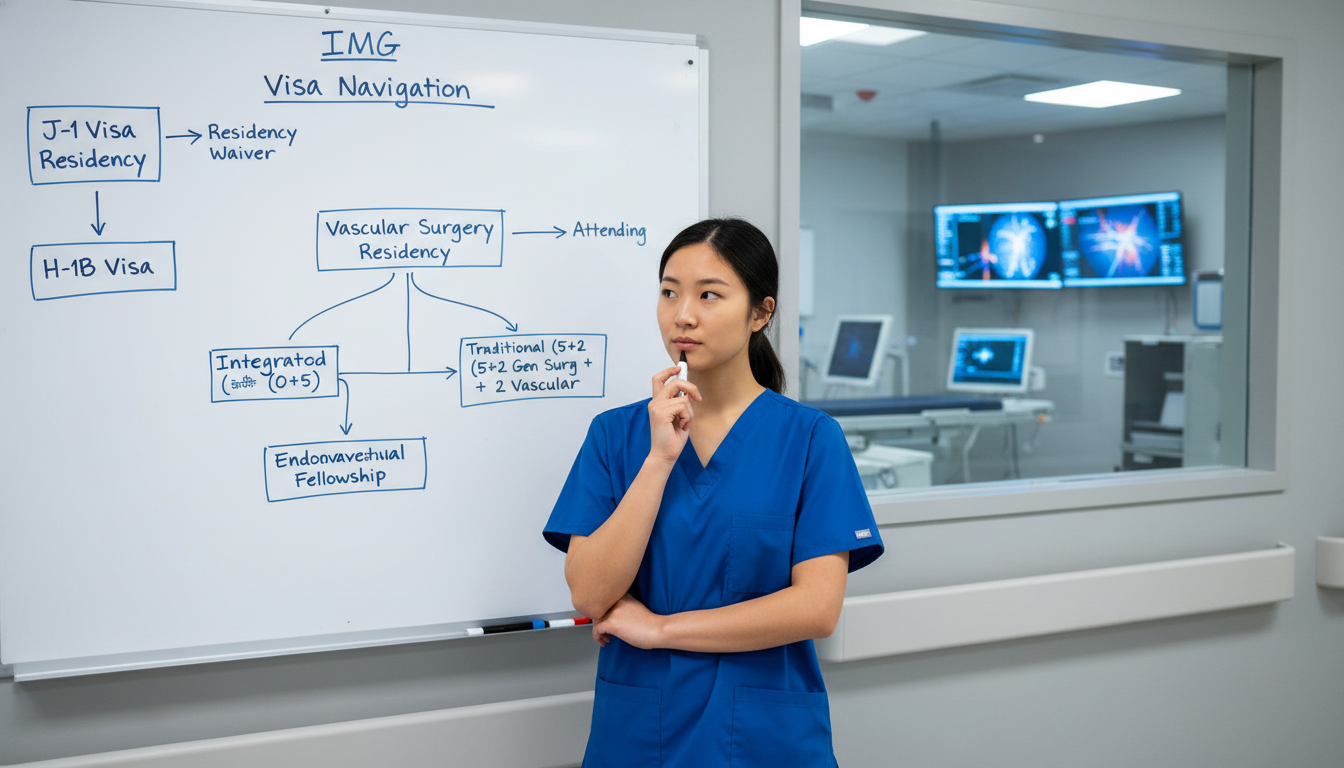
Core Residency Visa Options for IMGs: J-1 vs H-1B
For graduate medical education (GME), the two primary visa categories are J-1 and H-1B. Understanding their differences is essential for any international medical graduate planning a vascular surgery residency.
The J-1 Exchange Visitor (ECFMG-sponsored)
The J-1 physician visa is the most common IMG visa in US residency.
Key features:
- Sponsor: ECFMG (Educational Commission for Foreign Medical Graduates), not the individual hospital.
- Duration: Typically valid for the full length of standard training, renewable annually based on ECFMG approval.
- Eligibility basics:
- Valid ECFMG certification
- Contract or official offer from an ACGME-accredited program
- Proof of financial support (usually salary from the program)
- Sufficient English proficiency (usually via USMLE/ECFMG pathway)
Pros for IMGs in vascular surgery:
- Broadly accepted: Many general surgery and vascular programs are comfortable using J-1.
- Administratively simpler for programs: They don’t manage USCIS petitions themselves, making them more open to IMGs.
- Predictable for full duration of training: Once you’re in, renewing yearly is routine if training continues in a standard sequence.
Critical limitation – the 2-year home residence requirement:
- Most J-1 physicians are subject to a two-year home-country physical presence requirement (INA 212(e)).
- After finishing training (e.g., after a 0+5 integrated vascular program or after 5+2 training), you must:
- Return to your home country for at least 2 years cumulatively, or
- Obtain a J-1 waiver (e.g., via a Conrad-30 or other underserved-area waiver job), before you can:
- Change to an H-1B or L-1, or
- Apply for permanent residence (green card) in most categories.
How this impacts vascular surgery planning:
- If you complete general surgery residency plus vascular fellowship on J-1:
- You may need a waiver job in a region with enough need for a vascular surgeon, which may be more limited than primary care jobs.
- If you complete an integrated vascular program on J-1:
- You will still likely need a J-1 waiver job immediately after training; many such jobs are in underserved or rural areas.
The H-1B Temporary Worker (Specialty Occupation)
The H-1B allows you to work in a “specialty occupation” (in this case, a physician in training).
Key features:
- Sponsor: Your hospital or institution petitions USCIS for your H-1B.
- Requirements:
- Completion of all USMLE Steps required by the state for licensure (typically Step 3 is mandatory before H-1B filing).
- Valid ECFMG certification (for IMGs).
- Employer willing to pay legal fees and meet wage requirements.
Pros for IMGs in vascular surgery:
- No automatic 2-year home-country rule like J-1.
- Can sometimes transition more smoothly to a long-term H-1B job or green card after training.
- Attractive if you aim to stay in the US long-term without the constraints of a J-1 waiver.
Limitations:
- Not all programs sponsor H-1B. Some academic centers or smaller programs restrict to J-1.
- Timing issues: You must typically pass USMLE Step 3 early enough to allow filing. Late scores can kill an H-1B option even if the program is willing.
- H-1B category caps can apply, but many teaching hospitals qualify as cap-exempt, allowing year-round filing.
Special considerations for vascular surgery IMGs:
- General surgery residency on H-1B + vascular fellowship on H-1B is possible at some centers, but:
- You need each institution to be willing and experienced with H-1B filings.
- You must be careful about maximum time limits in H-1B status (usually up to 6 years, with some exceptions).
Side-by-Side: J-1 vs H-1B for Vascular Surgery IMGs
| Feature | J-1 (ECFMG) | H-1B (Employer-sponsored) |
|---|---|---|
| Who sponsors? | ECFMG | Hospital/University |
| Common in GME? | Very common | Less common; program-dependent |
| USMLE Step 3 needed? | No | Typically yes, before petition |
| 2-year home rule? | Usually yes | No |
| Suitable for 0+5 integrated vascular? | Frequently | Variable, some won’t sponsor |
| Suitable for 5+2 (gen surg + vascular) | Yes, but J-1 waiver after training | Yes, but watch 6-year H-1B limit |
| Long-term immigration flexibility | Constrained by waiver | More flexible if employer sponsors |
When deciding between J-1 vs H-1B, you must realistically assess:
- Which visa options your target programs support
- Your ability to pass USMLE Step 3 early
- Your long-term plan: return home vs building a permanent US career
Designing a Visa Strategy Around Your Vascular Surgery Path
Your visa strategy should be deliberate, not an afterthought. It must align with:
- Your training pathway (0+5 vs 5+2)
- Your career goals (return home vs stay in the US)
- Your geographical flexibility (where you are willing to work after training)
Step 1: Clarify Your Long-Term Intentions
Ask yourself:
After vascular surgery training, do I plan to:
- Return to my home country long-term?
- Stay in the US for several years (or permanently) if possible?
How flexible am I regarding practice location?
- Am I open to working in rural or underserved areas that commonly offer J-1 waiver positions?
- Or do I strongly prefer large academic or urban tertiary centers?
What are my immigration options outside GME?
- Do I have paths to permanent residence (e.g., through family) that might make J-1’s restrictions less problematic?
Example:
IMG A wants a brief US training experience then a career in their home country’s academic system.
- J-1 might be ideal: widely accepted, simpler process, 2-year rule is not a major issue.
IMG B wants to stay in the US long-term, ideally in an academic vascular surgery role.
- H-1B might fit better, provided they can secure programs willing to sponsor and clear Step 3 early.
Step 2: Choose Target Pathway and Match It to Visa Options
If aiming for 0+5 integrated vascular surgery:
- Research integrated programs to see:
- Do they accept IMGs?
- What is their stated policy on visas?
- Many integrated vascular programs are in academic centers that:
- Prefer J-1 due to administrative simplicity, or
- Accept only US citizens/green card holders.
- Action: Prepare to be flexible about accepting J-1 if integrated vascular is your top priority.
If aiming for general surgery with later vascular fellowship (5+2):
- Stage 1: General surgery residency visa
- Stage 2: Vascular fellowship visa
You might:
- Start general surgery on J-1, then continue with J-1 for fellowship, and then:
- Seek a J-1 waiver job as a vascular surgeon.
- Or start general surgery on H-1B, then:
- Move to an H-1B vascular fellowship, and possibly transition to an H-1B attending role.
Important: H-1B has a practical upper limit of 6 years (unless you start green card steps or have special circumstances). If you spend 5 years in general surgery residency on H-1B, that leaves only one standard year on H-1B for your vascular fellowship—not enough. Workarounds may exist (green card processing, recapturing time abroad, etc.), but they require early immigration planning with a lawyer.
For many IMGs, this makes J-1 more straightforward across a full 5+2 training sequence.
Step 3: Build a Visa-Friendly Application List
When creating your application list, explicitly categorize each program by:
- Visa types supported (J-1 only, J-1 + H-1B, none).
- Historical record of matching IMGs and visa-sponsored residents.
How to gather this information:
- Program websites → “Visa” or “Eligibility” sections.
- FREIDA and similar databases → filter for “Visa sponsorship.”
- Email or call coordinators with direct questions:
- “Do you sponsor J-1 and/or H-1B visas for international medical graduates?”
- “Have you previously sponsored an IMG for H-1B in your vascular / general surgery program?”
This approach creates an IMG residency guide tailored to your own visa situation, instead of relying on generic advice.

Practical Steps and Timelines: From Application to Visa Issuance
Well-organized timing minimizes delays and last-minute stress. Below is a structured timeline for residency and fellowship visa planning, especially relevant to vascular surgery IMGs.
Before Applying to Residency (12–18 Months Before Start Date)
Complete USMLE exams early.
- Step 1 and Step 2 CK for ECFMG certification.
- If you’re considering H-1B, aim to pass Step 3 at least 9–12 months before July 1 of residency start, so H-1B filing can proceed without rush.
Secure ECFMG certification.
- Mandatory for both J-1 and H-1B physicians working in ACGME-accredited programs.
Clarify your visa priorities.
- Decide if you will apply broadly to J-1-friendly programs or focus on H-1B sponsors as well.
- For integrated vascular surgery, identify which programs historically accept IMGs.
Optimize your CV for visa-friendly programs.
- US clinical experience (USCE), especially in surgery or vascular surgery.
- Publications or research in vascular or endovascular topics.
- Strong letters of recommendation from US faculty.
During Application and Interview Season
Ask visa questions strategically.
- During or after interviews, politely clarify visa policies if not clearly stated.
- Focus on programs where your visa type is viable.
Rank list decisions:
- Consider not only clinical fit but also visa reliability.
- A top academic general surgery program that “might” support H-1B is riskier than a slightly less famous program with a stable J-1 track record.
For integrated vascular applicants:
- Recognize that the integrated vascular program may share GME policies with their general surgery department; if their institution favors J-1, plan accordingly.
After Match: Securing Your Residency Visa
If you matched on J-1 (standard case):
- Program issues a contract and “statement of need” documentation may be required through your home country government (for J-1).
- You submit a J-1 sponsorship application to ECFMG with supporting documents.
- Once approved, ECFMG issues Form DS-2019.
- You schedule a visa interview at the US embassy/consulate and obtain your J-1 visa stamp.
If you matched on H-1B:
- Program’s GME or HR department works with their immigration office/legal counsel.
- You provide documentation:
- ECFMG certificate
- USMLE Step 3 score report
- Medical degree and translations
- Credential evaluations as required
- Program files an H-1B petition with USCIS (often premium processing for speed).
- After approval (Form I-797), you obtain an H-1B visa stamp at the consulate.
Timing tip: Start paperwork as soon as Match results are released to avoid delays that might affect your July 1 start date.
Transitioning from General Surgery to Vascular Fellowship
If you are in a 5+2 pathway:
On J-1 during general surgery:
- You will generally stay on J-1 for vascular fellowship at a new or current institution.
- ECFMG sponsorship continues as long as total training is within acceptable limits and in ACGME-accredited programs.
On H-1B during general surgery:
- Confirm remaining H-1B time and strategy for your vascular fellowship well in advance (second or third year of residency).
- Your vascular fellowship institution must agree to sponsor H-1B and carefully manage timing and transfers.
Long-Term Planning: Waivers, Jobs, and Staying in the US
Your residency visa is only one part of a larger picture. For an international medical graduate in vascular surgery, it is crucial to think beyond training.
If You Train on J-1: Understanding the Waiver Landscape
After completing your vascular surgery training on J-1, you typically must:
- Return home for 2 years, or
- Secure a J-1 waiver job in the US.
Waiver options for specialists like vascular surgeons may include:
Conrad-30 program:
- State-based programs that can sponsor up to 30 J-1 waivers each year, historically focused on primary care but often including specialists if the state has unmet need.
- Some states are more open to surgical and vascular positions, especially in rural or underserved regions.
Federal programs:
- VA (Veterans Affairs) facilities
- Department of Health and Human Services (HHS) programs in designated shortage areas.
Practical advice:
- Start exploring waiver-friendly states and employers during your final year of vascular fellowship.
- Be prepared for geographic flexibility—rural or semi-rural jobs may be your primary pathway.
- Work with hospital recruiters and immigration counsel aware of specialist waivers.
If You Train on H-1B: Transition to Attending and Green Card
If your residency and/or fellowship are in H-1B status:
Post-training, you may:
- Move to another H-1B-cap exempt employer (university/teaching hospital), or
- Transfer to an H-1B cap-subject employer (some private groups/hospitals), subject to lottery rules.
Many employers may:
- Sponsor an employment-based green card (e.g., EB-2 with or without National Interest Waiver).
- Help extend H-1B status beyond 6 years based on pending green card processes.
Vascular surgeons are often in demand, which can work in your favor for immigration sponsorship, but early planning with employers is essential.
Frequently Asked Questions (FAQ)
1. Is it realistic for an IMG to get into a 0+5 integrated vascular surgery program on a visa?
Yes, but it is highly competitive and program-dependent. Some integrated vascular programs:
- Do not sponsor visas at all.
- Only accept J-1 (and not H-1B).
- Have very limited history of matching IMGs.
To improve your chances:
- Build an exceptional CV: high USMLE scores, strong vascular-related research, US clinical experience, and robust letters.
- Apply widely and verify each program’s IMG visa options in advance.
- Be ready to accept J-1 sponsorship if that is the only route a desirable program offers.
2. For vascular surgery, which is better: J-1 or H-1B?
“Better” depends on your goals:
- J-1 is often easier to obtain, widely accepted, and fits well if you plan to return home or are open to underserved-area waiver jobs.
- H-1B may be better if:
- You aim to stay in the US long-term;
- You can pass USMLE Step 3 early;
- You match into programs with a strong track record of H-1B sponsorship.
For many IMGs in a 5+2 pathway, J-1 is more practical across 7 years of training, while for those in integrated programs or with clear long-term US goals, H-1B may be worth the extra effort if available.
3. Can I switch from J-1 to H-1B during or after vascular surgery training?
You generally cannot change from J-1 to H-1B inside the US unless you:
- Fulfill the 2-year home-country requirement, or
- Obtain a J-1 waiver.
Once you are subject to the 2-year requirement (which most J-1 physicians are), you must either:
- Complete the waiver and begin a waiver job, or
- Return home for two years, before changing status to H-1B or applying for many green card categories.
This is why understanding the J-1 home rule early is crucial for long-term planning.
4. Do vascular surgery fellowships sponsor visas differently than general surgery residencies?
Often, vascular surgery fellowships follow the same institutional GME policies as other programs at that hospital:
- Many fellowship programs routinely sponsor J-1.
- H-1B sponsorship is more variable:
- Some major academic centers are experienced and comfortable.
- Others restrict H-1B to certain departments or may avoid it due to administrative complexity.
Before committing to a general surgery residency or integrated vascular program, investigate how that institution historically handles fellowship visas and whether their policies are IMG-friendly in the long term.
By approaching visa navigation as a central part of your vascular surgery residency strategy, you position yourself to make realistic choices, avoid administrative dead ends, and create a coherent plan from Match Day through fellowship and beyond. With careful preparation, the right understanding of residency visa options, and early attention to J-1 vs H-1B trade-offs, international medical graduates can build successful vascular surgery careers in the United States.