
Understanding the Visa Landscape for IMGs in Addiction Medicine
Navigating visas as an international medical graduate (IMG) pursuing addiction medicine in the United States involves two distinct but connected stages:
- Residency or primary specialty training visa
- Addiction medicine fellowship and early-career visa planning
Most addiction medicine positions are fellowships completed after a primary residency (internal medicine, family medicine, psychiatry, pediatrics, etc.). Your visa strategy must therefore anticipate both residency and fellowship, as well as long‑term career goals.
Key concepts to understand at the outset:
- Residency visa choices (primarily J‑1 vs H‑1B) will influence:
- Where you can train
- Whether you must return home after training
- How smoothly you can transition into an addiction medicine fellowship
- Addiction medicine is a rapidly growing field, given the opioid epidemic and global substance use crisis, which can create unique opportunities—especially in underserved areas that frequently sponsor immigration benefits.
This IMG residency guide will walk you through:
- The main visa options for residency
- How those choices affect addiction medicine fellowship and beyond
- Common pathways and timelines
- Strategic tips to maximize both training and immigration outcomes
Core Visa Options for IMGs Entering Residency
1. J‑1 Physician Visa: The Most Common Route
The J‑1 exchange visitor visa for physicians (sponsored by ECFMG) is the most widely used visa for IMGs entering US residency.
Key features:
- Sponsor: Educational Commission for Foreign Medical Graduates (ECFMG)
- Purpose: Graduate medical education (residency and fellowship)
- Employment: Only at the ACGME-accredited program(s) listed on your DS‑2019
- Duration: Typically up to 7 years total for graduate medical education
- Often enough for a 3–4 year residency plus a 1–2 year addiction medicine fellowship
- Main restriction: The two-year home-country physical presence requirement (also called the “212(e) requirement”)
Under this rule, once you complete all J‑1-sponsored training:
- You must either:
- Return to your home country for at least 2 years, or
- Obtain a J‑1 waiver (commonly through service in an underserved area) before changing to H‑1B or a green card category
Pros of J‑1 for an IMG in addiction medicine:
- Most residency programs that routinely take IMGs are set up for J‑1 sponsorship.
- Easier administrative process for programs (handled largely by ECFMG).
- Broadly accepted in competitive specialties and fellowships.
- Frequently enough time to do:
- A primary residency (e.g., Internal Medicine, Family Medicine, Psychiatry)
- Then an addiction medicine fellowship within the 7‑year window.
Cons / limitations:
- Home-country requirement can make long-term US plans more complicated.
- Limited opportunity to moonlight or work outside approved training sites.
- Harder to pivot directly to non-training employment without a J‑1 waiver job, almost always in an underserved or high-need area.
Common scenario:
A psychiatry IMG matches into a 4-year psychiatry residency on a J‑1 visa, then completes a 1-year addiction medicine fellowship. Total training: 5 years within the 7-year J‑1 limit. After training, they pursue a J‑1 waiver job in a rural behavioral health clinic or addiction treatment center, often in an area with severe substance use disorder burden.
2. H‑1B Visa: Dual-Intent and More Flexibility
The H‑1B visa is a temporary worker visa used by some residency and fellowship programs. It allows “dual intent”—you may apply for permanent residency (green card) while on H‑1B.
Key features:
- Sponsor: The residency or fellowship program (employer) itself
- Purpose: Employment in a specialty occupation (physician)
- Duration: Generally up to 6 years total in H‑1B status
- Requirements for residency programs:
- Demonstrate that you have passed USMLE Step 3 (for most states/employers)
- Show prevailing wage and compliance with labor conditions
- Have institutional policy and resources to sponsor H‑1B
Pros for IMGs interested in addiction medicine:
- No two-year home-country return requirement
- Easier transition into:
- H‑1B for an addiction medicine fellowship, or
- H‑1B attending physician role directly after fellowship
- Compatible with green card processes such as:
- EB‑2 NIW (National Interest Waiver), especially for public health or addiction medicine work in underserved areas
- Employer-sponsored PERM/EB‑2 or EB‑3 pathways
Cons and limitations:
- Many residencies do not sponsor H‑1B for residents due to cost, complexity, or institutional policy.
- Some specialties have very limited H‑1B positions.
- The 6‑year cap must accommodate:
- Entire residency
- Addiction medicine fellowship
- Any gap time
- You usually need Step 3 results before starting residency, which can be challenging for IMGs on a tight application timeline.
Common scenario:
An IMG matches into a 3-year internal medicine program on H‑1B, then moves directly into a 1-year H‑1B-sponsored addiction medicine fellowship at the same or another institution. After that, they transition to an H‑1B attending role in a community addiction treatment center and eventually adjust to a green card through an EB‑2 NIW due to their work with underserved populations and substance use disorders.
3. J‑1 vs H‑1B: Choosing the Right Path
Key factors when comparing J‑1 vs H‑1B for residency:
- Program availability:
- Many programs are J‑1 only.
- H‑1B sponsoring programs are fewer and often more competitive.
- Long-term immigration goals:
- If your priority is to stay in the U.S. after training, H‑1B is more flexible.
- If you are open to a J‑1 waiver job in a rural or underserved addiction medicine setting, J‑1 can still work well.
- Timeline and exams:
- H‑1B often requires USMLE Step 3 before residency—plan early.
- J‑1 does not require Step 3 for visa issuance (though some programs may still prefer it).
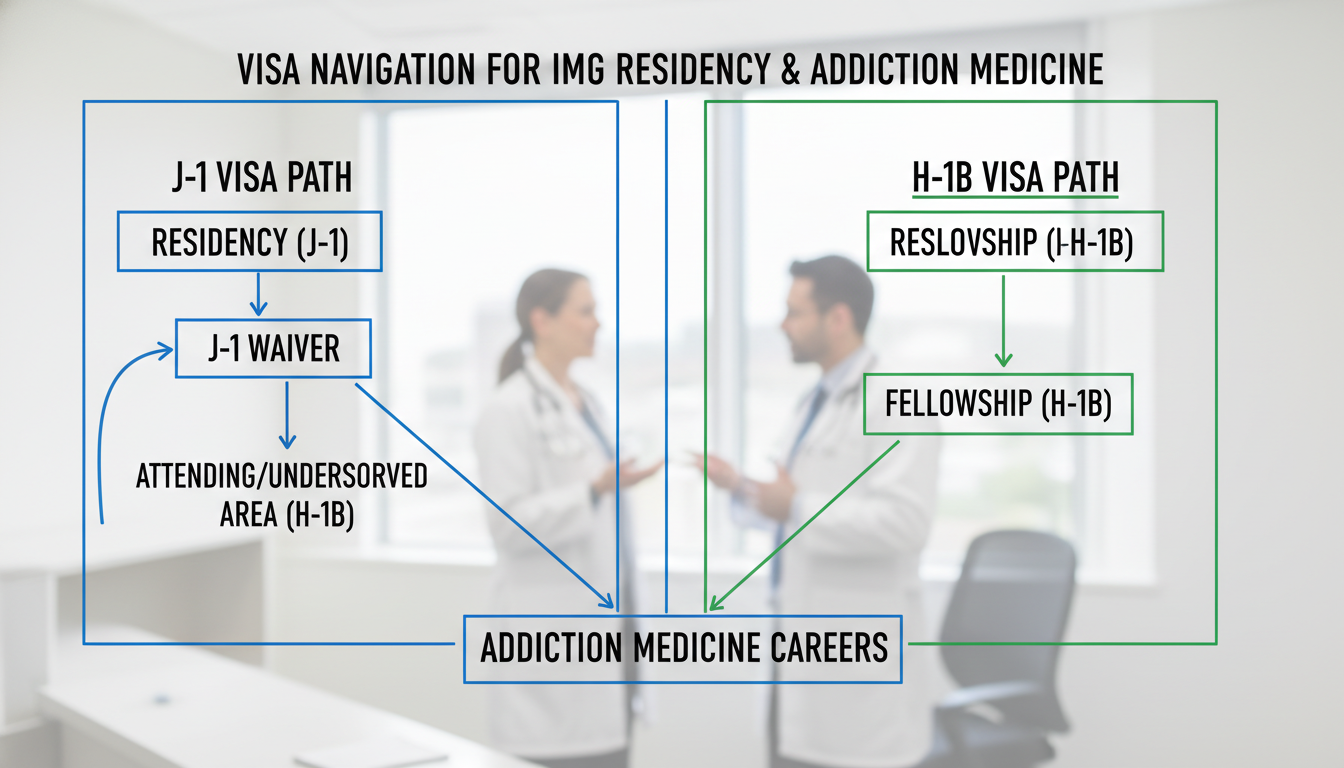
How Residency Visa Choices Shape Your Addiction Medicine Fellowship Path
Because addiction medicine is usually pursued through a fellowship after residency, you must view your visa strategy over a multi-stage trajectory:
- Medical school abroad →
- US residency (e.g., Psychiatry, Internal Medicine, Family Medicine, Pediatrics, Emergency Medicine) →
- Addiction medicine fellowship →
- Early attending career and immigration status stabilization
Training Duration vs Visa Duration
Combine the timelines:
- J‑1: Up to 7 years total of GME
- Example:
- 3 years Internal Medicine + 1 year Addiction Medicine = 4 years total → feasible
- 4 years Psychiatry + 1 year Addiction Medicine = 5 years total → still feasible
- Example:
- H‑1B: Generally 6 years total
- Example:
- 3-year residency + 1-year fellowship = 4 years → leaves 2 years for post-training H‑1B employment if needed
- If you already used H‑1B time for prior non-medical work in the US, that time counts toward the 6‑year cap.
- Example:
Impact on Fellowship Opportunities
On J‑1:
- Most addiction medicine fellowships accept J‑1 because they are ACGME-accredited and used to working with ECFMG.
- You must still remain within your 7-year total GME window.
- Fellowship time is considered part of your educational J‑1—you’re not extending J‑1 indefinitely.
On H‑1B:
- Some fellowships do not sponsor H‑1B, even if residencies do.
- You may need to target addiction medicine programs explicitly open to H‑1B fellows.
- H‑1B petitions must meet prevailing wage standards and job description requirements; some institutions may hesitate due to cost or perceived complexity.
Actionable step:
When shortlisting residency programs, ask specific questions about fellowship support:
- “Do your graduates on J‑1 typically match into addiction medicine fellowships successfully?”
- “Do you or your affiliated hospitals sponsor H‑1B for fellowship training?”
- “Have recent alumni pursued an addiction medicine fellowship on the same visa type?”
Planning for the Two-Year Home Return Rule (if on J‑1)
If you choose a J‑1 residency visa, you must proactively plan for the two-year home-country requirement well before completing your addiction medicine fellowship.
What the Two-Year Rule Means in Practice
Under INA 212(e), if you are subject to the rule, you:
- Cannot change status to H‑1B or certain immigrant visa categories within the US
- Cannot get an H or L visa at a US consulate abroad
- Cannot receive immigrant visas (e.g., green card) until either:
- You physically spend 2 years in your home country, or
- You obtain a J‑1 waiver
This does not stop you from returning to the US on some other categories (like certain tourist or student visas), but it blocks the main employment-based routes until resolved.
Common J‑1 Waiver Paths Relevant to Addiction Medicine
Conrad 30 Waiver (State Health Department Programs)
- Each US state can sponsor up to 30 J‑1 waivers per year for physicians who commit to 3 years of full-time work in a designated underserved area.
- Addiction medicine and psychiatry are often in high demand for these roles, particularly in:
- Rural mental health clinics
- Substance use treatment centers
- Federally Qualified Health Centers (FQHCs)
- You usually work on an H‑1B visa during the 3-year commitment.
Federal Agency Waivers
- Agencies such as:
- U.S. Department of Health and Human Services (HHS)
- Veterans Health Administration
- Indian Health Service
- Some have specific focus on behavioral health, mental health, or substance use disorders, which may be favorable for addiction medicine specialists.
- Agencies such as:
Hardship or Persecution Waivers
- Based on extreme hardship to a US citizen or permanent resident spouse/child, or fear of persecution.
- More individualized, legal-evidence intensive; less predictable.
Strategic Insight for IMGs in addiction medicine:
- Because substance use and behavioral health services are critically needed in underserved and rural areas, addiction medicine-trained IMGs can be very attractive J‑1 waiver candidates.
- Early in fellowship, you can start exploring:
- State-level Conrad 30 programs that prioritize mental health/addiction care
- Employers in rural regions with high overdose or substance use disorder rates

Step-by-Step Strategy: From Residency Match to Addiction Medicine and Beyond
Step 1: Before Applying – Clarify Your Long-Term Goals
Ask yourself:
- Do I want to live and work long-term in the United States?
- Am I open to working in rural or underserved areas for several years after training?
- How confident am I that I can pass USMLE Step 3 before starting residency?
If long-term US career is a high priority and you can get Step 3 early, it may be worth targeting H‑1B–friendly programs.
If maximizing match chances and flexibility of programs is your priority, applying broadly to J‑1 accepting programs may be more realistic.
Step 2: During ERAS Season – Research Programs’ Visa Policies
In your IMG residency guide for addiction medicine–oriented paths (e.g., psychiatry, FM, IM), include a dedicated column for:
- Visa types accepted:
- J‑1 only
- J‑1 and H‑1B
- H‑1B considered on case-by-case basis
- Past success of IMGs:
- Match trends
- Placement in addiction medicine fellowships
- Location and potential relevance to substance abuse training:
- Programs with strong addiction medicine rotations, opioid treatment programs (OTPs), buprenorphine/x-waiver training, or robust substance abuse training may be more aligned with your career goals.
Use:
- Program websites
- FREIDA
- Direct emails to program coordinators or GME offices:
- “As an international medical graduate interested in addiction medicine, could you please clarify your residency visa policy (J‑1 vs H‑1B)?”
Step 3: During Residency – Build Your Addiction Medicine Profile
Regardless of visa type, during residency:
- Seek rotations in:
- Inpatient detox units
- Outpatient addiction treatment clinics
- Integrated behavioral health-primary care clinics focused on substance use disorders
- Obtain formal substance abuse training:
- Training in medications for opioid use disorder (MOUD): buprenorphine, methadone, naltrexone
- Exposure to harm reduction models (needle exchange, overdose prevention)
- Engage in research or QI projects:
- Overdose prevention initiatives
- Integration of addiction medicine into primary care
- Tele-addiction services in rural areas
This not only strengthens your addiction medicine fellowship application but can also support future EB‑2 NIW or other immigration petitions by demonstrating national interest work.
Step 4: Applying to Addiction Medicine Fellowship – Visa Considerations
When applying to an addiction medicine fellowship:
- Confirm what visa types the fellowship supports:
- If you are on J‑1:
- Check that the fellowship is ECFMG-approved for J‑1 sponsorship.
- Make sure your total J‑1 GME time (residency + fellowship) stays within the 7-year maximum.
- If you are on H‑1B:
- Ask whether the fellowship:
- Sponsors H‑1B directly, or
- Requires switching to J‑1 (which could trigger a 2-year rule you previously didn’t have).
- Ask whether the fellowship:
- If you are on J‑1:
Ideal scenarios:
- J‑1 in residency → J‑1 addiction medicine fellowship → J‑1 waiver job in addiction medicine.
- H‑1B in residency → H‑1B addiction medicine fellowship → H‑1B attending role → progress toward green card.
Step 5: Transitioning from Training to Practice and Immigration Stability
For J‑1 Physicians (Post-Fellowship):
- Begin J‑1 waiver job search at least 12–18 months before finishing fellowship.
- Target employers in:
- Rural hospitals with high overdose rates
- Community mental health centers
- FQHCs or state-funded addiction programs
- Emphasize your:
- Addiction medicine fellowship training
- Commitment to underserved populations
- Additional skills (telemedicine experience, language skills, health equity projects)
For H‑1B Physicians:
- Secure an H‑1B employment offer as an addiction medicine attending (or dual role with primary specialty).
- Discuss green card sponsorship early:
- Many addiction medicine physicians working in underserved or correctional settings are strong candidates for EB‑2 NIW.
- Maintain careful H‑1B time accounting to avoid hitting the 6‑year cap without a green card process underway.
Practical Considerations and Common Pitfalls for IMGs
1. Overlooking Visa Policy When Ranking Programs
Many IMGs focus only on:
- Reputation
- Location
- Specialty competitiveness
But failing to integrate IMG visa options into your rank list can lead to:
- Matching at a strong program that only accepts J‑1, when you had counted on H‑1B’s flexibility.
- Or, turning down J‑1 friendly programs because of misinformation about the possibility of J‑1 waivers.
Actionable advice:
Create three lists before ranking:
- J‑1 only programs
- H‑1B friendly programs
- Mixed or case-by-case programs
Decide in advance how much J‑1 vs H‑1B you are willing to accept based on your long-term plan.
2. Underestimating the Importance of Step 3 Timing
If you want H‑1B for residency, you’ll likely need USMLE Step 3 done by:
- The time of rank order list submission, or
- At least before contract finalization/visa processing
This means:
- Scheduling Step 3 during the clinical rotation year of your home country or a US observership period.
- Allocating serious preparation time, as failing Step 3 can derail H‑1B plans.
If Step 3 is not realistic early, J‑1 may be the more pragmatic entry route.
3. Not Aligning Clinical Interests with Waiver/Immigration Realities
Addiction medicine expertise is particularly valuable in:
- Rural Appalachia
- Native American reservations
- Inner-city clinics with high overdose rates
These environments often:
- Support J‑1 waivers
- Have employers more open to sponsoring H‑1B and green cards
- Provide rich clinical experience in severe and complex substance use disorders
If you already know you want to live only in large coastal cities, you may find fewer J‑1 waiver options. Understanding this early helps set realistic expectations.
4. Assuming Policies Are the Same Everywhere
Visa policies vary widely:
- Some prestigious academic centers are J‑1 only for residents but allow H‑1B for fellows.
- Some community programs enthusiastically support H‑1B for residents due to physician shortages.
- Addiction medicine fellowships housed within psychiatry or internal medicine departments may have different visa rules than the main department.
Always obtain program-specific, updated information—do not rely solely on forums or outdated IMG residency guide posts.
Frequently Asked Questions (FAQ)
1. Is it harder to get an addiction medicine fellowship as an IMG on a J‑1 visa?
Not necessarily. Many addiction medicine fellowships:
- Are accustomed to ECFMG J‑1 sponsorship
- Are in institutions with strong IMG representation
- Actively seek diverse trainees interested in underserved and high-need populations
The main limitation on J‑1 is the overall 7-year GME limit, not your IMG status itself. If your residency plus fellowship fit in those 7 years, your J‑1 status should not be a major barrier.
2. If I start residency on a J‑1, can I switch to H‑1B for fellowship?
In practice, this is usually not possible without a J‑1 waiver. If you are subject to the two-year home-country requirement (as almost all J‑1 physicians are):
- You cannot change to H‑1B status until:
- You complete 2 years of physical presence in your home country, or
- You obtain a J‑1 waiver.
Therefore, most IMG physicians remain on J‑1 for both residency and fellowship and only move to H‑1B after securing a waiver job.
3. Does addiction medicine count as a primary specialty for visa purposes?
Addiction medicine is considered a subspecialty (fellowship) rather than a primary residency specialty. For visa purposes:
- J‑1: Both your residency and addiction medicine fellowship fall under ECFMG-sponsored physician training.
- H‑1B: Employers sponsoring you as an addiction medicine attending typically still identify a board-eligible/board-certified base specialty (e.g., Psychiatry, Internal Medicine, Family Medicine) plus a subspecialty in addiction medicine.
You almost always need a primary residency foundation before you can train or work clinically in addiction medicine.
4. Which visa is “better” for an IMG interested in addiction medicine: J‑1 or H‑1B?
“Better” depends on your priorities:
If your top goal is to maximize match chances and you’re flexible on location after training:
- J‑1 is often more realistic and widely accepted.
- J‑1 waiver positions can align well with addiction medicine’s focus on high-need populations.
If your top goal is long-term US immigration stability and you can pass Step 3 early:
- H‑1B can be more advantageous:
- No two-year return rule
- Compatible with early green card planning
- More seamless moves between residency, fellowship, and attending positions
- H‑1B can be more advantageous:
Most IMGs in addiction medicine succeed via both routes, as long as they plan early, understand J‑1 vs H‑1B trade-offs, and align training choices with long-term immigration and career objectives.