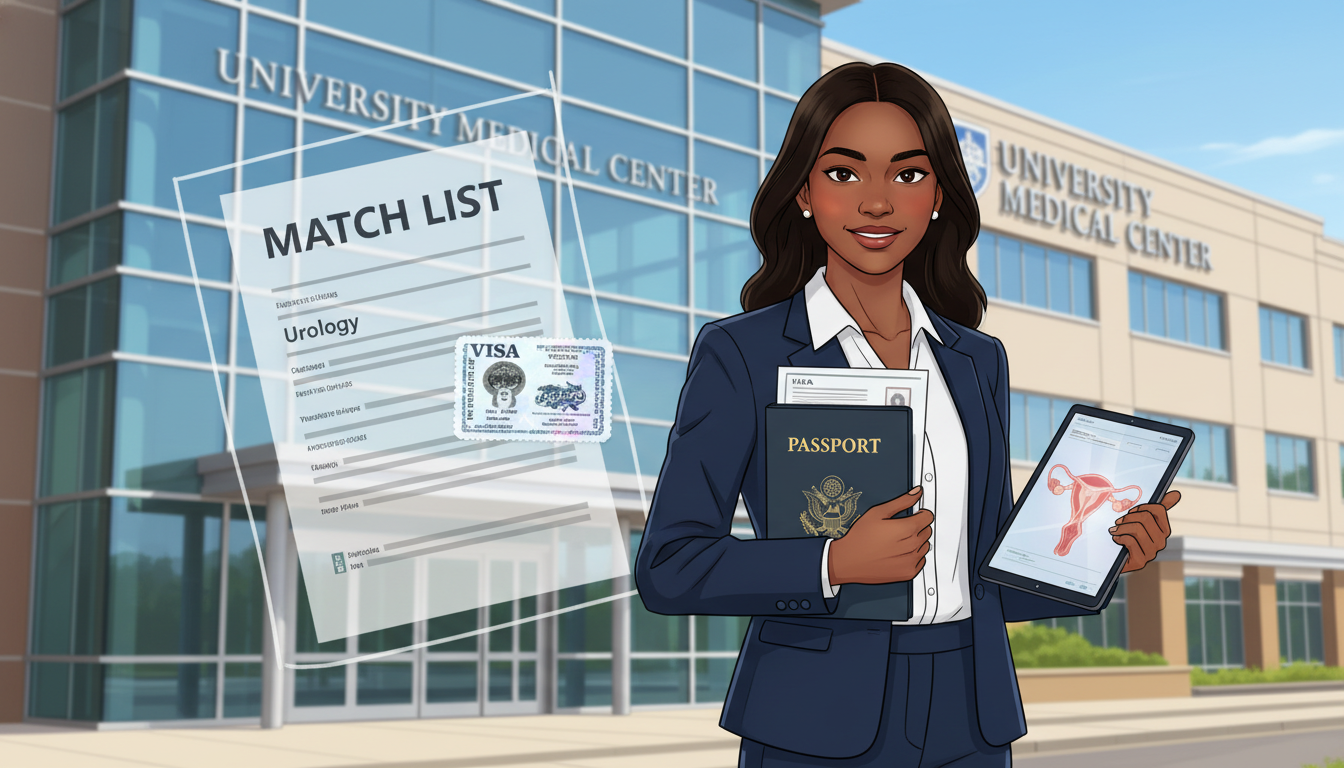
Chicago is one of the most IMG‑friendly cities in the United States, with a dense concentration of academic centers, community hospitals, and safety‑net institutions. For an international medical graduate, however, even the most IMG‑friendly program is out of reach without the right visa strategy. Visa navigation is not just paperwork—it directly shapes where you can apply, how competitive you are, and what your long‑term career in the U.S. might look like.
This IMG residency guide focuses on visa navigation for residency in Chicago and Illinois—what you must know about J‑1 vs H‑1B, how major Chicago residency programs handle visas, and practical steps to improve your chances.
Understanding the U.S. Visa Landscape for IMGs
Before looking at specific Chicago and Illinois residency options, you need a clear framework for IMG visa options during residency. Broadly, international medical graduates usually enter U.S. GME on one of three paths:
- J‑1 (Exchange Visitor Physician) visa
- H‑1B (Temporary Worker in a Specialty Occupation) visa
- U.S. work authorization through another status (e.g., green card, EAD via marriage or asylum, etc.)
For most IMGs applying from abroad, the realistic options are J‑1 or H‑1B, so understanding J-1 vs H-1B is crucial.
J‑1 Physician Visa: The Default Path for Many IMGs
The J‑1 physician visa, sponsored by the Educational Commission for Foreign Medical Graduates (ECFMG), is the most commonly used visa category for residency.
Key features of the J‑1 visa:
- Purpose: Graduate medical education (residency or fellowship) under ECFMG sponsorship.
- Duration: Initially up to 7 years, sufficient for most residency + standard fellowship paths.
- Funding/source: You can receive a salary from the hospital/clinic; this is allowed under J‑1 physician rules.
- Two‑year home country requirement (212(e)): After training, you are generally required to return to your home country or last country of permanent residence for a total of two years before:
- Applying for H‑1B
- Applying for a green card (in most categories)
- Changing to many other U.S. visa statuses
To waive this requirement, you typically need a J‑1 waiver, most often obtained via the Conrad 30 program at the state level (including Illinois) or federal programs (e.g., VA, ARC, HHS).
Pros of the J‑1 for IMGs:
- Widely used; most IMG‑friendly programs in Chicago sponsor J‑1.
- Centralized process via ECFMG with clear eligibility criteria.
- Many programs are structurally set up for J‑1 and familiar with the process.
Cons of the J‑1:
- Mandatory 2‑year home country return obligation (unless waived).
- Fewer programs will sponsor you for a J‑1 waiver job later compared to general H‑1B‑cap jobs.
- Less flexible if you are thinking about immediate green card pathways right after training.
H‑1B Visa: A More Complex but Powerful Option
The H‑1B is a work visa for specialty occupations, including physicians in residency and fellowship programs. Not all programs sponsor H‑1B, and those that do often have additional requirements.
Key features of H‑1B for residency:
- Purpose: Employment in a specialty occupation, which includes clinical physician roles.
- Duration: Up to 6 years total (initial up to 3 years, then extensions).
- Licensure requirement: For residency, Illinois requires at minimum:
- Passing USMLE Step 3 prior to H‑1B petition filing in most cases, and
- Meeting state medical licensing rules (typically “temporary” or “training” licenses for residents).
- Cap status: Many residency programs, especially university‑affiliated hospitals, are cap‑exempt H‑1B employers (e.g., non‑profit hospitals affiliated with universities). This means they can file H‑1B anytime, not just in April, and not subject to the lottery.
Pros of the H‑1B for IMGs:
- No two‑year home return requirement.
- Can transition more directly to a green card from H‑1B.
- Often preferable if your long‑term goal is permanent practice in the U.S. without a waiver obligation.
Cons of the H‑1B:
- Fewer programs in Chicago and across Illinois sponsor H‑1B for residencies.
- Requires USMLE Step 3 before petition submission—this is a major barrier for many applicants.
- Costs (legal + filing fees) are higher for the program; some are unwilling to bear this.
Other Statuses and Special Cases
Some IMGs come with existing work authorization, e.g.:
- U.S. permanent residents (green card holders)
- U.S. citizens (naturalized or by birth abroad)
- Asylees/refugees with EAD (Employment Authorization Document)
- Dependents of other visa categories (e.g., EAD‑eligible H‑4, L‑2, J‑2)
If you already have independent work authorization, programs often treat you similarly to U.S. graduates in terms of visa concerns, though they might still ask basic status documentation.
Chicago and Illinois Residency Landscape: Visa Realities for IMGs
Chicago is unique because it hosts a high density of teaching hospitals within a relatively small geographic area, making it an attractive region for the international medical graduate interested in urban training. Understanding how Chicago residency programs think about visas can guide your strategy.
Major Academic Centers and Their Visa Tendencies
While policies can change yearly, historically:
University of Chicago, Northwestern (Feinberg), University of Illinois at Chicago (UIC):
- Commonly sponsor J‑1 for residents.
- Select programs or individual departments may consider H‑1B for exceptional candidates, usually with Step 3 already passed.
- Highly competitive, with many U.S.-trained applicants.
Loyola University Medical Center, Rush University Medical Center:
- Typically J‑1‑friendly.
- H‑1B sponsorship varies by department and year; some have clear rules posted on their GME websites.
Community and safety‑net hospitals (e.g., Advocate Health sites, Mount Sinai Hospital, AMITA/Ascension hospitals, John H. Stroger Jr. Hospital of Cook County):
- Often very IMG‑friendly and strongly J‑1‑based.
- A subset will consider H‑1B; many default to J‑1 because of cost and administrative simplicity.
Always verify current policy on each program’s website or by direct e‑mail—Illinois residency programs may adjust rules based on institutional risk tolerance and prior experience with immigration.
Illinois Residency Visa Trends
Across Illinois residency programs:
- J‑1 remains the primary pathway for the majority of IMGs.
- H‑1B sponsorship is more common in:
- Internal Medicine, Neurology, Pathology, certain surgical subspecialties
- Large academic centers with robust GME infrastructure
- H‑1B sponsorship is less common in:
- Smaller family medicine programs
- Community psychiatry programs
- Hospitals with limited HR/immigration resources
If your heart is set on H‑1B, your realistic strategy is to:
- Identify programs that explicitly state “H‑1B considered” or “H‑1B sponsored” on their websites.
- Sort those with strong track records of actually granting H‑1B for residents (e.g., via alumni CVs, forums, past match lists).
- Apply broadly beyond Chicago as well; relying solely on H‑1B‑friendly programs in one city can be very high risk.

J‑1 vs H‑1B for Residency in Chicago: Making the Right Choice
For an international medical graduate, choosing between J‑1 vs H‑1B is not just a technical decision—it shapes your application strategy, exam timeline, and post‑residency career.
When J‑1 Is Usually the Best (or Only) Option
You should consider J‑1 as your primary path if:
- You have not passed USMLE Step 3 and are unlikely to do so before residency contract deadlines.
- You plan to apply to a wide range of IMG‑friendly Chicago programs, including community and safety‑net hospitals.
- You are comfortable with the idea of a J‑1 waiver job after residency (often in underserved or rural areas, which can still include some parts of Illinois or nearby states).
- You want to maximize the number of programs where you are a fully compatible candidate from a visa perspective.
For many IMGs, especially those applying from abroad, the practical sequence is:
- Match in Chicago/Illinois on J‑1.
- Complete residency (and possibly fellowship) under J‑1.
- Obtain a J‑1 waiver via the Illinois Conrad 30 program or another state that sponsors you for a waiver job.
- Transition to H‑1B (or other status) in the waiver job.
- Later, pursue a green card with the help of that employer.
When H‑1B May Be Worth Targeting
You might actively target H‑1B sponsorship if:
- You have already passed USMLE Step 3 by the time applications open (or at the latest by the time rank lists finalize).
- You have strong academic metrics (e.g., high scores, strong CV) that make you competitive for H‑1B‑sponsoring Chicago programs.
- You have a clear plan for early U.S. permanent residence without going through the J‑1 waiver pathway.
- You are risk‑tolerant and can manage a narrower list of programs with H‑1B sponsorship.
A balanced approach is:
- Apply broadly to J‑1‑friendly programs.
- Include a smaller set of H‑1B‑sponsoring programs where you explicitly mention your H‑1B preference.
- Stay open to accepting a J‑1 if the best match outcome happens there.
Practical Steps to Navigate Visa Issues During the Match
Successfully navigating residency visa questions is as much about timing and communication as it is about category choice. Below is a step‑by‑step approach tailored to IMGs targeting Chicago and Illinois.
Step 1: Clarify Your Baseline Immigration Status
Before you even build your program list, determine:
- Are you currently outside the U.S. on no status?
- Are you on F‑1 (e.g., U.S. MPH or research degree)?
- Are you already on J‑1 research, J‑2, H‑4, L‑2, or another status?
- Do you hold permanent residence, EAD, or U.S. citizenship?
Your starting status can significantly change your options. For example:
- An F‑1 student may have Optional Practical Training (OPT), but residency generally needs a J‑1 or H‑1B, not just OPT.
- A J‑2 with work authorization might be able to do residency without changing the principal’s status, but many programs prefer the standard J‑1 physician or H‑1B categories.
Step 2: Build a Chicago‑Focused Program List by Visa Policy
For each Illinois residency program you are considering, look up:
- Visa information page on the program or GME website.
- Whether they sponsor J‑1, H‑1B, or both.
- Any explicit restrictions (e.g., “J‑1 only,” “no visa sponsorship,” “H‑1B only with Step 3,” etc.).
Create a simple spreadsheet with columns:
- Program name (e.g., “UIC Internal Medicine – Chicago”)
- City/Region (“Chicago” / “Peoria” / “Rockford” / other Illinois)
- Accepted visa (J‑1 only / J‑1 & H‑1B / none)
- Step 3 requirement (Yes/No/Not stated)
- IMG friendliness (based on % IMGs in current residents)
Then, categorize programs into:
- Group A: J‑1 and H‑1B accepted
- Group B: J‑1 only
- Group C: H‑1B only (rare in residency)
- Group D: No visa sponsorship
IMGs interested in Chicago should aim for a strong mix of Group A and Group B, while carefully targeting Group A if H‑1B is a priority.
Step 3: Align USMLE Timeline With Visa Goals
Your Step 3 timing is critical if you want to keep H‑1B on the table.
- If you aim to start residency in July 2027, for example:
- Plan to pass Step 3 by late 2026 or very early 2027 so that programs can realistically file H‑1B petitions in time.
- Chicago programs that sponsor H‑1B frequently require Step 3 results at the time of rank list submission or contract issuance.
For many IMGs, an efficient plan is:
- Prepare Step 3 while applying or interviewing.
- Sit for the exam as soon as practically possible after Step 2 CK.
- Notify programs promptly if your Step 3 result becomes available during interview season.
Even if you end up on a J‑1, having Step 3 early can help with fellowship and post‑residency job competitiveness.
Step 4: Present Your Visa Story Clearly in Applications and Interviews
Programs want to avoid visa surprises. As an international medical graduate, especially applying to Chicago residency programs, you should:
- State your citizenship and current status clearly in ERAS.
- If your preferred status is H‑1B, you can add a concise note in:
- ERAS application (under “Additional Information”), and/or
- Personal statement (one sentence near the end), and/or
- E‑mail communication after interview (if appropriate).
Examples:
- “I am a citizen of India currently outside the U.S. I am fully eligible for J‑1 sponsorship and am willing to train on J‑1.”
- “I have passed USMLE Step 3 and would be eligible for H‑1B sponsorship. While I am open to J‑1, I would be grateful if the program would consider H‑1B.”
Avoid sounding demanding. Programs appreciate clarity but do not want to feel pressured into a visa type they don’t typically support.
Step 5: Coordinate With ECFMG for J‑1 (If Applicable)
If you accept a position requiring a J‑1:
- Your program will send you a contract and confirm they will sponsor you for J‑1.
- You must then apply for J‑1 sponsorship through ECFMG, which requires:
- Final medical school diploma
- ECFMG certification
- Statement of need from your home country
- Valid passport
- Other forms as specified by ECFMG
- ECFMG issues Form DS‑2019, enabling you to apply for a J‑1 visa at a U.S. consulate.
Make sure to start this process as soon as your contract is signed; consular wait times can vary, and you must be in Chicago in time for orientation.
Step 6: If on H‑1B, Work Closely With Program and Attorney
For H‑1B sponsorship:
- The hospital’s legal/HR department usually coordinates everything.
- You will need to provide:
- USMLE Step 3 pass result
- Medical diploma and ECFMG certification
- Licensing documents (Illinois training license requirements)
- Passport and immigration history
- Because Chicago academic hospitals are often cap‑exempt, they can file H‑1B at any time, but you still want early petition filing to avoid start‑date delays.

Planning Beyond Residency: J‑1 Waivers and Long‑Term Strategy
A strong IMG residency guide is incomplete if it stops at the Match. Visa navigation continues long after you arrive in Chicago.
The J‑1 Home Residency Requirement and Waiver Options
If you train on J‑1, you must either:
- Return home for two years cumulatively, or
- Obtain a waiver of that requirement.
Common J‑1 waiver paths include:
Conrad 30 State Waivers: Each U.S. state, including Illinois, can sponsor up to 30 physicians per year for J‑1 waiver positions in:
- Federally designated Health Professional Shortage Areas (HPSA),
- Medically Underserved Areas (MUA), or
- Facilities serving underserved patients (even if not in strict HPSA/MUA, depending on state rules).
Federal Waivers:
- Veterans Affairs (VA) hospitals
- Appalachian Regional Commission (ARC) – not typically covering Chicago but relevant regionally
- U.S. Department of Health and Human Services (HHS) for certain research or clinical roles
After you receive a J‑1 waiver sponsor job offer and complete the waiver process, you typically transition to an H‑1B tied to that job and can later pursue a green card through employer sponsorship.
Illinois Conrad 30 Program Overview
For those who love Chicago or Illinois and want to stay regionally:
- The Illinois Conrad 30 program historically:
- Prioritizes primary care and high‑need specialties.
- Looks at underserved and rural areas more than central Chicago; however, certain safety‑net and inner‑city sites may qualify.
- Has a competitive but achievable process if you start job negotiations early in your final year of training.
Actionable steps during residency:
- By PGY‑2/PGY‑3, start learning about Illinois J‑1 waiver employers (FQHCs, rural hospitals, safety‑net systems).
- Attend any career fairs or informational sessions your Chicago hospital hosts about post‑residency jobs.
- Keep an open mind about locations slightly outside central Chicago if a J‑1 waiver is your priority.
H‑1B Path After Residency
If you train on H‑1B:
- You are exempt from the two‑year home residence requirement, so you may:
- Transition to a fellowship (H‑1B if they sponsor, or J‑1 if you change status).
- Move directly to a post‑residency attending job on H‑1B.
- Begin green card steps (PERM, I‑140, etc.) with your employer.
Note: The 6‑year H‑1B limit can be extended if certain green card steps are in process; many hospital systems in Illinois are familiar with this.
Common Pitfalls and How to Avoid Them
Many IMGs lose opportunities due to avoidable visa missteps. Here are frequent pitfalls and how to handle them as you navigate Illinois residency and specifically Chicago residency programs.
Pitfall 1: Ignoring Visa Policies Until Late in the Cycle
Waiting until interview season to discover a program is “J‑1 only” or “no H‑1B” can force last‑minute strategy changes. Avoid this by:
- Checking each program’s GME or FAQ page before applying.
- E‑mailing the program coordinator early if the website is unclear.
Pitfall 2: Over‑Insisting on H‑1B
Some applicants push hard for H‑1B even with programs that clearly prefer J‑1. This can backfire.
Better approach:
- Indicate that you qualify for H‑1B if true (e.g., Step 3 passed).
- Express that you understand institutional practices and are open to J‑1 if that is the program’s standard.
- Reserve more assertive H‑1B requests for programs that publicly support it.
Pitfall 3: Incomplete or Late ECFMG/J‑1 Paperwork
Late DS‑2019 issuance or consular delays can jeopardize your start date in Chicago. Prevent this by:
- Completing ECFMG J‑1 sponsorship applications immediately after contract signing.
- Scheduling your visa interview as soon as you receive DS‑2019.
- Monitoring U.S. embassy/consulate processing times in your country.
Pitfall 4: Assuming All Illinois Programs Behave the Same
Even within Chicago:
- One hospital may be strictly J‑1 only.
- A neighboring program may actively sponsor H‑1B.
- Some programs shift policies after leadership or HR changes.
Always treat each program individually and verify information for the current recruitment year.
FAQs: Visa Navigation for IMGs Applying to Chicago Residencies
1. Do most Chicago residency programs sponsor visas for IMGs?
Yes, many Chicago residency programs are historically IMG‑friendly and sponsor J‑1 visas through ECFMG. However:
- H‑1B sponsorship is more limited and tends to be concentrated in larger academic centers and select community hospitals.
- A minority of programs offer no visa sponsorship and will accept only applicants with independent work authorization (e.g., green card, U.S. citizenship).
Always confirm policies on each program’s website before applying.
2. If I want H‑1B, is it mandatory to pass USMLE Step 3 before applying?
You can apply without Step 3, but to realistically be hired on H‑1B:
- Most Chicago and Illinois residency programs require Step 3 to be passed before they file the H‑1B petition.
- Some programs expect Step 3 to be completed by the rank list deadline; others by the time the contract is signed.
Therefore, if H‑1B is your goal, aim to have Step 3 passed as early as possible, ideally before or during interview season.
3. Can I switch from J‑1 to H‑1B during residency in Chicago?
Switching from J‑1 physician to H‑1B during residency is uncommon and complicated because:
- J‑1 physicians are subject to the two‑year home residence requirement.
- You usually cannot change to H‑1B inside the U.S. without first getting a J‑1 waiver, which is typically tied to a post‑residency job, not mid‑residency training.
Most IMGs stay on J‑1 for the entire residency and fellowship, then transition to H‑1B only when taking a waiver job or when the J‑1 obligations are otherwise addressed.
4. Does training in Chicago help me get a J‑1 waiver job in Illinois later?
Training in Chicago does not guarantee a J‑1 waiver job in Illinois, but it can be advantageous:
- You become familiar with Illinois healthcare systems, patient populations, and rural vs urban needs.
- Illinois employers may prefer candidates who trained locally and are already licensed in the state.
- Networking during residency (faculty, alumni, conferences) can help you find Conrad 30–eligible positions in Illinois or nearby Midwestern states.
However, J‑1 waiver jobs often cluster in underserved or rural areas, which may be outside central Chicago, so keep a flexible geographic mindset.
Visa navigation is an integral part of the IMG residency guide for anyone targeting Chicago residency programs. By understanding J‑1 vs H‑1B, researching each program’s policies across Illinois residency sites, and aligning your exam timeline and communication strategy with your preferred residency visa path, you significantly improve both your Match odds and your long‑term career options in the U.S.