
Understanding the Visa Landscape for IMGs in Clinical Informatics
For an international medical graduate (IMG) aiming for a U.S. residency and ultimately a clinical informatics fellowship, visa navigation is just as important as exam scores, US clinical experience, and letters of recommendation. This IMG residency guide focuses specifically on visa strategy for those interested in clinical informatics and health IT training.
Clinical informatics is unique: it sits at the intersection of medicine, data, and technology. Many informatics roles involve collaboration with IT vendors, health systems, and research teams—and some may extend into non‑clinical or leadership roles over time. That makes visa planning especially critical, because your choices now can affect:
- Where you can train (and for how long)
- What fellowships you can pursue (including clinical informatics fellowship)
- Whether you can work in industry (health IT, EHR vendors, digital health startups)
- Your options for long‑term U.S. immigration (e.g., permanent residency)
This guide will walk you through:
- Core residency visa types used by IMGs
- Specific implications for a future in clinical informatics
- How to build a smart visa strategy before you apply
- Practical steps to discuss visa options with programs
- Common pitfalls and how to avoid them
Throughout, we’ll focus on J‑1 vs H‑1B and related IMG visa options in the context of residency, fellowship, and health IT training pathways.
Core Visa Options for Residency: J‑1 vs H‑1B and Beyond
Most IMGs in U.S. graduate medical education (GME) train on one of the following:
- J‑1 Exchange Visitor Visa (ECFMG-sponsored)
- H‑1B Temporary Worker Visa (employer-sponsored)
- Less commonly: O‑1 (extraordinary ability), TN (for Canadian/Mexican citizens), or immigrant (green card) status
The J‑1 Visa for Residency
Who sponsors it?
- Educational Commission for Foreign Medical Graduates (ECFMG) is the only J‑1 sponsor for residency/fellowship physicians in the U.S.
Key features
- Duration: Up to 7 years total in clinical training (residency + fellowship)
- Full-time training only: Dedicated to GME; limited scope for outside employment
- Two-year home-country requirement (212(e)):
- After finishing all J‑1 training, you must return to your home country (or country of last permanent residence) for 2 years unless you obtain a J‑1 waiver
- During that time, you generally cannot change to H‑1B, L, or permanent resident status inside the U.S. without a waiver
Pros for IMGs
- Most residency programs are familiar and comfortable with J‑1 sponsorship
- Efficient and reliable process through ECFMG
- Often easier to obtain than H‑1B for initial residency, especially in competitive locations
- Usually no need for USMLE Step 3 before residency (unlike H‑1B in many states)
Cons for IMGs, especially those eyeing informatics
- Two-year home-country requirement may delay:
- Transition into U.S. clinical practice
- Start of a clinical informatics fellowship in the U.S.
- Movement into U.S. health IT industry roles (EHR vendors, big tech, startups)
- Limited flexibility to shift into non‑training roles (e.g., health IT consultant, analyst) until the requirement is fulfilled or waived
- Waiver jobs are often in underserved areas with primarily clinical demands and may limit early informatics focus
The H‑1B Visa for Residency
Who sponsors it?
- Your residency program/hospital files the petition.
Key features
- Dual intent: You can legally pursue permanent residency (green card) while on H‑1B
- Duration: Typically 6 years total, including all prior H‑1B time in any U.S. employment
- Job-specific: Tied to your employer, location, and role
Pros for IMGs seeking a future in informatics
- No automatic two-year home-country requirement
- Easier transition from residency → clinical informatics fellowship → health IT employment pathway if all are structured properly
- Can be extended beyond 6 years in some situations (e.g., pending green card based on approved I‑140)
- Strong alignment with long-term U.S. career in clinical practice + informatics leadership or health IT guidance roles
Cons
- Not all residency programs sponsor H‑1B (many J‑1 only)
- Often requires:
- USMLE Step 3 passed before H‑1B petition filing
- State-specific license or eligibility (varies by state)
- Filing costs and complexity make some smaller institutions reluctant
- Timing is critical; if you’re late with Step 3 or paperwork, H‑1B may not be possible
J‑1 vs H‑1B: Which is Better for Clinical Informatics?
There’s no universal answer; it depends on your priorities. However, some patterns are clear:
J‑1 may be preferable if:
- You are more focused on clinical residency now and are flexible about where you practice later
- You come from a country where you don’t mind spending two years practicing after training
- You are comfortable navigating a J‑1 waiver job first and possibly doing informatics later in your career
- The residency programs that most strongly support your informatics interests are J‑1 only
H‑1B may be preferable if:
- Your long-term goal is to live and work in the U.S. in a mix of clinical and informatics roles
- You aim to move quickly into a clinical informatics fellowship and then health IT leadership or industry roles
- You want more flexibility for green card sponsorship during or shortly after training
- You are ready and able to pass USMLE Step 3 early and meet H‑1B requirements
In short, the H‑1B offers a more direct bridge from residency → informatics fellowship → U.S. health IT careers, while the J‑1 can introduce a required detour back to your home country or a waiver service period.
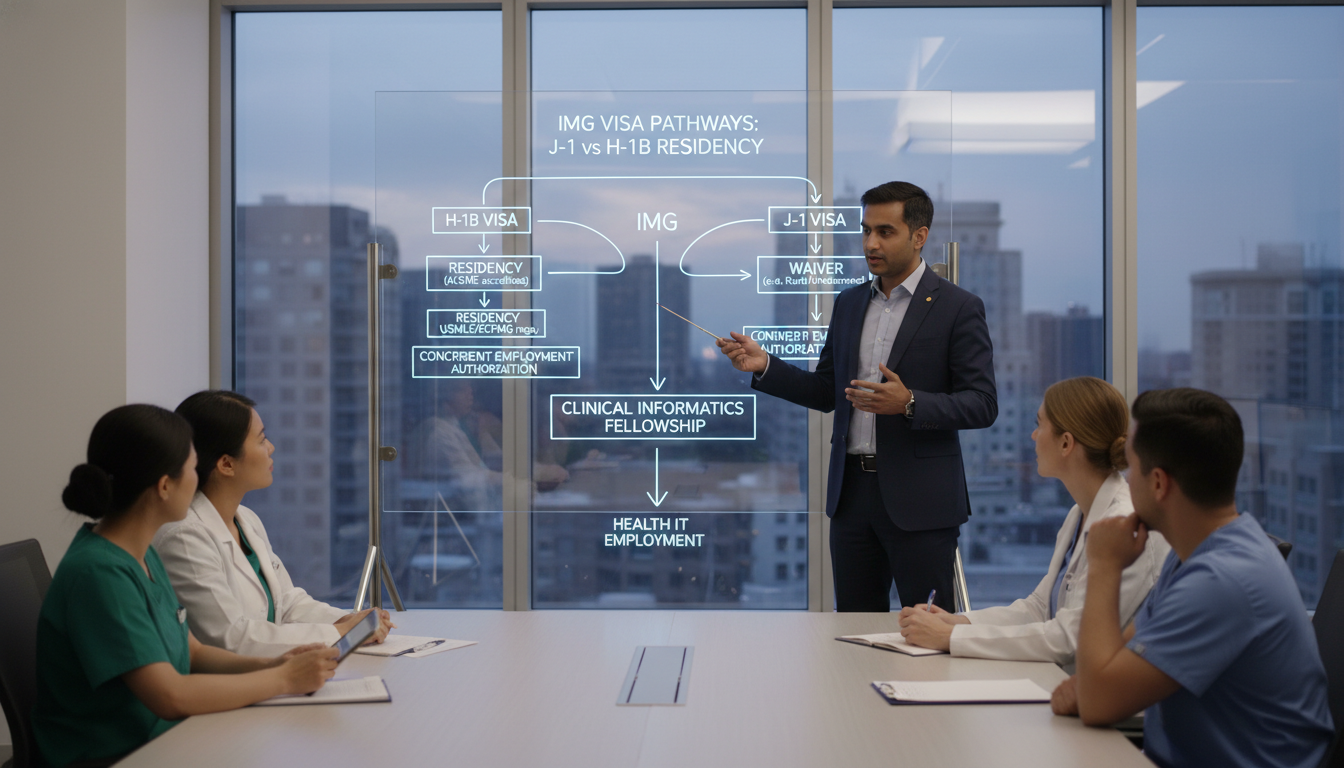
How Visa Strategy Intersects With Clinical Informatics Pathways
Clinical informatics has a distinct structure in U.S. training, so your visa plan needs to consider both residency and fellowship.
The Typical Pathway to Clinical Informatics
Most physicians entering clinical informatics follow this route:
- Core residency (e.g., Internal Medicine, Pediatrics, Family Medicine, Pathology, etc.)
- Board eligibility in a primary specialty
- ACGME-accredited Clinical Informatics Fellowship (usually 2 years)
- Certification via the American Board of Preventive Medicine (ABPM) or relevant primary board
- Career in:
- Health system informatics leadership (CMIO, associate CMIO, clinical informatician)
- Data analytics, population health, quality improvement
- EHR vendor, digital health company, or consulting
- Academic research in informatics and health IT
Visa Implications Across This Pathway
1. Residency Stage
J‑1 Residency
- Counts toward the 7‑year ECFMG J‑1 limit
- If you later do a clinical informatics fellowship, that also counts toward this limit
- At the end of all J‑1 training, you face the two-year home-country rule unless waived
H‑1B Residency
- Each year of residency counts towards the 6‑year H‑1B maximum
- If your residency is 3 years and fellowship 2 years, total 5 years of H‑1B is common
- You must plan ahead so you don’t “run out” of H‑1B time before your informatics training or early career stabilizes
2. Clinical Informatics Fellowship Stage
On J‑1:
- Clinical informatics fellowship programs can also sponsor J‑1 visas through ECFMG (if they are accredited and qualify for GME sponsorship).
- Time in fellowship adds to your total J‑1 training years.
- At the end of fellowship, your two-year home-country requirement triggers unless you pursue a waiver or return home.
On H‑1B:
- Fellowship programs may also sponsor H‑1B directly.
- You must ensure:
- No more than 6 total years of H‑1B time are used
- If you need longer, you may need a green card application initiated (I‑140) by an employer (often a hospital or health system) to extend beyond 6 years.
For IMGs targeting a career deeply embedded in U.S. health IT (e.g., long-term work with EHR vendors, health analytics, or digital health startups), preserving flexibility through H‑1B and green card planning can be particularly helpful.
3. Transition Into Health IT Roles
After clinical informatics fellowship, graduates often move into roles that may not be pure clinical training:
- Partial clinical practice + informatics leadership
- Non-clinical roles in EHR design, implementation, or optimization
- Industry research and development in health information technology
On a J‑1, you generally cannot transition directly from fellowship to these roles in the U.S. without:
- Serving in a J‑1 waiver job (usually clinical, often in underserved areas), or
- Spending two years in your home country
- Then later applying for a new work visa (e.g., H‑1B) or immigrant status
On an H‑1B, you may:
- Move from fellowship to an H‑1B-sponsored informatics or clinical-informatics hybrid role more smoothly
- Have an employer start your green card process while you continue working in informatics
For those who aspire to be CMIOs, health IT innovators, or academic informatics leaders in the U.S., H‑1B plus long-term immigration planning is often strategically advantageous.
Step-by-Step Visa Planning for IMGs Interested in Clinical Informatics
To make this IMG residency guide practical, here’s a structured plan to approach visa strategy from before ERAS to the end of training.
Step 1: Clarify Your Long-Term Vision
Before choosing between J‑1 vs H‑1B for residency, be clear on:
- Do you want your long-term life and career in the U.S., or are you open to returning to your home country or practicing internationally?
- How central is clinical informatics (not just being a tech-savvy clinician) to your career?
- Are you interested in:
- Academic informatics (research, teaching, projects)?
- Operational informatics (EHR governance, implementation, optimization)?
- Industry (health IT companies, digital health startups, pharma informatics)?
If your goal is U.S.-based, strongly informatics-focused work, H‑1B sponsorship for residency and fellowship may align better with your long-term vision.
Step 2: Understand Your Country’s Context
Your home country’s:
- Need for physicians
- Policies around return requirements
- Health IT and informatics growth
…all influence how acceptable a two-year J‑1 home return might be. For example:
- If your country is rapidly expanding national health IT infrastructure, returning for two years with U.S. informatics training may open major opportunities.
- If you fear limited informatics roles at home, a two-year return might delay your ideal career trajectory.
Step 3: Time Your Exams Strategically (Especially Step 3)
If there is any chance you may pursue H‑1B sponsorship, prioritize:
- Passing USMLE Step 3 early—ideally by the fall before Match or at least before programs must file petitions.
- Confirm with your target programs:
- Whether they require Step 3 for H‑1B
- The latest acceptable date for passing and reporting the score
A typical timeline:
- Start Step 3 studying during your final year of medical school or early in any U.S. observership/externship period.
- Sit Step 3 far enough in advance to have results before programs submit H‑1B paperwork (often in late spring or early summer before residency starts).
Step 4: Research Program Visa Policies With an Informatics Lens
When exploring residency programs, particularly if you want an eventual clinical informatics fellowship, gather two parallel data sets:
Visa policies
- Does the program:
- Sponsor J‑1 only?
- Sponsor both J‑1 and H‑1B?
- Have a history of H‑1B sponsorship for IMGs?
- Does the program:
Informatics environment
- Does the program/hospital have:
- A clinical informatics fellowship on-site?
- Faculty with informatics roles (CMIO, associate CMIO, directors of quality or analytics)?
- Active EHR optimization projects, data warehouse, or digital health initiatives?
- Opportunities for informatics electives or research during residency?
- Does the program/hospital have:
During interviews and virtual open houses, ask targeted questions such as:
- “Do you currently sponsor H‑1B visas for IMGs in residency or fellowship?”
- “Have residents from your program successfully matched into clinical informatics fellowship?”
- “Are there opportunities to participate in informatics projects or EHR optimization during residency?”
Aligning visa flexibility with a strong informatics training environment is ideal.
Step 5: During Application Season – Be Transparent and Strategic
When applying via ERAS:
- Indicate all visa types you are willing to accept, but be honest with yourself about your preferences.
- If H‑1B is important for your long-term informatics goals, prioritize programs that state they offer H‑1B.
- Consider applying to a mix:
- Programs with strong informatics and H‑1B
- Good informatics with J‑1 only
- Solid training with moderate informatics but clear H‑1B sponsorship
This diversification helps you balance match probability and long-term career alignment.

Special Considerations: J‑1 Waivers, Research, and Industry
J‑1 Waiver Jobs and Informatics
If you train on a J‑1 and do not return home for two years, you will need a J‑1 waiver to remain in the U.S. This typically involves:
- A 3‑year service commitment (full-time clinical work) in a designated underserved area under H‑1B
- Common waiver pathways:
- Conrad 30 (state-based)
- Federal agencies (e.g., VA, HHS, etc.)
Informatics implications:
- Waiver positions are primarily clinical, often with heavy patient-care loads.
- You may have limited formal protected time for informatics or research.
- However, in many settings, you can:
- Lead EHR optimization for your clinic or hospital
- Serve as a physician champion for tech implementations
- Develop quality and data projects that build your informatics profile
If you pursue this route, target waiver jobs at institutions:
- With growing health IT needs
- Open to giving you informal or formal roles in clinical decision support, telehealth, or quality systems
Research or Non-Clinical Fellowships on Different Visas
Some IMGs also consider:
- Research fellowships (e.g., in biomedical informatics or data science)
- Non-clinical positions in academia or industry
These may involve visas such as J‑1 Research Scholar, O‑1, or F‑1 with OPT (if you do a degree in the U.S., such as an MS in Biomedical Informatics).
However, for clinical informatics fellowship recognized for board certification, you generally must be in ACGME-accredited clinical training, meaning:
- ECFMG-sponsored J‑1 (clinical) or
- H‑1B (clinical) or
- Lawful permanent resident/citizen status
If you’re considering detours into degree programs (like an MPH, MS in Informatics) between residency and fellowship, carefully coordinate with an immigration attorney to avoid conflicts between multiple visa categories and long-term plans.
Industry and Startups: Health IT Training and Beyond
As health IT training and clinical informatics expand, many physicians:
- Collaborate with EHR vendors or health tech companies during fellowship
- Transition to part-time or full-time industry roles after training
Visa implications:
- J‑1 holders are limited in their ability to do non-training work in the U.S.
- H‑1B holders can transfer to a new H‑1B employer in industry (subject to specialty-occupation requirements and cap considerations)
- Some industry employers are reluctant to handle complex immigration cases, so having:
- Established H‑1B status
- Or a clear green card pathway
can make you a more competitive hire.
Considering your potential future in health IT now will help guide the residency visa choices you make today.
Practical Tips, Common Mistakes, and FAQ
Practical Tips for IMGs Targeting Clinical Informatics
Start Visa Planning Early
- Think about J‑1 vs H‑1B even before you sit Step 3 or finalize your specialty choice.
- If informatics is your likely future, treat visa planning as a long-term career decision, not a last-minute formality.
Document Your Informatics Interests
- In personal statements and interviews, highlight:
- Informatics projects
- EHR optimization participation
- Quality improvement with a data focus
- Programs may be more willing to sponsor H‑1B if they see your potential long-term value as a clinical-informatics physician.
- In personal statements and interviews, highlight:
Network With Current Fellows and Faculty
- Reach out to current clinical informatics fellows (many are active on professional forums and social media).
- Ask them:
- What visas they used for residency and fellowship
- What challenges they faced transitioning into informatics roles
- How they navigated H‑1B vs J‑1 decisions
Involve an Immigration Attorney When Needed
- Particularly if:
- You are switching visa types (e.g., J‑1 to H‑1B for a waiver job)
- You’ve had prior U.S. visas (F‑1, J‑1 research) that count toward limits
- You’re exploring early green card options (e.g., EB‑2 NIW for physicians, EB‑1 for exceptional achievements)
- Particularly if:
Common Mistakes to Avoid
- Not taking Step 3 early enough to qualify for H‑1B where desired
- Assuming all programs treat visas the same—policies vary greatly by institution and even by year
- Ignoring the 7-year J‑1 training cap when considering long residency + multiple fellowships
- Underestimating the impact of the two-year J‑1 home-country requirement on informatics and industry goals
- Relying on anecdotal advice from forums instead of verifying with ECFMG, program coordinators, and qualified immigration counsel
Frequently Asked Questions (FAQ)
1. If I do residency on a J‑1, can I still do a clinical informatics fellowship in the U.S.?
Yes. Many clinical informatics fellowships accept and sponsor J‑1 via ECFMG, as long as you remain within the 7-year J‑1 clinical training limit. However, when you complete all J‑1 training (residency + fellowship), the two-year home-country requirement will apply unless waived. That may delay or complicate your ability to stay in the U.S. for informatics or health IT positions immediately after fellowship.
2. Is H‑1B always better than J‑1 for someone interested in informatics?
Not always. H‑1B can offer more flexibility for staying in the U.S., moving into industry, and pursuing permanent residency—but it is harder to obtain, and fewer programs sponsor it. If the best informatics-oriented programs for you are J‑1 only, it might be better to train there and later manage the J‑1 waiver or return requirement, rather than sacrificing training quality just for visa type.
3. Can I switch from J‑1 to H‑1B after residency to avoid the two-year home requirement?
In general, no, not without addressing the two-year rule. The home-country requirement attaches to your J‑1 status and remains in place even if your J‑1 expires. To change to H‑1B or permanent resident within the U.S., you need a J‑1 waiver (e.g., through a waiver job) or you must fulfill the two-year requirement by spending that time in your home country. Some very limited exceptions exist, but they are narrow and require legal analysis.
4. I want to work in health IT (e.g., with an EHR vendor) after clinical informatics fellowship. Which visa strategy is best?
For this goal, an H‑1B pathway is often more straightforward:
- Residency on H‑1B → Clinical informatics fellowship on H‑1B or permanent residency → Health IT employment on H‑1B transfer or green card
- This route avoids the J‑1 two-year home return requirement and typically aligns better with industry hiring practices.
That said, some physicians do J‑1 residency and fellowship, then complete a J‑1 waiver job and transition to industry after waiver service, so there are multiple possible paths.
Visa navigation is a central part of your journey as an international medical graduate aiming for clinical informatics. By understanding IMG visa options, comparing J‑1 vs H‑1B, aligning your training choices with your health IT training goals, and planning for fellowship and beyond, you can position yourself for a sustainable and impactful career at the intersection of medicine and technology.