Understanding the Visa Landscape for IMGs in Dallas–Fort Worth
Navigating visas is often the most stressful and confusing part of the journey for an international medical graduate (IMG) seeking residency in Dallas–Fort Worth (DFW). Between J‑1 and H‑1B decisions, matching at a program that sponsors visas, and understanding how training will affect your long‑term immigration plans, there’s a lot at stake.
This IMG residency guide focuses specifically on the DFW region, where you’ll find a dense cluster of hospitals, academic centers, and community-based training programs—each with its own approach to visas. Knowing the local landscape, the most common visa pathways, and how to advocate for yourself is critical to your success.
In this article, you’ll learn:
- How residency visas work for IMGs in the U.S.
- Key differences between J‑1 vs H‑1B in the context of DFW medical training
- Typical visa policies at Dallas residency programs
- How to present yourself as a strong candidate despite visa needs
- Practical timelines, documentation, and post-residency strategies
Use this as a structured roadmap to plan both your match strategy and your long-term career in the U.S.
Core Visa Pathways for Residency: J‑1 vs H‑1B
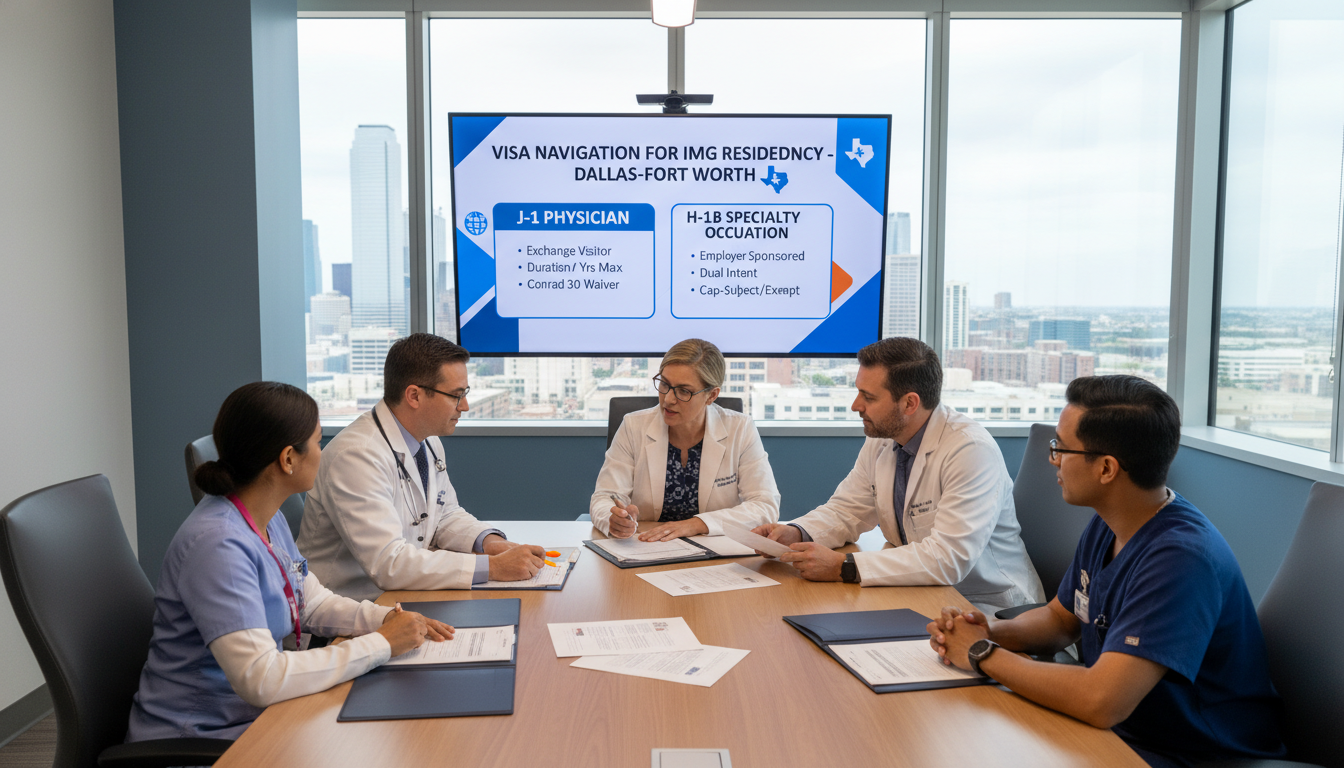
For graduate medical education, almost all IMGs use one of two main residency visa pathways: the J‑1 exchange visitor visa (via ECFMG sponsorship) or the H‑1B temporary worker visa. Understanding the core features of each is the foundation for your residency visa strategy.
The J‑1 Visa for Residency
The J‑1 exchange visitor visa for physicians is the most commonly used visa route for IMGs in residency and fellowship.
Key features:
- Sponsor: ECFMG sponsors your J‑1; not the hospital or university directly
- Purpose: Graduate medical education or training (residency/fellowship)
- Duration: Up to 7 years total of clinical training (with some exceptions)
- Employment: Only at the approved training site(s) in your ECFMG contract
- Visa issuance: You receive a DS‑2019 from ECFMG; then apply for the visa at a U.S. consulate (or change status if already in the U.S.)
Critical point: The two‑year home‑country physical presence requirement
Most J‑1 physicians are subject to INA 212(e), which requires:
- You must return to your home country (or country of last permanent residence) for a total of two years after training
- During those two years, you are not eligible for:
- H‑1B status
- L‑1 status
- Immigrant visas (green cards) or permanent residence
You can satisfy the requirement by physically spending two cumulative years at home, or waive it via certain programs (e.g., Conrad 30 waivers, federal programs, hardship, persecution claims).
Advantages of J‑1 for IMGs:
- Most DFW programs are comfortable with J‑1 and have established processes
- ECFMG, not the hospital, handles much of the complex immigration work
- J‑1 is widely accepted by academic medical centers and community hospitals alike
- Typically faster and more predictable to arrange compared with H‑1B in the residency context
Drawbacks and limitations:
- The two‑year home-country requirement is a major long-term planning issue
- You are tied to your training program; changes (transfers) require new ECFMG approval
- Moonlighting is restricted and only possible under specific conditions
- Not a direct stepping stone to a green card; you’ll frequently need a J‑1 waiver job first
The H‑1B Visa for Residency
The H‑1B is a temporary worker visa for “specialty occupations” including physicians. In residency, it is less common than J‑1 but available through select programs.
Key features:
- Sponsor: The hospital/university (the residency program’s institution) files the H‑1B petition
- Requirements:
- Pass USMLE Step 3 before H‑1B filing (state-specific rules may also apply)
- Hold a valid temporary or permanent state medical license (or meet requirements for training license)
- Duration: Maximum 6 years in H‑1B status (with some exceptions for green card processing)
- Cap-exempt: Most teaching hospitals are cap‑exempt, meaning:
- No lottery
- Can file at any time of the year
- Flexibility: More compatible with long-term U.S. immigration plans and green-card tracks
Advantages of H‑1B for IMGs:
- No two‑year home residence requirement
- Often easier to transition to employment-based green card in the future
- More flexibility after residency (portability between employers under H‑1B)
- Attractive for IMGs planning a long-term career in the U.S. without returning home
Drawbacks and practical limitations:
- Fewer DFW programs offer H‑1B sponsorship, especially for categorical interns (PGY‑1)
- Requires Step 3 passed early, often before rank list deadlines
- More administrative and financial burden on the program; legal fees, prevailing wage requirements
- If you change to a non-academic employer later, you may face the regular H‑1B cap and lottery
J‑1 vs H‑1B: How to Choose?
From a pure immigration perspective:
- If your priority is long-term U.S. settlement and green card: H‑1B is often preferable.
- If your priority is maximizing match chances, especially as a first-time IMG applicant: J‑1 is more widely available and acceptable to programs.
However, your decision is heavily constrained by:
- What your target Dallas residency programs actually sponsor
- Your exam timeline (whether Step 3 is completed early)
- Your country’s J‑1 waiver opportunities and your flexibility to return home, if needed
This IMG residency guide will return several times to the J‑1 vs H‑1B decision in the context of DFW medical training, because local program policies drive your realistic options.
Visa Policies in Dallas–Fort Worth Residency Programs
Dallas–Fort Worth is one of the largest medical hubs in Texas, hosting multiple academic centers and community-based systems. While specific visa sponsorship policies change year to year, the patterns are relatively stable and helpful for planning.
Major Types of DFW Residency Programs
You’ll find several categories of institutions:
Large Academic Centers / University-Affiliated Programs
- Examples include major university hospitals and children’s hospitals
- Often sponsor J‑1 routinely
- Some sponsor H‑1B selectively, often only for highly qualified candidates or upper years
Large Health Systems and Safety-Net Hospitals
- Provide a broad range of specialties and serve diverse populations
- Often more open to J‑1
- H‑1B sponsorship varies; some systems have well-established H‑1B processes, others avoid the complexity
Community-Based Residency Programs
- Smaller but numerous in the DFW area
- Many accept and sponsor J‑1 only
- Fewer sponsor H‑1B, often due to cost or institutional legal policies
Because policies differ even within the same health system, you must verify each program individually.
Where to Find Visa Information for Dallas Residency Programs
Use a structured approach:
- Program websites: Look under “Eligibility & Requirements,” “International Medical Graduates,” or “Visa Sponsorship.”
- FREIDA and ACGME data: Often list if a program accepts IMGs and which visa types they consider.
- Email the program coordinator: If unclear, send a concise, professional email:
- Confirm whether they sponsor J‑1
- Ask if they sponsor H‑1B and under what conditions (e.g., Step 3 required by rank list deadline)
Example email:
Dear [Program Coordinator Name],
I am an international medical graduate planning to apply to your [Specialty] residency program this season. I am writing to clarify your visa sponsorship policies for IMGs.
- Do you sponsor J‑1 visas through ECFMG for incoming residents?
- Do you currently sponsor H‑1B visas for residents, and if so, what are the prerequisites (e.g., USMLE Step 3 timing)?
Thank you very much for your time and guidance.
Sincerely,
[Your Name], MD
Realistic Expectations in DFW
In the DFW region, you will notice trends similar to other major U.S. cities:
J‑1 sponsorship:
- Common and widely accepted
- Standard pathway for many IMGs in internal medicine, pediatrics, family medicine, psychiatry, and some other core specialties
H‑1B sponsorship:
- Available but selective
- More commonly seen in academic programs that have:
- Dedicated legal/immigration offices
- Prior history with H‑1B residents
- Often favored for highly competitive applicants who have already passed Step 3
As an IMG targeting Dallas residency programs, assume:
- Your baseline viable visa option is J‑1.
- H‑1B is an enhancement but not guaranteed, even with strong credentials.
Planning with this realistic framework helps manage expectations and guide your application list.
Practical Strategies for IMGs: Planning Your Visa Pathway
Choosing your residency visa is not just a form; it’s a strategic decision that affects your match odds, training options, and long-term immigration path. Here is a step-by-step strategy tailored for IMGs who want to train in Dallas–Fort Worth.
Step 1: Decide Your Preferred End Goal
Before you choose between J‑1 and H‑1B, clarify your long-term priorities:
Ask yourself:
- Do you intend to live and practice in the U.S. long-term?
- Are you open to returning to your home country for at least 2 years after training?
- How important is it to be able to start the green card process as early as possible?
If you strongly want to avoid the 2-year home residence requirement and aim for a green card route quickly, H‑1B is more aligned with your goals—provided you can find a willing program.
If you are mainly focused on matching and are flexible about your long-term path, J‑1 may provide more opportunities in DFW.
Step 2: Build an Application List with Visa Reality in Mind
When creating your rank list of DFW medical training programs:
- Label each program by sponsorship:
- J‑1 only
- J‑1 and H‑1B
- Unclear / to be confirmed
- Include a good number of J‑1-friendly programs even if you’re aiming for H‑1B, to protect your overall match chances.
- If you absolutely cannot take J‑1 for personal or professional reasons, target only programs that explicitly offer H‑1B and be prepared for more competition and fewer choices.
Step 3: Time Your USMLE Step 3 (If Considering H‑1B)
For IMG visa options that include H‑1B:
- Texas programs often require Step 3 to be passed before H‑1B filing.
- Because H‑1B paperwork often starts early in the calendar year before residency begins (around March–May), you typically need Step 3:
- Passed no later than early winter, ideally before rank list submission, to reassure programs.
If you cannot complete Step 3 early, your realistic path is usually J‑1 for the initial residency, with the possibility of:
- Transitioning to H‑1B for fellowship or
- Later J‑1 waiver jobs with H‑1B sponsorship after training.
Step 4: Ensure Your Documentation is Visa-Ready
To avoid delays in the residency visa process:
- Maintain a valid passport that extends at least 6–12 months beyond your expected training start.
- Keep your ECFMG certification current and accessible.
- Prepare and safely store:
- Medical school transcripts and diploma (with official translations if needed)
- USMLE score reports
- Previous DS‑2019 or I‑20 documents, if you studied in the U.S. before
- CV and personal statement (may be requested by legal offices)
For J‑1:
- Submit required information to ECFMG as soon as your program instructs you, since DS‑2019 issuance can take time.
For H‑1B:
- Respond quickly to the hospital’s legal/HR requests:
- Copies of Step 3 results
- Medical license application information
- Academic credentials and translations
- Any prior U.S. immigration history
Missing or delayed documents risk you not starting on time with your class.

Life After Residency: J‑1 Waivers, H‑1B Jobs, and Long-Term Plans
Your residency visa decision creates downstream consequences for your first job, potential fellowship, and permanent residence options. Planning ahead—especially in the DFW context—can prevent unpleasant surprises.
If You Train on a J‑1 Visa
Most J‑1 physicians planning to remain in the U.S. pursue a J‑1 waiver job after residency/fellowship. This typically involves:
1. Conrad 30 (State 30) Waiver Programs
- Each U.S. state can recommend up to 30 J‑1 waivers per year for physicians who agree to practice in medically underserved areas for a set time (often 3 years full-time).
- You then change from J‑1 to H‑1B status for that waiver job.
- Texas has an active Conrad 30 program; many positions are in smaller cities and rural areas, but some are within or near large metros.
Relevance to DFW IMGs:
- While many waiver jobs are outside Dallas–Fort Worth proper, some can be within commuting distance to the metro area or in the broader North Texas region.
- If your long-term goal is to stay in DFW, you may:
- Complete your waiver in another part of Texas, then
- Move back to Dallas–Fort Worth for later employment once your obligation is complete.
2. Federal Waiver Programs
Some federal agencies (e.g., the VA, HHS in certain public health roles) may sponsor waivers. These are more specialized and competitive but can be options for specific niches (e.g., certain subspecialties, underserved veterans’ care).
3. Returning Home for Two Years
Some IMGs choose to:
- Return to their home country to complete the 2-year requirement, then
- Return later to the U.S. on H‑1B or as a permanent resident.
This might make sense if:
- You have strong professional opportunities at home
- You want to maintain ties and experience there
- You are not ready to commit to waivers or underserved employment in the U.S.
If You Train on an H‑1B Visa
If you manage to secure H‑1B sponsorship for DFW medical training:
- You do not have a 2-year home residence obligation.
- You can transition more directly to:
- H‑1B attending jobs after residency (often hospital systems or large physician groups)
- Fellowship on H‑1B (if the fellowship program is willing to sponsor)
- Permanent residency (green card) through employment-based categories (e.g., EB‑2, EB‑2 NIW, EB‑3), depending on your employer and qualifications
Important limits:
- Remember the 6-year total H‑1B limit (with some exceptions if green card processing (I‑140) is underway).
- Training years count toward this limit, so prolonged training (residency + multiple fellowships) can bring you close to the maximum.
Dallas–Fort Worth as a Long-Term Destination
DFW is an attractive long-term practice location for many IMGs because it offers:
- A large and diverse patient population (significant immigrant communities)
- Multiple health systems and physician groups in need of primary care, internal medicine subspecialties, psychiatry, pediatrics, and more
- Competitive compensation and no state income tax
Whether you are aiming for a J‑1 waiver job or a direct H‑1B/green card position, DFW-area employers are often accustomed to working with IMGs and visa attorneys. Network early during residency:
- Attend system-wide grand rounds across hospitals
- Connect with faculty in your field who practice in community settings, not only academics
- Express interest in long-term practice in North Texas—this can directly translate into job and sponsorship opportunities later.
Actionable Tips for IMGs Targeting DFW Residency with Visa Needs
To put everything together, here are concrete steps you can act on this year.
1. Start with a Clear Visa Narrative
When programs ask about your visa needs, be prepared to respond clearly and calmly:
If you are open to J‑1:
- State that you are eligible and willing to train under J‑1 sponsorship through ECFMG.
If you are strongly aiming for H‑1B:
- Emphasize you have completed or are scheduling USMLE Step 3 early
- Acknowledge that you understand the added complexity for the program and appreciate any consideration.
Programs value applicants who demonstrate:
- Realistic understanding of IMG visa options
- Flexibility
- Responsibility in planning their own paperwork and timelines
2. Balance Competitiveness and Visa Flexibility
Some specialties (e.g., internal medicine, family medicine, pediatrics, psychiatry) traditionally have more J‑1-friendly positions in DFW. Highly competitive specialties (like dermatology, plastic surgery, ENT) may be more restrictive for IMGs and especially for those needing H‑1B.
Adjust your expectations and strategy:
- Consider applying broadly across primary care and core specialties if visa support is a major concern.
- If you are targeting a competitive specialty, J‑1 may be the only practical way to secure U.S. training initially.
3. Use Observerships and Networking Strategically
Because many Dallas residency programs already have IMGs in their ranks:
- Try to secure observerships or externships in DFW hospitals or clinics, which:
- Provide U.S. clinical experience
- Let you see firsthand how the program handles prior international graduates
- Create opportunities to ask residents discreetly about their visa experiences
Networking outcomes might include:
- Meeting current J‑1 or H‑1B residents who can share details about timelines, institutional legal support, and real policies behind generic website statements
- Being recommended informally by faculty to program directors as a motivated IMG who understands the visa landscape
4. Consult an Immigration Attorney Early (Optional but Helpful)
Residency programs will work with their own attorneys, but having your own immigration counsel (even for a one-time consultation) can:
- Clarify your long-term options: J‑1 waiver routes, family-based options, extraordinary ability (EB‑1), national interest waivers (EB‑2 NIW), etc.
- Help you understand how your country of citizenship affects your choices (e.g., per-country visa backlogs).
- Give you a more stable plan if something changes (program closure, transfer, personal circumstances).
Choose an attorney with specific experience in physician immigration; this is a niche area.
FAQs: Visa Navigation for IMGs in Dallas–Fort Worth
1. Is it harder to match into Dallas residency programs if I need a visa?
Needing a visa does add complexity, but many DFW residency programs are very familiar with sponsoring IMGs, especially on J‑1 visas. Your competitiveness (USMLE scores, clinical experience, letters, language skills) still matters much more than your visa type. However, some programs that don’t sponsor visas at all will automatically filter out IMG applications.
2. Should I delay applying until I pass Step 3 so I can get an H‑1B?
Usually no. If delaying means missing an entire match cycle, you could lose valuable time. For most IMGs, applying when you’re otherwise ready and being open to J‑1 gives a better chance of getting into DFW medical training. Pursue Step 3 early if you can, but don’t sacrifice an entire application year just for potential H‑1B eligibility unless you have a very strong strategic reason and guidance from an immigration expert.
3. Can I switch from J‑1 to H‑1B during residency in Dallas?
In residency, you normally stay on J‑1 for the full duration of training once you start as a J‑1. Switching mid-residency to H‑1B is uncommon and complicated because of the 2-year home-country requirement attached to J‑1. Most IMGs either:
- Complete residency and then move to a J‑1 waiver job with H‑1B, or
- Begin residency on H‑1B from the start if the program sponsors it.
4. Will my visa type affect fellowship opportunities after a DFW residency?
Yes, somewhat. Many fellowships also sponsor J‑1 commonly and H‑1B selectively. If you are already on J‑1 from residency, most fellowships can continue J‑1 sponsorship through ECFMG. If you are on H‑1B, the fellowship program must be willing and able to sponsor H‑1B as well. Both paths are possible in Dallas–Fort Worth; you just need to verify each fellowship’s policy, similar to residency.
Visa navigation is complex, but it is absolutely manageable with early planning, realistic expectations, and clear communication. As an international medical graduate targeting Dallas–Fort Worth, align your application strategy with your preferred visa pathway—and stay flexible enough to seize strong training opportunities when they appear.