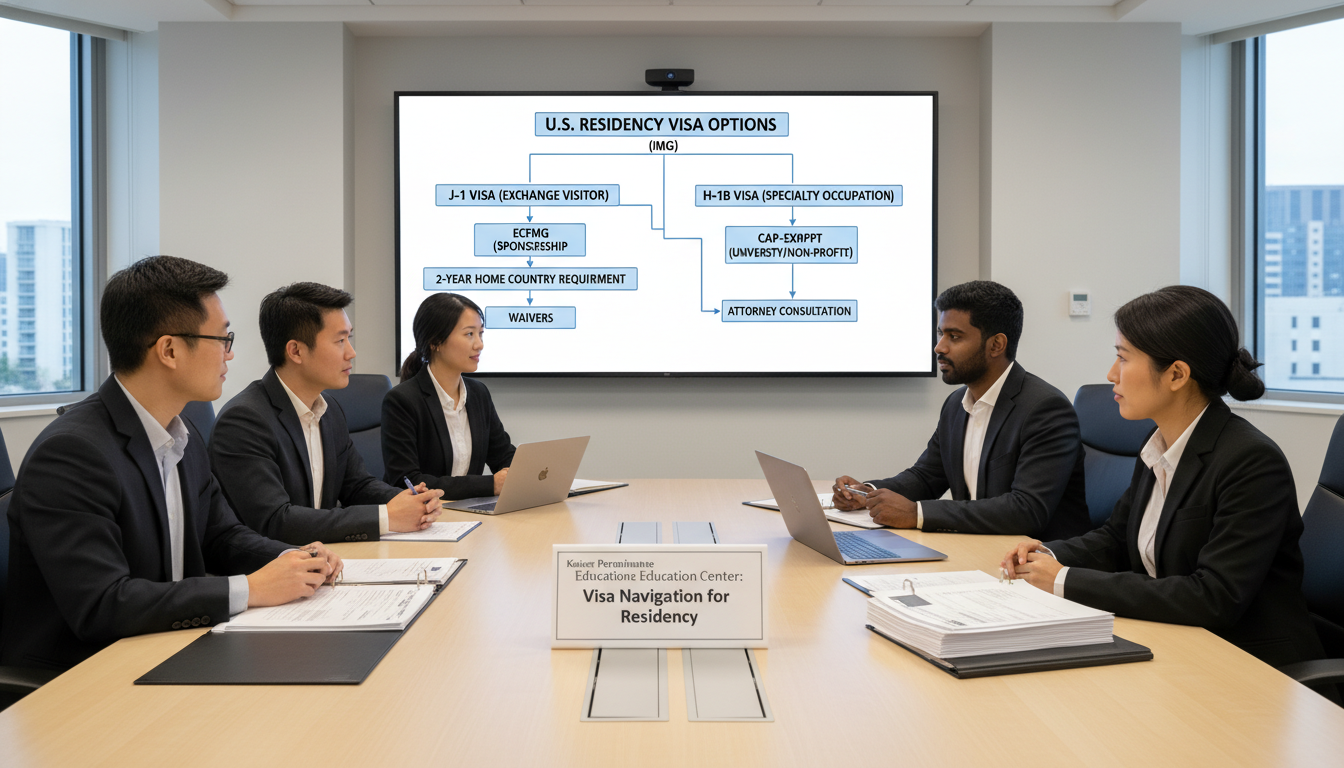
Understanding the Visa Landscape for IMGs in Kaiser Permanente Residency Programs
For an international medical graduate (IMG), matching into a Kaiser Permanente residency can be an exceptional opportunity: strong clinical training, integrated health systems, and competitive fellowship placement. But getting there requires careful navigation of U.S. immigration rules and program-specific policies.
This IMG residency guide focuses specifically on visa navigation for residency in Kaiser Permanente residency programs. You’ll learn what visa types are most relevant, how Kaiser typically handles sponsorship, and how to strategically plan your application timeline and documents.
We will focus on:
- The main IMG visa options for residency (J-1 vs H-1B vs others)
- How these options apply to Kaiser Permanente residency and fellowship programs
- Visa-sensitive steps in the ERAS/NRMP application and Match process
- Practical strategies and examples so you can make informed decisions early
Important: Visa policies at individual Kaiser Permanente sites can change from year to year. Always verify the current policy on each program’s website and by direct email before applying.
Core Visa Types for Residency: What IMGs Need to Know
Before looking at Kaiser-specific considerations, it’s crucial to understand the major residency visa categories IMGs commonly use.
1. J-1 Physician Visa (through ECFMG)
For most IMGs, the J-1 visa sponsored by the Educational Commission for Foreign Medical Graduates (ECFMG) is the most common option for residency training.
Key features of the J-1 physician visa:
- Sponsor: ECFMG, not the residency hospital
- Purpose: Graduate medical education and training
- Duration: Up to 7 years total (sometimes extendable in specific situations)
- Full-time training: Required for valid J-1 status
- Return-home requirement:
- Most J-1 physicians are subject to a two-year home-country physical presence requirement (INA 212(e))
- You must spend 2 years in your home country (or country of last permanent residence) after completing training before:
- Applying for H-1B or L-1 status, or
- Applying for a U.S. green card (with some exceptions)
- This can be waived via certain J-1 waiver programs (e.g., Conrad 30, VA, HHS, etc.)
Why programs like the J-1:
- Administrative burden is lower for the institution because ECFMG manages sponsorship
- Standardized, well-understood process
- Fewer USCIS petitions directly filed by the hospital
Why IMGs sometimes hesitate about J-1:
- The two-year home-country requirement can complicate long-term U.S. career plans
- If you want to immediately pursue a green card or remain in the U.S. after training, you must either:
- Fulfill the 2-year requirement, or
- Secure a J-1 waiver job, typically in a medically underserved area or VA/academic setting
Practical example:
- Dr. A, an IMG from India, matches into a Kaiser internal medicine residency on a J-1.
- After residency, she wants to pursue a hospitalist position in the U.S.
- She obtains a Conrad 30 waiver position in a rural area, fulfills three years of service, and then applies for a green card.
- Her initial J-1 did not prevent a U.S. career, but it required deliberate planning and a willingness to work in an underserved setting.
2. H-1B Visa for Residency Training
The H-1B (Specialty Occupation) visa is another potential path for IMGs in residency. However, it is more complex and less routinely used than J-1 in many programs, including some Kaiser Permanente sites.
Key features of H-1B for residency:
- Employer-sponsored: The residency program acts as your H-1B petitioner
- Specialty occupation: Physician roles qualify
- Licensure:
- Usually requires passing USMLE Steps 1, 2 CK, and 3 before filing
- State-specific licensure or training license requirements must be met
- Duration: Typically up to 6 years, including all prior H-1B time
- No two-year home requirement
- Dual intent allowed:
- You can be in H-1B and simultaneously pursue a green card through employment-based sponsorship
Why IMGs may prefer H-1B:
- Avoids the J-1 two-year home-country requirement
- Often a smoother transition to fellowships and long-term employment, especially when the same employer continues sponsorship
- More favorable for long-term U.S. settlement planning
Why some Kaiser residency programs limit H-1B sponsorship:
- Higher administrative and legal burden
- USCIS filing fees and legal costs
- Need to ensure state licensure and USMLE Step 3 are complete before residency starts
- Timing risk: H-1B petitions must be approved in time for the residency start date
Practical example:
- Dr. B, an IMG from Pakistan, has already passed USMLE Step 3 and holds a state postgraduate training license.
- He matches to a Kaiser Permanente residency that supports H-1B in limited cases.
- The program files his H-1B petition; it is approved before July 1.
- After residency, he transitions to a hospitalist position with continued H-1B sponsorship from the same health system, and later applies for a green card.
3. Other Less Common Paths: Green Card, EAD, and More
Some IMGs do not need a specific residency visa because they already have U.S. work authorization.
These include:
- U.S. permanent residents (green card holders):
- No need for J-1 or H-1B
- Treated as U.S. graduates in terms of visa status (but still IMGs academically)
- U.S. citizens (naturalized or by parentage)
- Dependent visas with work authorization:
- E.g., H-4 EAD (in some situations), L-2 with work authorization
- Asylees / refugees:
- May have EAD (Employment Authorization Document) and path to permanent residency
If you already have U.S. work authorization, most Kaiser programs will consider you similarly to a citizen/green card holder in terms of visa concerns, though they may still ask for proof of your immigration status.
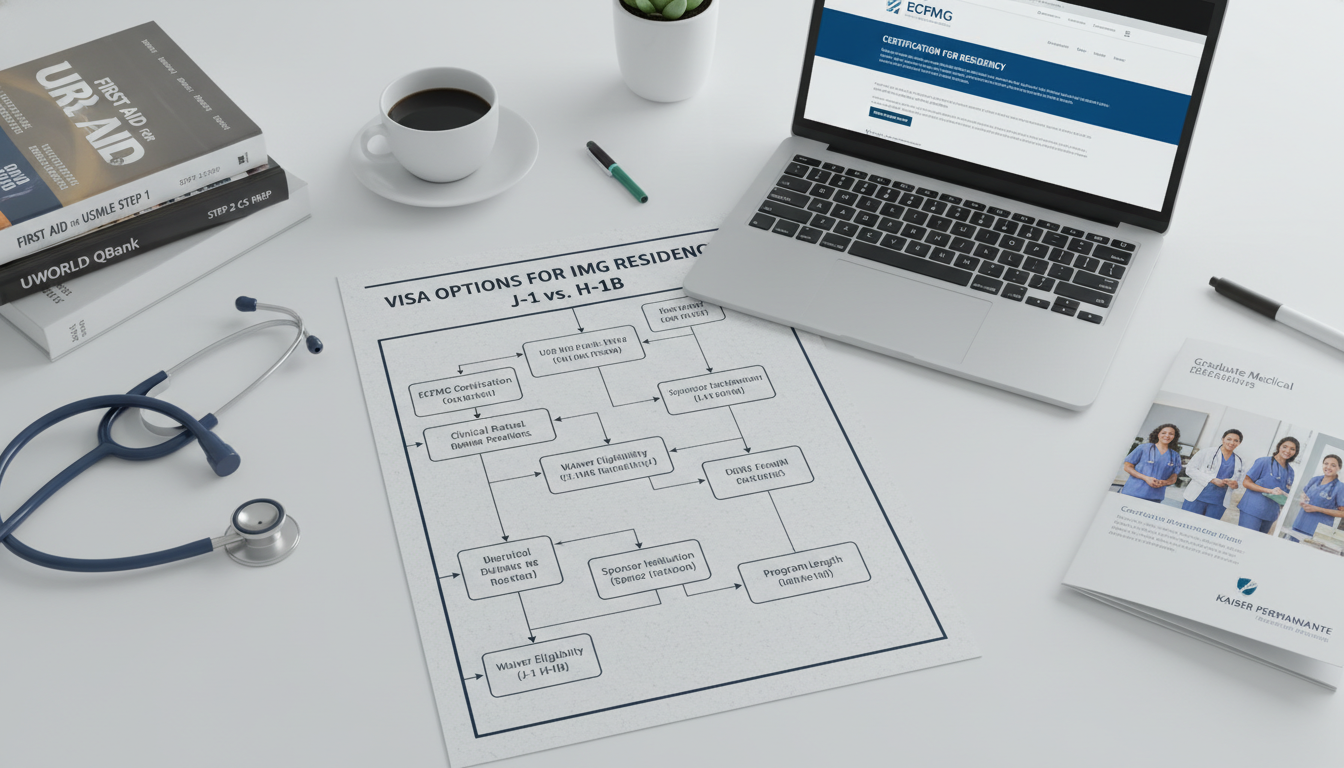
J-1 vs H-1B in Kaiser Permanente Residency Programs
A central piece of IMG visa navigation is understanding how J-1 vs H-1B realistically play out in Kaiser residency settings. Policies vary by program site, specialty, and year.
1. How Kaiser Permanente Programs Typically Approach Visa Sponsorship
Kaiser Permanente runs multiple residency programs across several regions (e.g., Northern California, Southern California, Pacific Northwest, etc.). Each individual program sets its own visa policy, even though they share an institutional brand.
You will commonly see one of three patterns on program websites:
J-1 only:
- Program states: “We sponsor only J-1 visas through ECFMG.”
- H-1B is either not considered or extremely rare.
J-1 preferred, limited H-1B:
- Program may list: “We sponsor J-1 visas and may sponsor H-1B visas on a case-by-case basis.”
- Often contingent on:
- USMLE Step 3 passed
- Strong academic or institutional need
- Sufficient lead time
No visa sponsorship:
- Program will state that it does not sponsor visas.
- Only accepts applicants who already have U.S. work authorization (citizens, green card holders, or other unrestricted EAD holders).
For your IMG residency guide planning, you should assume:
- J-1 is the baseline assumption for most Kaiser Permanente residency programs that sponsor IMGs.
- H-1B may be an exception, not the rule, and requires proactive preparation.
2. Evaluating J-1 vs H-1B for Your Long-Term Goals
When deciding between J-1 and H-1B (where you have a choice), consider:
Long-term U.S. career plans:
- If you are committed to a long-term U.S. practice, H-1B may simplify:
- Fellowship applications with continued H-1B
- Immediate employment post-training
- Direct green card sponsorship
- If you are open to practicing in your home country or in an underserved U.S. area, J-1 is often perfectly workable.
Willingness to work in underserved settings:
- J-1 waiver positions usually require 3-year service in:
- Medically underserved areas
- Certain government or academic institutions
- If that path appeals to you—or you see it as acceptable for a few years—J-1 may suffice.
Timeline for Step 3 and paperwork:
- H-1B typically requires Step 3 passed before the visa petition.
- If you cannot realistically clear Step 3 early enough, J-1 becomes the more practical route.
Program preference:
- Some Kaiser programs will effectively decide for you by only offering J-1.
- If H-1B is essential to your plan, target programs explicitly open to H-1B and confirm by email.
Example of a strategic decision:
- Dr. C from Egypt:
- Strong preference for H-1B due to a spouse’s long-term career in the U.S.
- She passes USMLE Step 3 before ERAS opens.
- She compiles a list of Kaiser Permanente and non-Kaiser programs explicitly open to H-1B.
- When invited to interviews, she politely confirms their current J-1 vs H-1B policy and mentions that she already has Step 3 and a training license.
- Her strategy improves the odds of securing an H-1B-sponsoring position.
Step-by-Step: Visa-Smart Planning Through the Match and Onboarding
Navigating residency visa issues in parallel with the Match process can feel overwhelming. Breaking it into stages makes it manageable.
Stage 1: Before ERAS – Setting Up Your Strategy
1. Clarify your personal constraints and preferences
Ask yourself:
- Do I need to avoid the J-1 home-country requirement?
- How open am I to working in underserved/rural areas after training?
- Can I realistically pass USMLE Step 3 before ranking programs?
- What is my spouse’s or family’s immigration situation?
2. Research program-specific policies (including Kaiser programs)
For each Kaiser Permanente residency you’re considering:
- Visit the program website (GME / residency page)
- Look for sections labeled:
- “Eligibility & Requirements”
- “International Medical Graduates”
- “Visa Sponsorship”
- Note:
- Do they accept IMGs?
- Do they sponsor J-1 (through ECFMG)?
- Do they sponsor H-1B? Under what conditions?
If unclear, send a concise, professional email to the program coordinator:
Dear [Coordinator Name],
I am an international medical graduate planning to apply to your [specialty] residency program. Could you please confirm your current policy regarding visa sponsorship for IMGs (J-1 vs H-1B)?Thank you for your time,
[Your Name, USMLE ID]
3. Decide how to label your visa preference in ERAS
In ERAS, you may be asked about your visa needs:
- If you are open to both J-1 and H-1B, you can state that flexibility.
- If you already have independent work authorization (e.g., green card, EAD), indicate that clearly; this often strengthens your application.
Stage 2: Application and Interview Season
1. Highlight your visa readiness in your application
For example:
- Mention USMLE Step 3 passed (especially important for H-1B possibilities) in:
- ERAS CV
- Personal statement or supplementary communication
- Clarify your current immigration status where relevant:
- “I am currently on F-1 OPT with an EAD valid until [date].”
- “I am a permanent resident of the United States.”
2. During interviews: be prepared but subtle
If visa status is not discussed, you don’t need to force it into the conversation. However, if asked:
- Answer clearly and concisely.
- Demonstrate that you:
- Understand the basics of IMG visa options
- Have realistic expectations (e.g., you realize many Kaiser programs primarily sponsor J-1)
Example interview response:
“As an IMG, I am eligible for ECFMG-sponsored J-1 visas and would be very comfortable training on a J-1 if that is your program’s standard. I have also completed USMLE Step 3 and would be eligible for H-1B sponsorship should the program consider it. I’m flexible and primarily focused on the quality of training.”
Stage 3: Rank List and Match
By the time you rank programs:
- Know which Kaiser programs:
- Sponsor J-1 only
- May consider H-1B
- Do not sponsor any visas
- Rank primarily based on program fit, but factor in visa reality:
- Do not rank programs that categorically cannot sponsor your needed status unless you have independent work authorization.
Example:
- You require visa sponsorship, and Program X at Kaiser states “we do not sponsor visas.”
- Unless you anticipate obtaining a green card/EAD before residency starts (which is rare and risky), it is usually unwise to rank that program.
Stage 4: Post-Match – Visa Paperwork and Deadlines
After Match Day, your focus shifts to implementing your chosen visa.
A. If You Are on J-1 via ECFMG
- Receive instructions from the residency program:
- Kaiser’s GME office will typically guide you to:
- Begin or finalize your J-1 sponsorship application through ECFMG
- Kaiser’s GME office will typically guide you to:
- Complete ECFMG requirements:
- Valid ECFMG certification
- Form DS-2019 application via ECFMG
- Documentation of contract/offer letter from the residency
- Schedule visa interview at a U.S. embassy/consulate:
- Most candidates get a J-1 visa stamp in their passport before traveling to the U.S.
- Track timelines:
- Allow time for:
- DS-2019 issuance
- Embassy appointments
- Administrative processing (if any)
- Allow time for:
B. If You Are on H-1B (and Kaiser agrees to sponsor)
- Confirm program’s immigration counsel and process:
- Kaiser or its affiliated institution usually works with:
- In-house legal teams, or
- Outside immigration attorneys
- Kaiser or its affiliated institution usually works with:
- Ensure all prerequisites are met:
- USMLE Step 3 passed
- State training license or eligibility
- Credentials verified
- Provide documents promptly:
- Passport, medical diploma, ECFMG certification, employment offer letter, etc.
- Monitor petition filing and approval timelines:
- Employer files Form I-129 (H-1B petition)
- If abroad, you then schedule a visa stamping interview
Tip: Start gathering documents immediately after Match to prevent delays. For H-1B especially, lost weeks can matter.
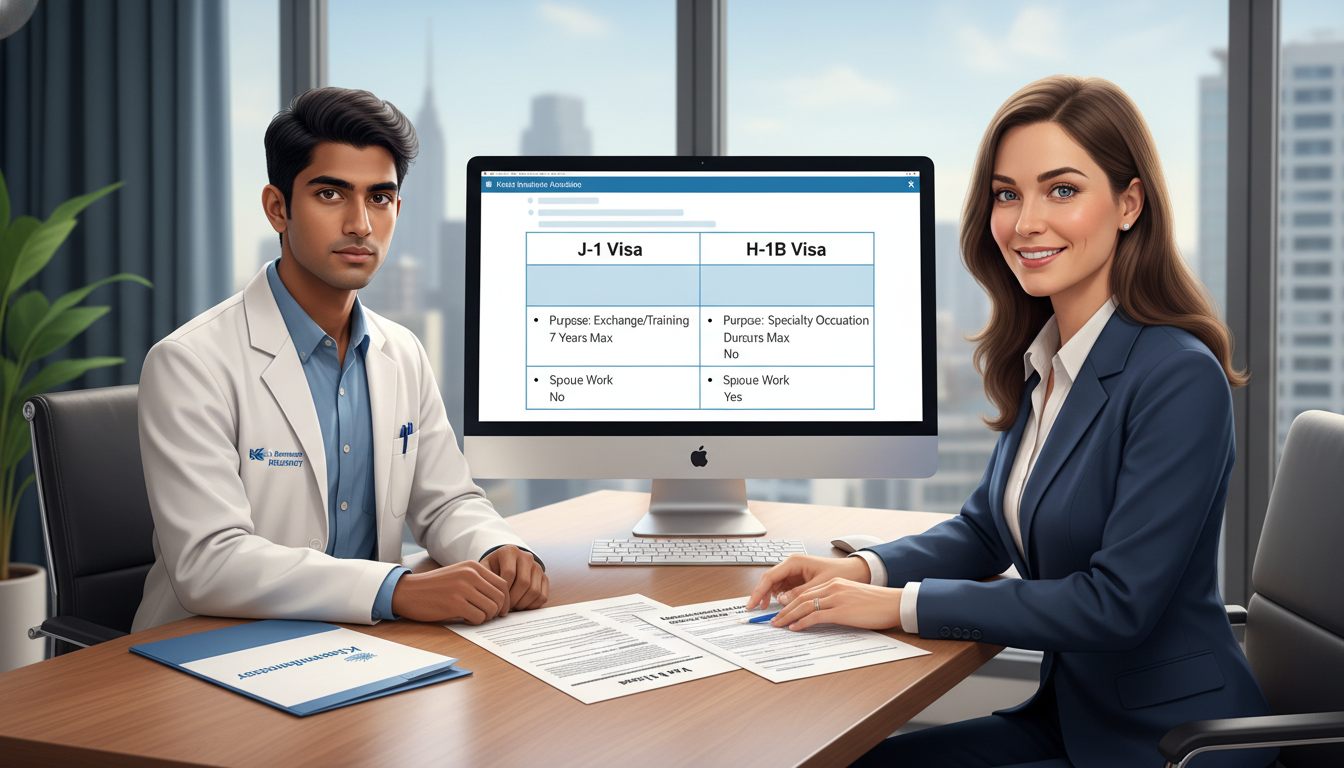
Special Considerations for Kaiser Permanente IMGs
Because this guide specifically focuses on Kaiser residency and Kaiser Permanente residency programs, there are some contextual nuances to keep in mind.
1. Multiple Regions, Multiple Policies
“Kaiser Permanente” is a large integrated system with different GME affiliates. That means:
- A Kaiser internal medicine residency in Northern California may have a different visa policy than:
- Kaiser psychiatry in Southern California, or
- Kaiser family medicine in Washington/Oregon
- Do not assume uniformity across all Kaiser-branded programs.
Actionable advice:
- Build a spreadsheet listing:
- Program name and location
- Specialty
- VISA policy (J-1 only, J-1 + possible H-1B, no sponsorship)
- Any specific notes from coordinator emails
This will help you plan a realistic application strategy.
2. Competition and Visa Flexibility
Many Kaiser residency programs are highly competitive:
- They often attract:
- Top U.S. graduates
- Strong IMGs
- Because of the strong applicant pool, some programs:
- May prioritize candidates who do not need complex visa sponsorship (e.g., U.S. citizens/green card holders)
- May limit H-1B sponsorship to exceptional candidates with early Step 3 and strong academic profiles
This doesn’t mean IMGs cannot match there, but it means:
- Presenting yourself as visa-ready (e.g., Step 3, organized paperwork, clear timelines) is an asset.
- Being flexible with the J-1 vs H-1B question can sometimes increase your chances.
3. Transition to Fellowship and Practice After a Kaiser Residency
Your residency visa also affects your next steps:
- If you train at Kaiser on a J-1:
- Many subspecialty fellowships (including some at Kaiser and many academic centers) also sponsor J-1.
- After fellowship, you may:
- Seek a J-1 waiver job (Conrad 30, VA, etc.)
- Return to your home country to satisfy the 2-year requirement
- If you train at Kaiser on H-1B:
- Fellowships may:
- Transfer/extend your H-1B, or
- Require J-1 for fellowship (less common but possible)
- Long-term practice:
- Often continues with H-1B followed by a green card process
- Fellowships may:
Practical approach:
Even while in residency at Kaiser:
- Attend GME or HR sessions on immigration and post-training options.
- Consult an immigration attorney early (usually at your own expense) if you have:
- Complex family immigration issues
- Strong desire for a specific state or practice type
Common Pitfalls and How to Avoid Them
Being proactive about visa navigation will protect you from many common mistakes IMGs make.
Pitfall 1: Ignoring Visa Policies Until After Interviews
- Some applicants wait to ask about IMG visa options until after ranking programs.
- Result: They end up ranking programs that cannot legally host them.
Solution:
- Verify each Kaiser program’s visa policy before submitting your rank list.
- If a website is unclear, email the coordinator.
Pitfall 2: Underestimating the Time Needed for Step 3 (H-1B Aspirants)
- Some IMGs plan to obtain H-1B but schedule USMLE Step 3 very late.
- If Step 3 isn’t done early enough:
- The program may default to J-1.
- In rare cases, if the program only does H-1B and Step 3 isn’t available, they may not be able to enroll you.
Solution:
- If H-1B is a priority, schedule Step 3 well ahead of ERAS if possible.
- At minimum, aim to have Step 3 results available before Match.
Pitfall 3: Assuming J-1 Automatically Allows Any Post-Residency Job
- The J-1 home-country requirement limits:
- Direct transition to H-1B or a green card without a waiver.
- Some residents realize too late that they must:
- Either accept a J-1 waiver job in a specific area, or
- Return home for 2 years.
Solution:
- Understand the long-term implications of J-1 early.
- During PGY-2 or PGY-3, actively explore:
- J-1 waiver options
- Potential employers and states that sponsor Conrad 30 positions
Pitfall 4: Poor Communication with the GME Office
- Delayed document submission, missed emails, and incomplete forms can:
- Put your visa at risk
- Delay your ability to start orientation
Solution:
- Read every email from Kaiser GME carefully.
- Respond quickly with requested documents.
- Keep personal copies of all immigration paperwork.
FAQs: Visa Navigation for IMGs in Kaiser Permanente Programs
1. Do Kaiser Permanente residency programs sponsor visas for international medical graduates?
Many Kaiser programs do sponsor visas for IMGs, but not all. Common patterns include:
- J-1 (ECFMG-sponsored): The most common residency visa for IMGs at many Kaiser sites.
- H-1B: Some programs sponsor H-1B on a case-by-case basis, often requiring USMLE Step 3 and timely paperwork.
- No sponsorship: A few programs accept only applicants with existing U.S. work authorization (e.g., green card holders, U.S. citizens).
Always check each program’s website and confirm directly with the coordinator for the most current policy.
2. If I train at Kaiser on a J-1 visa, can I stay in the U.S. afterward?
Yes, but usually not immediately in any location or job you choose. Most J-1 physicians are subject to a two-year home-country presence requirement unless they obtain a J-1 waiver. Common paths:
- Conrad 30 waiver: Work for 3 years in an underserved area in a specific state.
- Federal waiver programs (e.g., VA, HHS): Certain government or research jobs.
- Home-country return: Spend two years in your home country before applying for H-1B or a green card.
Strategic planning during residency and early fellowship is essential if you hope to remain in the U.S. long-term.
3. How do I know if a Kaiser residency program will consider H-1B sponsorship?
Look for explicit statements on the program’s official website under eligibility or IMG sections. If wording is unclear, email them:
- Provide your status (IMG), note that you’ve passed USMLE Step 3 if applicable, and ask:
- “Does your program sponsor H-1B visas for residency training?”
- Many will respond that they:
- Sponsor only J-1, or
- Will consider H-1B in limited circumstances.
Use this information to shape your application list and ranking strategy.
4. Is J-1 or H-1B better for an IMG planning to apply to Kaiser residency?
Neither is universally “better”; it depends on your goals and situation:
- J-1:
- More common and generally easier for programs to manage.
- Good for those open to working in underserved areas or returning home after training.
- H-1B:
- Better for those wanting a more direct path to long-term U.S. practice and a green card.
- Requires earlier completion of USMLE Step 3 and more complex employer sponsorship.
For many IMGs applying to Kaiser Permanente residency programs, being open to J-1 while preparing for H-1B (Step 3, documents) provides maximum flexibility.
By understanding the IMG visa options, especially J-1 vs H-1B, and how they apply within Kaiser residency settings, you can design a realistic, strategic pathway through the Match and beyond. Early planning, clear communication with programs, and awareness of long-term implications are the keys to navigating residency visa challenges successfully as an international medical graduate.